Sunday, July 05, 2009

Substance, Accident, and Transubstantiation

by
Peter A. Kwasniewski


Abraham Bloemaert, Supper at Emmaus


The priest celebrating the traditional Roman Rite whispers in the midst of consecrating the Precious Blood: “mysterium fidei.” Indeed, the Real Presence of our Lord and Savior Jesus Christ in the Holy Eucharist is among the greatest mysteries of our faith. Over the millennia the Catholic Church has lovingly pondered this mystery, and her great theologians, while humbly acknowledging reason’s limits in probing what is divine and supernatural, have nevertheless been able to offer a reasoned defense of it against all objections that unbelief and heresy have hurled against it. In the modern world, where materialism, scientism, skepticism, and similar views reign supreme, the mysterious change that the Church calls “transubstantiation” has its mockers and would-be debunkers — even, sadly, conscientious or de facto dissenters within the ranks of the Church, such as the modernists who populate many a Catholic university, seminary, or chancery. As Catholics who seek to understand and live our faith more deeply, we need to make an effort to get hold of the common-sense philosophy of reality that provides the Church with the raw materials for her dogmatic definition of transubstantiation. If we do this, we stand a better chance of achieving clear (or in any case, clearer) thinking about this wondrous work of God and thus of being in a position to speak of it to others. In his encyclical Mysterium Fidei (1965), Pope Paul VI said, apropos the Magisterium’s use of philosophically refined language in formulating Eucharistic dogma:
These formulas [of the Council of Trent] — like the others that the Church used to propose the dogmas of faith — express concepts that are not tied to a certain specific form of human culture, or to a certain level of scientific progress, or to one or another theological school. Instead they set forth what the human mind grasps of reality through necessary and universal experience and what it expresses in apt and exact words, whether it be in ordinary or more refined language. For this reason, these formulas are adapted to all men of all times and all places. (§24)
This article will attempt to show just what the Church’s formulas mean and how the mystery, while never ceasing to be a marvel and a miracle past all human thought, can nonetheless be clarified to the mind so that it no longer seems a colossal contradiction or impossibility. In short, we offer to the reader a modest essay in what the Father of Scholasticism, St. Anselm, called “faith seeking understanding.”

A Short Philosophical Primer

As the distinction between “substance” and “accident” is fundamental to the Church’s teaching on transubstantiation, anyone seeking a deeper understanding of the Sacred Mysteries will do well to spend a little time on what exactly these terms refer to.  The following short primer is intended to serve the purpose.

The distinction between substance and accident, in spite of the technical sound of the terms, is founded upon our everyday experience. While modern usage often restricts the meaning of “substance” to elements or chemicals and “accident” to an unintended and usually harmful event, their philosophical meaning is much wider. The word “substance” refers to any individual being, anything that exists in and of itself, e.g., a man, a horse, a plant, a stone, having its own proper nature (in contrast to a bench, for example, which, though it has a definition, does not have its own proper nature but is the result of art putting together different natural substances). The term “substance” derives from its function: it is “that which stands under” (Lt. substantia, Gk. hypostasis), in contrast to the “accidental” (Lt. accidens, Gk. katasymbebekos), “that which befalls, happens to, belongs to” substance. A substance exists in itself as opposed to what exists in a substance. Color, shape, weight, knowledge, virtue, fatherhood, sonship are examples of things that exist in a substance and not in themselves. Color, shape, and weight truly exist, but they exist as belonging to something which is colored, shaped, or heavy. We never see whiteness, but rather, a white horse or a white chair; we never see justice, but rather, a just man or a just law.1 When we say that someone is six feet tall, we mean that his size is a quantity of his substance; he is six feet tall. Fatherhood is not something that exists apart from someone who is a father; “being a father” belongs to one person in relation to another. Knowledge has existence only in the mind of him who possesses it; it is an accident inhering in his soul.
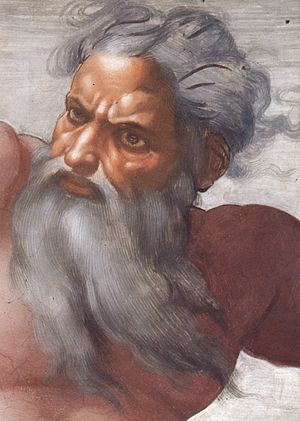


Creation of the Sun and Moon by Michelangelo

Things which are accidents in the soul of a rational creature (such as its knowledge and virtues), are, in God, identical with
His very being.


There are two kinds of accidents: accidents generally so called (non-proper accidents), and proper accidents (“properties”). Non-proper accidents can come to be and pass away in the same substance, as a pale man can become dark by tanning, or an unmusical man can become musical by study, and through lack of practice can lose this knowledge. A proper accident, on the other hand, is rooted in and flows from the very nature of a substance, so that it is always present when the substance is present, e.g., the ability to laugh or the ability to speak, which flow from man’s rational nature. These are called accidents because they only exist in a substance, but they are called properties because they are proper to a certain kind of substance and always accompany it. It would be wrong, therefore, to define accident as that which can either be or not be; some accidents are permanent, others mutable. The important notion in defining accident is that it exists in, or inheres in, an underlying subject. (The single exception is the mystery of the Eucharist, where, by divine power, the accidents of bread and wine exist without an underlying subject, as we shall discuss below.) Accidents are thus always distinct from substance, which is their source of being. If there were no rational animal, there would be no foundation for the properties of speech and laughter or the accidents of tall, brave, musical, etc.2

Because we gain our knowledge of reality through our senses, we can directly perceive only the accidental features of things. Nevertheless, the existence of substance is readily inferred from our experience of individual beings (this man, this horse) and from the impossibility of an abstract quality (whiteness, musicality, justice, six-footedness) existing apart from a subject or individual modified by it. The accidents we perceive point to a more fundamental level of being which enables them to exist. A person can change color or height, can acquire or lose virtue, without ceasing to be the same person; substance is the permanent principle underlying all other characteristics. This leads us to a broader meaning of substance: that which truly is, the essential foundation, as opposed to what is mutable or derivative. In this sense the very nature or essence of a thing is sometimes called its substance, because the nature or essence is that which makes a thing to be what it is; and by extension, the being of a thing can be called substance. When “substance” is used in these extended senses, it no longer signifies a counterpart to or foundation of accidents; hence when God is called a substance, or the Persons of the Trinity are referred to as hypostases, or when we speak of the hypostatic union of the human and divine natures in Jesus Christ, we do not imply that there are corresponding accidents inhering in the being of God or the Word. Things which are accidents in the soul of a rational creature (such as its knowledge and virtues) are, in God, identical with His very being.

The term “substance” entered into Christian theology very early on, in controversies surrounding the Incarnation and the Blessed Trinity. The Council of Nicea (325), defending the divinity of Christ, speaks of the Son as homoousian (Lt. consubstantialis), that is, of the same substance, the same divine essence, against the Arians who called Him homoiousian, “of a like substance.”3 In the Middle Ages, when the mystery of the Eucharist as the real Body and Blood of Christ was challenged by Berengarius of Tours, the vocabulary of substance and accident was employed to formulate the orthodox teaching.

The Miracle of Transubstantiation

As the central mystery of our faith, “the source and summit of the Christian life,” the Holy Eucharist is the object of the Church’s most profound adoration and most rigorous vigilance.4 To understand why the Church uses the term “transubstantiation” for the miracle that occurs at the moment of consecration, two truths are presupposed: first, that the Eucharist really is the Body and Blood of Christ, and second, as a necessary counterpart, that bread and wine really change into the Body and Blood. Both truths are taught in Scripture5 and unequivocally attested to by the Eastern and Western Fathers of the Church. Greek authors refer to the change that takes place in the gifts as a metousiosis or change of one being (ousia) into another; to this day, Eastern Orthodox theologians who remain faithful to the Patristic heritage are fundamentally in agreement with Catholic dogma, even if they use a different and less precise terminology.6 The Latin term transubstantiatio appeared in the late 11th century and was set forth authoritatively at the Fourth Lateran Council (1215). Opposing the Eucharistic heresies of the self-styled Reformers, the Council of Trent (1545–63) solemnly restated the doctrine, noting that its meaning, if not the special term, has been the common faith of the Church always and everywhere.

One must marvel at the beautiful fittingness of the means chosen by our Lord: bread and wine are evident sources of nourishment for the body, thus perfectly symbolizing the spiritual nourishment the soul receives in Holy Communion.

The substance of a thing is what it most fundamentally is as a certain kind of thing (e.g., bread is a product of baked flour, oil, salt, etc.), as distinguished from its various accidents or characteristics (color, taste, smell, shape, size, location, and the like).7 Normally, the accidents of a thing indicate its substance; the color and taste of bread lead us to make the unsurprising inference that it is bread. Transubstantiation is rightly called miraculous, that is, altogether outside of the ordinary course of nature, because in this mysterious conversion the accidents or characteristics of bread and wine continue to remain while the inner substance, the essential reality, comes to be entirely different. As the Council of Trent teaches, at the moment of consecration, in virtue of the efficacious words of our Lord uttered by His minister, the entire substance of bread is changed into the entire substance of the Body of Christ and the entire substance of wine is changed into the entire substance of the Blood of Christ. Bread and wine as such cease to exist and the full reality of Christ comes to be present under their appearances, which by remaining permit us to consume the divine gifts. The accidents of bread and wine thus remain without any substance in which they inhere, and the substance of Jesus Christ becomes present without any of His sensible accidents or characteristics. One must marvel at the beautiful fittingness of the means chosen by our Lord: bread and wine are evident sources of nourishment for the body, thus perfectly symbolizing the spiritual nourishment the soul receives in Holy Communion, and the lingering accidents of these foods permit the communicant to receive the true flesh and blood of the Lord, and thus His soul and divinity, unbloodily, in a manner well suited to us and our powers. When we receive Holy Communion, the Lord of heaven and earth comes to dwell within us in the most intimate way, blessing our souls and bodies with the infinite holiness of His divinized humanity. While the human body transforms ordinary food into its own substance, in receiving Christ worthily it is we who, bathed in His grace, are transformed by degree into His image and likeness.

Transubstantiation is rightly called miraculous, that is, altogether outside of the ordinary course of nature, because in this mysterious conversion the accidents or characteristics of bread and wine continue to remain while the inner substance, the essential reality, comes to be entirely different.

Because through the words of consecration the Body and Blood of Our Lord come to be present in all their truth, as the living flesh and blood of the risen Lord in heaven, the consecrated host necessarily also contains — “by concomitance,” to use the language of Saint Thomas and the Council of Trent — His Blood, Soul, and Divinity, for the latter are inseparable from the former.8 They always accompany the Body (the verb concomitare simply meaning to attend, accompany, go along with). The same is true in regard to the wine, which is made the Blood of Christ by virtue of the words of consecration, but in which is present by concomitance the Savior’s Body, Soul, and Divinity. This is the reason why reception under one species, whether that of bread or that of wine, does not in any way lessen one’s reception of the whole Christ, the Word made flesh, even if the signification or sign-value of the sacrament is more fully acknowledged and embraced by reception under both species, as befits above all the priest who offers the sacrifice.

Objections and Replies

Some have objected that the use of “substance and accident” in defining the mystery of the Eucharist makes an illegitimate use of pagan philosophical categories which are not revealed in Scripture or found explicitly prior to the scholastic thinkers of the Middle Ages. In her efforts to defend this holiest of mysteries, the Church, so it is said, tied herself to debatable human distinctions instead of remaining content with a simple act of faith in the Presence of Christ. One might initially reply that the terms Incarnation and Trinity are also not mentioned in Scripture, but are no less true on that account. But more to the point, this objection fails to see that the distinction between substance and accident is firmly rooted in common experience and the very structure of reality. The Church uses philosophical terminology whenever it captures some undeniable truth about the world we live in or the faith we profess. Even if the Church does not enjoin Aristotelian physics per se, she perceives that the mystery of the Eucharist can be correctly defined in terms originally introduced by Aristotle. Although she encourages further theological reflection on the sacred mysteries, the Church has solemnly defined that the wondrous and singular change occurring at the moment of consecration is most appropriately and correctly called transubstantiation. Responding to the Synod of Pistoia (1786) which held that the theory of transubstantiation is a “purely scholastic question,” Pope Pius VI reaffirmed to the contrary that all of the faithful should be instructed in it. Pope Paul VI’s encyclical Mysterium Fidei (1965) issued a stern warning against devaluing or replacing the term “transubstantiation,” condemning in particular two innovations, “transfinalization” (namely, that the words of consecration change the finality or purpose of the bread and wine, which then serve the function of stimulating faith in Christ’s love) and “transignification” (that the words of consecration change the meaning of the bread and wine, which thus acquire a symbolic significance lacking in ordinary human food). Such theories hearken back to the errors of Protestant Reformers who either denied the actual conversion of bread and wine into the Body and Blood of Christ and consequently rejected the Real Presence, or denied the total conversion of the gifts, insisting that after consecration the bread and wine continue to remain, together with or alongside of the newly-present Body and Blood (a theory known as consubstantiation). It was precisely such heresies that the Council of Trent anathematized in order to safeguard the profoundest mystery of divine love. When she rejects consubstantiation, moreover, the Church is in fact upholding reason; for to say that the very same thing is both the entire substance of Christ and the entire substance of bread is a contradiction in terms, a metaphysical impossibility.

When she rejects consubstantiation, moreover, the Church is in fact upholding reason; for to say that the very same thing is both the entire substance of Christ and the entire substance of bread is a contradiction in terms, a metaphysical impossibility.

Catholics should be aware of other objections that may be directed against the mystery of transubstantiation. First, it might be thought that God is “deceiving” us if Jesus Christ is truly present but cannot be perceived in any way as present; why would the Savior choose to give Himself to us under different and misleading appearances? The practical answer is that, granting our Lord’s intention to nourish us with Himself, we could not eat His Body and drink His Blood in a dignified way unless it were made available after the manner of ordinary food and drink. But the deeper answer is that the Eucharist, as the supreme mystery of faith, beckons us to place our entire trust in the infallible word of God, the God of mercy who condescended to enter the world as a helpless infant whose divinity could not be recognized by human senses (John 1:9-13, Matthew 16:17). The hidden presence of Christ upon the altar is at once the greatest mercy to sinners (Matthew 26:28) and the greatest challenge to disciples, who must discern Christ in the breaking of the bread (Luke 24:35) or they shall find Him nowhere, even were He to appear and walk alongside them. If we must exercise the supernatural virtue of faith to accept all the mysteries of our holy religion — the Trinity, the Incarnation, the virgin birth, the resurrection — we must exercise this virtue above all when worshiping and approaching the God hidden under the humble appearances of the consecrated gifts. Our Lord said to Thomas: “Blessed are they who have not seen and yet believe” that I am truly risen from the dead (John 20:29); to us at every Mass He says: “Blessed are you who do not see and yet believe” that I am truly here, in your midst, fulfilling my promise to be “with you always even to the end of time” (Matthew 28:20).

A philosophically-minded person could object that a substance cannot change without its accidents or appearances also changing; thus if bread and wine cease to be, their appearance must also cease, and if Jesus comes to be present, His appearance must also come to be present. In replying, one should note that God is able, in His omnipotence, to cause a substance to exist by itself without its usual sensible characteristics, and to sustain accidents in being apart from their customary subject, because He is the first and absolute cause of all being — the being of substances as well as of their accidents — and whatever is the first and absolute cause of a composite is also the cause of its aspects or components taken one by one. Thus the Creator who causes both iron and its accidents (shiny surface, hardness, durability) to exist and remain in existence, can, if He chooses, cause the characteristics of iron to remain while withdrawing the substance underlying them. That He can do so should not be difficult to accept when we consider that God, in creating the world, the angels, and each human soul, brings forth being out of nothing (ex nihilo) — an act which surpasses every miracle. The objection is valid only so far as our common experience goes, for the Eucharist is an absolute exception. With all other beings it is true that substance and accidents always go together, but in the mystery of the Blessed Sacrament God has willed that they remain separate by an act of His indomitable power.

Related to this objection is another: how can the Body of Christ be in more than one place at a time? Would not Christ be impossibly multiplied in the many hosts? In response: only the accidents of bread and wine are divided up and distributed, and only the accidents can perish with time, as they do in the stomach of the recipient; the glorified Savior in heaven, without suffering division, makes Himself wholly present in the Eucharist, which is truly one because its substance is truly one. St. Paul’s teaching — “The bread which we break, is it not a sharing in the Body of Christ? Because there is one bread, we who are many are one body, for we all partake of the one bread” (1 Corinthians 10:16-17) — shows that one and the same Bread of Life, Jesus Himself (John 6:35), is received by Christians under the appearances of that physical bread which can be broken up and given out. Though the comparison limps, even a mere man can be present at the same time in different places according to different modes: on a telephone conference call, a speaker is present to himself in one way and present to the others in another way, without ceasing to be the same man. In the Holy Eucharist, our Lord is present in a sacramental mode which permits of multipresence or multilocation.


The Nativity by John Singleton Copley

The Eucharist, as the supreme mystery of faith, beckons us to place our entire trust in the infallible word of God, the God of mercy who condescended to enter the world as a helpless infant whose divinity could not be recognized by human senses.

Finally, some people think that the doctrine of transubstantiation is made untenable by “modern science.” The empirical sciences of recent centuries, however, have done no more than provide a vast amount of detailed information and numerous interesting theories about the very same world in which the ancients and medievals lived, the same world all of us live in and experience. There can never be any reasonable dispute about the normal sequence of events and the ordinary constitution of substances in the natural world. Just as the believer who eats the host tastes bread but knows by faith that he receives Jesus Christ, chemical analysis performed on a consecrated host (God forbid) would obviously indicate the accidental features of bread — just as the believer has always known. Neither the five senses of man nor the most advanced instruments of empirical science can reach into the inward substance of things; all they can know and register are the accidents, the appearances, the qualities and quantities, which, in the Eucharist, remain what they were before transubstantiation. The hostility that a modern empiricist might aim at the Eucharist is rooted in a prior axiomatic rejection of the existence of God or of the very possibility of miracles, i.e., events outside the ordinary “law-abiding” course of nature. These are errors to be engaged on a larger battlefield. Once the existence of God and the infinite perfections of His nature are demonstrated, it becomes impossible to deny the possibility of miracles, since the God who creates and sustains all things can do as He wishes with them; and because Jesus Christ is true God, it immediately follows that He can perform the miracle of transubstantiation by the infinite power of His divinity, a power to which the priest is given special access through his sacramental conformity to Christ the High Priest.

Notes

  1. An idiom like "Will we ever see justice?" means: Will we see the just thing done in this situation? [back]

  2. There are also two levels of substance. Primary substance is what we have been speaking of, the individual existing thing, this particular man or horse or tree. Secondary substance refers to the genus or species of an individual. "Animal" or "plant" may be called substance, but since there are only individual animals and plants in the world, substance most properly refers to actually existing things rather than their species or genera. [back]

  3. The expression "It doesn't matter one iota" is a rationalist snub against the theological precision of our forefathers. One iota makes all the difference between Christianity and the dressed-up paganism of Arius. [back]

  4. See Lumen Gentium 11, Catechism of the Catholic Church 1324. That this adoration and vigilance have often been lacking, especially in recent decades, can hardly be blamed on official teaching. It results more from the decay in authority, the lack of effective discipline, and the gradual loss of a sense of Tradition among the faithful, as documented in Romano Amerio's Iota Unum [back]

  5. See, inter alia, John 6:48-60; Matthew 26:26-28, Mark 14:22-24, Luke 22:19-20; 1 Corinthians 10:16-17, 11:23-29. [back]

  6. They see their linguistic reserve as a great virtue, of course, but this is no place to enter into a debate about why they are mistaken. [back]

  7. While bread is not a substance produced by nature but rather a mixture of natural ingredients brought together by man and subjected to heating, the end result is not a mere conglomeration of ingredients, unless the baking has been quite unsuccessful; it is a constantly recognizable something to which we have no difficulty assigning a single name. [back]

  8. Inseparable now that Christ is risen and death holds no dominion over Him. The humanity we receive in the Eucharist is risen, glorified, whole and imperishable. When Jesus first celebrated the Eucharist on Holy Thursday, the humanity received by the disciples was passible (able to suffer). Saint Thomas goes so far as to say that if the Eucharist had been offered during the interval between Christ's death and resurrection, the host would have contained the Body with the Divinity but without the Blood or the Soul, and the chalice would have contained the Blood with the Divinity but without the Body or the Soul. All this is simply the rigorous application of the principle that the Eucharist contains the substance of Christ as He is. [back]

[Dr. Peter A. Kwasniewski is Associate Professor of Theology and Philosophy at Wyoming Catholic College in Lander, Wyoming. The present article, "Substance, Accident, and Transubstantiation," was originally published in Latin Mass: A Journal of Catholic Culture and Tradition, Vo. 18, No. 1 (Spring 2009), pp. 8-13, and is reprinted here by permission of Latin Mass Magazine, 391 E. Virginia Terrace, Santa Paula, CA 93060.]

Saturday, March 14, 2009

Dignitatis Humanae

The Interpretive Principles

by Peter A. Kwasniewski


In the history of the Church no magisterial document has generated as much controversy and contradiction among its interpreters as the Second Vatican Council's Declaration on Religious Liberty Dignitatis Humanae. By some it has been exalted as the Council's choicest fruit, by others contemned as a flagrant departure from preconciliar teaching. It has been reviewed, analyzed, critiqued, and defended in countless books and articles.

What business is it of mine, then, to dare to add another essay to this ever-growing pile? The answer is this. Most treatments begin from such an entrenched predisposition of favoritism or antagonism that they fail to come to grips with perennially valid interpretive or hermeneutical principles that a reader must bring to the document if it to be read as a magisterial text, that is, one that must be in harmony with the Catholic tradition rather than in opposition to it (whether the rupture be rejoiced in or lamented). Put differently, what is lacking is a clear introduction to the method of interpretation of this conciliar document. My goal, therefore, is both modest and ambitious. I do not attempt a detailed interpretation; thus for modesty. But I do offer a perspective according to which Dignitatis Humanae can, without intellectual contortions, be seen by anyone as a logical extension of the preconciliar Magisterium on the question of a man's right to pursue the truth in freedom; thus for ambition.

Preambles to magisterial interpretation

We must begin with certain preambles without which any attempt to understand an ecclesiastical document will falter.

1. The fundamental principle of all magisterial interpretation, especially when it comes to the Second Vatican Council, is what Pope Benedict has called a "hermeneutic of continuity," in contrast to a "hermeneutic of rupture."1 One always grants the benefit of the doubt, so to speak, to any substantive doctrinal assertion in a document that is promulgated by legitimate authority -- that is, one presumes its continuity with the preceding tradition even where this is not apparent, or where the opposite seems apparent. One then endeavors to understand the later teaching in continuity with preceding tradition, as part of a larger tradition that encompasses it, and in light of analogous, parallel, or subsequent texts which flesh out the meaning. No text is to be read in a vacuum, since there is a tradition that serves as context; no merely circumstantial evidence (e.g., what so-and-so, when interviewed, says is the meaning of a certain statement) is to be taken as definitive; preference is given to clearer authoritative expressions of doctrine, earlier or later.

2. The Church, in the person of her legitimate pastors, is the living agent of interpreting her own Magisterium. There is no detached, "scientific" perspective outside of her, on the basis of which the Magisterium can be determined apart from its own self-elucidation. However, as Pope Benedict has also stressed, the Church is a servant of revelation and in no way its author of final measure; the Holy Spirit abiding in the Church is the font of all authentic interpretation. This opens up the real possibility of greater or lesser fidelity, clarity, and competence on the part of pastors, even the Supreme Pastor. While error in faith and morals is categorically excluded, no such guarantee of Divine assistance extends to inappropriate silence or omission, ambiguity or vagueness, insufficient elaboration, and so forth. Because the Church's understanding of her teaching is always expressed at the specific historical moments with specific intellectual resources, an ongoing process of reflection and clarification will be desirable, even unavoidable. Finally, as we known, individual Bishops can falter and require correction -- and even the Pope, in regard to prudential applications or personal opinions.2

3. While it does not address every difficulty that interpreters have raised in connection with Dignitatis Humanae, the Catechism of the Catholic Church contains a number of crucial clarifications manifestly intended to banish unacceptable postconciliar appropriations of the teachings of Dignitatis Humanae, for example those that skew it in the direction of legal positivism.3 For his part, John Paul II left a rich body of teaching on the intrinsic connection between freedom and truth, which is the key to unlocking the deepest intention of Dignitatis Humanae. Without this key, its is a document that must remain a closed door -- or worse, a door that leads into another world than that of unanimous Catholic teaching prior to 1965.4

Preambles to Dignitatis Humanae

1. By its own admission, Dignitatis Humanae does not intend to address every aspect of the problem of religious liberty.
Russell Hittinger has often drawn attention to two facts: the geopolitical situation at the time of Dignitatis Humanae, with the still-fresh memory of the towering totalitarianisms of the Second World War as well as the ever-present threat of militant atheistic Communism, and the document's deliberate silence regarding the thesis-hypothesis debate (the "thesis" being that the Catholic Church, as the embodiment of the one true religion, must be the approved public religion of the State; the "hypothesis," that the evil of non-establishment or of pluralism could be tolerated to avoid a greater evil such as civic unrest).5 In that sense, Dignitatis Humanae is not first and foremost an abstract or theoretical treatment but a practical assessment of and approach to a current world situation, in which the Church is often persecuted and denied her legitimate freedom. Although it expresses general principles that are always valid, it does not take up some of the more complex questions as to diverse ways in which these principles could or should be realized in particular situations.

The immediate background in the 1960s is, of course, the de facto triumph of "liberal" democracies in one part of the world, and the ominous threat of their militant opponents, the Marxist-communist "people's republics." In this scenario, the points made by Pope Pius XII in his 1953 address Ci Riesce to the National Convention of Italian Catholic Jurists stand out all the more boldly: in some historical situations, the best -- in the sense of most prudent -- policy can be one of a broad toleration of religious half-truths and errors. But Pius XII insisted on an essential condition, as did Leo XIII: such toleration can only be justified by the general well-being of society, its common good, which may suffer more from attempts at suppression.6 The controversy over Dignitatis Humanae is largely a controversy over whether it is ever legitimate, in principle, for a government to oppose, prohibit, or prosecute religious errors. We shall return to this point.

2. At the insistence of Pope Paul VI, the final version of Dignitatis Humanae includes, near the beginning, the following unambiguous statement, intended as a hermeneutical principle for the remainder of the document: "Religious freedom, in turn, which men demand as necessary to fulfill their duty to worship God, has to do with immunity from coercion in civil society. Therefore, it leaves untouched traditional Catholic doctrine on the moral duty of men and societies toward the true religion and toward the one Church of Christ.7 While the conciliar text does not expand upon or explain this affirmation, much less attempt to resolve apparent contradictions between it and other statements that follow in the document, the statement nevertheless makes it plain that however those other statements are to be interpreted, neither they nor the document as a whole may be interpreted in contradiction to the constant teaching of the preconciliar Roman Pontiffs, above all Leo XIII.8

General points on the "right to religious liberty"

According to unanimous papal teaching, no right of an individual is absolute and unconstrained; the natural moral law, as well as the Divine law, is always the measure of human actions and of the exercise of any right. In Pope John XXIII's formulation of this truth, man "has a right to freedom in investigating the truth, and -- within the limits of the moral order and the common good -- to freedom of speech and publication, and to freedom to pursue whatever profession he may choose."9 A right is understood as a "moral power," that is, a power, rooted in reason and free will, to pursue the good according to a well-formed conscience. Again John XXIII speaks to the point:
Also among man's rights is that of being able to worship God in accordance with the right dictates of his own conscience, and to profess his religion both in private and in public. According to the clear teaching of Lactantius, "this is the very condition of our birth, that we render to the God who made us that just homage which is His due; that we acknowledge Him alone as God, and follow Him. It is from this ligature of piety, which binds us and joins us to God, that religion derives its name."10
Accordingly, the right to religious freedom is nothing other than the right to pursue the truth about God and man without external interference or coercion. Hence, the freedom in question is a freedom from coercion, not a freedom from any social regulation whatsoever, much less a freedom of total indifference toward truth. The explanation just given is exactly what one finds in the Catechism of the Catholic Church.

In itself, the human will cannot be coerced, precisely because it is free by its very nature; it is a first cause of action within the human soul. It can, of course, be moved by God, the creator of man and all his powers, and such an internal motion is not only not contrary to the will's nature but most deeply in accord with it -- in fact, liberating, for grace heals and elevated the human will wounded and bent low by sin. Thus, metaphysically speaking it is not possible to coerce the will. For this reason, it is also not possible for any government to control what a man is thinking, what he thinks to be true, his search for truth, his silent prayer -- anything that takes place within his soul.

Attempts can be made and have always been made, however, to regulate the exercise of liberty as regards its outward manifestations, its social or public expression. It is necessary also to make a distinction between actions that are domestic (within the family circle) and actions that are civic or public, that is, open to a wider circle. The distinction is not always easy to make, but it has evident consequences for the understanding of law. Legal regulations governing the outward actions of men -- their speech and publications, their worship and works of art, and so forth -- are not only not contrary to human dignity, but are demanded by the very goods that civil society is designed to promote, such as order, peace, and justice. Put differently, it is never the case that men are, or should be left free to do or say absolutely anything at any time and in any place. On the contrary, the social exercise of free will is limited by the society's common good -- the good that pertains to and redounds to each and every member of that society. Thus John XXIII insists in Pacem in Terris that for every right there is a corresponding obligation or duty both to use the right well and to respect the rights of others. The right is bound internally by its purpose and externally but the freedom that must be guaranteed to others who are also pursuing legitimate ends:
The natural rights of which We have so far been speaking are inextricably bound up with as many duties, all applying to one and the same person. These rights and duties derive their origin, their sustenance, and their indestructibility from the natural law, which in conferring the one imposes the other. Thus, for example, the right to live involves the duty to preserve one's life; the right to a decent standard of living, the duty to live in a becoming fashion; the right to be free to seek out the truth, the duty to devote oneself to an ever deeper and wider search for it.11
Shortly after this passage John XXIII extends his analysis to interpersonal relations: "Once this is admitted, it follows that in human society one man's natural right gives rise to a corresponding duty in other men; the duty, that is, of recognizing and respecting that right."12 He draws the following conclusion: "Since men are social by nature [natura congregabiles], it is necessary for them to live together and to seek one another's good [alii aliorum quaerant bonum]. That men should recognize and perform their respective rights and duties is imperative to a well-ordered society."13 From this perspective, then, the question is not so much whether laws can be made to govern public actions, but which and what kind of laws are best in any given set of circumstances. The question of limits to the outward or public exercise of rights is always a question of the prudential order, and never a purely theoretical question.

If freedom, properly understood, is not mere freedom from constraint but freedom to embrace the good and the true, then free human actions can be either in accord with the good and the true, or directly opposed to them in varying ways. Prior to the invention of supposedly moral neutral political philosophies in the modern period, civil law -- together with its means of implementation, such as courts and punishments -- had always been understood as an instrument admittedly limited, by which at least the worst excesses of liberty against the moral law could be restrained and at the same time dispositions favoring virtuous actions could be formed in the citizens, so that they would be responsible members of society who actively contribute to its common good. This remains the Church's understanding of civil law, which is nothing other than a concrete specification of precepts of the natural law; for us there can be no morally neutral political philosophy or system of government.

A correct frame of interpretation

These things being premised, we are now in a position to see why John Paul II's constant teaching on the indissoluble link between freedom and truth is the key to a correct and consistent understanding of religious liberty. The only reason freedom is a good thing is that it is ordered to, and capable of attaining, truth. Freedom is only as worthwhile as its achievement of the goal. Thus, men are always and everywhere to be allowed the freedom -- to do what? To seek out and adhere to the truth. Why does Jesus say those sobering words about Judas, that "it would have been better for that man if he had not been born" (Mt 26:24)? Because Judas had received from God the gift of freedom but had then abused it radically, so that ultimately he gained nothing, indeed lost the very beatitude that is man's gained nothing, indeed lost the very beatitude that is man's end. Freedom is not a self-justifying, self-fulfilling good; it is, through and through, a power of seeking and adhering to the beloved. It is a noble power because, unlike a heavy object's falling without knowledge or spontaneity to a center of gravity, freedom implies the consciousness and movement from within or "motivation" of the one who is seeking and adhering.

The teaching that error has no rights remains untouched; one finds it not only in Leo XIII's social encyclicals but also in Pius XII's Ci Riesce and in John Paul II's Veritatis Splendor and Evangelium Vitae. But the Church adds (and this is a central point in Dignitatis Humanae): Although error as such has no rights, the erring person does have rights, and his errors do not strip away those rights.14 The reason is that the erring person is, as a human person equipped with intellect and free will, naturally ordered to the truth by his conscience and by the author of his nature; no external agent can force him either to reach that truth or to renounce his errors, although certain errors may be judged sufficiently harmful to the common good that the expression and inculcation of these errors may be lawfully prohibited. Any attempt to force the recognition of revealed truth or the internal renunciation of religious error is contrary to human dignity as such, for man can only adhere to truth or renounce error from within. Note well that this statement is not incompatible with the efforts of civil power -- efforts always necessary -- to impose just limits on the way in which the right to search for the truth (as with any right to act publicly) is exercised, as well as on the public manifestations of the truth people believe they have found. On these points, the unsurpassed magisterial treatment remains that of Pius XII's Ci Riesce.

Catholic social teaching fundamentally repudiates the secularism according to which the State has no responsibility for the moral and religious formation of its citizens, even as the same teaching rejects the totalitarianism that sets up the State as final arbiter of moral and religious truth. This arbiter remains the Catholic Church (Dignitatis Humanae does not shy away from making strong statements to that effect), to which the State owes at least full freedom of action.15 Human governance, for its part, can indeed make it easier to attain the truth and easier to avoid error. For example, the State must do all it can to promote healthy family life and prohibit practices or vices that undermine it, such as fornication, polygamy, divorce, contraception, in vitro fertalization, abortion, and sodomy. All of this pertains to the natural law, which, on the one hand, it is the State's proper responsibility to uphold and promote, and which, on the other hand, it is the Church's province to interpret and clarify in accord with the full truth about man. Pace Justice Scalia, the role of civil authority and jurisprudence is ineluctably bound up with interpreting and appling the precepts of natural law; it is precisely these precepts that justify or even require that limitations be placed on the public exercise of human freedom. The Church has never adopted the enlightenment ideology of absolute rights -- rights that are foundationless, unrestrainable, autonomous. Instead, in Dignitatis Humanae itself, not to mention a host of other documents, she indicates that rights are correlative with duties and that no rights can be absolute but all are subject to the measure of the common good.16

Sources for a better understanding

When all is said and done, Dignitatis Humanae remains a problematic document if only because its own scope and method are left unclear to the reader and, as a result, its interpretation has been terribly, but predictably, vexed. It has given rise to acrimonious debate, intense partisanship, and even to real or emergent schism: leaders of the Society of Saint Pius X have pointed above all to Dignitatis Humanae as undeniable proof of the doctrinal discontinuity that justifies skepticism about the Second Vatican Council. It little helps most of us who are neither proficient in French nor have leisure for vast amounts of reading that a learned monk of the traditional Abbaye Sainte-Madeleine du Barroux, Dom Basile Valuet, O.S.B., has published a 3,000-page definitive study of Dignitatis Humanae, responding to both Lefebrvist and liberal/modernist interpretations by documenting and defending the doctrinal continuity of Dignitatis Humanae with the entire preceding Catholic tradition. It is true that Dom Basile prepared a one-volume synopsis, which he personally told me he wishes to see translated into other languages than French, but to my knowledge, an English edition has not yet appeared.

Still, there are many good readings that shed light on the quetion of the interpretation of Dignitatis Humanae. I highly recommend the following.

1. Thomas Storck has taken up the Dignitatis Humanae question three times: first, with an article in Faith & Reason, then with an article in Homiletic & Pastoral Review, and most recently with a chapter and appendix in his book Foundations of a Catholic Political Order.17 This last treatment is the best short treatment I know of.

2. For historical background and common sense textual analysis, see Russell Hittinger's "Dignitatis Humanae, Religious Liberty, and Ecclesiastical Self-Government," a chapter in his book The First Grace (Wilmington: ISI Books, 2003). Related articles by the same author are "What Kind of Caesar?"; "The Pope and the Liberal State"; and "Making Sense of the Civilization of Love: John Paul II's Contribution to Catholic Social Thought."18 Although I am not completely convinced by some of Hittinger's arguments, I find his approach refreshingly uncluttered and certainly much better than interpretations that do not pay sufficient attention to historical context.

3. A goldmine of background and documentary information is contained in Michael Davies' The Second Vatican Council and Religious Liberty.19 Davies' approach is handicapped by methodological flaws that make it impossible for him to avoid drawing an unacceptable conclusion, namely, that Dignitatis Humanae fundamentally conflicts with the prior Magisterium of the Church. A review by Father Brian Harrison, O.P., exposes these flaws quite clearly, while praising aspects of Davies' work in other respects.20

4. It is important to aquire a good grasp of the nineteenth-century historical situation and the way in which the papal teaching on State and society was precipitated and influenced by the fierce battle waged against the Church by rampant liberalism. Again, while not endorsing all their views, I recommend E.E.Y. Hales' Pio Nono, especially the chapter on the Syllabus of Errors,21 and Canon Roger Aubert's essay, "Religious Liberty from Mirari Vos to the Syllabus."22

At the Second Vatican Council, the idea of a state that aimed to give public honor to God by privileging the Catholic religion was called into question. Some were saying: "We can't retain a double-faced policy (thesis/hypothesis) such that, if you are in power, you must grant freedom to us, but if we're in power, we don't need to grant freedom to you. How illogical!" In truth, this is no counter-argument at all; it is symptomatic, rather, of a sociologically eviscerated notion of "religion" that fails to give due primacy to the fullness of truth revealed by God and entrusted to the Catholic Church. Of course the Church has unique rights over civil society, even as she has a unique right to interpret the natural law without error. She is unique, period. The Catholic Faith is not one religion among many but the one true religion, of which all others (excepting, in a certain sense, the Jewish religion) are partial and groping images that arise principally from man and are inherently non-salvific. Hence a common political theory of the relationship between religion and civil society -- one that would take in the Catholic religion on equal terms with all other religions and treat them as if politically indistinguishable -- is impossible in principle, and so cannot be applied in practice.

In the end, there are two mutually exclusive political paradigms and paths, one of which must be taken while the other is left behind: Leonine Thomism and Lockean-Murrayite secularism. According to the first, the civil and ecclesiastical or kingly and sacerdotal powers are intended by God, their Creator and Redeemer, to stand in the correct hierarchical relationship, so much so that the very well-being of society and of culture depends intimately on the concrete realization of this relationship; according to the second, the two powers have no formal relationship at all, at best a tenuous material one. The contrast is like that between a marriage intended and sanctified by God, open to the gift of new life in the synergetic activity of procreation, and a couple without vows, living together for mutual convenience. In spite of superficial similarities, which may even include offspring, these avenues tend to go in opposite directions and, barring perversion or conversion, will end in opposite destinies.

Image Credits
  • Vatican II, from Australian EJournal of Theology, August, 2003.
  • Fathers of the Latin Church by Abraham Bloemaert
  • The Cardinal in His Study by Giovanni Paolo Bedini
Notes

  1. From the Holy Father's address to the Roman Curia, December 22, 2005. [back]

  2. A well-known example of a false papal opinion was Pope John XXII's view, expressed in a sermon, that the righteous dead would not behold God until after the Last Judgment -- a view he later retracted. His successor Benedict XII solemnly defined the Church's teaching on this matter in 1336. It is, of course, important to distinguish between magisterial and non-magisterial statements of our pastors, since they are still legitimate pastors even when they do (as John XXII did) speak erroneously. [back]

  3. See the Catechism, esp. 2104-9 (2109 specifically excludes conceiving of "public order" in a "positivist or naturalist manner") and 2136, but also 1731-33, 1738, 1747, 1782, 1884, 1887-88, 1898, 1907-12, 1925, 1930, 2084, 2235, 2244-46, and 2257. [back]

  4. DH is a document misread by many not only because they have little familiarity with magisterial documents preceding it but also because they do not understand the canons of interpretation. The main canon is this: anything that has been repeatedly taught by the popes at a high level of authority and as pertaining to the essence of the Faith cannot, in principle, be contradicted by any later pronouncement. As one can see from reading Immortale Dei or Libertas Praestantissimum (an encyclical to which John Paul II was particularly fond of drawing attention), Leo XIII's main conclusions are presented not as prudential judgments but as timeless truths flowing from revelation and from first principles of reason. It is impossible that the Magisterium teach that the Catholic Church or the Catholic religion ought to be treated in exactly the same way as other religious bodies or opinions and that civil authorities/regimes have no positive responsibilities toward the one true religion. Indeed, Paul VI's crucial addition to the final draft of DH (discussed below) had no other purpose than to remind the reader of this point. [back]

  5. I am speaking of a state that is predominantly Catholic in its population and rulers. Some have objected to this line of argument by saying that "the state is not competent to judge about religion." True but irrelevant. When Catholics who are competent to judge about religion form the majority, obviously -- if they really believe in Christ as king and savior of men and of societies -- they will desire to form a Catholic state. Consequently, it is not the state per se that makes the judgment, but Catholics who already know that theirs is the true religion. [back]

  6. Recall that for Leo XIII, an increasing toleration of evils -- an increasing "liberalization" of society -- is a sign of weakness and imperfection of its government and its populace (Libertas Praestantissimum 33-35). [back]

  7. Fourth paragraph of section 1. [back]

  8. This is Thomas Storck's point of departure in the treatment given in Foundations of a Catholic Political Order (Beltsville, Maryland: Four Faces Press, 1998) as well as in his other publications on DH. [back]

  9. Pacem in Terris 12. [back]

  10. Pacem in Terris 14. Implied in the phrase "right dictates of conscience" is that the worship be given according to objectively true criteria, not merely what seems true to this or that person. Inevitably, a state will have to tolerate a certain amount of error in order to leave people sufficiently free to discover truth if they have not already found it. [back]

  11. Pacem in Terris 28-29. [back]

  12. Pacem in Terris 30. [back]

  13. Pacem in Terris 31. [back]

  14. See John XXIII, Pacem in Terris 157-60; John Paul II, Veritatis Splendor, passim, esp. 32-35, 42, 61-64, 84, 93, 95=97, 104; Evangelium Vitae, passim esp. 18, 19, 24, 70-72; cf. Congregation for the Doctrine of the Faith, Doctrinal Note on Some Questions Regarding the Participation of Catholics in Political Life. [back]

  15. See, inter alia, DH Introduction and 14. In the former place we read: "God Himself has made known to mankind the way in which men are to serve Him, and thus be saved in Christ and come to blessedness. We believe that this one true religion subsists in the Catholic and Apostolic Church." In the latter place: "the Church is, by the will of Christ, the teacher of the truth. It is her duty to give utterance to, and authoritatively to teach, that truth which is Christ Himself, and also to declare and confirm by her authority those principles of the moral order which have their origins in human nature itself." [back]

  16. People have sometimes argued that DH replaced the old standard of "common good" with a new, positivistic standard of "public order." Apart from the salient fact that DH 7 does invoke the common good and the "objective moral order," such an interpretation is in any case expressly ruled out by the Catechism (see note 3 above). [back]

  17. The first is available at http://www.ewtn.com/library/ANSWERS/FR89103.HTM; the second used to be available but the link perished, while the third is out of print. There is a high likelihood that Foundations, which is quite simply essential reading for all who are eager to understand Catholic social teaching, will soon be made available online. [back]

  18. The first appeared in Catholic Dossier; the second appeared originally in First Things and was published subjequently in A Free Society Reader, ed. Michael Novak (Lanham/New York: Lexington Books, 2000), 185-98; the third may be found in The Legacy of Pope John Paul II,Geoffrey Gneuhs, ed. (New York: Crossroad, 2000), 71-93. [back]

  19. Long Prairie, MN: Neumann Press, 1992. [back]

  20. Published in Living Tradition, January 1993, the review may be accessed at http://www.rtforum.org/lt/lt44.html. Father Harrison also has a set of very revealing essays called "Is John Cortney Murray a Reliable Interpreter of Dignitatis Humanae?? Here he documents cases of equivocation and mendacity on the part of Murray, who did all that he could to advance his own theory after the Council, in spite of the fact that the final text differed with him on a number of points. [back]

  21. E.E.Y. Hales, Pio Nono: A Study in European Politics and Religion in the Nineteenth Century (New York: P.J. Kennedy, 1954), 255-73; in the Doubleday Image Book papaerback edition, 265-86. [back]

  22. The essay was printed in Historical Problems of Church Renewal, vol. 7 of Concilium (Glen Rock, NJ: Paulist Press, 1965), 89-105. [back]

[Dr. Peter A. Kwasniewski is Associate Professor of Theology and Philosophy at Wyoming Catholic College in Lander, Wyoming. The present article, "Dignitatis Humanae: The Interpretive Principles," was originally published in Latin Mass: A Journal of Catholic Culture and Tradition, Vo. 18, No. 1 (Winter 2009), pp. 12-17, and is reprinted here by permission of Latin Mass Magazine, 391 E. Virginia Terrace, Santa Paula, CA 93060.]

Sunday, February 01, 2009

The Mass and the Four Most Important Lessons of Childhood

by Michael P. Foley

The four principal ends of the Mass are also the four most important things to teach our children—and ourselves.

One of the questions of the old Baltimore Catechism is, "What are the purposes for which the Mass is offered?" The answer given was fourfold:

  • First, to adore God as our Creator and Lord.
  • Second, to thank God for His many favors.
  • Third, to ask God to bestow His blessings on all men.
  • Fourth, to satisfy the justice of God for the sins committed against Him.[1]

Adoration, thanksgiving, petition, and satisfaction—mention of these four ends found their way into many an old missal and are still a familiar feature of any traditional catechesis on the Mass. What is often overlooked, however, is the relation of these ends to our own concrete lives as human beings. How exactly do these four things relate to our psychological, emotional, and spiritual welfare?

One way to approach this question is to consider the four most important things that we learn to say as children: "I love you," "Thank you," "Please," and "I’m sorry." These four simple sayings are not only capable of directing both young and old onto the path toward human happiness; they also provide a useful analogy for what happens at every Sacrifice of the Mass.

Lessons for Life

The tragedy of language east of Eden is that a vehicle originally designed for accurately labeling reality (as we see with Adam and the beasts) has more often than not become a means of manipulating or obscuring reality. Saying "I love you," "thank you," "please," and "I’m sorry" can all be acts of enormous disingenuousness and even exploitation, yet I take it as practically self-evident that when every decent parent imparts these words to his child, it is not to equip him with tools of manipulation.

Though we speak of the importance of teaching our children to "say" please and thank you, our ultimate goal is really to have them say these things and mean them. When a mother makes her son apologize to his sister for pulling her hair, she is usually not content with an icy "sorry" and a defiant, unrepentant glare. Clearly her objective is to make the boy understand that what he did was wrong so that he may feel genuine regret for his action and seek to correct the injustice, not simply to utter a particular sequence of verbal sounds. And this is true for the other three things she instructs her children to "say" as well.

Implicit, then, in the objective to raise children who say "I love you," "thank you," "please," and "I’m sorry" is something more than a trivial habit of politeness, a meaningless conformity or capitulation to social convention. Somehow, the aim is to form a young mind into the kind of person who is loving, grateful, deferential, and, when necessary, contritely determined to make amends. Perhaps this is because such qualities are not only choices worthy in themselves, but they also lead to the acquisition of other virtues.

Someone who knows the importance of repentance, for example, also knows the importance of offering forgiveness (which is no small thing); and someone who is truly grateful to one is more easily inclined to be generous to another. Certainly, one of the reasons why believer and nonbeliever alike find the unforgiving servant in the parable of that name so reprehensible is that he grossly violates both of these principles of common sense.[2]

Behind these simple expressions, then, lies a sound moral anthropology, a broad outline of the good life. Ideally speaking, a person who is capable of saying "I love you" and meaning it is capable of commitment, devotion, and self-sacrifice. A person who is capable of saying "thank you" and meaning it recognizes, as we will see, the unmerited gift of his existence and his debt to a broader world he did not create.

A person who is capable of saying "please" and meaning it confesses his dependence on a reality outside himself and rejects the principle that might makes right, transcending the debilitating egoism that would leave him, to paraphrase Sir Walter Scott, a vile wretch concentered all in self. And finally, a person who is capable of saying "I’m sorry" (or for more minor offenses, "excuse me") and meaning it makes the difficult but crucial breakthrough into unflattering and unglossed self-knowledge, mustering the courage to acknowledge his faults and the resolve to redress them.

By contrast, a person who has not been brought up on these four dictums and the dispositions behind them has been done a grave injustice, for he was either discouraged from overcoming his selfishness or, what ends up being the same thing, from understanding the reality of the human condition.

The Four Ends of the Mass

Interestingly, this fourfold path to authentic human flourishing, as it were, bears a remarkable similarity to the traditional theology of the Mass. Specifically, saying "I love you" at home is analogous to the act of adoration that takes place in the Mass, "thank you" to thanksgiving, "please" to petition, and "I’m sorry" to satisfaction.

When Our Lord offered Himself on the Cross as a living sacrifice, that sacrifice included an infinite act of adoration of his Father, of thanksgiving to Him, of petition or impetration on our behalf, and of satisfaction (also known as propitiation or expiation) for the sins of mankind. Those four components of this perfect act of worship, in turn, are re-presenced by Christ through the agency of His priest at every Mass. And we the faithful participate in the Mass in order to partake of and be enriched by these ends. Our own acts of devotion are, to be sure, not identical to Our Lord’s. Christ’s expiation, for example, did not include "I’m sorry" in the way that ours must, for He had nothing to be sorry about. But our meager attempt to make good on our failings in an act of expiation is made efficacious by the infinite liberality of our crucified and risen God, and hence the bond between the two is profound.

The Four Stirrings

One reason why this analogy is significant, then, is that it indicates that the Sacrifice of the Cross—and by extension that of the Altar—contributes powerfully to the supernatural perfection of our natural potential for the good as well as to the restoration of our nature after its fall from perfection.

As a further demonstration of this, we need only consider man’s basic emotional range in light of the soul’s four "stirrings" (perturbationes): joy, desire, fear, and sorrow. This useful taxonomy was employed by Cicero,[3] who himself borrowed it from the Stoics, and was to be later picked up by Christian thinkers like St. Augustine.[4] The four emotions Cicero cites bear an interesting relationship to the four sayings we have discussed and the four ends of Mass—not that they align neatly with each other in the same way but that truly good acts of adoration, thanksgiving, petition, and contrite restitution bring to perfection our most basic instincts of delight, appetite, fear, and sorrow.

Appetite
On the natural level, for example, raw personal desire is humanized and sublimated by the simple and sincere act of saying "please." Rather than grabbing what we want, we recognize a boundary of ownership and humbly request that that boundary be redrawn, and in so doing we relinquish the brutality of coercion for the gentility of courtesy. Supplication at its best, then, is a sublimation of desire, not in the bastardized Freudian sense of suppressing libido but in the original sense of making desire sublime or lofty.

It is this sense of sublimation that finds its highest expression in the Mass, where personal desire is perfected supernaturally in the ultimately altruistic petition we make therein not just for ourselves but, as the Baltimore Catechism reminds us, for all men. How far this is from the gussied-up materialism of "the prayer of Jabez" fad, in which Christians are encouraged to pray for the trinkets of this life as if they had no eternal longings at all. The Mass, by contrast, is designed both to expand and reorder our desires so that higher goods take priority over lower on the one hand, and then to transcend even them on the other.

This is particularly obvious in the collects of the Tridentine Missal for the Sundays after Pentecost, the season of the liturgical year corresponding to the era of the Church. The collects reflect a recurring focus on retooling and heightening the desire of the faithful. In addition to asking for a granting of our wishes, for example, they ask for a change in what it is we wish for: "make us love what You command" (Thirteenth Sunday), "graft in our hearts the love of Your name" (Sixth), "make us ask for things that please You" (Ninth), etc. And once our desires have been converted or turned to these much greater goods, the Church goes on to assert that God will surpass even these and give us, as it is said in the Eleventh Sunday collect, what "our prayer does not even dare to ask for." This entire theology of desire, petition, and transcendence is perhaps no more beautifully or succinctly expressed than in the collect for the Fifth Sunday after Pentecost:

O God, who hast prepared for them that love Thee such good things as pass understanding: pour into our hearts such love towards Thee, that we, loving Thee in all things and above all things, may obtain Thy promises which exceed all that we can desire.

It would require an additional essay to unfold the collect’s nuanced presuppositions regarding the human mind’s telos and its relation to the created order and its Creator; suffice it to say that the "please" of human longing is being transposed here to an entirely new level.

Fear and sorrow
Fear and sorrow, on the other hand, are both accounted for in the act of apologizing and making amends, though only if those acts are genuine. An imperfect apology stems solely from a motive of fear: I am apologizing to you not because I am truly sorry but because I am afraid of what you will do to me if I do not apologize. Perfect apology, by contrast, is concomitant with the emotion of sorrow: I see that I have hurt you in some way and I in turn am truly saddened by this fact.

But a perfect apology also involves fear, not the fear of reprisal as in the previous case but the fear of being alienated from a loved one. St. Thomas distinguishes two kinds of fear: servile fear, like that of a slave afraid of being punished by his master; and a noble or filial fear,[5] like that of a husband afraid of doing something to his wife for fear that she will lose respect for him, not for fear that she will beat him for what he has done. While servile fear has its place in this life (it is even sufficient for making an act of contrition, albeit an imperfect one), it is clearly inferior to that filial fear which is motivated by a love higher than mere self-preservation.

And so it is with propitiation in divine worship, which presupposes a sorrow for the injustices we have committed and a fear that we offended the God whom we love and who has done so much for us. True, the fear involved may sometimes be merely that of going to Hell, that presentiment that if I sleep in on Sunday instead of going to Mass I am committing a mortal sin; and that fear, base though it may be, may succeed in getting me to Mass and even opening me up to the graces that can be obtained there. But as St. Augustine once wryly observed, "people who are afraid of sinning because of Hell are afraid, not of sinning, but of burning." Just as the emotionally mature man is motivated by noble rather than servile fear, so too is the spiritually mature man more afraid of the intrinsic destructiveness of sin and the effect that it has on his close friendship with his Maker than of the extrinsic judgment awaiting him at the end of his life.

Delight
Finally, the stirring of joy accompanies the genuine acts of saying "I love you" and "thank you." True, love is not always accompanied by the elation of gladness, as often love’s commitments bring with it sorrow and hardship. Nevertheless, in an odd sort of way even love’s pain is better than love’s absence (assuming that we are speaking of well-ordered and not concupiscible love), and it is only through love that genuine joy is ever experienced.

The same is true for gratitude, though this is not as easy for us to recognize as it used to be. For thinkers like Immanuel Kant, having to say thank you is more an occasion of sorrow than of joy, for by his reckoning, gratitude betokens indebtedness, and indebtedness is a threat to personal autonomy, the bedrock of Kantian philosophy and modern liberal democracy to boot.

Yet as Fr. Paul McNellis, S.J., has pointed out, such a legalistic mindset ignores the liberating effect that extensive human ties have on the individual.[6] For the ancients, the proper response to the wickerwork of human interdependence was pietas, that noble devotion to one’s family, one’s country and, ultimately, one’s God. This was a "debt" one was happy to have, for it rested on a superfluity of goods one had undeservedly received. The act of remembering these benefits, in turn, was a source of gladsome gratitude. In the words of Seneca:

The most ungrateful man of all is the man who has forgotten a benefit . . . there is no possibility of a man’s ever becoming grateful if he has lost all memory.[7]

Gratitude, therefore, is not only an important component of one’s moral character, it is a symptom of one’s hold on reality, that is, of one’s ability to remember accurately the real benefits one has received from real beneficiaries and to react to these realities accordingly.

And needless to say, all of this bears poignantly on giving thanks to God in the Mass, that supreme, divinely-initiated act of anamnesis, of remembering and thus re-presenting the greatest good ever given in human history. No wonder that Aquinas sees gratitude as a virtue rooted in love, one that is not unreasonably without limit.[8] And how appropriate and how beautiful it is that the last words of the Mass, in both the old rite and the new, are simply, "Thanks be to God."

Conclusion

Our comparison between the four ends of the Mass and the four great things we learn as children also gives one final insight into the importance of the Eucharistic sacrifice. To think of Mass "attendance" as a legalistic burden imposed on us by the Church is as impoverishing as thinking of manners as mere extensions of parental power and caprice. Though by no means sufficient, manners are nevertheless instrumental in orienting us to the created order, and when they are appropriated properly, they help actuate our full potential as human beings. Similarly, the adoration, thanksgiving, petitions, and satisfaction we make at Mass orient us to the Creator of our nature, actuating not simply our native potential, but our capacity to participate in the very Godhead itself.

To be able to say "I’m sorry," "I love you," "please," and "thank you" to our Heavenly Father through the mediation of His Son and under the guidance of His Spirit is not only a unique privilege for a lowly creature; it is a steadily transformative act. And to that we can only say, Deo gratias.

Michael Foley holds a doctorate in systematic theology and is assistant professor of patristics at Baylor University. He is the author of Why Do Catholics Eat Fish on Friday? The Catholic Origin to Just About Everything (Palgrave Macmillan, 2005).

1 The New Saint Joseph Baltimore Catechism no. 2, explained by Rev. Bennet Kelly, C.P. (NY: Catholic Book Publishing Co., 1969) no. 361, p. 173.
2 Mt. 18:23–34.
3 De finibus 3.10.35; Disputationes Tusculanae 4.6.11.
4 Confessions 10.13.22.
5 Cf. Summa Theologiae II-II.19.4f, also I-II.67.4.ad 2; II-II.7.1.
6 "Rights, Duties, and the Problem of Humility," in Gladly to Learn and Gladly to Teach: Essays on Religion and Political Philosophy in Honor of Ernest L. Fortin, A.A., eds. Michael P. Foley and Douglas Kries (Lanham, MD: Lexington Books, 2002), pp. 125–143. The following paragraphs on gratitude are deeply indebted to Fr. McNellis’ article.
7 De beneficiis 3.1, trans. John W. Basore, Loeb Classical Library (Cambridge, MA: Harvard University Press, 1935), pp. 128–9.
8 Summa Theologiae II-II.106.6.ad 2.


[See Catholics United for the Faith]

Sunday, October 12, 2008

John Lamont on what was wrong with Vatican II

Part I. Why the Second Vatican Council Was a Good Thing & Is More Important Than Ever

Longtime readers will remember the article by John Lamont published in New Oxford Review, which we reproduced online by permission of the editor: "Why the Second Vatican Council Was a Good Thing & Is More Important Than Ever" (Musings, August 31, 2005). That article was prompted by a question raised by NOR in response to a Crisis magazine article by George Sim Johnston, whose article was subtitled: "Why Vatican II Was Necessary." Dale Vree, the Editor of NOR, had written: "We'd dearly like to know why it was. We can think of a few things that Vatican II did that were good and necessary -- but only a few -- and we doubt if an ecumenical council was necessary to accomplish them." Lamont said that this was an excellent question that needs an answer, and his article was written to take up the challenge posed by it.

Lamont's article is one of the best I've seen and too long to be summarized here; but after making the case that the disasters that followed the Council were not caused by its documents, he gets down to the business of laying out why the Council was a good thing. Briefly, he argues that there were two kinds of problems the Council was required to address -- external and internal problems. External problems involved such things as Church-state relations, which required the sort of natural law argument for religious liberty made by Dignitatis Humanae; the evolving relations with Protestants and other non-Catholic Christians, which elicited the kind of ecclesiological statements one finds in Unitatis Redintegrato; and relations with the Jews, which demanded the Church's forthright rejection of antisemitism found in Nostra Aetate.

The internal problems addressed by the Council are far subtler, deeper, and more difficult to discern. It is here, however, that Lamont is particularly illuminating. Following Louis Bouyer, Alasdair MacIntyre, and Servais Pinckaers, he sees these problems as ultimately stemming from the influence of nominalism on Catholic thought in the late Middle Ages, "an influence that gave rise to Protestantism, and that in the emergency of contriving a Catholic response to Protestantism was not properly eradicated." What sorts of problems does Lamont identify?

Among other things, there was a tendency to identify religion with obedience to orders and commandments, and to separate it from happiness and truth. One manifestation of this tendency was was anti-intellectualism and hostility towards reason: "If faith is a matter of obeying orders, then asking questions about Catholic belief is insubordinate." Another was the spiritual weakness stemming from a morality of obligation that regarded the development of a life of prayer, virtue, and pursuit of holiness as the province of the religious, rather than the laity. Yet another was a defective attitude toward the world resulting from this weakness: if religion is seen as a matter of obeying orders and the secular world is largely ignoring the orders, the orders themselves are seen as flawed, in need of being changed, or at least rephrased, to make them acceptable.

The Council addressed this weakness in four ways: it (1) presented Christ as the ultimate fulfillment of human nature, along Thomist lines, with the Church offering the means needed to attain this fulfillment; (2) asserted that everyone, not just religious, is called by God to be perfect; (3) insisted on the necessity of Catholics being familiar with the Scriptures; and (4) promoted, in Sancrosanctum Concilium, the revival of the liturgy that had been developing since the 19th century, and had been endorsed by Pius XII's encyclical Mediator Dei.

Yet, as Lamont states, "These attempts to address this fundamental weakness, however, were received by a Church that was still enthralled by them," which is what explains the disasters that followed the Council and the triumph of the very weaknesses the Council tried to remedy. "Its attempts at overcoming the nominalist mindset were interpreted as rejecting the previous requirement of obedience," freeing "all the bitterness and resentment that had been produced by such obedience ... untrammeled by any intellectual discipline or loyalty to truth. The idea of coming to terms with the world, which was given support by some utterances of John XXIII and Paul VI, was embraced as the main theme of the Council, despite the lack of any basis for it in the conciliar documents." The triumph of this weakness, according to Lamont, "means that the Council's teaching is even more important now than at the time it was convoked," an importance compounded by the fact that the basic Church teaching it sets forth, largely taken for granted at the time, is now widely rejected. "There does not seem to be a better way of promoting these teachings than by getting the clergy and laity to realize that they are taught by the Council that progressives claim as their own," concludes Lamont.

Part II. What was Wrong with Vatican II

Last year, John Lamont published another article, this time entitled "What was Wrong with Vatican II" (New Blackfriars, Vol. 88, 2007) [fee levied for online access]. He begins by rehearsing the broad outlines of the turmoil and catastrophe that followed the Council, admitted by no less an authority than Pope Paul VI in an often-quoted sermon on June 29, 1972, in which he remarked that "from some crack the smoke of Satan had entered the temple of God."1 He notes that Pope Benedict XVI, in his address to the Roman Curia on December 22, 2005, distinguished two different ways of interpreting the Council -- a "hermeneutics of discontinuity and rupture," and a "hermeneutics of reform." While applauding this analysis as quite correct, Lamont observes that it leaves certain questions unanswered. "The bishops at the Council were the same people who presided over the mess that followed," he writes. "For the most part, they either wholeheartedly accepted the "hermeneutics of discontinuity and rupture," or else went along with measures that followed from it." While they may have done so for the most part in the sincere belief that they were implementing the Council, says Lamont, this raises a pressing question: "what was it about the Council that could have promoted its disastrous misinterpretation, and the calamities that resulted from it?"

While ecumenical councils cannot go wrong through teaching anything false, says Lamont, this does not mean that they cannot be "one-sided or ill-judged or even harmful in some respects"; and he gives as an example Canon 26 of the Third Lateran Council.2 Nevertheless, at pains to make clear that he does not think the Council was simply a disaster, Lamont reiterates the claim of his earlier article that the Council was on the whole a good thing and introduced a number of important and needed reforms (see above). But this only makes more urgent the task of sorting out the Council's flaws from its achievements:
This task is especially pressing, in my view, because traditionalists have not gone about it in the right way. I do not think that the Council can be held responsible for the liturgical abuses that followed it; in this I am supported by the view of Fr. Louis Bouyer, an important figure in the liturgical movement, who remarked of the post-conciliar liturgical changes that "perhaps in no other area is there a greater distance (and even formal opposition) between what the Council worked out and what we have."3 Nor do I think that the Council contradicted previous Church teachings on religious freedom, as the Lefebvrists maintain -- the declaration Dignitatis Humanae, on religious freedom, was the most debated and revised document of the entire Council, precisely in order to avoid such a contradiction.
Here is where Lamont approaches his thesis, first by the partial insight found in a common criticism of Gaudium et Spes:
A better criticism of the Council focuses on its constitution Gaudium et Spes, and accuses the document of an unrealistically optimistic view of modern culture. This is true as far as it goes, but it does not get to the heart of the problems with the Council. The circumstances; they go deeper. They are found in two areas; in the Council's teaching on mission, and in the view of the human condition that underlies its approach to mission. By mission I mean the task of converting unbelievers to Catholicism.
A. The Council's teaching on mission

Lamont continues:
The trouble with the Council's approach to mission is that although it stresses that Catholics must seek to convert unbelievers, it gives no adequate reason for doing this. It does give Christ's command to evangelize as a reason, but it gives no proper explanation of why that command is given, or of the good that the commandment is supposed to promote. This, of course, means that the command is unlikely to be followed; and it has in fact been largely disregarded since the Council.
This omission, as Lamont points out, represents a departure from Catholic tradition, which is replete with references to evangelization as an activity that should be undertaken in order to save the souls of unbelievers. Lamont offers ample historical documentation, which I will not detail here. He carefully analyzes the historical statements on invincible ignorance, noting the non sequitur of leaping from the claim that unbelief is not a sin when it is beyond the control of unbelievers to the conclusion that unbelievers will therefore necessarily be saved, despite lacking faith or baptism and still being subject to original sin. Earlier discussions of the subject articulated a more balanced position. Pius IX's statement in Quanto Conficiamur Moerore that unbelief need not be a sin and that unbelievers can be saved despite their unbelief, was never intended or taken as more than a modal statement, an hypothetical possibility; it makes no claim about what actually happens. All of the positions taken by the Church historically entail that, although it is possible that unbelievers can be saved, we should nevertheless endeavor to convert them in order to save their souls. Lamont comments:
However, the Council did not state this balanced position. It made no reference at all to unbelief rendering salvation doubtful. Instead, in its decree on missions, Ad Gentes, it offers the following rationale for missionary activity:
"Christ himself explicitly asserted the necessity of faith and baptism (cf. Mk. 16:16; Jn. 3:5), and thereby affirmed at the same time the necessity of the Church which men enter as through a door. Hence those cannot be saved whom, knowing that the Catholic Church was founded by God as something necessary, still refuse to enter it, or remain in it (Lumen Gentium, 14)." So, although in ways known to himself God can lead those who, through no fault of their own, are ignorant of the Gospel to that faith without which it is impossible to please him (Heb. 11:6), the Church, nevertheless, still has the obligation and also the sacred right to evangelize."4
As a rationale for missionary activity this is absurd, since it does not give a reason for trying to convert unbelievers generally, but only a reason for trying to convert those (presumably rare) souls who are already convinced of the truth of the Catholic faith, but obstinately refuse to follow its command to join the Church. It is in fact a rationale for avoiding missionary activity, since if people are not made aware that God founded the Church as something necessary for salvation, they cannot be lost through refusing to be baptized.
This neglect to mention the traditional rationale for mission could not fail to be noted by Catholics, and it led to predictable consequences. One was to lull Catholics into assuming that unbelief was not a serious obstacle to salvation, which eroded their interest in mission and evangelization. "This loss of interest was noted," says Lamont, "by John Paul II in his encyclical Redemptoris Missio, although that encyclical failed to properly address its cause." Another consequence was to lead Catholics to assume that the distinctive tenets of Catholicism and of Christianity were optional picture preferences. For if people who do not accept the distinctive tenets of Catholicism and Christianity can reasonably hope to be saved, then these distinctive tenets may obviously be thought to be unnecessary and discarded at will. Yet a third consequence for those Catholics who still continued to take salvation and evangelization seriously was to leave them vulnerable to the attraction of religious groups like Pentecostalists and other Evangelical Protestant sects who overtly stress the importance of mission and concern for the salvation of human souls. From this, says Lamont, stems the numerous defections of Catholics to Pentecostalists and other Protestant groups.

Lamont's discussion is detailed, and he considers various possible objections and offers replies; but these elude the scope of the present discussion.

B. The Council's teaching on the human condition

The second problem, the one underlying the Council's unsatisfactory teaching on mission, centers precisely on the reason for evangelization. Lamont writes:
The reason we cannot be confident of the salvation of unbelievers is that they are human, and are born into slavery to evil, suffering from the cancer of original sin. Damnation is the default setting for humanity -- that is why Christ had to die to redeem us -- so we can have no reason for expecting anyone to be saved unless they have undergone a real conversion. (This applies to Christians as well as unbelievers -- a Christian whose life is not noticeably different from those of the unbelievers around him has no reason to expect salvation.) To deny this is to deny the doctrine of original sin, and to ignore the evidence of human evil that is recorded in all of history. The Council did not of course actually make this denial; but, by remaining silent about salvation as a motive for missionary activity, it gave the impression that original sin and the evil that results from it are not realities. This failure to adequately acknowledge the reality of evil is the second problem with the Council.
Although the chief expression of this deficit is in the Council's teaching on mission, says Lamont, it can be found also in other places. For example, in Lumen Gentium, one of the most authoritative documents of Vatican II, one finds an unfolding of the inner nature and universal mission of the Church. Yet it's description of the Fall, says Lamont, passes over that event in the phrase: "when they had fallen in Adam, [God] did not abandon them."5 Missing is any explanation of the Fall, its effects, why Christ's death was needed to save us from it, or how Christ's death achieves this, even though these doctrines are indispensable for understanding the nature and mission of the Church. The problem, says Lamont, "goes deeper than being unrealistically positive about modern society; it is being unrealistically positive about the human condition itself.

This overlooking of the reality of sin and evil, according to Lamont, was the feature of the Council most responsible for the way the "Church of Vatican II" was fashioned by the bishops and curial officials after the Council. Lamont offers several examples:

(1) One example of an official implementation of this approach cited by Lamont is "the bowdlerization of the Divine Office, the public prayer of the Church." The Office, he notes, "is centered around the psalms, as is traditional, but every passage from the psalms -- and a few whole psalms -- that condemns evildoers, and threatens their punishment, has been removed." He mentions as an example Psalm 62(63), one of the most frequently recited Psalms in the Breviary, which stops at the line "My soul clings to You; Your right hand upholds me." The ending of the Psalm, with its negative message of condemnation upon the evil, however, has been removed. "This really shocking and blasphemous censorship of the Scriptures," writes Lamont, "illustrates how the 'spirit of Vatican II,' of which the refusal to acknowledge evil was a central part, was preferred to God's revelation."

(2) Another official measure Lamont considers is the new code of canon law promulgated after the Council. He cites canonists R. Michael Dunnigan and Charles Wilson as pointing out the greatly reduced role of penal sanctions in the new code, with penalties for specific crimes being reduced from 101 in the old code to 35 in the new, as well as concerns raised by Bishop V. de Paolis, formerly professor of canon law at the Gregorian University and secretary of the Apostolic Signature (the supreme court of appeal in the Church) at the time of Lamont's article.

(3) A third example mentioned is the abolition of the post of the devil's advocate in canonization cases

(4) A fourth is the "grave inadequacy of the new rite of exorcism," a rite, Lamont points out, "that has been described by the chief exorcist of Rome, Fr. Gabriele Amorth, as a farce."6

(5) On the level of one language group, as opposed to the whole Church, he notes the problem of the standard English versions of the liturgy originally produced by ICEL (the International Commission on English Liturgy) in the 1970s, "versions which the new secretary of ICEL, Fr. Bruce Harbert, has described as tending towards the Pelagian heresy."7

(6) As an example of policies not officially promulgated but generally agreed upon, Lamont cites the observation by Dunnigan and Wilson that even the reduced penal sanctions of the new code "have been tacitly abandoned, and that penal sanctions are no longer applied." The most scandalous instance, of course, is the sexual abuse by priests. While canon law requires the punishment of this offense (see canon 1395, sec. 2 of the 1983 code), the canonical requirement was ignored by bishops who simply refused to apply it. "This refusal was a reflection of the post-conciliar practice of appointing 'pastoral' bishops," writes Lamont. "A 'pastoral' bishop was understood to be one who would not confront rejection of the Church's doctinal and moral teachings, but instead treat such rejection as an acceptable option for Catholics -- and would require everyone over whom he had power to do the same."

(7) Turning to trends and policies outside the hierarchy, Lamont finds ready examples of the refusal to acknowledge evil in the wide acceptance of proportionalism and fundamental option theories by moral theologians. While both of these positions have been condemned by Rome, each is designed to permit or excuse actions formally condemned as mortally sinful, if not to completely remove any actual possibility of mortal sin. Another example of the influence of this mitigation of evil among self-styled 'progressive' Catholics is the general enthusiasm for some form or other of mitigated universalism as set forth by Hans Urs von Balthasar, which claims that we can at least dare to hope that no human being is damned. Yet another example is found by Lamont, also linked to von Balthasar, in the popularity of the connection between theology and aesthetics, which tends to minimize if not altogether neglect the problem of sin. "God is beautiful, and sin is ugly," writes Lamont, "but there is more to its evil than ugliness; ugliness in itself is not sin. Ugliness is unpleasant, but it does not as such attract the wrath of God and bring damnation."

What explains this refusal to acknowledge evil on the part of the Council, according to Lamont, and the adoption of this deficiency as the main aspect of postconciliar changes? "It should be stated that the postconciliar embrace of this refusal [to acknowledge evil] was partly due to shortcomings the Council tried to remedy," writes Lamont. Ignorance of Scriptures was one such shortcoming, and understanding of morality in terms of obligation (as detailed in Lamont's earlier article) was another. Yet none of these sorts of explanations explain the refusal to acknowledge evil on the part of the Council itself. Papal leadership, which Lamont discusses briefly, does not sufficiently account for it either. Given the time frame of the Council -- less than twenty years after Europe had been convulsed by the most brutal war in human history and during a period when a third of the world was groaning under communist tyranny (which the Council refused to condemn) -- this refusal to acknowledge evil, says Lamont, was "grotesquely incongruous and bizarre." Yet Lamont wonders whether it wasn't precisely this situation that led to the problem. In other words, Lamont wonders whether it wasn't the fact that the bishops of Europe had seen Europeans go from unprecedented cultural pre-eminence to committing the worst crimes in human history, that led them to recoil from the condemnation of evil. This reaction would have been exacerbated, particularly, in instances where they had found themselves compromised by moral dilemmas in the face of Nazi or Fascist rule. Lamont even speculates that the roots of this failure may go back to the Counter-Reformation, given that the idea that we have to rely on God's righteousness rather than our own is something that sounds Protestant to Catholics, and was thus devalued in the Catholic Church.

Be that as it may, Lamont states that it was not the Council's failure to acknowledge evil that was the cause of the diasters that followed it -- with the exception of the collapse in mission and evangelization. Yet "it was an indispensable catalyst for these disasters," he says, and lent them most of their strength. "Refusal to admit the existence of evil is not just a negative step; it usually leads to actual involvement in it. This is what happened after the Council, as the sexual abuse scandals illustrate."

How can this problem be corrected? While it is inevitable, as in the case of the sex scandals, that evil cannot be ignored forever, this recognition itself is insufficient. "In order for such a correction ot have its best effects in the Church," says Lamont, "it will be necessary to admit the one-sidedness of the Second Vatican Council with respect to evil, and to remedy this one-sidedness through a better understanding of the teachings of Scripture and tradition on the power and gravity of evil in this world, and on the warfare that Christians have to carry out against it."

Notes

  1. Insegnamenti di Paolo VI, X: 1972 (Vatican City: Tipografia Poliglotta Vaticana, 1972), p. 707. [back]

  2. "... We declare that the evidence of Christians is to be accepted against Jews in every case, since Jews employ their own witnesses against Christians, and that those who prefer Jews to Christians in this matter are to lie under anathema, since Jews ought to be subject to Christians and to be supported by them on grounds of humanity alone" (Decrees of the Ecumenical Councils, vol. 1: Nicaea I to Lateran V, ed. Norman P. Tanner S.J. [London: Sheed & Ward, 1990], p. 224). [back]

  3. Louis Bouyer, The Decomposition of Catholicism, tr. C.V. Quinn (London: Sands & Co., 1970), p. 99. [back]

  4. Vatican II, Decree Ad Gentes, para. 7, in Vatican Council II: The Counciliar and Post-Conciliar Documents, ed. Austin Flannery O.P., new ed. (New York: Costello, 1992), p. 821. [back]

  5. Vatican II, Dogmatic constitution Lumen Gentium, para. 2, in Flannery (1992), p. 350. [back]

  6. In an interview in 30 Days, June 2001. [back]

  7. In an interview in the Catholic Herald, May 2002. [back]

[John Lamont is professor at Catholic University of Sydney, 99 Albert Road, Strathfield NSW2135 Australia. Hat tip to Prof. E.E.]