Showing posts with label Latin Mass. Show all posts

Sunday, July 10, 2011

Latin Will Always Be the Ideal Liturgical Language


Peter Kwasniewski

Many convincing arguments can be and have been given in favor of preserving the Latin language in the rites of the Roman Catholic Church—as even the Second Vatican Council’s Constitution on the Sacred Liturgy Sacrosanctum Concilium (1963) stated that it should be, following close on the heels of John XXIII’s remarkable Apostolic Constitution Veterum Sapientiae of 1962.1 As we all know, Pope John XXIII’s and the Council’s reaffirmations of Latin in the liturgy were more or less cancelled out completely by the ill-considered decisions of Pope Paul VI, who once more demonstrated to the world that if the pope enjoys the charism of infallibility when teaching the truths of faith and morals, he enjoys no such gift in regard to particular prudential judgments, including the dispositions of the liturgy in its changeable elements.2 In any case, my purpose in this article is not to catalog and review the many arguments in favor of Latin, a task that has already been well explored by traditionalist authors, but merely to speak of some of my own personal experiences of where and when the impressive unity of Latin would have made so much more sense in real life than the Babel of vernacular languages.

My wife and I lived in Austria for seven and a half years. Being in Europe convinced me past all doubt, if I had any doubts, that the switch after the Council to an exclusive use of the vernacular for the Mass was the dumbest change that could have been made. Not to mince words: the switch to vernacular is the utmost example of postconciliar near-sightedness. Instead of making the Mass more deeply accessible, it localizes, particularizes, and relativizes it, shutting off everyone who does not speak the local tongue; traveling or immigrant Catholics are thrust into a foreign environment that alienates them far more than the solemn Latin liturgy ever alienated the simplest peasant. In fact, due to its pervasive aura of sacredness and its perceptible focus on the mystery of the Eucharist, the traditional liturgy, even when the words are not fully understood, shapes the soul better than the new liturgy when cerebrally understood.

The irony can be seen on many levels.

* * * * * * *
Latin is universal and is not the daily language of any modern nation or people. There is no cultural imperialism in the use of Latin, but rather a visible sign of the Church of Christ reaching out to all nations, leading them back to unity in one faith, one communion, one worship of God.


* * * * * * *

First, Latin is universal and is not the daily language of any modern nation or people. There is no cultural imperialism in the use of Latin, but rather a visible sign of the Church of Christ reaching out to all nations, leading them back to unity in one faith, one communion, one worship of God. If the use of Latin were argued to be a form of cultural imperialism, we would have to go further and say that proclaiming and preaching the Trinity or the Incarnation is a form of theological imperialism destructive of pagan African, Asian, and European cultures and religions, or that the very use of the same Mass, the same missal (in however many vernacular tongues), is a form of liturgical imperialism destructive of the peculiar ways that an Aborigine might choose to worship Christ. There is no escaping this logic: if you deny the fittingness of a universal presence of Latin, a universality insisted on by none other than Blessed John XXIII, you are on the road to denying the universality of Christian doctrine and worship.

Second, modern Europeans in general are strongly multilingual,3 which makes Latin easy enough for them to get used to, as indeed they once were, not many decades ago. There has never been an age where Latin would be more accessible than now, precisely on account of the “globalization” taking place. If men of Switzerland or Denmark can and often must speak several languages, what would be the difficulty of liturgy in Latin? It would be a source of international unity among believers, far more than idiosyncratic local liturgies could ever be. In those years in Europe, I participated in many liturgies that would have gone far more smoothly had they simply been in Latin. On my sole visit to Lourdes, I attended a Mass in which the languages were being shifted constantly to accommodate the international congregation, a kind of elaborate show of linguistic gymnastics that I found highly distracting, almost impossible to pray with. The already overly verbal and self-involved character of the new liturgy was heightened all the more by this preoccupation with proportional coverage of language groups.

Third, and building on the last point, because literacy has spread everywhere, large numbers of people are in a position to follow along with a hand missal or a booklet that reproduces the Ordinary of the Mass. Even the illiterate, who often enjoy (in compensation, as it were) a rich oral culture and a high level of intuitive understanding, will benefit from sermons in their own tongue that explain the Mass, as Romano Guardini explained it to his German congregations. Moreover, as Jacques Maritain says in Peasant of the Garonne, the believer who, by simply kneeling at Mass and letting his mind be drawn to heavenly things, is caught up in silent worship of God, does not need words, missals, long readings and sermons; it is enough for him to be there. As the peasant of Ars put it: “He looks at me and I look at Him.” When the liturgy breaks this immediate spiritual contact in favor of the specious immediacy of verbal didacticism, it does the ultimate disservice to the spiritual lives of believers.

Fourth, the longed-for fraternity of nations and peace on earth — what could serve this aspiration better than a liturgy everywhere the same? An American traveling in France, a German traveling in Spain, an Italian traveling in Denmark, indeed an Asian in Africa or an Indian in Australia, all of them would find themselves “back home” in the local parish church. And given the importance G. K. Chesterton and Gabriel Marcel rightly place on this deep and inexpressibly consoling feeling of “being at home,” should not the Church do everything in her power to make the liturgy the very place where one can always be “at home,” no matter where one is? Not, of course, by making the liturgy chummy and casual, but by ensuring that it remains deeply familiar in its identity, coherence, consistency, and stability.

* * * * * * *
The believer who, by simply kneeling at Mass and letting his mind be drawn to heavenly things, is caught up in silent worship of God, does not need words, missals, long readings and sermons; it is enough for him to be there. As the peasant of Ars put it: “He looks at me and I look at Him.”


* * * * * * *

We are living in the age of travel, the age of the “global village.” At least in the Western world, almost everyone travels now at some point or another; there has never been a time in the entire history of the world when so vast a number of people take trips within their country as well as to foreign countries. How foolish it was to break down the universal mode of worship just when it has become more pertinent than ever! The ancient Roman rite emphatically illustrates and admirably furthers the purpose of human brotherhood — and, as Henri de Lubac observes, there is definitive brotherhood only in a common adoration of God. In the realm of the Novus Ordo, however, the liturgical celebrations illustrate a diversity or plurality that is not traced back to unity and universality, as is painfully evident to a traveler who speaks few or no other languages than his own. Once upon a time, parishes and chapels across the entire globe testified to the profound inner unity of the Catholic (that is, universal) Church; now there is only the tired Protestant phenomenon of localization.

This last point deserves a bit of development. The era of the old liturgy in fact left much room for inculturation or local adaptation, whether in the design of churches, in the style of vestments, in the layout and decoration of sanctuaries, or in popular hymns, carols, and processions. Nevertheless, the one constant axis was the Holy Sacrifice of the Mass, which remained the same from the rising of the sun to its setting, and testified in its very language to an unbroken unity with Rome, the mystical-historical seat of the Church founded by Christ. The incarnational scandal of the particular was never sacrificed in view of temporary and superficial gains; Christ was never declared to be an African or an Asian, a female or a hermaphrodite, in order to win converts from paganism, feminism, gnosticism, etc. The Faith is founded on the rock of Peter, by providence Bishop of Rome, and this utmost particularity will remain until the end of time, as an image of the even greater scandal of the particularity of Christ, a Jewish man born in Nazareth during the heyday of the Roman Empire. The Chinese Catholic, as a man and as Chinese, worships God in communion with Rome. This is what the old liturgy proclaimed, in blissful and holy ignorance of the shallow charge of “cultural imperialism,” which of course the proclamation of truth can never be, even though the Gospel was given to mankind through the most particular of all particular circumstances.


The Baptism of Christ by the Master of the Saint Bartholomew Altar

Some years ago, I was taken aback when a friend forwarded me a discussion by a conservative Catholic apologist who had come out in full arms and armor to defend the vernacularization of the Mass after the Council. My first impression was that his panoply of arguments, though reasonable-sounding, had already been rehearsed by the promoters of the Consilium’s “reform” back in the 1960s, and had not gained in truth or persuasiveness with the intervening decades. My second impression was that I was looking at a case of old-fashioned dissent. Pope John XXIII in his Apostolic Constitution Veterum Sapientiae, solemnly signed in St. Peter’s Basilica on the very eve of the Second Vatican Council, declares Latin to be the language of the Church’s worship, explains why it is the superior language for liturgy, and resolutely concludes that no other language could serve as well. This Constitution has been contradicted a million times over since its promulgation, but it has never been rescinded nor its contents abrogated. It may be that a future pope will be able to take it up again with praise when the full effects of Summorum Pontificum have permeated the Church.

In any case, the apologist argued that Latin was the common language of ancient Rome, and so we ought to be using the common language of our day and age. Well, Latin certainly was the common language of many members of the Catholic Church once upon a time, in the declining Roman Empire, but already in the early Middle Ages, with the invasions of barbarian tribes speaking a plethora of languages, Latin became more and more a monastic and academic tongue, and at the popular level morphed into early forms of the Romance languages, such as the Italian dialect in which Dante wrote his Divine Comedy, or the Neapolitan dialect St. Thomas Aquinas used when preaching in his native territory. Thus, we may safely say that for over a thousand years the Catholic Church was worshiping in a language that had become a fixed, formal, sacred language, just as Hindus use Sanskrit, Jews Hebrew, Moslems Arabic, and so on.

* * * * * * *
I was looking at a case of old-fashioned dissent. Pope John XXIII in his Apostolic Constitution Veterum Sapientiae, solemnly signed in St. Peter’s Basilica on the very eve of the Second Vatican Council, declares Latin to be the language of the Church’s worship, explains why it is the superior language for liturgy, and resolutely concludes that no other language could serve as well. This Constitution has been contradicted a million times over since its promulgation, but it has never been rescinded nor its contents abrogated.


* * * * * * *

It was also plain silly for this apologist to assert that most people in the old days didn’t understand what was going on at Mass. From what I can tell, it seems fair to say that far more people in the old days knew what was going on at Mass — essentially — and why it was important, than people know nowadays, even though the Mass is in their own language! Now, I don’t blame the language for this, I blame the clergy, as well as the mendacious translation that was foisted by the original ICEL on the English-speaking world. Still, the tectonic shift in language signified in the popular mind a shift in the very meaning of what was taking place in church, and hence, over time, a further deviation in the faith of the people regarding the Holy Sacrifice of the Mass.

Will it ever be possible to calculate the damage done to the Church by the banishment of Latin from her public worship? I think not. We have little conception of the true extent of the harm, just as we have trouble imagining the size of the earth, the solar system, or the galaxy we are in. By the sudden cessation and replacement of the solemn sacred language that for nearly 2,000 years had been the tongue, the voice, part of the inmost character, of the Western Church, the false attitude and opinion already circulating at the time of the Council that the past is utterly meaningless to the present and the present must be liberated from the past, must ignore the past, was confirmed and, as it were, forever institutionalized. In the very fact of vernacular worship is embodied the hermeneutic of discontinuity, a feeling of superior enlightenment and superior mission, as though now we finally understand, now we finally know what we are to do in the modern world. “Fools, for they have not far-reaching minds,” as Empedocles once said. What we ought to do in the modern world is nothing other than precisely what we have always been doing in every age. The mistake was made in thinking that we could do better. For our punishment, we have been permitted not only to do much worse, but to burn many of the bridges that lead back to doing better.

* * * * * * *
Will it ever be possible to calculate the damage done to the Church by the banishment of Latin from her public worship? I think not. We have little conception of the true extent of the harm, just as we have trouble imagining the size of the earth, the solar system,
or the galaxy we are in.


* * * * * * *

Although he hated many features of the Catholic liturgy after his break from Rome, Martin Luther retained respect for the Latin tongue that he was compelled to use when addressing intellectuals. Actually, the case is even more embarrassing for today’s Latin-loathing Catholics, inasmuch as Luther had the basic psychological insight to realize that Latin adds something to the liturgy and that it should not simply be thrown out, as can be seen in his preservation of the Latin language in Lutheran worship—a custom that lasted well into the time of Johann Sebastian Bach, whose more compact settings of the Gloria and Sanctus are not crypto-Catholic oddities but perfectly useful Lutheran church music. I wouldn’t be surprised if there are pockets of conservative Lutherans out there who still sing in Latin, when their Catholic neighbors have long since forgotten even how to pronounce, let alone sing, “Agnus Dei.” Is it not long past the time when the Pope and the appropriate dicasteries at the Vatican should do something about this travesty, this amnesia of our own identity, history, culture, and mother tongue of worship?

Maybe someday historians will be able to look back and see that Summorum Pontificum marked a decisive shift in the “language wars” — a phrase by which I advert not to the more pedestrian, albeit still important, question of whether the ordinary form is well translated, but rather, to the more intriguing and more consequential question of whether a liturgy that has been cut off from its age-old roots in the Latin language and the piety of the Latin rite can survive in the long run. Maybe the motu proprio marks the beginning of a movement that will culminate, decades or centuries later, in the rightful triumph of the Roman liturgy, the Mass of our forefathers, the Mass of the ages. For this quixotic but, with God’s power, manifestly achievable goal, we should certainly not fail to get on our knees to pray: Miserere nobis, Domine.

Notes
  1. Vatican II’s Constitution on the Sacred Liturgy, Sacrosanctum Concilium, states: “Particular law remaining in force, the use of the Latin language is to be preserved in the Latin rites” (36.1); “steps should be taken so that the faithful may also be able to say or to sing together in Latin those parts of the Ordinary of the Mass which pertain to them” (54); “In accordance with the centuries-old tradition of the Latin rite, the Latin language is to be retained by clerics in the divine office” (101.1). Even Annibale Bugnini writes in his memoirs: “The conclusion reached in this debate [between partisans of Latin and partisans of the vernacular] was ultimately set forth in Chapter I of the Constitution on the Liturgy, where the question is answered in a way that reconciles the rights of Latin and the need of the vernaculars in celebrations with the people” (The Reform of the Liturgy [Collegeville: Liturgical Press, 1990], 25). Would that the rights of Latin had been respected by Paul VI. [back]

  2. Although I sympathize with many arguments given by the “reform of the reform” people, I cannot agree with their contention that Latin has always remained the language of the liturgy. It is, of course, the language of the editio typica on which translations are based, but the Vatican has done next to nothing in the past forty years to ensure that Latin remain the language of the Novus Ordo Mass anywhere. Already when Paul VI introduced the new missal, he lamented the loss of Latin it would bring, and said it was a valid sacrifice because of how greatly the vernacular would serve the contemporary needs of the Church. Whenever John Paul II mentioned Latin, he reserved for it a small place, not the dominant place given it by John XXIII and Vatican II. It is not clear to me that Pope Benedict XVI has made great efforts yet to see that the Ordinary Form be celebrated far and wide using the Latin typical edition; rather, he has encouraged the use of the Extraordinary Form, which, Deo gratias, remains in the Church’s mother tongue. [back]

  3. The time is not far distant when Americans will have to get used to being bilingual, so the points I make in this paragraph will be relevant to our English-Spanish situation. [back]

[Dr. Peter A. Kwasniewski is Professor of Theology and Philosophy at Wyoming Catholic College. The present article, "Latin Will Always Be the Ideal Liturgical Language," was originally published in The Latin Mass: A Journal of Catholic Culture and Tradition, Vol. 20, No. 2 (Spring 2011), pp. 6-9, and is reprinted here by kind permission of Latin Mass Magazine, 391 E. Virginia Terrace, Santa Paula, CA 93060, and the author.]

Sunday, February 01, 2009

The Mass and the Four Most Important Lessons of Childhood

by Michael P. Foley

The four principal ends of the Mass are also the four most important things to teach our children—and ourselves.

One of the questions of the old Baltimore Catechism is, "What are the purposes for which the Mass is offered?" The answer given was fourfold:

  • First, to adore God as our Creator and Lord.
  • Second, to thank God for His many favors.
  • Third, to ask God to bestow His blessings on all men.
  • Fourth, to satisfy the justice of God for the sins committed against Him.[1]

Adoration, thanksgiving, petition, and satisfaction—mention of these four ends found their way into many an old missal and are still a familiar feature of any traditional catechesis on the Mass. What is often overlooked, however, is the relation of these ends to our own concrete lives as human beings. How exactly do these four things relate to our psychological, emotional, and spiritual welfare?

One way to approach this question is to consider the four most important things that we learn to say as children: "I love you," "Thank you," "Please," and "I’m sorry." These four simple sayings are not only capable of directing both young and old onto the path toward human happiness; they also provide a useful analogy for what happens at every Sacrifice of the Mass.

Lessons for Life

The tragedy of language east of Eden is that a vehicle originally designed for accurately labeling reality (as we see with Adam and the beasts) has more often than not become a means of manipulating or obscuring reality. Saying "I love you," "thank you," "please," and "I’m sorry" can all be acts of enormous disingenuousness and even exploitation, yet I take it as practically self-evident that when every decent parent imparts these words to his child, it is not to equip him with tools of manipulation.

Though we speak of the importance of teaching our children to "say" please and thank you, our ultimate goal is really to have them say these things and mean them. When a mother makes her son apologize to his sister for pulling her hair, she is usually not content with an icy "sorry" and a defiant, unrepentant glare. Clearly her objective is to make the boy understand that what he did was wrong so that he may feel genuine regret for his action and seek to correct the injustice, not simply to utter a particular sequence of verbal sounds. And this is true for the other three things she instructs her children to "say" as well.

Implicit, then, in the objective to raise children who say "I love you," "thank you," "please," and "I’m sorry" is something more than a trivial habit of politeness, a meaningless conformity or capitulation to social convention. Somehow, the aim is to form a young mind into the kind of person who is loving, grateful, deferential, and, when necessary, contritely determined to make amends. Perhaps this is because such qualities are not only choices worthy in themselves, but they also lead to the acquisition of other virtues.

Someone who knows the importance of repentance, for example, also knows the importance of offering forgiveness (which is no small thing); and someone who is truly grateful to one is more easily inclined to be generous to another. Certainly, one of the reasons why believer and nonbeliever alike find the unforgiving servant in the parable of that name so reprehensible is that he grossly violates both of these principles of common sense.[2]

Behind these simple expressions, then, lies a sound moral anthropology, a broad outline of the good life. Ideally speaking, a person who is capable of saying "I love you" and meaning it is capable of commitment, devotion, and self-sacrifice. A person who is capable of saying "thank you" and meaning it recognizes, as we will see, the unmerited gift of his existence and his debt to a broader world he did not create.

A person who is capable of saying "please" and meaning it confesses his dependence on a reality outside himself and rejects the principle that might makes right, transcending the debilitating egoism that would leave him, to paraphrase Sir Walter Scott, a vile wretch concentered all in self. And finally, a person who is capable of saying "I’m sorry" (or for more minor offenses, "excuse me") and meaning it makes the difficult but crucial breakthrough into unflattering and unglossed self-knowledge, mustering the courage to acknowledge his faults and the resolve to redress them.

By contrast, a person who has not been brought up on these four dictums and the dispositions behind them has been done a grave injustice, for he was either discouraged from overcoming his selfishness or, what ends up being the same thing, from understanding the reality of the human condition.

The Four Ends of the Mass

Interestingly, this fourfold path to authentic human flourishing, as it were, bears a remarkable similarity to the traditional theology of the Mass. Specifically, saying "I love you" at home is analogous to the act of adoration that takes place in the Mass, "thank you" to thanksgiving, "please" to petition, and "I’m sorry" to satisfaction.

When Our Lord offered Himself on the Cross as a living sacrifice, that sacrifice included an infinite act of adoration of his Father, of thanksgiving to Him, of petition or impetration on our behalf, and of satisfaction (also known as propitiation or expiation) for the sins of mankind. Those four components of this perfect act of worship, in turn, are re-presenced by Christ through the agency of His priest at every Mass. And we the faithful participate in the Mass in order to partake of and be enriched by these ends. Our own acts of devotion are, to be sure, not identical to Our Lord’s. Christ’s expiation, for example, did not include "I’m sorry" in the way that ours must, for He had nothing to be sorry about. But our meager attempt to make good on our failings in an act of expiation is made efficacious by the infinite liberality of our crucified and risen God, and hence the bond between the two is profound.

The Four Stirrings

One reason why this analogy is significant, then, is that it indicates that the Sacrifice of the Cross—and by extension that of the Altar—contributes powerfully to the supernatural perfection of our natural potential for the good as well as to the restoration of our nature after its fall from perfection.

As a further demonstration of this, we need only consider man’s basic emotional range in light of the soul’s four "stirrings" (perturbationes): joy, desire, fear, and sorrow. This useful taxonomy was employed by Cicero,[3] who himself borrowed it from the Stoics, and was to be later picked up by Christian thinkers like St. Augustine.[4] The four emotions Cicero cites bear an interesting relationship to the four sayings we have discussed and the four ends of Mass—not that they align neatly with each other in the same way but that truly good acts of adoration, thanksgiving, petition, and contrite restitution bring to perfection our most basic instincts of delight, appetite, fear, and sorrow.

Appetite
On the natural level, for example, raw personal desire is humanized and sublimated by the simple and sincere act of saying "please." Rather than grabbing what we want, we recognize a boundary of ownership and humbly request that that boundary be redrawn, and in so doing we relinquish the brutality of coercion for the gentility of courtesy. Supplication at its best, then, is a sublimation of desire, not in the bastardized Freudian sense of suppressing libido but in the original sense of making desire sublime or lofty.

It is this sense of sublimation that finds its highest expression in the Mass, where personal desire is perfected supernaturally in the ultimately altruistic petition we make therein not just for ourselves but, as the Baltimore Catechism reminds us, for all men. How far this is from the gussied-up materialism of "the prayer of Jabez" fad, in which Christians are encouraged to pray for the trinkets of this life as if they had no eternal longings at all. The Mass, by contrast, is designed both to expand and reorder our desires so that higher goods take priority over lower on the one hand, and then to transcend even them on the other.

This is particularly obvious in the collects of the Tridentine Missal for the Sundays after Pentecost, the season of the liturgical year corresponding to the era of the Church. The collects reflect a recurring focus on retooling and heightening the desire of the faithful. In addition to asking for a granting of our wishes, for example, they ask for a change in what it is we wish for: "make us love what You command" (Thirteenth Sunday), "graft in our hearts the love of Your name" (Sixth), "make us ask for things that please You" (Ninth), etc. And once our desires have been converted or turned to these much greater goods, the Church goes on to assert that God will surpass even these and give us, as it is said in the Eleventh Sunday collect, what "our prayer does not even dare to ask for." This entire theology of desire, petition, and transcendence is perhaps no more beautifully or succinctly expressed than in the collect for the Fifth Sunday after Pentecost:

O God, who hast prepared for them that love Thee such good things as pass understanding: pour into our hearts such love towards Thee, that we, loving Thee in all things and above all things, may obtain Thy promises which exceed all that we can desire.

It would require an additional essay to unfold the collect’s nuanced presuppositions regarding the human mind’s telos and its relation to the created order and its Creator; suffice it to say that the "please" of human longing is being transposed here to an entirely new level.

Fear and sorrow
Fear and sorrow, on the other hand, are both accounted for in the act of apologizing and making amends, though only if those acts are genuine. An imperfect apology stems solely from a motive of fear: I am apologizing to you not because I am truly sorry but because I am afraid of what you will do to me if I do not apologize. Perfect apology, by contrast, is concomitant with the emotion of sorrow: I see that I have hurt you in some way and I in turn am truly saddened by this fact.

But a perfect apology also involves fear, not the fear of reprisal as in the previous case but the fear of being alienated from a loved one. St. Thomas distinguishes two kinds of fear: servile fear, like that of a slave afraid of being punished by his master; and a noble or filial fear,[5] like that of a husband afraid of doing something to his wife for fear that she will lose respect for him, not for fear that she will beat him for what he has done. While servile fear has its place in this life (it is even sufficient for making an act of contrition, albeit an imperfect one), it is clearly inferior to that filial fear which is motivated by a love higher than mere self-preservation.

And so it is with propitiation in divine worship, which presupposes a sorrow for the injustices we have committed and a fear that we offended the God whom we love and who has done so much for us. True, the fear involved may sometimes be merely that of going to Hell, that presentiment that if I sleep in on Sunday instead of going to Mass I am committing a mortal sin; and that fear, base though it may be, may succeed in getting me to Mass and even opening me up to the graces that can be obtained there. But as St. Augustine once wryly observed, "people who are afraid of sinning because of Hell are afraid, not of sinning, but of burning." Just as the emotionally mature man is motivated by noble rather than servile fear, so too is the spiritually mature man more afraid of the intrinsic destructiveness of sin and the effect that it has on his close friendship with his Maker than of the extrinsic judgment awaiting him at the end of his life.

Delight
Finally, the stirring of joy accompanies the genuine acts of saying "I love you" and "thank you." True, love is not always accompanied by the elation of gladness, as often love’s commitments bring with it sorrow and hardship. Nevertheless, in an odd sort of way even love’s pain is better than love’s absence (assuming that we are speaking of well-ordered and not concupiscible love), and it is only through love that genuine joy is ever experienced.

The same is true for gratitude, though this is not as easy for us to recognize as it used to be. For thinkers like Immanuel Kant, having to say thank you is more an occasion of sorrow than of joy, for by his reckoning, gratitude betokens indebtedness, and indebtedness is a threat to personal autonomy, the bedrock of Kantian philosophy and modern liberal democracy to boot.

Yet as Fr. Paul McNellis, S.J., has pointed out, such a legalistic mindset ignores the liberating effect that extensive human ties have on the individual.[6] For the ancients, the proper response to the wickerwork of human interdependence was pietas, that noble devotion to one’s family, one’s country and, ultimately, one’s God. This was a "debt" one was happy to have, for it rested on a superfluity of goods one had undeservedly received. The act of remembering these benefits, in turn, was a source of gladsome gratitude. In the words of Seneca:

The most ungrateful man of all is the man who has forgotten a benefit . . . there is no possibility of a man’s ever becoming grateful if he has lost all memory.[7]

Gratitude, therefore, is not only an important component of one’s moral character, it is a symptom of one’s hold on reality, that is, of one’s ability to remember accurately the real benefits one has received from real beneficiaries and to react to these realities accordingly.

And needless to say, all of this bears poignantly on giving thanks to God in the Mass, that supreme, divinely-initiated act of anamnesis, of remembering and thus re-presenting the greatest good ever given in human history. No wonder that Aquinas sees gratitude as a virtue rooted in love, one that is not unreasonably without limit.[8] And how appropriate and how beautiful it is that the last words of the Mass, in both the old rite and the new, are simply, "Thanks be to God."

Conclusion

Our comparison between the four ends of the Mass and the four great things we learn as children also gives one final insight into the importance of the Eucharistic sacrifice. To think of Mass "attendance" as a legalistic burden imposed on us by the Church is as impoverishing as thinking of manners as mere extensions of parental power and caprice. Though by no means sufficient, manners are nevertheless instrumental in orienting us to the created order, and when they are appropriated properly, they help actuate our full potential as human beings. Similarly, the adoration, thanksgiving, petitions, and satisfaction we make at Mass orient us to the Creator of our nature, actuating not simply our native potential, but our capacity to participate in the very Godhead itself.

To be able to say "I’m sorry," "I love you," "please," and "thank you" to our Heavenly Father through the mediation of His Son and under the guidance of His Spirit is not only a unique privilege for a lowly creature; it is a steadily transformative act. And to that we can only say, Deo gratias.

Michael Foley holds a doctorate in systematic theology and is assistant professor of patristics at Baylor University. He is the author of Why Do Catholics Eat Fish on Friday? The Catholic Origin to Just About Everything (Palgrave Macmillan, 2005).

1 The New Saint Joseph Baltimore Catechism no. 2, explained by Rev. Bennet Kelly, C.P. (NY: Catholic Book Publishing Co., 1969) no. 361, p. 173.
2 Mt. 18:23–34.
3 De finibus 3.10.35; Disputationes Tusculanae 4.6.11.
4 Confessions 10.13.22.
5 Cf. Summa Theologiae II-II.19.4f, also I-II.67.4.ad 2; II-II.7.1.
6 "Rights, Duties, and the Problem of Humility," in Gladly to Learn and Gladly to Teach: Essays on Religion and Political Philosophy in Honor of Ernest L. Fortin, A.A., eds. Michael P. Foley and Douglas Kries (Lanham, MD: Lexington Books, 2002), pp. 125–143. The following paragraphs on gratitude are deeply indebted to Fr. McNellis’ article.
7 De beneficiis 3.1, trans. John W. Basore, Loeb Classical Library (Cambridge, MA: Harvard University Press, 1935), pp. 128–9.
8 Summa Theologiae II-II.106.6.ad 2.


[See Catholics United for the Faith]

Saturday, March 01, 2008

Solemnity: The Crux of the Matter (Part One)

by Peter A. Kwasniewski


[Recessional, Solemn High Mass, St. John Cantius, Chicago]


At a recent conference on the sacramental theology of Saint Thomas Aquinas, I heard a speaker make the following statement:
It seems to me that most of the disagreements about the liturgy since the implementation of the reform initiated by the Second Vatican Council concern solemnity in one way or another.... Whether the arguments assert too much, not enough, or a wholly new understanding of the shape it should take, the question of a certain solemnity in the liturgy has been at the heart of almost all of the controversy.
Now, one might wonder if there could ever be "too much" solemnity, and one might also wonder if most of the committees who autocratically determine the fate of poor parishioners at Mass have given much or any through to the notion of solemnity in the past few decades. Still, the speaker was stating an important truth. The difference between good liturgy and bad liturgy, as far as the mind of the Church is concerned, often does come down to a difference between worship that is solemn, formal, and devout, and worship that is slipshod and superficial, with a decidedly casual air. So, I began to wonder: Why is the contemporary liturgy, as celebrated in churches across the world, generally so lacking in anything that could merit the description "solemn"?

* * * * * * *
The difference between good liturgy and bad liturgy, as far as the mind of the Church is concerned, often does come down to a difference between worship that is solemn, formal, and devout, and worship that is slipshod and superficial, with a decidedly casual air.

* * * * * * *

At first, I asked myself if this might be a fault endemic to the ordinary form of the Roman rite of the Mass, that which follows the Missal of Paul VI. But my happy memories of Oratorian liturgies in which the same Missal was employed with splendor and gravitas compelled me to acknowledge that the problem was not--at least not simply and altogether--a problem with that Missal as such, flawed though it is in many respects.1 It seemed to be more a problem with the people and their shepherds. It was caused by what parents call a "bad attitude."

This attitude might be characterized as embarrassment or (may the good Lord help us) boredom when it comes to the very idea of solemnity, the treating of anything with utmost reverence--the kind of reverence that issues in angelic music or silent contemplation. The result is, alas, more than a mere "lack" of solemnity: it is negligence or contempt of the solemnity demanded by the Eucharistic mystery. Even though it might be done properly, the ordinary form of the Roman rite is but rarely done in a spirit of comprehensive solemnity, whereas solemnity, or at a minimum, sacred dignity, is the very atmosphere in which the extraordinary form of the same rite lives and moves and has its being. The "Solemn High Mass" illustrates this truth with particular forcefulness, although High Mass (or a Sung Mass) and Low Mass are not far behind. Supported by the rich liturgical culture of thirteenth-century Europe, Saint Thomas Aquinas could calmly state: "Because the whole mystery of our salvation is comprised in this Sacrament [of the Eucharist], it is therefore performed with greater solemnity than the other Sacraments."2 Implied is that all Sacraments were (and should be) celebrated solemnly.

The death of solemnity--as witnessed by the schlocky music used at vernacular Masses, the way priests and servers are dressed and their relaxed bearing, the placement of a clunky table to function as a turned-around altar, the sign of peace (please find me a single layman out of a hundred who invests this ceremonial interruption with anything like a sacred meaning), and other such things--comes, ultimately, from a loss of faith, a loss of confidence, a loss of responsibility and spiritual authority. The priest seems no longer confident of his role as teacher, ruler, sanctifier sub et cum Christo. Such a crisis of confidence reflects the more general loss of faith in the ministerial priest's sublime vocation of standing in Christ's place, representing the Eternal High Priest.3 Loss of solemnity is directly traceable to loss of faith in the Real Presence, in the sacrificial nature of the Mass, and in the spiritual authority of the sacerdotal office. It is thus connected with a passive or active advocacy of the vice of insouciance toward divine things that makes them cease to appear divine in our eyes, even though they remain divine in themselves. Weakened, is the earnestness, undermined the solemnity, that comes naturally to a confident priesthood humbly serving the Holy Mysteries of God.4

The Fear of Ritual

One of the many errors that poisoned the liturgical reform was the fear of ritual, stemming from the view that ritual keeps people away, prevents the priest from "getting in touch" with the people. The new missal has been deritualized, or at least allows and even encourages the priest to deritualize the Mass by injecting the liturgy with extemporaneous remarks, by moving about in a causal manner, and by inviting into the sanctuary numerous unvested laity, which is totally contrary to the spirit of ritual or divine cultus. In Thomas Day's Why Catholics Can't Sing, there is an hilarious (and appallingly true) description of the schizophrenic liturgies generated by the current rubrics together with poor training and clueless custom: a clearly ritual ceremony performed by people who act as though the ceremony were not a ritual. The priest, wearing ritual vestments, processes down the aisle to the tune of a hymn. He arrives at the altar. He adjusts his microphone. He looks out to the congregation. He smiles, and then descends into utter banality: "Good morning, everyone!" Back to ritual: "In the name of the Father ..." Back to chatter: "Today, we remember that we are trying our best but are still failing, and so we go to the Lord for mercy." Back to ritual: "Lord, have mercy." Back and forth it goes, until he dismisses the congregation with "Have a nice day, everybody!"
* * * * * * *
The new missal has been deritualized, or at least allows and even encourages the priest to deritualize the Mass by injecting the liturgy with extemporaneous remarks, by moving about in a causal manner, and by inviting into the sanctuary numerous unvested laity, which is totally contrary to the spirit of ritual or divine cultus.

* * * * * * *

For a long time it struck me as bizarre that so few should sense the utter discontinuity between ritual and quotidian modes of address and bearing, but as I better sized up the mess of modernity, I saw how markedly anti-ritualistic and indeed anti-spiritual our age has become: anything outside the comfort zone of everyday speech about business or pleasure is alien, dangerous, and threatening, and people avoid that region of dissimilitude as much as possible. The Catholic liturgy, which is all about the sacred, the numinous, the mysterious, is diametrically opposed to the mentality of the Western "marketplace of ideas"; it runs against the grain of the ubiquitous modern lifestyle of indulgent materialism. Any traditional liturgy, whereby eyes and souls are focused on that which is above and beyond, is a serious threat to the triumph of egoism that the government, the school systems, and the private sector are all mightily struggling to bring about in every town and home. Never before have I appreciated so much the slogan: "Save the liturgy, save the world."5

We should be clear about this: There has been a war in modern times against martyrial meaning, that is, absolute truth worth dying for, worth giving up everything for. One of the main objectives of the nihilist Jean-Paul Sartre was to convince his readers that there was no "truth" to serve, worship, and die for, or put differently, that the only reason to live was to serve the "truth" of oneself. Perhaps this is why Sartre was such a notorious womanizer and drug-user, and so callously selfish: he did serve himself, with utmost consistency.

The Sartrean war against ultimate, transcendent meaningfulness has also been at work in the horizontalization and secularization of the liturgy. In many instances, liturgical celebrations are no longer intensely focused on God and spiritual realities--Angels and Saints, grace, sin, Heaven, hell. Adherence to spiritual truth is a martyrdom for the carnal ego: if one truly believes in the transcendent truths of the Faith, one must crucify the "flesh," which in this case means fallen man's tendency to cheapen, neglect, forget, or treat lightly the dogmas and rituals of the faith. Every phrase of the traditional Mass is worth dying for, because every phrase brings to us (and brings us to) Christ the Lord. The moment one looks upon it as a merely human construct to be tinkered with, to be socially engineered, one has abandoned the martyrial stance toward tradition and truth that has marked all the saints of our holy Church. Can you for a moment imagine Saint Augustine, Saint Thomas Aquinas, Saint Francis de Sales or Saint Pio of Pietrelcina tinkering with the text of the Mass, or sitting down to a committee meeting that has on its agenda the creation of new Eucharistic prayers? (As the saying goes: "God so loved the world that He did not send a committee.") The saints accepted with grateful hearts what was handed down to them and used it to sanctify their lives. They were ready to explain and defend the prayers and practices of their ancestors, even if it meant enduring torture and death at the hands of infidels or heretics.

I sometimes wonder about the Consilium or the original ICEL team: what were their spiritual credentials--not their academic qualifications, their pseudo-scientific blustering, their convenient curial connections, but, I repeat, their spiritual credentials--to undertake tasks as delicate, demanding, and dreadfully earnest as those of "reforming" and then "translating" the liturgy of the Catholic Church? Was this a question anyone even thought of or bothered to ask? On the contrary, it would not have been amiss to ask Padre Pio (who lived until 1968) to suggest one or two changes to the Missal, but I am almost certain the saintly stigmatist, in his mystical intimacy with Christ, would have respectfully, even vociferously, declined.6

Al his life Jean-Paul Sartre warred against the belief that something can be so good, so true, so worthy, that one should embrace and defend it with utter seriousness and self-sacrifice. Yet if there is any accurate description of what the ancient liturgy does with respect to the divine mysteries, it is precisely this: it embraces and defends them with utter earnestness, solemnity, and self-surrender.

Music and Vessels Worthy of the House of God

Consider two case studies: Gregorian chant and beautiful vessels.

The main reason Gregorian chant was thrown out of the churches is not that it was in Latin (for the music could have been patiently adapted for English texts7) but that it is not "happy" music, it is not "stirring" in the Hollywood sense. Plainchant is not for happy cats but for God-thirsting monastic souls--the kind of monastic soul that is demanded of every Christian according to his mode of life. Chant presupposes a fundamental seriousness of soul, and fosters this condition more and more until it becomes what the mystics call "sober inebriation," sobria inebrietas. A person steeped in chant actually comes to perceive the world around him differently--with the eyes of faith, with a contemplative readiness, penetration, and serenity. Chant is a powerful agent of spiritual change and maturity: it suffuses the soul with an earnest spiritual longing for God, a longing embodied and expressed in every curving melody, reflecting the nameless nuances, the subtle currents, of the human soul.8 How mature the anonymous composers must have been, how strong and soaring were their aspirations toward God, compressed into these wonderfully diverse and gracious melodies!

One morning when singing the chants for the Common of Doctors I was especially filled with a sense of awe at their beauty, their sweetness, their melancholy edge, as if to express in music what the Salve Regina captures in words: the blending of love, trust, joy, with longing, sorrow, tears. Yes, this is music that can, over time, make those who sing it or hear it grow mature in their faith, which means: grow into contemplatives who know how to suffer and how to rejoice in the Lord. With quite different means, Byzantine chant accomplishes the same goal. In stark contrast, contemporary liturgical music, with its second-rate sentimental lyrics, schmaltzy melodies, superficial emotions, and strident accompaniments, is not only incapable of producing spiritual maturity, but harms the Christian soul by muddying clarity of intellect, diminishing the sense of beauty, drawing the will into the grip of feelings, and creating dispositions contrary to the love of solitude and silence.9 In short, it could neither engender nor sustain a monastic community dedicated to a fervent life of meditation and contemplation. That alone is reason enough to "banish it from the sanctuary of the temple," as the Popes poetically say.10 If it's not healthy for people who dedicate their lives to God, it's not healthy for any of us, since we're all supposed to be a priestly people.

This was brought home to me powerfully one morning in Austria by a bizarre experience. In the baroquified Gothic church there was an upper chapel built atop a lower chapel, in such a way that occasionally two liturgies or services were taking place simultaneously. On that day, a group of us were worshiping in the upstairs chapel at a Tridentine Mass, singing the ancient melodies of Gregorian chant, when suddenly from the downstairs chapel there began to emanate the cacophonous caterwauling of youngsters singing the horrible ditties of the past few decades. It was a vivid study in contrasts: a traditional manner of worship that is noble, restrained, full of awe, focused on mystery, lovingly conveying in lilting Latin lines, and a modern way of worship, hyperactive, monotonous and raucous, without measure, beauty, dignity. The fanciful idea occurred to me that upstairs we were fortunate to be caught up in a foretaste of the heavenly liturgy, while taking place downstairs, unbeknownst to its participants, was an image of the ceremonies (for some such there must surely be) of the underworld.


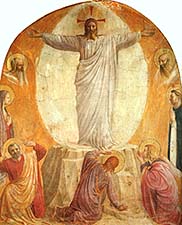
[The Transfiguration by Fra Angelico]


As for sacred vessels, I will never forget a homily by a Swiss priest, preaching on the gift of gold brought by one of the Magi, in which he remarked: "If we do not give the very best we have to God, we do not really believe in God at all. If we have gold, which is precious and costly and beautiful, we must use it for His glorification; if we make sacred vessels out of wood or glass or clay, we are in effect saying that we do not think of Him as all-excelling, beyond everything we can give, so that we must give Him the best we can possibly manage to give, even (or especially) when it pinches our pockets. We have cut God down to our size and placed Him in a tidy budget, just as we would do when stocking our kitchen at home; we believe in Him weakly, or maybe not at all."

This homily was memorable not only because I had never heard a priest say anything like it--expounding venerable traditions of the Catholic Church is not, alas, to be counted among the more common homiletic strategies nowadays--but also because it helped me to understand why Christians have always tried to give God the best. An honest effort in this direction produced the sublime art and architecture of the Middle Ages, next to which their modern equivalents look, on the whole, shallow and rude. It is impossible to exaggerate the importance, for the entire ethos of the liturgy, of the sacred vessels appearing worthy (as much as it is possible for us to make them so) of the Mysteries they are honored to contain. The elevation of the consecrated Victim at Mass is the pinnacle of the many-versed hymn that mankind and all of creation raises to God; that is the time when the supernatural inward reality of the gifts ought to be most evidently symbolized in the external beauty of the chalice and other vessels on the altar. Of the holy Curé of Ars, Saint John Vianney, who wore tattered clothes, slept on the floor, and subsisted on potatoes, we read:
When it was a question of the objects destined for divine worship, he could not find anything beautiful enough.... His joy was unspeakable when he received from the Vicomte d'Ars a magnificent canopy, superb chasubles, banners, a large monstrance in silver gilt, a tabernacle of gilded copper, some beautiful candlesticks, and six reliquaries.11
Jesus was born in a humble stable and placed in a manger, true; but the Wise Men did not bring him straw, dirt, and dung, they brought him costly royal gifts of gold, frankincense, and myrrh. The way in which our Lord was born revealed His humility, which disdains earthly pomp; the way in which the three kings adored Him revealed their humility, which looked for the best they could offer, knowing in their wisdom that it was far beneath what He deserved. It is not for us to behave as if we were Jesus come into the world and thus to create churches that look like barns or stables or caves to receive us. It is rather our business to join the Magi and shepherds in heeding the divine call that beckons us beyond our limits. Responding in faith, we must give our utmost to the Word-made-flesh. The same thing can be said of sacred music. Modern man is no different in essence from man of any age, and therefore has no valid excuse for producing or perpetuating eyesores and earaches. Such unworthy stuff is not what most of our contemporaries would want, had they any chance to choose; it is certainly not what any of them need.

* * * * * *
The Mass is a living image or efficacious likeness of the perfect worship offered by Jesus Christ as Head of the Church--the sinless Lamb slain on Calvary, now reigning in the heavenly Jerusalem--and so it makes present in our midst the glorified Savior whose second coming will not be in quiet poverty but in earth-shattering splendor.

* * * * * * *

As was said, it is true that Our Lord first appeared on earth in a humble manger, hidden and poor. The sacred liturgy, however, is not time-travel to Bethlehem circa 6-4 B.C. The Mass is a living image or efficacious likeness of the perfect worship offered by Jesus Christ as Head of the Church--the sinless Lamb slain on Calvary, now reigning in the heavenly Jerusalem--and so it makes present in our midst the glorified Savior whose second coming will not be in quiet poverty but in earth-shattering splendor. For this reason the instinct of our faith has always been to maximize the beauty of the liturgy and its diverse furnishings and surroundings, yearning for what is to come rather than indulging in backward glances. From that point of view, the liturgists who clamor for a return to evangelical or apostolic "simplicity" are the ones guilty of nostalgia, not the faithful who desire the traditional Roman rite. They want to go back, we want to press forward. It is the difference between archaeology and eschatology. The irony, in fact, is greater: one of the most ancient liturgical customs of all, and one that survived all ages and cultures until it met its match in the hubris of the modern West, is that of facing eastwards when we pray to Christ, the True Light that enlightens every many (cf. Jn 1:9). In having the priest turn his back on the Sun of Justice and "face the people" in a closed circle, as if he were the coming light, advocates of the new liturgical style disdain universal symbolism and banish one of the few customs we can be certain the church of the early centuries practiced. Once again, those who defend Tradition find that they are more capable than their adversaries of preserving what the latter claim to value most--in this instance, antiquity.

To be continued in the next issue.

Notes

  1. I say "not simply and altogether," because on the one hand it is possible to bring the celebration of the ordinary rite into manifest visible continuity with the extraordinary rite (as some Oratorians do), but on the other hand, there are many ways in which the Missal of Paul VI neither encourages nor demands solemnity whereas the traditional Missal does this, indeed methodically. This is a key reason why some preists today are unwilling to learn the old Mass: it is too demanding in its regularions of speech, posture, gesture. But it is also a key reason why a good many young seminarians and priests are eager to learn it: what person in good physical shape could hear about a nearby steep mountain with a beautiful view from the top, and not feel the urge to climb it? [back]


  2. Summa theologiae III, q. 83, a. 4. [back]


  3. All of these comments could be applied also to the death of homiletics in our age. There is hardly a priest left in the world who can preach as the Fathers of the Medievals did. Where is a Saint Gregory, a Saint Augustine, a Saint Bernard, a Saint Bonaventure! They are gone; there is hardly such a thing as preaching anymore. We hear stories, jokes, platitudes, generic newspaper advice, but little in the way of sustained and robust exegesis of Scripture, little in the way of provocative challenges against popular culture, little in the way of urging asceticism for penance and reparation. The clergy have by and large grown soft and their message is softness. The need for clergy who can effectively preach the Word in season and out of season, stirring up the people to conversion of heart, is as great now as it was at the time of Saint Dominic and the Albigensian crisis. [back]


  4. It is important to realize that there are cultural and political reasons for the loss of solemnity that do not exactly correspond to the Novus Ordo's own weaknesses. We might well have witnessed a similar decay of solemnity in the Tridentine rite had it never been supplanted by the Novus Ordo (e.g., attempts at "inculturated" Latin Masses, which were already happening before the Council). Perhaps the Tridentine Mass has retained the power to stand firm against these cultural-political forces because its distinctive cultivation of solemnity has been officially marginalized and is now attractively countercultural. Its solemnity, which would have been secularization's most inviting target, has only been underlined and guaranteed, due to the old rite's wholesale mainstream abandonment. [back]


  5. This is not to say that there could not be a preoccupation with ritualism that would diminish the joy, zeal, and charity characteristic of a healthy Christian spiritual life. Lovers of tradition may also suffer from the compromise of compartmentalization, whereby what happens in church has little or nothing to say to their consumerist lifestyle and neoconservative ideology. However, my purpose here is not to diagnose lapses or distortions of traditionalism, but on the contrary, to point out that its fundamental instinct is sound--the desire to worship God with the very best that our deep and rich tradition has given us. Relativism is not the final word; certain customs, rituals, sacred songs, and so forth are objectively more beautiful and more fitting for divine worship than others. [back]


  6. Lest I be misunderstood: I am aware that there have been comissions appointed by Popes with the view to evaluating, researching, restoring, or augmenting aspects of the liturgy. My point is not to say that there is never a place for such consultations. Rather it is a question of the minimum qualification required of someone who dares to sit on such a commission. I think it would be impossible to refute the claim that the minimum qualification is the most profound respect and reverence for Tradition, such that one would almost rather cut off one's hand than tamper with what has been handed down. As the Notitiae or official notices along with documents like Bugnini's memoirs reveal, however, this spirit of veneration was shockingly absent from the Consilium, the body of theolgians entrusted with revising the liturgical books of the Roman rite. The most disgraceful example, to my mind, is the reply published in Notitiae responding to a query about why the old offertory prayers were removed. The Consilium said, in short: "The Offertory Prayers are redundant and unnecessary, as they anticipate the sacrificial action that is to occur later." With one smug reply, centuries of worship and theology are swept aside, as if nobody had ever understood the offertory before the enlightenmed gurus of the Consilium came along to explain it. Such a union of hubris and idiocy might possibly be unique in the history of Catholic theology. [back]


  7. As Father Samuel Weber, O.S.B. and Jeffrey Ostowski are each doing with considerable success these days. [back]


  8. For further reflections along these lines, see the wonderful little book Reflections on the Spirituality of Gregorian Chant by Dom Jacques Hourlier, trans. Dom Gregory Casprini and Robert Edmonson (Orleans, MA: Paraclete Press, 1995), as well as two classics: Richard R. Terry's Catholic Church Music (1907) and Marie Pierik's The Spirit Of Gregorian Chant (1939), both republished in 2007 by The Church Music Association of America. [back]


  9. For a detailed treatment of the problems mentioned here, see my article "Contemporary Music in Church?" Homiletic & Pastoral Review 107.1 (October 2006): 8-15, available at http://www.ignatius.com/magazines/hprweb/kwasniewski.htm. [back]


  10. For documented summaries of what the Magisterium has taught about sacred music, see my articles "Cantate Domino Canticum Novum: Aspects of the Church's Liturgical Magisterium," The Catholic Faith 6.2 (March-April 2000): 14-23 and "John Paul II on Sacred Music," Sacred Music vol. 133, n. 2 (Summer 2006): 4-22. These are available at http://www.catholicculture.org/library/view.cfm?recnum=4440 and http://www.musicasacra.com/publications/sacredmusic/pdf/sm133-2.pdf. Magisterial interventions of Benedict XVI have only underlined the conclusions made in these articles. [back]


  11. Abbé H. Convert, Eucharistic Meditations: Extracts from the Writings and Instructions of Saint John Vianney, trans. Sister Mary Benevenuta, O.P. (Wheathampstead, Hertfordshire: Anthony Clarke Books, 1964), 100. [back]


Dr. Peter A. Kwasniewski is Associate Professor of Theology at Wyoming Catholic College in Lander, Wyoming. The present article, "Solemnity: The Crux of the Matter," was originally published in Latin Mass: A Journal of Catholic Culture and Tradition (Winter 2008), pp. 8-12, and is reprinted here by permission of Latin Mass Magazine, 391 E. Virginia Terrace, Santa Paula, CA 93060.

Sunday, February 24, 2008

Motus Magnus: An Analysis of Summorum Pontificum


by Michael Foley


July 7th is the traditional feast of Saints Cyril and Methodius, the missionaries who introduced a venacular liturgy to the Slavic Church. And now, July 7th may also be remembered as the day when Pope Benedict XVI reintroduced a Latin liturgy to the Roman Church.

The Motu Proprio Summorum Pontificum is finally here, set to take effect on the exquisitely appropriate feast of the Exaltation of the Holy Cross (September 14th). The Pope tells us in his accompanying letter to the Bishops that "the document is the fruit of much reflection ... and prayer," and it shows.

What Didn't Happen

Summorum, though, has not met all expectations. Contrary to earlier press reports, it does not contain a numerical figure (previously rumored to have been thirty) for how many are required to petition for a Tridentine Mass. This frees the document from unnecessary regimentation, which is reasonable for a Church whose parishes vary widely in size.

Nor, thank goodness, was there any change to the Good Friday prayer for the conversion of the Jewish people -- though at the time of this writing (mid-July) protestations from lobbyists like the ADL's Abe Foxman continue unabated. Needless to say, if the prayer ever served as an occasion of bigotry (which has never been proved), what is needed is not further tinkering but a deeper understanding of its meaning.

* * * * * * *
By making the traditional liturgy universally accessible, the Holy Father is affirming that the Mass of the Ages belongs to every Catholic, not just those with a particular spirituality or vocation.

* * * * * * *

Contrary to some hopes, Summorum did not create a personal prelature or apostolic administration along the lines of Opus Dei, one that would safeguard the classical liturgy from the harassment of hierarchs and liturgists. Yet what the Pope has given us is far greater, even if it means having to endure some of the same difficulties as before. By making the traditional liturgy universally accessible, the Holy Father is affirming that the Mass of the Ages belongs to every Catholic, not just those with a particular spirituality or vocation. It lies at the center of the Catholic patrimony, not ina carefully sequestered ghetto for a few eccentrics and malcontents.

Further, thought the 1962 Missal is now universally available, no mention is made of a universal indult. This is a subtle yet tremendous change in language. In Church parlance an indult denotes permission to do something not allowed by the common law. It is thus an exception to the rule, an exception that, int he case of Pope John Paul II's 1988 Ecclesia Dei indult, was conceded begrudgingly. By speaking instead of two forms of the same rite, one extraordinary (the 1962 Missal) and the other ordinary (1970), Benedict has redrawn the map. No longer is the old Mass an exception to the rule; it is an established part of it. True, it will be a less frequently occurring form of Catholic worship, but there is a significant legal and even psychological difference between more frequent and less frequent on the one hand and a rule and its exception on the other. And as one blogger wryly remarked, "Let's hope that the term 'extraordinary' when referring to the 1962 Missal will be as broadly applied as it is when referring to 'extraordinary ministers of Holy Communion'!"

Power to the People

Another way in which Summorum redraws the map is by locating the initiative with the faithful and requiring the pastor and Bishop to address their needs (Article 5, para. 1). As Cardinal Dario Castrillon Hoyos explained, "If a group ... having a priest available to do it, asks to celebrate this Mass, the pastor or rector of the church cannot oppose it."1 Indeed, the entire trajectory of Summorum is from the ground up: the faithful petition their pastor, and if he cannot accommodate them, they are to appeal to the Bishop; if the Bishop does not help, the matter should be referred to an expanded Ecclesia Dei Pontifical Commission (5 para. 1, 7). In a twist that some might consider ironic, Summorum performatively reaffirms Vatican II's teaching on not only the clergy but the laity as the people of God.

Vindictated

Summorum also offers a robust vindication of the legitimate aspirations and claims that traditional Catholics have been making for decades. The Pope gently reminds the Bishops that it was their own failure to implement Pope John Paul II's indult that led to the Motu Proprio, and he laments the liturgical "deformations" that betrayed the aims of Vatican II and caused great suffering among the faithful -- including, he adds in a touching personal note, himself.2 His Holiness also rejects the old canard that attachment to the classical liturgy is geriatric nostalgia by speaking of all the young who have been drawn to it, and he accords greater intellectual respect to traditionalists by mentioning those whose attachments have been "formed by the liturgical movement," that is, by study and prayer rather than mindless habit or mere allergy to the new."3

* * * * * * *
The Pope gently reminds the Bishops that it was their own failure to implement Pope John Paul II's indult that led to the Motu Proprio, and he laments the liturgical "deformations" that betrayed the aims of Vatican II and caused great suffering among the faithful -- including, he adds in a touching personal note, himself.

* * * * * * *

Most significantly, Summorum explicitly states that the 1962 Missal was "never abrogated" (Article 1).4 A special group of Cardinals studying the issue in 1986 arrived at the same conclusion, but their report was gagged by protests from several national Bishops' conferences. For the past few years Cardinals Estevez and Castrillon Hoyos have reasserted the group's findings, but they were politely ignored. No more.

The Holy Father, however, is not blind to the vices that plague some traditionalists, who might be prone to "exaggerations and [unsavory] social aspects."5 Yet even here Benedict tells his Bishops that the best way to help them is by responding with charity. Put differently, if you want people to stop acting like freaks and fanatics, stop treating them like freaks and fanatics.

Restrictions

Summorum does not provide a carte blanche for the 1962 Missal. The group petitioning for the old Mass must be "stable" (5 para. 1), or as the Latin puts it, coetus ... qui continenter existit: "a group that exists consistently."6 Ordination is the only Sacrament not mentioned as one that can be conferred according to the old usage, but no matter: the traditional seminaries will be able to continue their current practices, as Summorum is primarily addressing parish life. The priest must be capable of celebrating the classical form and be juridically unimpeded (5 para. 4), and he can privately celebrate the Mass every day of the year except during the Sacred Triduum --- a reasonable restriction, since this is the practice for all private Masses on those days (and note that it does not forbid public Tridentine services during the Triduum).

Though the priest is obliged to accommodate the requests of the faithful for a traditional Mass, he must harmonize their welfare with the rest of the parish's (5 para. 1). No doubt the desire for peaceful harmony also prompted the limitation of the only one Tridentine Mass on Sundays and feast days (5 para. 2). Since Summorum is principally concerned with the Sunday celebrations that will be created by it, this should except churches that currently have more than one Sunday Tridentine Mass.7

All of these things are to be carried out "under the guidance of the Bishop in accordance with Canon 392" (5 para. 1). The Pope is quick to stress that his decision in no way undermines the Bishop's authority: though the rules of the game may have changed, the Bishop remains its referee.8 Given the intrinsic nature of episcopal orders, this is as it should be. And it is significant that His Holiness contextualizes this guidance in terms of Canon 392, which does not elucidate a Bishop's right to curtail liturgies but his duty to protect them for abuse. Bishops, in other words, are being instructed to promote a proper observace of the 1962 Missal in the dioceses.

No Rupture

One of the reasons Pope Benedict define the 1962 and 1970 Missals as two forms of the same rie is to underscore that there has been no "rupture" in the Church's liturgy. This, of course, might sound like an inaccurate claim, for do not the many novelties in the 1970 Missal mark a sharp departure from the Church's tradition of organicliturgical development?

* * * * * * *
As is clear from his writings as cardinal, the Holy Father is aware that not everything in the Novus Ordo is the fruit of organic development, but also needs a viable framework in which the new Missal can
be evaluated dispassionately.


* * * * * * *


As is clear from his writings as cardinal, the Holy Father is aware that not everything in the Novus Ordo is the fruit of organic development, but also needs a viable framework in which the new Missal can be evaluated dispassionately. By speaking of a single rite with two forms, Benedict is advancing what he elsewhere calls a "hermeneutic of continuity," an interpretation of vatican II and its aftermath in light of the great tradition rather than vice versa. In the long run, this approach will do much good in restoring the very continuity that has been breached by the distorted beliefs and practices rampant today.

Article 6

The most potentially problematic clause of Summorum is Article 6, which states that at a Tridentine Mass "the readings may be given in the vernacular, using editions recognized by the Apostolic See."

At the time of this writing, it remains unclear as to whether this refers simply to duly approved translations of the 1962 readings or to the use of the 1970 new Lectionary. The Ecclesia Dei commission has apparently authorized the latter in the past, so Article 6 could be referring to this as well.9 Such is the interpratation that the United States Conference of Catholic Bishops (USCCB) has given10 (see inset on page 19).

It would certainly be strange if this were the article's meaning, especially in light of the Vatican's own understanding of the 1962 Missal. The day the Motu Proprio was released, the Holy See Press Office issued a statement explaining the extraordinary form of the Roman rite to the media. One of the things the explanatory note states is that the 'form' is a 'complete' Missal in the Latin language, that is, it also contains readings for the celbrations (that is it is not disctinct from the 'Lectionary' as the later 1970 Missal is).

Is it then the Church's intention to allow a break int he very integrity it acknowledges? Grafting onto the old Missal the new Lectionary, which is based on a completely different set of organized principles and is incongruous with the collects and other propers of the 1962 calendar, would constitute precisely the kind of contrived dallying that Pope Benedict so eloquently rejected as a cardinal. And it saddles the extraordinary form with the Notoriously poor English. translations currently difiguring the 1970 Missal. Clearly the matter requires greater clarification from Ecclesia Dei.

Nevertheless, even if Article 6 should permit the new Lectionary, the good news is that it will probably not have much impact. Ecclesia Dei, as we have just noted, has been offering this same option for years, and it has never, to my knowledge, been acted upon. Moreover, since the entire trajectory of Summorum is from the ground up, the initiative for such a move would remain with the faithful themselves. And I am fairly confident that traditionalists will use this option for their Masses as much as progressive priests use the now optional maniple for theirs.

What Article 6 clearly does allow, however, is the biblical readings from the 1962 Missal to be proclaimed in the vernacular instead of Latin. This, too, is not unprecedented (Ecclesia Dei has always allowed this), nor does it necessarily constitute a disregard for ritual purity. Indeed, the late Michael Davies (if only he had lived to see this day!) spoke favorably of this possibility.11 My own sense is that many traditionalists, having been scarred by one too many liturgical deformations, will be loathe to adopt this practice and that it might be prudent to defer the issue; either way, charity should prevail in determining the best local course of action.

Authentic Development

One change that all parties can welcome, however, is the statement that "new Saints and some of the new Prefaces can and should be inserted in the old Missal."12 This is not a recipe for reckless alteration but for careful and authentic development, especially since it is to be carried out in cooperation with traditional bodies like the Priestly Fraternity of Saint Peter and the Institute of Christ the King.13 Until now, one could not celebrate in the traditional form the feast of Saint Padre Pio (a bitter irony given the Saint's love for the old Mass), of Saint Thomas More (which was not on the universal calendar in 1962), of Saint Faustina, or of the many other saints recently canonized. Similarly, it is not unreasonable to add prefaces to the 1570/1962 Missal, which has fewer than its medieval predecessors. In the 1962 Missal, for example, there is no proper preface for Advent, and thus the generic Common Preface or the Preface of the Holy Trinity is used from June all the way up to Christmas Eve.

* * * * * * *
Until now, one could not celebrate in the traditional form the feast of Saint Padre Pio (a bitter irony given the Saint's love for the old Mass)

* * * * * * *

But the deeper significance to this move is that the classical form is finally "unfrozen." As long as the Tridentine Missal was petrified in the year 1962, it could be seen as a museum piece, something as beautiful but as lifeless as a butterfly in amber -- and something that could be quietly put back into storage once this whole traditionalist brouhaha faded. But now, the traditional Missal will yet again reflect the ever growing roster of God's saints; it will yet again be capable of an authentic development that adds to rather than subtracts from its richness. Though seeminly minor, these proposals decisively ensure the ancient form's dynamic and ongoing vitality.

Conclusion

Because Summorum Pontificum does not and cannot provide a panacea for the current liturgical crisis, the dark night of abuse is far from over and the progress will remain slow. If experience is any guide, papal documents do not so much make things happen as set the conditions for making them happen. The onus, then, is on the grass-roots level, with the priests and faithful.

Finally, we should not forget Pope Benedict XVI. It was hiis vision and his determination in the face of stultifying opposition that made this outstanding document possible; and for this gift to the Church he now faces an escalating wave of hostility from enemies within and without. Let us fervently pray for our Supreme Pontiff and gladly heed his call for boundless charity as we work towards that "inner reconciliation in the heart of the Church" animating his liturgical largesse.


Notes

  1. From an interview in the Intalian magazine 30 Giorni, translated and cited by Catholic News Service. Emphasis mine. [back]

  2. Cf. the Pope's "Letter to the Bishops on the Occasion of the Publication of the Apostolic Letter 'Motu Proprio Data' Summorum Pontificum," Vatican translation. The letter does not contain official paragraph numbers, and so I am unable to cite it more precisely. [back]

  3. Ibid. [back]

  4. The Holy Father repeats this in the letter as well. [back]

  5. Letter. [back]

  6. With the exception of my literal rendering here of the Latin, all citations of Summorum are taken from the unofficial English translation of the Vatican Information Services. [back]

  7. Similarly, it should exempt "personal parishes" such as those run by the FSSP (1). The matter, however, may require greater clarification from Ecclesia Dei. [back]

  8. Cf. the letter. [back]

  9. Cf. Michael Davies, "The Missal of 1962: A Rock of Stability," TLM 10:2 (Spring 2001), 12. [back]

  10. USCCB Newsletter, Vol. XLIII (June-July 2007), q. 12, p. 24. [back]

  11. Unfortunately I cannot locate the passage. As attested by Alcuin Reid's amazon.com book reviews, both Monsignor Klaus Gamber in his Reform of the Roman Liturgy and Aidan Nichols in his Looking at the Liturgy "accept the appropriateness of vernacular readings." The Ordinances of the Society of Saint Pius X, signed by Archbishop Lefebvre, purportedly permit readings exclusively in the vernacular, and at least one SSPX priest, Fr. Basil Wrighton, speaks of the practice as "reasonable" (cf. "Roman Protestants," Angelus, August 1982). [back]

  12. Letter. [back]

  13. Ibid. [back]

[Dr. Michael P. Foley is a professor of Patristics at Baylor University and the author of Why Do Catholics Eat Fish on Friday? The Catholic Origin to Just About Everything (Palgrave Macmillan, 2005). The present article, "Motus Magnus: An Analysis of Summorum Pontificum," was originally published in Latin Mass: A Journal of Catholic Culture and Tradition (Advent/Christmas 2007), pp. 32-34, and is reprinted here by permission of Latin Mass Magazine, 391 E. Virginia Terrace, Santa Paula, CA 93060.]