Showing posts with label Liturgy. Show all posts

Saturday, November 12, 2011

Marini's Conciliarist Manifesto

[The views expressed in the following article are solely the responsibility of its author and are not necessarily shared by the editor of this site.]


Peter A. Kwasniewski

“Just before sunrise, the wind got up. It was a vile, stubborn wind ...”

—Tove Jansson, Moominpappa at Sea1


As a historian phenomenon, “conciliarism” refers to the erroneous view that a general council of the Church is superior to the Pope in matters of faith and morals — that a Pope can be trumped, so to speak, by all the bishops assembled. This heresy was dealt a series of blows throughout the second millenium of Christianity, culminating in the double coup de grace of a pair of dogmatic constitutions on the Church: Vatican I’s Pastor Aeternus and Vatican II’s Lumen Gentium. As those who have studied the latter document know, section 25 of Lumen Gentium contains the clearest, most extensive teaching ever given concerning the unique, supreme, direct authority of the Pope over the entire Church and all her members, including the bishops who must remain in union with him in order to remain truly Catholic.2

In the past forty years, however, a new form of conciliarism has arisen, one harder to define with precision and far more influential: the view that Vatican II, all by itself, was a Council that redefined the Church and her theology from top to bottom. For historians of the influential “Bologna school,” the Council gave birth to a new Church, ushered in a new age, cleared away ages of debris and decadence, proclaimed at last an ecumenical Gospel that sought out the world and passionately embraced it. While the falsity of such a bald statement may cause a wry smile, it is a sad fact that this peculiar brand of conciliarism has been the main force at work in the wreckage of the sacred liturgy for the past forty years. So much so, indeed, that a new “Great Schism” appeared in the twentieth century: a schism between a self-styled modern Church and the Church of Tradition. This virtual schism, like the doctrinal rupture and rampant liturgical abuses that are the hallmarks of its proponents, is far worse than any internal crisis the Church has ever faced before, outstripping in combined ignorance, error, and contempt even the horrors of the Protestant revolt.

* * * * * * * *
It is a sad fact that this peculiar brand of conciliarism has been the main force at work in the wreckage of the sacred liturgy for the past forty years. So much so, indeed, that a new “Great Schism” appeared in the twentieth century


* * * * * * *

As students of Chuch history know, the Holy Spirit does not long allow the Church to be storm-tossed and in danger of shipwreck. All the hard-won gains of the aging old guard—religious liberalism, laicism, secularism, feminism, soft modernism, horizontalism, relativism, and so forth, a whole litany of -isms that have replaced the Litany of Saints as the standard and measure of Catholic life today—are now being called into question by a new generation of believers and, ironically perhaps, by the elderly Pope who was a major force at the very Council whose spirit is claimed to be embodied in the new order of Mass and the new style of worship it promotes. Those who follow the Catholic media can see it daily: the graying liberals sound outraged, panicked, desperate. The more intelligent among them must surely know that the sun is beginning to go down on their long-reigning agenda.

Standing tall and unrepentant in the ranks of the rupturists is the retired papal M.C. for John Paul II, Archbishop Piero Marini, who was unceremoniously replaced at Pope Benedict XVI’s behest by the infinitely more competent and traditional Monsignor Guido Marini (no relation), a model M.C. if ever there was one. For the remainder of this article, “Marini” will always refer to the bishop plagued with a futuristic agenda and no future.
Back in 2007, Marini published a book that made quite a splash. A Challenging Reform: Realizing the Vision of the Liturgical Renewal contains little to surprise those who are already familiar with the standard (“Bologna”) history of the Council and the divinely inspired reforms attributed to it. Anyone who has dared to dip into Bugnini’s disturbing memoirs will find Marini’s book not terribly original. It comes across rather as the last gasp of a dying cause, a kind of “rage against the dying of the light” from an energetic retiree. At a press conference in England, Marini portrayed in livid terms an ongoing battle between “conservation and progress,” and “the center and the periphery.” He wanted his book to sound “an invitation to look to the future, to take up with enthusiasm the path traced by the council.” How’s that for tendentious? We—the Church of the ages—are the periphery? I believe it was Chesterton who said that Tradition is the democracy of the dead. It is the soft modernist faction of the Council that are the periphery, with their loud minority opinion.

Benedict XVI has been the only pope since Blessed John XXIII who seems to have understood with crystalline clarity that Vatican II can have been a legitimate council only if it was intended to be, and is continually received as being, in continuity with the entire Tradition that preceded it. “The path traced by the Council” is, de facto and de iure, the path traced by Tradition—or it is irrelevant, not to say worse. The speech Pope Benedict delivered to the Roman Curia on December 22, 2006 was a beautifully clear indicator of the mind of Holy Mother Church: the Council is to be received within a hermeneutic of continuity, not a hermeneutic of rupture and discontinuity.
Journalist John Allen summarizes Marini’s identification of historical factors that paved the way for the Consilium’s triumph. First, “the presence of the council fathers in Rome during the first two years of implementation of Sacrosanctum Concilium, Vatican II’s constitution on liturgy. The bishops themselves, [Marini] said, were ‘the first guarantors of reform.’” How easily the victors rewrite history! Many who were present at and involved in the Council have testified that the bishops had no idea they were about to witness the wholesale dismantling and reconstruction of the Roman Rite. Archimandrite Boniface Luykx (1915–2004) frequently noted that not a single bishop at the Council believed that Latin would be abolished, in practice, from the celebration of the Mass, that the priest would face the people, or that the prayers would be notably altered. In a moment of honesty, could Marini admit that Sacrosanctum Concilium did NOT ASK FOR most of the changes that were implemented?

* * * * * * *
Not a single bishop at the Council believed that Latin would be abolished, in practice, from the celebration of the Mass, that the priest would face the people, or that the prayers would be notably altered.

* * * * * * *

The second factor in the Consilium’s success, according to Marini: “The personal support of Pope Paul VI.” Alas, this is no relevation; it is but one more reason to hold this beleaguered pontiff of modernist sympathies in suspicion. People often rush to Paul VI’s defense by pointing out his heroically countercultural defense of chastity and the natural law in Humanae Vitae. We might be in danger of damning with faint praise. Humanae Vitae may seem bizarrely backwards or startlingly revolutionary to a world of hedonist nitwits, but any Catholic with an instinctive attachment to healthy sexuality, a modicum of religious education, and a morally sound outlook on family life would not for a moment be tempted by something as disgustingly unnatural as artificial contraception, nor would he or she register any surprise about what the Church had always taught and will always teach.

Let us move on to Marini’s third factor: “The rapid emergence of a network of ‘competent scholars,’ led by Lercaro and Bugnini.” Do I sense what the logicians call a petitio principii—a begging of the question? Competent by whose definition? Many of the fashionable scholarly theories of the mid-century have long since been discredited, even ridiculed, by liturgists and scholars whose first job is not grinding axes but understanding the history of Western liturgy. The business about how the Pope historically celebrated versus populum in St. Peter’s basilica was one of the main myths that drove the novelty of the priest’s turning his back to Christ, the symbolic East. We now know, thanks to better studies, that the Pope and the people faced eastwards at the most solemn part of the Mass, so important was their unanimous orientation felt to be.3

As the old guard present at Vatican II passes away year by year, Marini pleads that “it is important for the church to retain and renew the spirit that gave rise to the liturgical movement, and that inspired the council fathers to approve the constitution on the liturgy as the first fruit of that great grace of the 20th century which was the Second Vatican Council.” Hmm. The “spirit” behind the liturgical movement—is that anything like the particolored “spirit of Vatican II”? What about the origins of the liturgical movement among people who deeply and dearly loved the Church’s traditional liturgy and would have been disgusted by the superficial (if not sacrilegious) hootenanny that often replaced it? I can’t help thinking of a funny quotation by British Dominican Herbert McCabe, no traditionalist he, who nonetheless points out with brutal honesty:
There are satisfying experiences that are immediately satisfying, like drinking good Irish whiskey, but there are other satisfactions that occur only over long periods of time, like having a decently-furnished room. . . . If you are deprived of a decent liturgy for a fairly long period of time you discover an important gap in your emotional life. I might as well say at this point that I think there is a mistaken tendency, more especially in the United States but to some extent here [in England], to design the liturgy for too immediate a satisfaction. I have been with the “underground” groups in the American Church who do not really feel they have celebrated a Eucharist unless they get some kind of immediate experience of personal warmth and enhanced sensitivity. I think the liturgies designed by these people are very frequently in bad taste. I agree with those critics who find the Missa Normativa a little dull, except that I do not think it is altogether a criticism. A room furnished in good taste is a little dull compared to one covered in psychedelic posters saying “Love is Love” and “Mary, the ripest tomato of them all.”4
At the same press conference, Marini pontificated: “The goal of the liturgy is none other than the goal of the church, and the future of the liturgy is the future of Christianity and Christian life.” Even the devil quotes Scripture, and Balaam’s ass had intelligent counsel to offer. The future of the liturgy, in reality, is nothing other than, and nothing less than, the Mass of the Ages, the traditional Roman Rite that had organically developed for almost 2000 years until its violent deformation at the hands of Bugnini & Company.


The end of Mass at Rocafort by Jose Benlliure Ortiz

Our Lord gave the Mass to the Church for all her people, especially for the simple and the childlike. It is precisely such lowly laity who are not sophisticated enough to judge on the basis of theories and hypotheses, but who judge by what they see and hear—“O taste and see how gracious the Lord is...”

* * * * * * *

Anyone with good sense can see that the sudden virtual suppression of huge parts of Catholic liturgical tradition can only have had a profoundly unsettling, disorienting, and destabilizing effect on the Church as a whole. The apparent “success” of the reform has been belied by the bitter problems of doctrine and morals that have plagued the Church in the past four decades, centering on a loss of priestly identity, a drastic decline in priestly vocations, and an almost universal ignorance of the Faith and of the Sacred. The glamorous meetings of ICELated conspirators conveniently fail to mention the countless Catholics who felt betrayed, alienated, and even scandalized by the drastic changes that occurred as if overnight. I was talking to a neighbor one day—someone I’d gotten to know from seeing him so often around town—and when he found out that I taught for the Catholic College, he volunteered that he was a fallen-away Catholic who stopped going to Mass back in the seventies. “I went one Sunday and it was Hallelujah this and Hallelujah that, and I said to myself: What the hell is all this? It sure isn’t Mass!” Years ago, another friend told me a similar story. He said when the drums and guitars invaded the sanctuary, practically overnight, and routed the quiet low Mass he had grown up with, he felt dismayed, betrayed, assaulted, actually sick to his stomach. He stopped going to Mass for years, and nearly lost his faith entirely. Fortunately, he was one of those who, thanks be to God, returned to the Church after the indult Masses began.

Our Lord gave the Mass to the Church for all her people, especially for the simple and the childlike. It is precisely such lowly laity who are not sophisticated enough to judge on the basis of theories and hypotheses, but who judge by what they see and hear—“O taste and see how gracious the Lord is...” And judging by what they saw and heard, many came to the conclusion that the Church had either gone bonkers or had “come of age” and surrendered to secularism. In either case, it was time to stop going to Church. Rather than rejoicing in a botched reform conducted with all the finesse of bulldozers, one ought to feel righteous indignation about the high and mighty doings of the liturgical elite in the heady days of the late sixties and beyond, as they indulged in their liturgical fantasies while carelessly trampling on the hearts and minds of innumerable ordinary Catholics who loved the beauty and dignity of the Church’s worship as they knew it.

* * * * * * *
Anyone with good sense can see that the sudden virtual suppression of huge parts of Catholic liturgical tradition can only have had a profoundly unsettling, disorienting, and destabilizing effect on the Church as a whole.

* * * * * * *

Marini’s talk in London was full of that peculiar messianism characteristic of Vatican II nostalgics. Here is how it ended: “The Holy Spirit that inspired the liturgical movement and the council fathers still encircles us like a sacred cloud, and guides us like a column of fire,” offering “beauty ever new” as well as “joy and hope.” That’s what they call rhetoric, folks, but not in the most flattering sense of the word. If it was indeed the Holy Spirit and not the Zeitgeist or something more infernal yet, then the entire way we receive and rejoice in the Council and in the liturgical movement will of necessity exemplify the hermeneutic of continuity: the Council is to be interpreted in line with and in light of the great Tradition of Catholic theology and worship. It will not, pace Marini, cleave to the “hermeneutic of rupture,” whereby the Council would signify a decisive change of course that requires systematically deconstructing what came before and terrorizing those who adhere to it.

Let us remind ourselves again and again that Sacrosanctum Concilium expressly says that “there must be no innovations unless the good of the Church genuinely and certainly requires them; and care must be taken that any new forms adopted should in some way grow organically from forms already existing” (§23). To those who are familiar with the wonderfully durable and ineffably beautiful preconciliar sacramental rites, it would seem obvious that few, if any, changes could have been defensible according to this strict criterion of “genuine good.” It would be like looking into a chest filled with treasures fashioned of precious metals and jewels, and saying: “Let’s get rid of anything in here that’s worthless.” Good luck finding the iron and bronze brooches. But the Consilium came along and—to the horror of orthodox Catholics, the delight of far-seeing modernists, and the surprise of just about everyone—discovered that the rites of the Roman Church were thoroughly defective and in need of a massive overhaul. An overhaul, in fact, that would culminate, decades later, in a pathetic banalization of the very rite of exorcism, as if we could pull the wool over Old Scratch’s intellectual eyes. According to many exorcists, the new rite does not even work very well; it is certainly much less effective than the old. A personal friend of mine, an exorcist for a major diocese, told me that water blessed by the old solemn formula is considerably more effective against demons than water blessed with newer formulas. In a way, if one may compare great things to small, Church leaders made the same mistake as Coca-Cola did, but lacked the marketing brains to realize it and bring back the original recipe. It seems that hierarchical office does not bring with it a charism of factual analysis.

The Consilium found that the Tradition was defective and the People of God were crying out for a new Mass, a new Liturgy of Hours, new blessings, new everything. This sounds like special pleading. Who are we to trust: the Tradition of the Church, which embodies the faith, hope, and love of countless believers and pastors over many centuries, or the Experts whose theories embody (at best) the ephemeral wisdom of academia, here today and gone tomorrow? Why do the Experts think that they know better than the common man—or, for that matter, than the Common Doctor, St. Thomas Aquinas, who is always on the common man’s side? The whole tenor of the Consilium ascendancy, as of Marini’s book, smacks of the spirit of Protestantism: we, a select few enlightened by the Spirit of God, will choose what is the best way forward in Catholic worship.

In any case, one thing is certain: we will see a lot of this kind of nostalgic resistance from the aging conciliarists; it will be a hallmark of at least the next ten years, and it will become more and more acerbic, accompanied by an increase in clandestine acts of desperation. They accuse the traditionalists of wallowing in nostalgia, but as brilliant a light as Fr. Richard McBrien finds himself caught short trying to explain how young Catholics who never grew up with the Latin Mass are flocking to it, loving it, and passing it on to their children. A “nostalgia” for what one could never have remembered is positively indecent and categorically illogical! (I was born in 1971, after Pope Paul VI had safely earned his place in the ranks of the worst popes of history, so I can add fuel to McBrien’s ire.) In an interview for the National Catholic Reporter, Marini memorably compared the traditional nostalgics with the carnal Jews who, having been liberated from the bondage of Pharaoh and his evil empire, longed for the fleshpots of Egypt:
First of all, it’s important that I spoke about a path [of liturgical reform], one that I believe is irreversible. I often think about the journey of the ancient Israelites in the Old Testament. It was a difficult journey, and sometimes the people became nostalgic for the past, for the onions and the melons of Egypt and so on. In other words, sometimes they wanted to go back. But the historical journey of the church is one which, by necessity, has to move forward.
Marini is not quite finished, however, with his penetrating analysis. He is puzzled that so many young people are drawn to the older liturgical forms—how can this be? He shares his reasoning process with us:
I see a certain nostalgia for the past. What concerns me in particular is that this nostalgia seems especially strong among some young priests. How is it possible to be nostalgic for an era they didn’t experience? . . . I’m always surprised to see young people who feel this nostalgia for something they never lived with. “Nostalgia for what?,” I find myself asking.
In reality, now that we are finally beginning to see genuine liturgical renewal thanks to Summorum Pontificum and the “reform of the reform” movement, the nostalgia is all on the side of the wrinkled cheerleaders with their placards of “Man has come of age; so should the Mass.” They are gazing wistfully back to the sixties while younger and wiser Catholics are thanking God that we’ve made tracks away from that benighted time of false hopes and Teilhardian illusions. Or better, the younger Catholics who take their faith seriously are doing just that: taking it seriously. Taking it as given, not as manufactured; as timeless, not as up-to-date. The Mass is not an experiment, a proving ground for academic theories, a do-it-yourself when ordained ministers run dry. It is the one and only Sacrifice of Calvary made present in our midst, in a hallowed form we receive from our forebears, bearing not only its own sanctifying reality, but also the sanctified history of the communion of saints. The reaction of any sane believer is to fall to his knees in adoration, along with generations of his fathers and—may God in His mercy grant it—generations of his children to come.

* * * * * * *
The Mass is not an experiment, a proving ground for academic theories, a do-it-yourself when ordained ministers run dry. It is the one and only Sacrifice of Calvary made present in our midst, in a hallowed form we receive from our forebears, bearing not only its own sanctifying reality, but also the sanctified history of the communion of saints.

* * * * * * *

In my years of teaching undergraduate and graduate theology, I have seen how young people who are serious about their faith flock to the traditional Mass, with little prompting or explanation required, and how they continue to attend it throughout their adult lives, eventually introducing their children to it. I have seen the spectacle of college students who, because they grew up in a parish or chapel run by the Fraternity of St. Peter, have never attended a Novus Ordo Mass, and who therefore need it to be explained to them. I was one of those young people who flocked to the (once-forbidden) “old Mass,” and as the years pass, my love for it only grows deeper and stronger. It has nothing to do with nostalgia. Nostalgia would be impossible for people who existed only in God’s mind, not on earth, when Paul VI made his fateful decision to promulgate the Novus Ordo Missae. It has to do with something much more fundamental than nostalgia: the transcendentals of truth, goodness, and beauty. Every soul is created by God to resonate with these transcendentals. We yearn for their presence in a modern world hell-bent on falsity, evil, and ugliness. And the traditional Mass, the crown of all the sacred rites and ceremonies of our Faith, powerfully contains and expresses them. What a gift! And what a privilege is ours to see this gift once more given and received!+

Notes

  1. Trans. Kingsley Hart (n.p.: Farrar, Straus & Giroux, 1993), 88. [back]

  2. The same section 25 redresses an imbalance from Vatican I: while Pastor Aeternus seemed to focus on infallible ex cathedra pronouncements, i.e., what could be called the extraordinary Magisterium, Lumen Gentium broadened its consideration to include, and to emphasize, the authoritative nature of the Pope’s ordinary Magisterium—a lesson the vast majority of Catholics, both liberal and conservative, have still not accepted. [back]

  3. For more on this, see Ratzinger, Spirit of the Liturgy, and Lang, Turning Towards the Lord. [back]

  4. Herbert McCabe, God Matters (New York/London: Continuum, 2005), 215-6. [back]

[Dr. Peter A. Kwasniewski is Professor of Theology and Philosophy at Wyoming Catholic College in Lander, Wyoming. The present article, "Marini's conciliarist Manifesto," was originally published in The Latin Mass: A Journal of Catholic Culture and Tradition, Vol. 20, No. 3 (Summer 2011), pp. 6-10, and is reprinted here by kind permission of Latin Mass Magazine, 391 E. Virginia Terrace, Santa Paula, CA 93060, and the author.]

Saturday, October 01, 2011

Bankrupting the Banquet: Reflections on the Distribution of Holy Communion


By Michael P. Foley

Seven years ago the Reverend Massimo Salani made international news by accusing fast food of being Protestant. Characterizing the popular form of eating as the complete oblivion of food’s “sacred nature,” the Italian Patristics scholar went on to opine that fast food “reflects the individualistic relation between man and God introduced by Luther” and is thus “the fruit of a Protestant culture.”1 While Salani’s theory won praise from the Italian Minister for Agricultural Resources, both the German Lutheran community and the McDonalds Corporation were quick to issue letters of rebuttal, almost as if both were equally insulted by association with the other.

Regardless of where one stands on the value of fast food, the topic certainly invites reflection on the relationship between dining and the Catholic sacramental life. Indeed, Fr. Salani could just as easily have asked not whether fast food is Protestant, but whether fast food is now, thanks to the way we currently administer Holy Communion, Catholic.

Specifically, while the rite of communion in the Tridentine Mass (and in all other historic apostolic rites) takes on the form of a high banquet or feast, communion in the typical Novus Ordo Mass celebrated in the U.S. today generally resembles the experience of eating at a fast-food restaurant. I stress “today,” for it would be simplistic and misleading to lay blame on the 1969 Missal per se.2 But we can at least suggest the following. Even when the communion rite of the Tridentine Mass is celebrated poorly by a hasty priest, the form of it remains unmistakably that of a grand banquet. On the other hand, the more negotiable form of the Novus Ordo communion rite, together with the implementations of the USCCB and the guidance of many American liturgists, have clearly made possible a number of practices that more often than not sell our banqueting birthright for a bowl of McPottage.

At the Lamb’s High Feast

In a Tridentine Mass, everything about the communion rite betokens participation in a great feast. Only the choicest vessels, made out of silver or gold, are used and only the finest linens. The atmosphere, even when there is only a single priest in somewhat of a hurry, is one of solemn leisure. The communicant stops, kneels, and waits. He is honored by the approach of the priest himself, not a lower minister and certainly not a fellow layman, just as diners at a fine restaurant are particularly honored when the chef comes out and visits their table (I apologize for the profane comparisons here and throughout, but they are necessary for the argument).

When the priest arrives, accompanied by his “waiter,” a formally-dressed acolyte, precious dishware (a gold paten) is placed under the communicant’s chin and he is treated to three things: a beautiful invocation directed specifically to him, “May the body of Our Lord Jesus Christ keep thy soul unto eternal life. Amen”; a mini-Benediction (for the priest makes the sign of the cross with the Host in his hand before distributing it); and the sacred Host itself. The prayer is particularly relevant to our discussion. The chef at a fine restaurant is likely to “pray” that his patrons obtain the intended effects of the fare he has served: hence he says something like, “Enjoy your meal.” The purpose of Holy Communion, on the other hand, is not pleasure for the body but bliss for the soul: hence the priest’s precise yet succinct prayer to each and every communicant.

The communicant then usually lingers for a little while in gratitude. In some parishes, kneelers even wait until everyone on their side of the aisle has received before rising and returning to their pews, both to prolong their adoration but also to show good manners in not rising from the table until everyone has finished.

Of particular importance throughout this ritual feasting is the communion rail. Its opponents depict it not only as a barrier between God and man but as an impediment to the Lord’s supper, for it keeps the congregation segregated from the altar, which in the great tradition has been understood as both the locus of sacrifice and a mensa, a table on which a meal is shared. Yet they overlook how the chancel rail, like the Byzantine iconostasis, is not a partition separating but a seam uniting heaven and earth, sacred and profane; and subsequently, it is more of a window than a wall. Moreover, the communion rail is a table, a banquet setting for the communion of God and His children in the congregation. Underscoring this function was the custom in some parishes of placing a fine white linen communion cloth -- a tablecloth, if you will -- on the chancel rail.

The Happy Meal

The ethos for Holy Communion at the average American Novus Ordo is noticeably different. The communion rail now gone and the striking descent of the priest from the high altar now ameliorated by architectural changes to the sanctuary and by the team of Eucharistic ministers diluting his distributive office, the communicants form a single file line from which they never fully escape. As they hasten forward (in my experience, the line usually moves quickly), they are advised to make some gesture of reverence as they approach the Blessed Sacrament as long as it is not the traditional genuflection -- presumably because it might impede efficiency.3 In the traditional communion rite, the line breaks as individual communicants find a place at the rail and then prepare for Holy Communion. In the most common current dispensation, by contrast, there is no local (and possibly no psychological) transition from reaching the head of the line to receiving the Eucharist.


All of this smacks of a fast-food arrangement, with its focus on speed and efficiency. Customers form single file lines either in the restaurant or in the drive thru, and their food is ready for them before they are seated, sometimes even before they receive their change.

Instead of receiving from a priest, chances are that the communicant will be receiving from a lay Eucharistic minister, often located at various points throughout the church (again to aid efficiency). As has been mentioned already, it is an honor to receive one’s fare from the chef himself (the “high priest,” as it were, of the dinner), but in a decent restaurant one can at least expect to be served by a duly-uniformed waiter. What one would not expect is to have diners from the next table suddenly stand up and serve you your food. Yet this is precisely what happens with Eucharistic ministers. They are not priests, they are not members of a minor order (acolyte), and they are not even laymen performing the function of a minor order (altar boys).4 They are fellow diners who have taken a workshop (sometimes) on how to distribute God.

Instead of a precious vessel made out of gold or silver, the priest or Eucharistic minister may be holding in his or her hand cheap earthenware. From it he/she proffers a Host and says, “The Body of Christ.” This brief declarative statement, no longer than “Have a nice day,” has replaced the beautiful prayer addressed to the individual for his eternal salvation as well as the mini-Benediction. Gone too are the gold patens and the communion cloth that add to the festive splendor and that reinforce belief in the Real Presence of every particle of the Host.
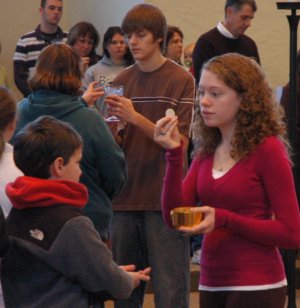
Though one is still permitted to receive on the tongue, it is more common for communicants to receive on the hand, a practice that further facilitates a fast-food mentality. Under this arrangement, it is easy to begin the return to one’s pew before the Host is actually in one’s mouth. Such an impatient action, should it occur (and it does), is roughly comparable to the fast-food customer who pops some fries into his mouth as he takes his tray and finds a table. Tellingly, McDonalds refers to the counter area where this happens as the “grab and go” zone.5 This essentially describes the action of such a communicant: he grabs and goes, masticating on His Lord as he strolls back to his pew. And should he try to slow things down or receive more reverently, he renders himself vulnerable to sometimes humiliating censure. In April 2006 Bishop Tod Brown of Orange, California, was videotaped yanking a young woman to her feet after she tried to receive Holy Communion kneeling, despite the fact that she begged him not to.

It is not difficult to see, incidentally, which of the two dining paradigms we have described better accords with the Eucharistic passages of the Bible. With the exception of the miracle of the fish and loaves (a picnic setting, so to speak, necessitated by the circumstances), scriptural foreshadowings of the Eucharist tend to involve grand or traditional feasts, such as the Wedding of Cana or the Parable of the Prodigal Son. Moreover, the Last Supper itself took place during no mere meal but the Seder, the highest and most solemn banquet of the Hebrew year, with every its dimension steeped in ritual and ceremony. Finally, the earthly liturgy that Christ instituted in the cenacle is itself a participation in His heavenly wedding feast described in the Book of Revelation. Since every Mass not only synthesizes all of the just sacrifices from Abel on but anticipates this great eschatological banquet in Heaven, it only makes sense to have this hidden reality reflected in signs and gestures that are suitably august.

Reply to Objections

Two objections can be raised against our thesis, the first being that, despite the “grab and go” temptation, Communion in the hand as well as Communion standing up remain closer in form to that of a banquet. Few people at a feast, after all, are either spoon-fed by another or take their food on their knees. Yet this is precisely where the analogy -- as all analogies eventually do -- begins to fail. At an earthly banquet, an adult must indeed be somewhat active in taking food to his mouth. At the heavenly banquet, however, we are more like what St. Paul refers to as “little ones” -- helpless infants seeking sustenance from our Parent. The gesture that a communicant takes in the traditional Roman rite is one of perfect receptivity (which is not to be confused with passivity).6 He is like a fledgling chick, head tilted back, eyes closed, mouth open, pleading for Life.

This image may be mildly insulting to those who think of themselves as all grown up, but it is evocative of the gala logikos, the “rational milk” (or “milk of the Word”) that St. Peter admonishes us to receive as newborn babes (1 Pet. 2:2); and it hearkens to the ancient association of Christus passus with the mythical pelican. According to a Greek legend, a male pelican returned to the nest after a three-day absence to find his young killed by a serpent. To bring them back to life, he tore open his breast and let his blood trickle onto them. Church Fathers like St. Jerome saw in this tale an allegory of the Eucharist, which is why in Eucharistic hymns like St. Thomas Aquinas’ Adoro Te, Devote, Jesus is addressed with the words, Pie Pelicane, and why tabernacle doors sometimes contain the relief of a pelican immolating itself. And if Jesus is the Pelican whose blood is life-giving Logos-milk, then we are certainly His newborn babes, smitten by the old serpent of sin and recumbent before Him.7

The pelican’s affinity with Our Lord also puts into perspective the inappropriateness of recent experiments in intinction, where the communicant takes the Host and then dunks it in the Precious Cup. This chips-’n’-dip motion of the layman is far removed from the practice of several Eastern rites, where the communicant receives both species (the Body intincted in the Blood) from the priest in a fledgling manner similar to that of the believer at a Tridentine Mass. And, of course, it gives the rite of communion an additional air of nonchalant informality, at least in cultures affected by the habits of Super Bowl Sunday snacking.

Second, it may be objected that Communion under both kinds is more banquet-like, since obviously banquets involve drink as well as food. As with Communion in the hand, there is an ancient Roman precedent for this practice, though likewise it is debatable that what we are doing today actually restores the tradition. Few proponents of the former, for example, seem to realize that the original practice, in some places at least, required a woman’s hands to be covered by a cloth when she received the Host.

The issue with Communion under both species is not so much that the Precious Blood is shared (which is theologically unproblematic and even in some respects commendable), but how it is shared. The answer to that question today is, again, fast-food-like. The communicant moves to a second station, almost always staffed by a lay Eucharistic minister, as if he were driving up to the second window of a drive thru. There he takes the Chalice in his hands (further undermining his fledgling orientation), imbibes his share, and goes. Having this second station can also undermine respect for the Eucharist, for invariably -- in order not to hold up “traffic” -- other communicants pass by the Chalice without acknowledging the presence of their Eucharistic Lord. And it hardly resembles the ancient practice, where only the deacon (the sous-chef of the Sacrifice, so to speak) took a golden straw called a fistula, lowered it in the Chalice, and put his finger over one end so that it would hold the Precious Blood. Then, moving to the communicant (not vice versa), he would suspend the fistula over the person’s open mouth and release his finger so that the Blood would empty into it, pelican-like.

Conclusion

Entitling this article “Bankrupting the Banquet” is not intended to be sensationalist or to suggest that when Mass is celebrated in a fast-food manner the Sacrament loses any of its efficacy. Both “bankrupt” and “banquet” come from bancus (the Latin for bench), the former in reference to a banker’s counter, the latter to a dining table. Keeping this etymology in mind sets into relief the content of our critique: by removing the communion rail and all the other elements of grand feasting, we have literally bankrupted the Roman rite, ruptured or broken the banquet bench on which the communion between God and man appropriately takes place.

Consequently, nature abhorring the vacuum that it does, an ethos of efficient consumption comparable to that of the American fast-food industry has crept into our solemn worship. The result is an atmosphere and an etiquette at odds not only with the sacrificial, regal, and divine character of the Eucharistic liturgy but with its festive, leisurely nature. Exorcizing the spirit of Burger King from the banquet of the Heavenly King remains an urgent and pastorally pressing task. If, as the 2005 Eucharistic Synod intimates, the Church is serious about restoring a sense of reverence for the Eucharist, she may wish to reconsider how she distributes It.

Notes

  1. From an interview that appeared in Avvenire, November 8, 2000. English translation from 2000 Religion News Service Star Telegram, Ft. Worth, Texas. [back]

  2. Indeed, many of the features of a contemporary American Mass I am about to describe are not at all mandated by the 1969 Missal. On the other hand, it must be acknowledged that the new Missal and many post-conciliar directives either permit or insufficiently guard against the encroachment of “fast-food” practices in the liturgy. [back]

  3. While the American adaptations to the General Instructions for the Roman Missal discourage kneeling or genuflecting during the reception of Communion (the bishops’ effort to forbid the practice outright, you may recall, was rejected by the Vatican), they do not state why these practices are now so objectionable. One respected liturgical scholar once suggested to me that the motive was purely logistical: kneeling and genuflecting interrupt the flow of the communion line. [back]

  4. Even tonsured clerics were not permitted to distribute Holy Communion: only the major order of priest (for the Body) and the major order of deacon (for the Precious Blood) had such privileges. [back]

  5. It has even been speculated that McDonald’s signature yellow and red are designed to encourage faster customer turnover, since no one is able to stay in a room of such loud colors for too long. Perhaps this also explains the choices made in church design over the past half-century. [back]

  6. The Blessed Virgin Mary, for instance, was utterly receptive to the Angel Gabriel’s announcement, not utterly passive. [back]

  7. The pelican metaphor also underscores the inappropriateness of Eucharistic ministers whose activity alienates the priest -- acting in persona Pelicani, as it were -- from the Divine Pelican’s blood and brood. For the pelican does not ask some other bird to revive his young after his act of self-sacrifice but carries the act through to its completion himself. [back]

[Michael P. Foley is associate professor of patristics at Baylor University. He is author of Wedding Rites: A Complete Guide to Traditional Vows, Music, Ceremonies, Blessings, and Interfaith Services(Eerdmans, 2008) and Why Do Catholics Eat Fish on Friday?: The Catholic Origin to Just About Everything(Palgrave Macmillan, 2005). Dr. Foley's article, "Bankrupting the Banquet: Reflections on the Distribution of Holy Communion,” Latin Mass: The Journal of Catholic Culture and Tradition, Vol. 16, No. 3 (Summer 2007), pp. 38-41, is reproduced here by kind permission of Latin Mass, 391 E. Virginia Terrace, Santa Paula, CA 93060.]

Related:
Leroy Huizenga, "A Modest Proposal" (First Things, On the Square, September 26, 2011).

Thursday, July 14, 2011

The Great School of Spirituality: Learning to Love the Divine Office


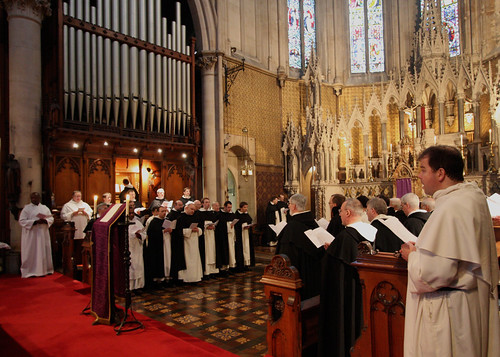
Dominican Vespers photo by Lawrence OP

By Michael P. Foley

During a recent Angelus address, the Holy Father referred to the liturgy as “a great school of spirituality.” By that the Pope meant not simply the Mass but the Divine Office. Together these two sacrifices—one of the altar, the other of praise—school the believer in the divine mysteries, shaping his sensibilities, honing his judgment, and conditioning his heart to a life of holiness. The Divine Office is also a key to unlocking the great secrets of the Catholic liturgical year: its prayers and readings perfectly complement the propers of the Mass.

Today, however, the Divine Office remains relatively unknown or unused by lay Catholics, even by those who otherwise savor every morsel of our grand and sacred tradition. To address this situation, we offer a brief overview of the Divine Office and discuss some available “back-to-school supplies.”

What It Is

The Divine Office consists of the hours of Matins (originally 12:00 a.m.) and Lauds (3 a.m.), Prime (6 a.m.), Terce (9 a.m.), Sext (12:00 p.m.), None (3 p.m.), Vespers (6 p.m.), and Compline (9 p.m.). Most of these predate Christianity by several centuries. Lauds and Vespers, for instance, are heirs to the grand morning and evening liturgies before the Ark of the Covenant ordered by King David, liturgies in which over a hundred Levites would chant the Psalms.1 Since their institution on Mount Zion, these services have never been discontinued: Solomon’s Temple, the Jewish Diaspora, and now the Church have kept up the daily praise of God in this form.2

The so-called “Little Hours” of Terce, Sext, and None, on the other hand, arose from the Jewish custom of going to the Temple for private prayer at the third (tertia), sixth (sexta), and ninth (nona) hours of the day (Sts. Peter and John were observing this custom when they cured the man lame since birth).3 Finally, Matins, Prime, and Compline were added in the early centuries of Christianity: Matins began as an anticipation of the Second Coming and a commemoration of the Resurrection, while Prime and Compline are the products of early monasticism.

Together, these eight daily sacrifices of praise fulfill Psalm 118:62 and 164 -- “I rose at midnight to give praise to Thee” and “seven times a day I have given praise to Thee.” Moreover, they punctuate the day, helping to keep the soul from becoming overwhelmed by worldly concerns, and they consecrate time itself with the fragrant incense of prayer.

* * * * * * *
Since their institution on Mount Zion, these services have never been discontinued: Solomon’s Temple, the Jewish Diaspora, and now the Church have kept up the daily praise of
God in this form.


* * * * * * *


God’s Prayer Book

The format of each Hour varies, but at their center is the chanting or reciting of the Psalms. As the only book of prayer written by God, the Psalms hold a unique place in the devout life. In the eloquent words of St. Augustine (354-430): “That God may be praised well by man, God Himself has praised Himself; and since He has been pleased to praise Himself, man has found the way to praise Him.”4 St. Basil (330-379) called the Psalter the natural voice of the Church,5 and St. Thomas Aquinas (1225-274) goes so far as to say that the Psalms contain the whole of theology.6 No wonder that St. John Chrysostom (347-407) wrote that the Christians of his time used the Psalms more than any other part of the Old or New Testament.7

Special mention must also be made of the Latin hymns in the Breviary (the name of the book that contains the Divine Office). Penned by saints as early as the fourth century, these hymns are, in the words of the great liturgist Fr. Adrian Fortescue, “immeasurably more beautiful than any others ever composed. Other religious bodies take all their best hymns from us. It would be a disgrace if we Catholics were the only people who did not appreciate what is our property.”8

Later History

The Divine Office essentially received its current configuration from Pope St. Gregory the Great, though it continued to develop long after and in somewhat diverging directions. The multiplication of saints’ days, for instance, ended up superseding the weekly rotation of the Psalms, with the result that the whole Psalter was no longer being recited within the year, let alone in a week, as intended by St. Gregory.9 The Council of Trent (1545-1563) was forced to deal with this problem, and calls for radical reform were legion. As Vilma Little, writing in 1957, notes with eerie relevance to our own times: “As so often happens in times of general abuses calling for redress, the suggested remedies would have been worse than the disease. Ruthless plans of wholesale alterations were put forward by certain French and German theorists.”10

Fortunately, Little continues, “the saner views of the more level-headed bishops prevailed.”11 Trent outlined a moderate plan for revising the Breviary, which was enacted by Pope St. Pius V. The Sunday and weekday offices were restored while not upsetting the arrangement as a whole.

Not all changes to the Breviary during the Tridentine period, however, were for the better. In 1632 Pope Urban VIII allowed the spirit of Renaissance humanism to affect the hymns of the Breviary, revising almost all of them so that they would conform to the rules of classical prosody. The original verses of St. Ambrose and the like were butchered on the grounds that they were not “good Latin,” yet the new versions were hardly improvements.

Speaking of the four Jesuits commissioned with revising these hymns, Fortescue writes: “They slashed and tinkered, they re-wrote lines and altered words, they changed the sense and finally produced the poor imitations that we still have in place of the hymns our fathers sang for over a thousand years. Indeed their confidence in themselves is amazing.”12 Fortunately, there is a note in the 1912 Antiphonale stating that the old hymns can be used where they are permissible “by law, custom, or indult.” It is difficult to say what this would mean after Vatican II, but it is my personal opinion that a certain latitude can be applied in good conscience.13

* * * * * * *
“As so often happens in times of general abuses calling for redress, the suggested remedies would have been worse than the disease. Ruthless plans of wholesale alterations were put forward by certain French and German theorists.”

* * * * * * *

But while the modifications made by Trent were sensible, they were not complete; it was left to Pope St. Pius X to enact further reforms. The Pope redistributed the entire Psalter, again with the goal of ensuring its recital within a single week. Further changes were made in 1956 and again in 1960 which simplified certain aspects of the Hours and accorded greater dignity to the Sunday Office.

Around the same time, some editions of the Breviary began to use the Psalterium Novum or Pius XII Psalter,14 which was an unfortunate repeat of the same classicist hubris that marred the hymns in 1632 now applied to the Psalms themselves.15 Fortunately, these Ciceronianized Psalms were made optional but never mandated.

Happily, all of the books considered in this article use only the traditional Vulgate Psalter. The Fraternity of St. Peter has published an impressive, new, two-volume edition of the Breviarium Romanum with the Vulgate and in accord with the rubrics of 1962, and so has Angelus Press. Both of these publications reflect the loving care that went into them: their only drawback, from a typical layman’s perspective, is that they are in Latin only. Baronius Press promises to remedy this with a new, three-volume version in English and Latin based on the popular Collegeville Breviary from 1963, which will be out in August. For bilingual alternatives currently in print, we must turn to the different variations of the Breviary.16

Variations

The celebration of the Divine Office has always admitted of greater variety than that of the Mass. To begin with, the Office used by the secular clergy and others (the “Roman Breviary”) was different from the Office used by various monastic orders (the “Monastic Breviary”). And even within this division there were further subdivisions. The Carmelites, Dominicans, Franciscans all had their own versions of the Roman Breviary, to say nothing of different regions and dioceses; and the Benedictines, Carthusians, and Cistercians all had their own versions of the Monastic Breviary.

One of these versions now back in print is St. Michael’s Abbey Press’s The Monastic Diurnal, Or the Day Hours of the Monastic Breviary.17 A diurnal is an abridged monastic Breviary containing only the “day Hours,” that is, every canonical hour except Matins. Diurnals were originally designed to be a handy single volume for monks and nuns to use when they were away from the cloister during the day, but they can also be used by laymen. This edition, originally compiled by the Benedictine monks of St. John’s Abbey in Collegeville, Minnesota and published between 1948 and 1963, has been lovingly reproduced according to the highest standards. Bound in Moroccan leather with gilt edges and six cloth marker ribbons, The Monastic Diurnal is a visual treasure. In addition to all of the Psalms one needs for the week, it contains all of the relevant propers for the entire liturgical year in both Latin and English.

Another variation to the Divine Office were the breviaria parva, or “little Breviaries,” abridged editions tailored to specific uses or devotions. The best known of these is the Little Office of the Blessed Virgin Mary, which was especially popular with the laity and with religious communities with active apostolates and not a great deal of time for communal or private prayer. A beautiful edition of the Little Office of the Blessed Virgin Mary has been reprinted by Baronius Press featuring a blue leather cover, gilt edges, all of the prayers in both Latin and English, and much helpful information. The Little Office is an exquisite prayer to our Lady: its only drawback is that it does not include the calendar’s various saints of the day and some of its seasons.

Another abridged Breviary, which has been specially published by Angelus Press for use by the laity, is Divine Office: Officium Divinum. This handsome, leather-bound volume contains, in both Latin and English, Sunday Lauds, Prime, Sext, Vespers, and Compline, as well as Prime, Sext, and Compline for the entire week. Each Office and Psalm are prefaced by brief and enlightening excerpts from Fr. Pius Parsch’s The Breviary Explained, the first book of its kind when it was published in the early 1950s. The Divine Office also includes musical notation for much of the chant. Like the Little Office and the other breviaria parva, its only drawback is the absence of feast days.

Not Just For Clerics

A common misconception is that the Divine Office is only for the clergy. It is true that clerics are required to say the Divine Office: indeed, priests and seminarians sometimes joke about this requirement by calling the Office the onus Dei (burden of God) instead of its more poetic title, opus Dei (the work of God).

However, this does not mean that the Church wants the clergy to have a monopoly on the Office. St. Augustine tells us that his mother St. Monica went twice a day to church for Lauds and Vespers in addition to daily Mass,18 and the crusader king St. Louis of France, a man with eleven children and a country to rule, is said to have grieved more about the loss of his Breviary than being taken captive by the Saracens. In addition to hearing Mass twice a day, St. Louis also rose at midnight for Matins and said Prime when he woke in the morning. More recently, the Dominican spiritual master Fr. A.G. Sertillanges recommended Prime to the layman first thing in the morning, for “there are no prayers more beautiful, more efficacious, more inspiring.”19

Solemn Vespers on the Lord’s Day was once so well known among the faithful that Sunday dinner was known in some parts of Europe as the Vespers meal. St. Alphonsus Liguori assumed Sunday Vespers would be available at most parishes when he wrote: “Although there is no express commandment which makes it a mortal sin to be absent from Vespers, yet every good Catholic will make it his duty to attend when he can, and see that his family are present also. We are commanded to sanctify the Lord’s day, and the other Holy days of obligation; but if a Catholic neglects the public service of the Church on Sunday afternoons, without any reasonable excuse, how can it be expected that he will apply himself to sanctity in other ways?”20


Vespers by Karl Brulloff

* * * * * * *
Making the effort to understand the Psalms is well worth it. With their exultations of joy or their impassioned pleas for mercy, help, and even vengeance, the Psalms speak from the heart.

* * * * * * *


How

The best way to learn any method of prayer is directly from an experienced practitioner. For those who do not have access to such a person, there are several useful resources available. Both Preserving Christian Publications (PCP) and the Fraternity of St. Peter offer reprints of Cardinal Cicognani’s Rubrics of the Roman Breviary and Missal, translated by Leonard Doyle. This booklet contains the English translation of the sections in the Rubricae Generales of the 1962 Missale Romanum and Breviarium Romanum, as well as the motu proprio of Pope John XXIII introducing the changes made to the liturgy in 1960. It explains both the Breviary and Mass in minute detail and contains all of the textual changes of 1960 so that one may use this book in tandem with an older edition of the Missal or Breviary and still stay current. The PCP reprint is more handsome and durable than its FSSP counterpart (which has a comb binding), and subsequently it costs a little more: $15 for the former, $10 for the latter.

PCP has also reprinted Bernard A. Hausman’s Learning the New Breviary, “new” referring to the changes of 1960. Hausman’s little book, which retails for $14, is an excellent introduction to the mechanics of reciting the hours and following the calendar: it is written in clear, accessible prose and follows a “user-friendly” order. In 2008, the Fraternity, on the other hand, came out with its own aptly named Pocket Guide for the Recitation of the Divine Office According to the 1962 Edition of the Breviarium Romanum. This tiny, 21-page booklet is a compendium of all you need to remember about the Breviary once you have already learned it from a more thorough source. It also has a helpful section titled, “Frequently Asked Questions about Reciting the 1962 Breviary.” The Pocket Guide sells for a mere $1.50.

Seeking Understanding

At first, praying the Divine Office can be confusing, but like any other form of prayer, once it becomes familiar, its value becomes apparent. The most valuable part of the Office, however, is also one of its lingering challenges: the Psalms. The Psalms are unquestionably beautiful, but they are often difficult to understand, since we are often ignorant of the context out of which they arose. It is not unusual to recite a Psalm verse and to find oneself asking: “What on earth does that mean?” Yet making the effort to understand the Psalms is well worth it. With their exultations of joy or their impassioned pleas for mercy, help, and even vengeance, the Psalms speak from the heart.

Fortunately, there are several fine aids to assist our efforts. Thomas Merton, before he went a bit screwy in the late 60s, wrote a lovely little book on the Psalms in general entitled Praying the Psalms. A more detailed alternative is St. Robert Bellarmine’s (1542-1621) A Commentary on the Book of Psalms, translated by John O’Sullivan and reprinted by PCP. This well-made, single volume is able to contain Bellarmine’s commentary on every Psalm because it omits some of his more arcane analyses of the Hebrew wording. The result is a readable commentary which, at $56, is an excellent value.

* * * * * * *
The Divine Office essentially received its current configuration from Pope St. Gregory the Great

* * * * * * *

There are also aids to understanding the hymns. Fr. Joseph Connelly’s 1957 Hymns of the Roman Liturgy explains the meaning and history of the 154 hymns of the Roman Breviary, as does Dom Matthew Britt’s 1922 Hymns of the Breviary and Missal. Both are still in print.

For those who pray the Office in Latin, Dom Britt’s A Dictionary of the Psalter is an essential resource. This meticulously researched volume, again reprinted by PCP, provides vital information about the peculiar Latin of the Vulgate not found in typical Latin dictionaries. To give but one example: years ago I used to recite Friday Vespers with my mentor, a priest who had suffered a stroke and was no longer able to read. When we came to Psalm 138:3, funiculum meum investigasti, he would sometimes ask, “What’s a funiculus?” I looked it up in a conventional Latin dictionary and discovered that it meant a thin cord or rope. Hence the verse literally says, “you have investigated my little rope” (the Douay Rheims renders it, “my line thou hast searched out”). That made us even more confused.

Had I only had Britt’s Dictionary, I could have learned that funiculus also signifies a measuring cord, and thus by way of metonymy it refers to one’s estate or inheritance, the portion of land measured out by surveyors’ lines. The verse, then, is stating that God has marked out my inheritance for me; God is not portrayed here not as a glorified string-inspector but a benevolent probate judge. Clearing up that ambiguity alone was worth the price of the book.

As for the Office itself, the text of Parsch’s The Breviary Explained is available online at Breviary.net;21 excerpts from it are also used in Baronius Press’s forthcoming Breviary and in Angelus Press’s abridged Divine Office. Votaries of the Little Office of the Blessed Virgin, on the other hand, have at their disposal Angelus Press’s reprint of Sr. Marianna Gildea’s 1955 Living the Little Office: Reflections on the Little Office of the Blessed Virgin Mary.This accessible book guides the reader through the prayers of the Office as it follows their order. Sr. Marianna’s commentary is insightful but not overbearing.

Conclusion

“It is good to give praise to the Lord,” the psalmist sings, “and to sing to Thy name, O most High: to shew forth Thy mercy in the morning, and Thy truth in the night” (Ps. 91:2-3). How true that is, as those who mold their daily lives to the rhythm of the canonical Hours know so well.

Resources Notes
  1. See 1 Paralip. 15 and 16. [back]
  2. The fact that incense may only be used at Lauds and Vespers hearkens to this Davidic tradition. [back]
  3. Acts 3:1-8. [back]
  4. In Ps. Cxliv, 1. [back]
  5. Homil. In Ps. I, 2. [back]
  6. Postilla super Psalmos, prologue. [back]
  7. Homily 6 on penitence. [back]
  8. Adrian Fortescue, quoted in Michael Davies, The Wisdom of Adrian Fortescue (Roman Catholic Books, 1999), p. 45. [back]
  9. Gregory, in turn, took this arrangement from St. Benedict, the founder of Western monasticism. [back]
  10. Vilma G. Little, The Sacrifice of Praise: An Introduction to the Meaning and Use of the Divine Office (P.J. Kennedy & Sons, 1957), pp. 17-18. [back]
  11. Little, p. 18. [back]
  12. Davies, pp. 30-31. As the old saying has it, Accessit latinitas, recessit pietas: When Latinity came in, piety went out. [back]
  13. It should also be mentioned that the changes of 1632 only affected the Roman Breviary, not the Monastic Breviary. [back]
  14. It is also called the Bea Psalter after its main author, the Jesuit priest Augustin Bea, Rector of the Pontifical Biblical Institute and confessor of Pius XII who was later made a cardinal by Pope John XXIII. [back]
  15. To be fair, these retranslations were often more accurate renderings of the Hebrew. [back]
  16. Online, however, the impressive divinumofficium.com contains the entire Breviary in both Latin and English. Musicasacra.com has a downloadable book of the Diurnale as well as other resources. [back]
  17. The FSSP and PCP also sell an all-Latin Diurnale Romanum. [back]
  18. Confessions 5.9.17. [back]
  19. A.G. Sertillanges, O.P., The Intellectual Life, trans. Mary Ryan (CUA Press, 1998), p. 89. [back]
  20. St. Alphonsus Liguori, The Mission Book: A Manual of Instructions and Prayers Adapted to Preserve the Fruits of the Mission, Drawn chiefly from the works of St. Alphonsus Liguori (NY: D & J Sadlier & Co., 1853), p. 67. [back]
  21. http://Breviary.net/comment/comment.htm. Unfortunately, the rest of the website is a sedevacantist mishmash. [back]
_____________________________________
Michael P. Foley is an associate professor of Patristics at Baylor University. He is author of Why Do Catholics Eat Fish on Friday?: The Catholic Origin to Just About Everything (Palgrave Macmillan, 2005) and Wedding Rites: A Complete Guide to Traditional Vows, Music, Ceremonies, Blessings, and Interfaith Services(Eerdmans, 2008). Dr. Foley's article, "The Great School of Spirituality: Learning to Love the Divine Office," Latin Mass: The Journal of Catholic Culture and Tradition Vol. 20, No. 2 (Spring 2011), is reproduced here by kind permission of Latin Mass, 391 E. Virginia Terrace, Santa Paula, CA 93060, and the author.

Sunday, July 10, 2011

Latin Will Always Be the Ideal Liturgical Language


Peter Kwasniewski

Many convincing arguments can be and have been given in favor of preserving the Latin language in the rites of the Roman Catholic Church—as even the Second Vatican Council’s Constitution on the Sacred Liturgy Sacrosanctum Concilium (1963) stated that it should be, following close on the heels of John XXIII’s remarkable Apostolic Constitution Veterum Sapientiae of 1962.1 As we all know, Pope John XXIII’s and the Council’s reaffirmations of Latin in the liturgy were more or less cancelled out completely by the ill-considered decisions of Pope Paul VI, who once more demonstrated to the world that if the pope enjoys the charism of infallibility when teaching the truths of faith and morals, he enjoys no such gift in regard to particular prudential judgments, including the dispositions of the liturgy in its changeable elements.2 In any case, my purpose in this article is not to catalog and review the many arguments in favor of Latin, a task that has already been well explored by traditionalist authors, but merely to speak of some of my own personal experiences of where and when the impressive unity of Latin would have made so much more sense in real life than the Babel of vernacular languages.

My wife and I lived in Austria for seven and a half years. Being in Europe convinced me past all doubt, if I had any doubts, that the switch after the Council to an exclusive use of the vernacular for the Mass was the dumbest change that could have been made. Not to mince words: the switch to vernacular is the utmost example of postconciliar near-sightedness. Instead of making the Mass more deeply accessible, it localizes, particularizes, and relativizes it, shutting off everyone who does not speak the local tongue; traveling or immigrant Catholics are thrust into a foreign environment that alienates them far more than the solemn Latin liturgy ever alienated the simplest peasant. In fact, due to its pervasive aura of sacredness and its perceptible focus on the mystery of the Eucharist, the traditional liturgy, even when the words are not fully understood, shapes the soul better than the new liturgy when cerebrally understood.

The irony can be seen on many levels.

* * * * * * *
Latin is universal and is not the daily language of any modern nation or people. There is no cultural imperialism in the use of Latin, but rather a visible sign of the Church of Christ reaching out to all nations, leading them back to unity in one faith, one communion, one worship of God.


* * * * * * *

First, Latin is universal and is not the daily language of any modern nation or people. There is no cultural imperialism in the use of Latin, but rather a visible sign of the Church of Christ reaching out to all nations, leading them back to unity in one faith, one communion, one worship of God. If the use of Latin were argued to be a form of cultural imperialism, we would have to go further and say that proclaiming and preaching the Trinity or the Incarnation is a form of theological imperialism destructive of pagan African, Asian, and European cultures and religions, or that the very use of the same Mass, the same missal (in however many vernacular tongues), is a form of liturgical imperialism destructive of the peculiar ways that an Aborigine might choose to worship Christ. There is no escaping this logic: if you deny the fittingness of a universal presence of Latin, a universality insisted on by none other than Blessed John XXIII, you are on the road to denying the universality of Christian doctrine and worship.

Second, modern Europeans in general are strongly multilingual,3 which makes Latin easy enough for them to get used to, as indeed they once were, not many decades ago. There has never been an age where Latin would be more accessible than now, precisely on account of the “globalization” taking place. If men of Switzerland or Denmark can and often must speak several languages, what would be the difficulty of liturgy in Latin? It would be a source of international unity among believers, far more than idiosyncratic local liturgies could ever be. In those years in Europe, I participated in many liturgies that would have gone far more smoothly had they simply been in Latin. On my sole visit to Lourdes, I attended a Mass in which the languages were being shifted constantly to accommodate the international congregation, a kind of elaborate show of linguistic gymnastics that I found highly distracting, almost impossible to pray with. The already overly verbal and self-involved character of the new liturgy was heightened all the more by this preoccupation with proportional coverage of language groups.

Third, and building on the last point, because literacy has spread everywhere, large numbers of people are in a position to follow along with a hand missal or a booklet that reproduces the Ordinary of the Mass. Even the illiterate, who often enjoy (in compensation, as it were) a rich oral culture and a high level of intuitive understanding, will benefit from sermons in their own tongue that explain the Mass, as Romano Guardini explained it to his German congregations. Moreover, as Jacques Maritain says in Peasant of the Garonne, the believer who, by simply kneeling at Mass and letting his mind be drawn to heavenly things, is caught up in silent worship of God, does not need words, missals, long readings and sermons; it is enough for him to be there. As the peasant of Ars put it: “He looks at me and I look at Him.” When the liturgy breaks this immediate spiritual contact in favor of the specious immediacy of verbal didacticism, it does the ultimate disservice to the spiritual lives of believers.

Fourth, the longed-for fraternity of nations and peace on earth — what could serve this aspiration better than a liturgy everywhere the same? An American traveling in France, a German traveling in Spain, an Italian traveling in Denmark, indeed an Asian in Africa or an Indian in Australia, all of them would find themselves “back home” in the local parish church. And given the importance G. K. Chesterton and Gabriel Marcel rightly place on this deep and inexpressibly consoling feeling of “being at home,” should not the Church do everything in her power to make the liturgy the very place where one can always be “at home,” no matter where one is? Not, of course, by making the liturgy chummy and casual, but by ensuring that it remains deeply familiar in its identity, coherence, consistency, and stability.

* * * * * * *
The believer who, by simply kneeling at Mass and letting his mind be drawn to heavenly things, is caught up in silent worship of God, does not need words, missals, long readings and sermons; it is enough for him to be there. As the peasant of Ars put it: “He looks at me and I look at Him.”


* * * * * * *

We are living in the age of travel, the age of the “global village.” At least in the Western world, almost everyone travels now at some point or another; there has never been a time in the entire history of the world when so vast a number of people take trips within their country as well as to foreign countries. How foolish it was to break down the universal mode of worship just when it has become more pertinent than ever! The ancient Roman rite emphatically illustrates and admirably furthers the purpose of human brotherhood — and, as Henri de Lubac observes, there is definitive brotherhood only in a common adoration of God. In the realm of the Novus Ordo, however, the liturgical celebrations illustrate a diversity or plurality that is not traced back to unity and universality, as is painfully evident to a traveler who speaks few or no other languages than his own. Once upon a time, parishes and chapels across the entire globe testified to the profound inner unity of the Catholic (that is, universal) Church; now there is only the tired Protestant phenomenon of localization.

This last point deserves a bit of development. The era of the old liturgy in fact left much room for inculturation or local adaptation, whether in the design of churches, in the style of vestments, in the layout and decoration of sanctuaries, or in popular hymns, carols, and processions. Nevertheless, the one constant axis was the Holy Sacrifice of the Mass, which remained the same from the rising of the sun to its setting, and testified in its very language to an unbroken unity with Rome, the mystical-historical seat of the Church founded by Christ. The incarnational scandal of the particular was never sacrificed in view of temporary and superficial gains; Christ was never declared to be an African or an Asian, a female or a hermaphrodite, in order to win converts from paganism, feminism, gnosticism, etc. The Faith is founded on the rock of Peter, by providence Bishop of Rome, and this utmost particularity will remain until the end of time, as an image of the even greater scandal of the particularity of Christ, a Jewish man born in Nazareth during the heyday of the Roman Empire. The Chinese Catholic, as a man and as Chinese, worships God in communion with Rome. This is what the old liturgy proclaimed, in blissful and holy ignorance of the shallow charge of “cultural imperialism,” which of course the proclamation of truth can never be, even though the Gospel was given to mankind through the most particular of all particular circumstances.


The Baptism of Christ by the Master of the Saint Bartholomew Altar

Some years ago, I was taken aback when a friend forwarded me a discussion by a conservative Catholic apologist who had come out in full arms and armor to defend the vernacularization of the Mass after the Council. My first impression was that his panoply of arguments, though reasonable-sounding, had already been rehearsed by the promoters of the Consilium’s “reform” back in the 1960s, and had not gained in truth or persuasiveness with the intervening decades. My second impression was that I was looking at a case of old-fashioned dissent. Pope John XXIII in his Apostolic Constitution Veterum Sapientiae, solemnly signed in St. Peter’s Basilica on the very eve of the Second Vatican Council, declares Latin to be the language of the Church’s worship, explains why it is the superior language for liturgy, and resolutely concludes that no other language could serve as well. This Constitution has been contradicted a million times over since its promulgation, but it has never been rescinded nor its contents abrogated. It may be that a future pope will be able to take it up again with praise when the full effects of Summorum Pontificum have permeated the Church.

In any case, the apologist argued that Latin was the common language of ancient Rome, and so we ought to be using the common language of our day and age. Well, Latin certainly was the common language of many members of the Catholic Church once upon a time, in the declining Roman Empire, but already in the early Middle Ages, with the invasions of barbarian tribes speaking a plethora of languages, Latin became more and more a monastic and academic tongue, and at the popular level morphed into early forms of the Romance languages, such as the Italian dialect in which Dante wrote his Divine Comedy, or the Neapolitan dialect St. Thomas Aquinas used when preaching in his native territory. Thus, we may safely say that for over a thousand years the Catholic Church was worshiping in a language that had become a fixed, formal, sacred language, just as Hindus use Sanskrit, Jews Hebrew, Moslems Arabic, and so on.

* * * * * * *
I was looking at a case of old-fashioned dissent. Pope John XXIII in his Apostolic Constitution Veterum Sapientiae, solemnly signed in St. Peter’s Basilica on the very eve of the Second Vatican Council, declares Latin to be the language of the Church’s worship, explains why it is the superior language for liturgy, and resolutely concludes that no other language could serve as well. This Constitution has been contradicted a million times over since its promulgation, but it has never been rescinded nor its contents abrogated.


* * * * * * *

It was also plain silly for this apologist to assert that most people in the old days didn’t understand what was going on at Mass. From what I can tell, it seems fair to say that far more people in the old days knew what was going on at Mass — essentially — and why it was important, than people know nowadays, even though the Mass is in their own language! Now, I don’t blame the language for this, I blame the clergy, as well as the mendacious translation that was foisted by the original ICEL on the English-speaking world. Still, the tectonic shift in language signified in the popular mind a shift in the very meaning of what was taking place in church, and hence, over time, a further deviation in the faith of the people regarding the Holy Sacrifice of the Mass.

Will it ever be possible to calculate the damage done to the Church by the banishment of Latin from her public worship? I think not. We have little conception of the true extent of the harm, just as we have trouble imagining the size of the earth, the solar system, or the galaxy we are in. By the sudden cessation and replacement of the solemn sacred language that for nearly 2,000 years had been the tongue, the voice, part of the inmost character, of the Western Church, the false attitude and opinion already circulating at the time of the Council that the past is utterly meaningless to the present and the present must be liberated from the past, must ignore the past, was confirmed and, as it were, forever institutionalized. In the very fact of vernacular worship is embodied the hermeneutic of discontinuity, a feeling of superior enlightenment and superior mission, as though now we finally understand, now we finally know what we are to do in the modern world. “Fools, for they have not far-reaching minds,” as Empedocles once said. What we ought to do in the modern world is nothing other than precisely what we have always been doing in every age. The mistake was made in thinking that we could do better. For our punishment, we have been permitted not only to do much worse, but to burn many of the bridges that lead back to doing better.

* * * * * * *
Will it ever be possible to calculate the damage done to the Church by the banishment of Latin from her public worship? I think not. We have little conception of the true extent of the harm, just as we have trouble imagining the size of the earth, the solar system,
or the galaxy we are in.


* * * * * * *

Although he hated many features of the Catholic liturgy after his break from Rome, Martin Luther retained respect for the Latin tongue that he was compelled to use when addressing intellectuals. Actually, the case is even more embarrassing for today’s Latin-loathing Catholics, inasmuch as Luther had the basic psychological insight to realize that Latin adds something to the liturgy and that it should not simply be thrown out, as can be seen in his preservation of the Latin language in Lutheran worship—a custom that lasted well into the time of Johann Sebastian Bach, whose more compact settings of the Gloria and Sanctus are not crypto-Catholic oddities but perfectly useful Lutheran church music. I wouldn’t be surprised if there are pockets of conservative Lutherans out there who still sing in Latin, when their Catholic neighbors have long since forgotten even how to pronounce, let alone sing, “Agnus Dei.” Is it not long past the time when the Pope and the appropriate dicasteries at the Vatican should do something about this travesty, this amnesia of our own identity, history, culture, and mother tongue of worship?

Maybe someday historians will be able to look back and see that Summorum Pontificum marked a decisive shift in the “language wars” — a phrase by which I advert not to the more pedestrian, albeit still important, question of whether the ordinary form is well translated, but rather, to the more intriguing and more consequential question of whether a liturgy that has been cut off from its age-old roots in the Latin language and the piety of the Latin rite can survive in the long run. Maybe the motu proprio marks the beginning of a movement that will culminate, decades or centuries later, in the rightful triumph of the Roman liturgy, the Mass of our forefathers, the Mass of the ages. For this quixotic but, with God’s power, manifestly achievable goal, we should certainly not fail to get on our knees to pray: Miserere nobis, Domine.

Notes
  1. Vatican II’s Constitution on the Sacred Liturgy, Sacrosanctum Concilium, states: “Particular law remaining in force, the use of the Latin language is to be preserved in the Latin rites” (36.1); “steps should be taken so that the faithful may also be able to say or to sing together in Latin those parts of the Ordinary of the Mass which pertain to them” (54); “In accordance with the centuries-old tradition of the Latin rite, the Latin language is to be retained by clerics in the divine office” (101.1). Even Annibale Bugnini writes in his memoirs: “The conclusion reached in this debate [between partisans of Latin and partisans of the vernacular] was ultimately set forth in Chapter I of the Constitution on the Liturgy, where the question is answered in a way that reconciles the rights of Latin and the need of the vernaculars in celebrations with the people” (The Reform of the Liturgy [Collegeville: Liturgical Press, 1990], 25). Would that the rights of Latin had been respected by Paul VI. [back]

  2. Although I sympathize with many arguments given by the “reform of the reform” people, I cannot agree with their contention that Latin has always remained the language of the liturgy. It is, of course, the language of the editio typica on which translations are based, but the Vatican has done next to nothing in the past forty years to ensure that Latin remain the language of the Novus Ordo Mass anywhere. Already when Paul VI introduced the new missal, he lamented the loss of Latin it would bring, and said it was a valid sacrifice because of how greatly the vernacular would serve the contemporary needs of the Church. Whenever John Paul II mentioned Latin, he reserved for it a small place, not the dominant place given it by John XXIII and Vatican II. It is not clear to me that Pope Benedict XVI has made great efforts yet to see that the Ordinary Form be celebrated far and wide using the Latin typical edition; rather, he has encouraged the use of the Extraordinary Form, which, Deo gratias, remains in the Church’s mother tongue. [back]

  3. The time is not far distant when Americans will have to get used to being bilingual, so the points I make in this paragraph will be relevant to our English-Spanish situation. [back]

[Dr. Peter A. Kwasniewski is Professor of Theology and Philosophy at Wyoming Catholic College. The present article, "Latin Will Always Be the Ideal Liturgical Language," was originally published in The Latin Mass: A Journal of Catholic Culture and Tradition, Vol. 20, No. 2 (Spring 2011), pp. 6-9, and is reprinted here by kind permission of Latin Mass Magazine, 391 E. Virginia Terrace, Santa Paula, CA 93060, and the author.]