Showing posts with label Church history. Show all posts

Tuesday, July 07, 2015

The Faith and The Drink


By Michael P. Foley

A dozen years ago, Rev. Jim West published Drinking With Luther and Calvin to show how the Reformers’ view of alcohol was far different from what came to dominate in many American Protestant churches following the Temperance Movement. West’s book was a fitting sequel of sorts to Kenneth Gentry’s 2000 God Gave Wine: What the Bible Says About Alcohol, and it also set the stage for Brad Whittington’s 2013 What Would Jesus Drink?

No list of comparable publications exists within the Catholic world; apparently, there is little doubt about Catholicism’s attitude regarding the Drink. The Catechism of the Catholic Church does not condemn fermented or distilled beverages, only their abuse by way of excess (CCC 2290). Indeed, one of the Church’s seven sacraments necessitates alcohol. The Eucharist is the body, blood, soul, and divinity of Jesus Christ, but it must start out as bread and wine. 
 
But aside from this sacramental requirement and a few aging Irish stereotypes, is there really a strong link between Catholicism and alcohol, and if so, why? And what does that mean for us today? Such are the questions animating this essay. We begin with a survey of the historic impact that Catholicism has had on the production and development of alcohol.

A Wet History
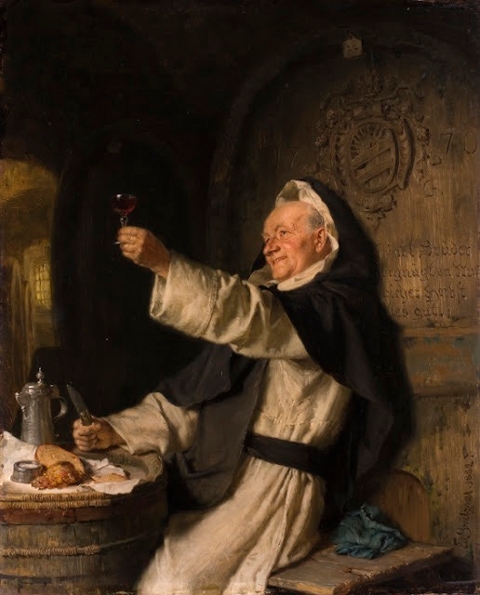


Although the purpose of the Catholic Church is to bring souls to Heaven, she has also made life here on earth more pleasant in a number of ways. Consider the following:

Wine predates Christianity by centuries, but it was monks who largely preserved viniculture during the Middle Ages. Religious orders such as the Benedictines and (later) Jesuits became expert winemakers; many only quit because their lands in Europe were confiscated by the modern State in the name of secularization.

Pressed by the duty to celebrate the Eucharist, Catholic missionaries brought their knowledge of vine-growing with them to the New World. Wine grapes were first introduced to California by Blessed Junipero Serra and his Franciscan brethren, and the rebirth of the California wine industry after Prohibition was thanks in large part to a chemistry teacher and LaSalle Christian Brother named Brother Timothy. There are similar stories about the origins of vineyards in Argentina and Australia. The Jesuits, for instance, founded the oldest winery in South Australia’s Clare Valley when they purchased 100 acres of land in 1851 and planted a vineyard to make sacramental wine. Named Sevenhill Cellars after the seven hills of Rome, the operation is still supervised by a Jesuit with the title of Winemaker and produces “notably sturdy Cabernet Sauvignons of high colour, huge flavor and long life.”

Pious men not only preserved and promulgated oenology; they also advanced it. The méthode champenoise was invented by a Benedictine monk whose name now adorns one of the world’s finest champagnes: Dom Pérignon. According to the story, when he sampled his first batch, Perignon cried out to his fellow monks: “Brothers, come quickly. I am drinking stars!” Monks and priests even found new uses for the grape. The Jesuits, for instance, are credited with improving the process for making grappa in Italy and pisco in South America (both of which are grape brandies).

Similarly, although beer may have been invented by the ancient Egyptians, it was perfected by the medieval monasteries that gave us modern brewing as we know it: one saint (Arnold of Soissons) has even been credited with inventing the filtration process. To this day, the world’s finest beer is made within the cloister—specifically, within the cloister of a Trappist monastery. Other orders, such as Carmelites and the Paulaner monks, have contributed very fine beers as well.

Equally impressive is the Catholic contribution to distilled spirits. Whiskey was invented by Irish monks, who probably shared their knowledge with the Scots during their missions. Chartreuse, the world’s most magical liqueur, was perfected by Carthusian monks and is still made by them. Bénédictine D.O.M. was invented by Dom Bernardo Vincelli to “fortify and restore weary monks.” Frangelico, which today comes in a brown bottle shaped like a monk, was invented by a hermit of that name during his solitude by experimenting with various nuts, herbs and berries he had gathered. Rompope, a kind of Mexican eggnog, was invented by nuns in Mexico when it was still a Spanish colony. Maraska liqueur was invented by Dominican apothecaries in the early sixteenth century.

A Threefold Cause?

Given that there are indeed historic ties between the Catholic Faith and alcohol, the next relevant question is why? Why would a religion dedicated to otherworldly bliss get involved with such an earthly (and potentially immoral) delight?

There are, in my opinion, three reasons. First, the economic and social conditions were right for it. Medieval monastic communities possessed all of the qualities necessary for the production of beverages such as wine and beer. They had vast tracts of land for planting grapes or hops, and they had an economic incentive to produce goods that could earn income for their order. Moreover, a monastery has great institutional stability with a long, inter-generational memory and a respect for tradition; it has a facility for teamwork and for collaboration; and it has a commitment to excellence in all that it does. The last point is especially important: the Benedictine motto Ora et Labora (Work and Pray) encourages the believer to see all of his work as a prayer to God. When you apply this principle to beer, the results are outstanding.

Second, to promote bodily health. Because we live in an age where we are told to drink eight glasses of water a day and to be careful about the health effects of too much alcohol, it is easy to forget that for most of human history, clean water was something of a rarity. Water sources often carried dangerous pathogens, and so as a remedy, small amounts of alcohol would be mixed with water to kill the germs therein. Roman soldiers were given a daily allowance of wine, not for them to get drunk, but so that they could purify whatever water they found on campaign.

During the Middle Ages, “small beer” was beer low in alcohol that was consumed by women, children, and manual laborers. (Again, it contained just enough alcohol to kill bacteria but not enough to make you tipsy.) The bishop-saints Arnulf of Metz and Arnold of Soissons are both credited with saving their flock from the plague because they admonished them to drink beer instead of water.

Alcohol also served as a medicine. In the New Testament, St. Paul admonishes St. Timothy to drink wine for his stomach problems (1 Tim. 5:23). Centuries later, distilled spirits such as whiskey would be developed by monks because of their medical use. The first written mention of whisky, which is Gaelic for “water of life,” is as a cure for “paralysis of the tongue.” Apparently it works, too, for no Irishman since has been accused of being tongue-tied.
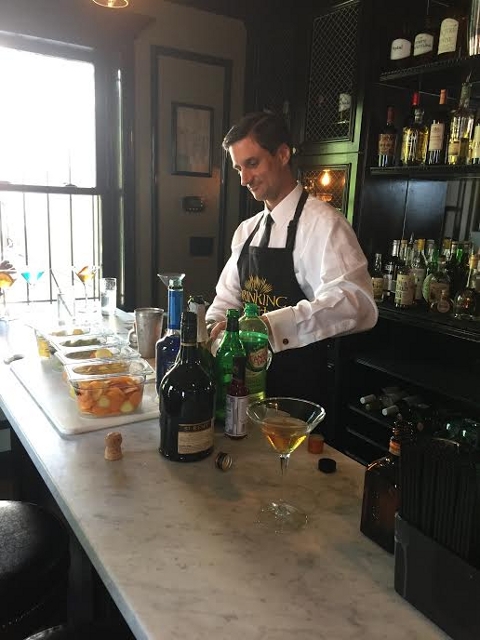


The author, plying his avocational trade

Other spirits, such as chartreuse, were produced as a vegetable elixir to aid one’s health. The original version by the Carthusian order had a high proof of 138 (69% alcohol). When the monks discovered that their product was being used recreationally, they lowered the proof to 110, thereby giving us green chartreuse as we now know it. Chartreuse continues to be used medicinally, starting with the Carthusians themselves, who take a tablespoon of it instead of cough medicine when they catch a cold.

Even beer was used as a vitamin supplement. Beer’s nickname in the Middle Ages was “liquid bread” because of its nutritional value. The beer known as doppelbock, which is rich in carbohydrates, calories and vitamins, was invented specifically for the season of Lent to compensate for the fast by the Paulaner monks in Munich. It is said that they gave up all food during this penitential season and lived entirely on their beer. Named Salvator after our Savior, Paulaner doppelbock is still produced today.

Third and most importantly, alcohol is “sacramental” in both senses of the word. As we already noted, wine is the matter for one of the seven canonical sacraments. With his customary mastery, St. Thomas Aquinas offers several compelling reasons why wine, along with bread, was most likely chosen by the Son of God to become the Eucharist. Since this sacrament “avails for the defense of soul and body” (I Cor. 11:20), we may think of Christ’s body in the species of bread offered for the health of the body, and Christ’s blood in the species of wine offered for the health of the soul, since according to Leviticus 17:14, “The life of all flesh is in the blood.”i

Further, like bread, wine is an apt symbol of the Church and of the effect of the Eucharist on the Church as a whole, for just “as bread is composed of many grains, and wine flows from many grapes,” “We being many are [made] one body” (see I Cor. 10:17).

Finally, “wine from the grape is more in keeping with the effect of this sacrament, which is spiritual; because it is written (Ps. 103:15): ‘That wine may cheer the heart of man.’” In other words, the Eucharist cheers the soul of man like wine cheers his heart. Let us reflect on this reason for a moment. Why is wine associated with cheer more than bread? Is it not because it contains alcohol, which in moderation raises man’s spirit, rendering it more cheerful? According to Aquinas, then, wine was in part chosen to be the matter of the sacrament precisely because of its inebriating effect, not despite it.

Second, wine—along with other forms of alcohol—are loosely “sacramental” insofar as they act as “divine signs” (sacramenta) reminding us of the goodness of God’s creation and His providential care over us. As St. Arnulf of Metz put it: “from man’s sweat and God’s love, beer came into the world.” Or consider the following statement made by the monks from the Monastero San Benedetto in Norcia, Italy, a Benedictine community that celebrates the traditional liturgy and that recently began to produce its own beer: 

[We] have sought to share with the world a product which came about in the very heart of the monastic life, one which reminds us of the goodness of creation and the potential that it contains…. The project of the monastic brewery was conceived with the hope of sharing with others the joy arising from the labor of our own hands, so that in all things the Lord and Creator of all may be sanctified. 

Such a positive attitude is even endorsed by the formal worship of the Church. Note the italicized sections of the following blessings, taken from the Roman Ritual:

Lord, bless this creature beer, which by your kindness and power has been produced from kernels of grain, and let it be a healthful drink for mankind. Grant that whoever drinks it with thanksgiving to your holy name may find it a help in body and in soul. (Blessing of Beer)

Lord, Jesus Christ, Son of the living God, who in Cana of Galilee changed water into wine, be pleased to bless and to hallow this creature, wine, which you have given as refreshment for your servants. And grant that whenever it is taken as drink or poured into wounds it will be accompanied by an outpouring of grace from on high. (Blessing of Wine for the Sick).

God, who in creating the world brought forth for mankind bread as food and wine as drink, bread to nourish the body and wine to cheer the heart; who conferred on blessed John, your beloved disciple, such great favor that not only did he himself escape the poisoned potion but could restore life by your power to others who were dead from poison; grant to all who drink this wine spiritual gladness and everlasting life. (Blessing of Wine on the Feast of St. John the Evangelist).

Application

At this point we are in a position to ask what all of this means for our own use of alcohol in today’s day and age, when many of the historic reasons for a Catholic endorsement of the bottle may no longer apply. Thanks to modern water treatment plants, safe, clean water in our society is plentiful; and the majority of today’s alcohol manufacturers are secular concerns that are driven by profit rather than prayer, even when they tout a “monastic” product such as Bénédictine D.O.M. or an “abbey ale.” Finally, the modern pharmaceutical industry offers a dazzling array of medicinal solutions to man’s ailments.

Despite these important developments, however, alcohol retains its sacramental value as a divine sign of God’s love for us for which thanksgiving and moderation are the appropriate answer: In Chesterton’s immortal words, “We should give thanks to God for beer and burgundy by not drinking too much of them.” A recognition of the goodness of God’s physical creation in the form of alcohol produces wonder and gratitude, and this cheerful gratitude, especially in fellowship with others, is a hallmark of an authentically Catholic culture. 
 
Think of the Mediterranean countries where food and wine (and an aperitivo and digestivo thrown in for good measure) are not occasions for abuse but for drawing closer to family and friends. To this day, when you see a drunk in the streets of Italy, it is usually an American or north German tourist. The old American Protestant culture, especially in some parts of the South, produced a schizophrenic attitude towards alcohol according to which you were either a teetotaler or a dipsomaniac. Catholic cultures, on the other hand, produced well-balanced gourmands even on the level of the peasantry. Hence the poem penned by Hillaire Belloc:

Wherever the Catholic sun doth shine,
There’s always laughter and good red wine.
At least I’ve always found it so.
Benedicamus Domino!

Drunkenness Condemned

It is important, then, to distinguish between the moderate use of alcohol and drunkenness, which is potentially not only a mortal sin but the occasion of additional falls from grace. St. Ephrem the Syrian, for instance, composed an impassioned hymn about Noah’s inebriation in which he warns chaste maidens about the power of wine to take away their virtue.

Beware of Wine in that it disgraced Noah the precious;
He that had conquered the Deluge of water was himself conquered by a handful of wine;
The Flood that was outside him did not overcome him, but the wine that was within him in silence did steal.
If wine disgraced and cast down Noah, the head of families and tongues, forsooth, O lonely one, how it will conquer thee!

Understandably then, while the Bible makes generally favorable mention of wine and strong drink, it consistently condemns drunkenness. And the same is true for Church teaching.

Interestingly, many of the saints drank very little alcohol while some drank none. As St. Thomas Aquinas explains, for most people, in order to gain the wisdom that is sufficient for salvation, it is only necessary to abstain from the immoderate use of wine. But for certain persons, he continues, “it is requisite… that they abstain altogether from wine,” depending on the circumstances.

Usually, when a saintly soul abstains from alcohol, it is as a form of penance or mortification. Such self-denial, it should be noted, is an implicit affirmation of the goodness of alcohol. In a delightful essay called “Fish on Friday,” Fr. Leonard Feeney explains that weekly abstinence from flesh meat pays an “enormous compliment” to meat “by considering its absence from our table to be a hardship.” He continues: “One does not offer God by way of penance what one thinks is bad but what one thinks is good. And nobody really understands how good meat is until he tries going without it one day a week.”ii

This logic applies to other ascetical acts as well: clergy and religious, for example, take vows of celibacy not because sexual intimacy and family are evils to be avoided but because they are goods to be missed for the sake of a higher calling. And the same logic applies to abstinence from strong drink. In Mormon teaching, alcohol and caffeine are believed to be harmful to the body, which is why God allegedly gave “a law of health” to Joseph Smith in 1833 forbidding their use. But for the Catholic, alcohol is a medicine that gladdens the heart of man. While the Mormon believer abstains from alcohol because it is bad, the Catholic ascetic abstains from alcohol because it is good.

Bad Teetotaling

One of the interesting implications of this line of thought is that just as there can be bad forms of drinking, there can also be bad forms of abstinence. St. John Chrysostom had to deal with a heretical group which held that alcohol was evil. The great Greek Father’s response was crystal clear: in denying the goodness of wine, you are calling St. Paul and the Holy Spirit liars, and therefore you should receive a sound thrashing:

In writing to Timothy, [Paul] bid him take refuge in the healing virtue of wine-drinking. Not that to drink wine is shameful. God forbid! For such precepts belong to heretics....
      And should you hear any one in the public thoroughfare, or in the midst of the forum, blaspheming God [by saying that wine is evil], go up to him and rebuke him; and should it be necessary to inflict blows, spare not to do so. Smite him on the face; strike his mouth; sanctify your hand with the blow, and if any should accuse you, and drag you to the place of justice, follow them thither; and when the judge on the bench calls you to account, say boldly that the man blasphemed the King of angels! For if it be necessary to punish those who blaspheme an earthly king, much more so those who insult God.iii

That’s right: sanctify your knuckles on anyone who tells you not to drink wine! Abstinence may be a moral obligation for some (e.g., alcoholics), but for others it can be a sin. If abstinence were to “molest nature grievously,” St. Thomas Aquinas writes, it “would not be free from sin.”iv The same is true if abstinence is a masked form of pride or a Manichean denial of the goodness of carnal existence and its potential to act as a conduit of heavenly grace. Jesus commended John the Baptist’s asceticism because he was doing so in anticipation of the Messiah; one must be careful not to abstain in priggish denial of the Messiah’s gifts to mankind.


Notes:
i Summa Theologiae III.74.1.
ii “Fish on Friday,” in Fish on Friday and Other Sketches (Sheed & Ward, 1934), p. 6.
iii Homilies on the Statues 1.7.
iv Summa Theologiae II-II.150.1.ad 1.

__________

Michael P. Foley, an associate professor at Baylor University, is the author of the recently published Drinking With the Saints: The Sinner’s Guide to a Holy Happy Hour (Regnery, 2015).  The present essay, "The Faith and The Drink," was first published in The Latin Mass: The Journal of Catholic Culture and Tradition, Vol. 24, No. 2 (Summer 2015), pp.38-41, and is reproduced here by kind permission of the publisher. 

Sunday, September 25, 2011

An Apology for the Confessional State


Crowning of Charlemagne


by James Tillman

There are perhaps but two views of the state's purpose. In the traditional view, the state helps men to some definite idea of perfection by inculcating virtue in them through good laws; such an ideal has been advanced by Aristotle, Aquinas, and various Popes. In the classical liberal view, the state allows men to pursue whatever they want by protecting their freedom of action; such an idea has been advanced by Locke and various Protestants.

The dispute between the two has nevertheless crept into Catholic circles, despite the church's historical preference for the traditional view of the state's purpose. In the middle of the previous century, for instance, American Catholics saw the conflict between John Courtney Murray, who through the American experiment in religious liberty to be a good thing, and the Roman Catholic Curia, which did not and which therefore silenced him. Later in the century, Frank Meyer, convert from Communism to secular conservatism, argued with Brent Bozell, convert to Catholicism and founder of the militant Catholic magazine Triumph, over whether government's ultimate end is promoting freedom or promoting virtue. Other modern Catholic figures have tried to reconcile the Church's teaching with principles amenable to the American mind. Notwithstanding the accusation that they reconcile only inasmuch as they obscure, such arguments have had a great deal of success.

It is not the purpose of this article to address these arguments.

Rather, it is to question a premise upon which the arguments have been based. For the argument over whether the state should promote some specific morality is founded upon the conviction that the state is able to not promote some specific morality. Agreement over the descriptive, therefore, founds disagreement over the prescriptive. I would like to question this agreement. I will argue that the state, in the course of its actual operation, must ultimately promote some specific idea of morality -- whether a secular ideal, a Protestant ideal, and Islamic ideal, or a Catholic ideal. It is impossible for it not to do so. Thus, debating whether the state ought to move men to a specific end is foolish: the state will do so, whether one wants it to do so or not. The question is only what sort of morality the state will promote.

This thesis may be very counter-intuitive; surely, most Americans will wish to plead, government is able simply to step back from issues of morality, religion, and man's final end? Why must these issues come into the laws in some way? More specifically, why cannot government simply limit itself to the protection of human rights, such as the right to life, liberty, and property?

If government does not pass laws to bring man to his good, government must aim laws at something else. In the classical liberal scheme, government passes laws meant to protect man's rights. The idea of secular government is therefore founded on both the existence of such rights and the enforceability of such rights by the government. The former is a very dubious proposition -- indeed, if rights do exist they would certainly seem not to be morally neutral things. In their modern form, rights historically sprang into being from anti-Catholic sources, as in the French Revolution's Declaration of the Rights of Man. But for now I will pass over whether rights exist and whether they are morally neutral and examine instead how these rights would be defended by a government that recognizes their existence.

Rights are meant to delimit a sphere of action, within which each individual may do what he wants and the bordrs of which government is supposed to protect. Under such a system, government does not look to whether property is used for good or for ill; it simply protects one's right to have it and use it. Government does not look to whether free speech spreads lies or truth; it simply protects one's ability/right to speak. Deliberation regarding laws centers on how best to protect the various rights, not onl whether laws will help men be better men. Like that of the Wiccans, the classical liberal motto is "If it harm none, do what ye will."

* * * * * * *
Everyone assaults everyone else with cries of intolerance. And everyone is right; everyone is intolerant. There can be no peace between those with different moralities, different ideas of human nature, and different ideas of God; the ideal of government as a neutral umpire has never existed and never can exist.

* * * * * * *

In reality, however, such an idea of rights cannot ultimately be enforced without appealing to a specific standard of morality and thus without enforcing a specific standard of morality. To see why government cannot enforce rights without an appeal to morality, we must examine a few rights in the concrete.

When such rights are examined, we find quickly that they are not absolute. Freedom of speech infamously does not give one the right to yell "Fire!" in a crowded theatre. Neither does it give one the right to put a sign on one's lawn advocating the lynching of African-Americans. The right to freedom of speech is outweighed by the right to life. The majority of cases, however, are not so clear. Does freedom of speech permit me to sell books advocating a subversive and Communist political philosophy? Does it permit me to sell books on how to conduct a coup d'état? Does it permit one to put up billboards quoting the Levitical laws against sodomy? Such cases are not easy to decide and will require significant prudential deliberation regarding the goods to be gained and lost by each course of action. In each case the so-called "right" to freedom of speech is clearly not an absolute right; those who make decisions do not make them based upon clear and unambiguous laws, but upon prudential weighing of the various goods involved.

Similarly, the right to freedom of religion requires prudential decision-making. Some religions involve smoking marijuana; others involve polygamy; others involve the execution of those who decide to leave that religion and the establishment of a world-wide theocracy beneath religious law. Such religions may be offensive to Catholics, just as the Catholic religion is offensive to those who believe that it teaches people to hate homosexuals, that it represses man's natural instincts, that it advocates the subjugation of women, or that it leaves one ultimately loyal to a monarch in the Vatican rather than to the United States. When government decides what sort of religion to allow and to what extent to allow it, then it does not simply take into account the right to religious freedom; one also takes into account a host of other moral evaluations regarding the importance of various goods. Similar instances might be given as regards education, the right to private property, and so on and so forth.


Pope Leo XIII

* * * * * * *
The Popes in the nineteenth and early twentieth century tried to keep men from giving up the fight for Christ's social reign, but their efforts failed. The secular state triumphed, in which a secular, humanistic morality is used as a basis for the laws, in which the Church is marginalized and forced to conform to rules that effectively muzzle and tame it, and in which men's loyalties are but nominally to the church and really for their government or careers.

* * * * * * *

Thus, in all cases the so-called rights to which people appeal are not absolute guidelines for government; they are simply things often considered good, which must be weighed and curbed when they interfere with other good things. Is freedom of speech more important than the harm caused by racism? Is it more important than the offense caused by Christian teaching on homosexuality? Is it more important thatn the injury to the innocence of children caused by indecent advertisements? Such decisions cannot be rationally evaluated unless one appeals to a specific, concrete, moral ideal; and so, the decisions and actions of government cannot be rationally evaluated unless one appeals to a specific, concrete, moral ideal; and so, the decisions and actions of government cannot be morally neutral. Whether those in government think religion to be important, think Catholicism to be true, think the family to be important, or think a thousand other things will alter their decisions as they weigh all the various variables involved in deciding upon a specific course of action. Government's action must therefore always favor one moral scheme above another.

Nor is it simply in controversial, high-profile issues that government must take into account various moral ideals. Consider tax laws. Government often taxes corporations at lower rates than it taxes the family; furthermore, corporations are generally taxed on the profits that they make -- on their sales minus expenses -- rather than simply on gross income. On the other hand, families are taxed on gross income without regard for the expenses the family incurs. Such laws favor the production of stuff rather than the production and raising of children; and while both are necessary to the economy, each is necessary in different ways and to different degrees. One might argue that the government's policy is just or is unjust, but in any event such argument would probably refer to the relative importance of the family and the corporation, the benefits of small-scale versus large-scale production, distributism and capitalism, and other moral issues. Even the blandest of governmental decisions, therefore, involve moral evaluation.

Consider, again, the government and the mandatory education of children. Few would disagree that children ought to be educated. Yet evaluating whether the government should mandate some sort of education and what the content of that mandated education should be; whether the government provide public schools and what the curricula of such schools should be is anything but a morally neutral affair: it involves one's idea of the relation of parents to children, the permanence and role of the family, the relative importance of the family and government, and even the differential treatment of men and women in society. To act on such an issue is to give an opinion on it: to mandate the public education of children unless parents meet certain stringent governmental requirements, for instance, is to rule that children are in some ways more the responsibility of government than of parents -- and thus that government ought to have more control over them. A morally neutral argument can be nothing but a farce under such circumstances.

The impossibility of governmental neutrality contributes to the often shrill accusations of bigotry flung from side to side in the current day. Homosexual activists accuse Christians of trying to impose their morality on others; Christians accuse homosexuals of trying to impose their views on school children; television advertisers accuse Christians of censorship while Christians accuse them of corrupting the youth; everyone assaults everyone else with cries of intolerance. And everyone is right; everyone is intolerant. There can be no peace between those with different moralities, different ideas of human nature, and different ideas of God; the ideal of government as a neutral umpire has never existed and never can exist. The classical liberal ideal of a government indifferent to man's final end seemed possible only because of the mostly Christian consensus found in the first liberal governments; the cracks cause by disagreement were few and far between and easily disguised. Yet centuries of secularity have done their work, and religious pluralism has introduced beliefs yet more and more divergent. The façade can no longer be maintained. The state cannot be neutral: one's own moral system must reign in it, or one will be crushed by that of another.

* * * * * * *
Inasmuch as the Republican -- or even the Democrat -- agenda agrees witht he Catholic, to that extent they can be made temporary allies; but we must never mistake such an alliance for a friendship. There is no agenda for the Catholic but the Catholic agenda ...

* * * * * * *


In light of this fact one must applaud the wisdom of the Church, which condemned the ideas of liberalism from its start. The Syllabus of Errors of Blessed Pius IX condemns the idea that "the Church ought to be separated from the State, and the State from the Church"; it condemns the idea that "in the present day it is no longer expedient that the Catholic religion should be held as the only religion of the State, to the exclusion of all other forms of worship." When one ceases trying to wrench society towards a state in which God and His rule is recognized, society must slide towards a denial of God and His rule. The Popes in the nineteenth and early twentieth century tried to keep men from giving up the fight for Christ's social reign, but their efforts failed. The secular state triumphed, in which a secular, humanistic morality is used as a basis for the laws, in which the Church is marginalized and forced to conform to rules that effectively muzzle and tame it, and in which men's loyalties are but nominally to the church and really for their government or careers.

The current political spectrum distorts this necessary conflict; it causes us to pretend that it can be sidestepped. Members of the Republican Party and members of the current Tea Party cry for government to cease its crawling -- and occasionally sprinting -- socializing of medicine and business, and inasmuch as they do so they are good. But will they admit that education cannot be neutral, and that our current concept of government-run education is flawed? Will they admit that the right to private property includes no right to sell products that help destroy family and society? Will they admit the principle of subsidiarity and admit that local communities need their power increased greatly, just as the federal and state governments must be shrunk? Inasmuch as the Republican -- or even the Democrat -- agenda agrees witht he Catholic, to that extent they can be made temporary allies; but we must never mistake such an alliance for a friendship. There is no agenda for the Catholic but the Catholic agenda, which would require decades of unremitting effort for its realization and which would require men to transcend most of the issues currently dividing political parties. The Catholic agenda requires us to admit what the rest of society yet hypocritically denies -- that between rival moral theories there can be no peace.

Catacombs or Christendom? Society slides and wavers between the two; but there can be no third way.

[James Tillman is a Catholic Journalist and graduate of Christendom College. The present article, "An Apology for the Confessional State," was originally published in The Latin Mass: A Journal of Catholic Culture and Tradition, Vol. 20, No. 1 (Winter 2011), pp. 60-63, and is reprinted here by kind permission of Latin Mass Magazine, 391 E. Virginia Terrace, Santa Paula, CA 93060.]

Thursday, December 30, 2010

Fish on Friday: The One That God Away


Still Life with Fish by Edouard Manet


By Michael P. Foley

One of the most recognizable markers of Catholic identity used to be the practice of abstaining from meat on Friday. A Protestant colleague of mine speaks admiringly of how in his youth he would hang out, Happy Days style, at a burger joint on Friday night. When the clock struck twelve, the Catholic teens who were there would let loose a cry that echoed through the parking lot: “Ham-burger!”

What those teenagers didn’t know was that they were honoring a discipline probably as old as Christianity itself. Abstaining on Friday from “flesh meat,” the meat of a warm-blooded animal, is potentially older than some books of the New Testament.1 Be it with fasting (having little or no food) or abstaining (refraining from food of a particular kind), the Church has always observed Friday with some sort of restriction on comestibles.

Broader Impact

Friday abstinence has also had a ripple effect going far beyond its primary aim of personal sanctification. Contrary to wild theories about medieval fishermen lobbying the Church to create Friday abstinence, it was Friday abstinence that helped create the medieval fishing industry.2 Professor Brian Fagan claims that the Church’s Friday discipline may have even led to the discovery of the New World, spurring Atlantic fishermen to push further westward in search of better waters and providing navigational precedents for Christopher Columbus.3 By pushing the borders of the known world, Friday abstinence not only put fishing on the map, it helped make the map itself. Friday and Lenten abstinence prompted medieval monasteries to pioneer new techniques in pisciculture, including artificial fish ponds and artificial fertilization.4 It was a Catholic nun who wrote the first fishing manual in English and a Catholic priest who invented the first spinning reel.5

Nor has only distant history been affected by this ancient custom. Restaurants typically have a Friday seafood special of the day or a soup du jour such as clam chowder because of the power that Catholics once wielded as a united front. Even titans of global uniformity like McDonald’s were forced to take notice. The Filet-o-Fish sandwich was added to its menus in 1962 after Louis Groen, owner of the chain’s Cincinnati franchises, noticed that his restaurants experienced a sharp drop in sales every Friday. Even today, of the 300 million Filets-o-Fish sold annually, 25% of those sales come from the forty days of Lent.


* * * * * * *
So strong was the American association of Catholics with fish on Friday that “mackerel snapper” was once a common
epithet for papists.


* * * * * * *
Everyday language has been affected as well. So strong was the American association of Catholics with fish on Friday that “mackerel snapper” was once a common epithet for papists. “Meager” refers to something that has little flesh, and so the word came to be applied to days of total or partial abstinence in the Church calendar. A soup-maigre or “meager soup” was one that was not made from flesh meat or meat broth and was consequently suitable for “meager days,” while to “make meager” meant eating food appropriate for meager days.6

Of course, one of the curious things about all of these effects is that Catholics don’t have to eat fish on Fridays. This is a point impishly brought home in an essay by Fr. Leonard Feeney.7 “I am one of those moderately good Catholics,” Feeney writes, “in whom the persuasive power of Canon Law has not developed a taste for fish either on Friday or any other day, and stands no chance of doing so.”8 For Feeney, the reputation of Catholics as a queer sort of “Sixth Day Adventists” is a badge of honor to be worn in cheerful defiance of Protestant America.

Another mackerel snapper, renowned anthropologist Mary Douglas, agrees. Douglas sees in the rule of Friday abstinence “allegiance to a humble home in Ireland and to a glorious tradition in Rome.”9 These allegiances, she continues, are particularly important for a humiliated class. “At its lowest,” Douglas writes, Friday abstinence for a “bog Irishman” meant “what haggis and the pipes mean to Scots,” and at its most, “it means what abstaining from pork meant to the venerable Eleazar as narrated in 2 Maccabees.”10 One wonders if the Church in Ireland and America today, which in both countries is being humiliated by the savagery of the press and the corruption of some of its clergy, is not in need of a similar morale-boosting sign of allegiance.

Exceptions Curious and Quaint

Fr. Feeney also remarks: “if we dared tell non-Catholics the number of reasons which will legitimately permit us to eat meat on Friday, they would be scandalized.”11 There were numerous variations of the Friday rule based on local usage and the judgment of “intelligent and conscientious Christians.”12 Holy days such as Christmas trumped Friday abstinence, and Pope Pius XII, in order to relieve their overburdened refrigerators, allowed U.S. Catholics to eat meat the day after Thanksgiving. Special groups, such as travelers and soldiers, were occasionally exempted, and so were areas that either already had a seafood-rich diet or were smitten by epidemic or famine.

And sometimes whole peoples got a free pass. In 1089 Spanish counts were granted a dispensation from the Friday rule by Pope Urban II for their role in the Crusades; after the Battle of Lepanto in 1571, Pope St. Pius V extended the dispensation to the entire Spanish dominion, including her colonies in the New World. Mexico, for example, was not instructed by the Holy See to observe Friday abstinence until 1950, and the following year bishops in New Mexico and Texas informed their flock that this applied to them as well.13

And then there are the curious local substitutes. During Lent the people of Venezuela can eat capybaras, the world’s largest rodent, a fact that has inspired the following doggerel:
You’ll enjoy capybaras to eat;
Venezuelans proclaim them a treat.
Those of Catholic bent
May consume them for Lent
If a fine rodent burger’s their meat.
Writing about the year 1188, Giraldus Cambrensis remarks that in “Germany and the arctic regions,” beavers’ tails are eaten during times of fast by “great and religious persons” because of their resemblance to fish meat.14 This practice was carried to parts of the New World, especially Canada. Jesuit missionaries wrote to Rome to verify that the custom was permissible. Rome replied that not only were beavers allowable but so were most amphibious animals and even some species of wild duck.15

* * * * * * *

... some Michiganders have the dubious privilege of dining on muskrat for their Friday and Lenten observances. ... the bishop added: “Anyone who could eat muskrat was doing penance worthy of the greatest of the saints.”

* * * * * * *

In the United States, some Michiganders have the dubious privilege of dining on muskrat for their Friday and Lenten observances. Several Catholic communities in the Wolverine State have claimed a dispensation to eat the aquatic rodent since the days of the French trappers. In 1987, Bishop Kenneth Povish of Lansing wrote that although such a permission could not be found in the Church’s records, the practice had been around for so long that it could continue as an “immemorial custom.” And there was another reason to allow it, the bishop added: “Anyone who could eat muskrat was doing penance worthy of the greatest of the saints.”16

The Law No One Knows

After Vatican II Pope Paul VI took up the question of Friday abstinence in his 1966 Apostolic Constitution Paenitimini. The document masterfully reaffirms the traditional theology of penance and abstinence, and it resolves a longstanding inconsistency about which feast days should supersede Friday abstinence.17 But Paenitimini also announces the Pope’s goal of reorganizing “penitential discipline with practices more suited to our times.”18 Even so, Friday abstinence was explicitly reaffirmed.19

In November of the same year, the U.S. bishops responded to the call for reorganization with a “Pastoral Statement on Penance and Abstinence.”20 Whereas American Catholics were hereby released from a strict obligation under pain of sin to keep Friday abstinence, the bishops emphasized that Friday was still a mandatory day of penance: indeed, they wrote eloquently of Friday as a mini-Lent in the same way that Sunday is a “weekly Easter.”21 And they made it clear: “We give first place to abstinence from flesh meat. We do so in the hope that the Catholic community will ordinarily continue to abstain from meat by free choice as formerly we did in obedience to Church law.”22 The 1983 Code of Canon Law would later codify this teaching by stating that: Friday is an obligatory day of penance and abstinence is the standard form of Friday penance, although other forms may be done instead.23


Clam Chowder Bread Bowl

* * * * * * *

Restaurants typically have a Friday seafood special of the day or a soupdu jour such as clam chowder because of the power that Catholics once wielded as a united front.

* * * * * * *

If this is the position of the Magisterium, then why has it failed so miserably, with the majority of the world’s Catholics ignorant of any obligation to do anything special on Friday? Certainly, the media’s mishandling of the 1966 news (which made glib remarks like “you won’t go to hell anymore for eating a hamburger on Friday” instead of reporting all the facts), the minimalist mindset of the faithful who were happy to be free of one less duty, and the failure of the clergy to catechize on the subject all played a part in the overnight disappearance of Friday abstinence.

But there may also be a more fundamental reason. The removal of a symbol, or in this case the removal of a law protecting a symbol, can give the impression that the reality to which the symbol points is likewise being rejected. “To take away one symbol that meant something,” notes Mary Douglas,
is no guarantee that the spirit of charity will flow in its place….We have seen that those who are responsible for ecclesiastical decisions are only too likely to have been made, by the manner of their education, insensitive to non-verbal signals and dull to their meaning. This is central to the difficulties of Christianity today. It is as if the liturgical signal boxes were manned by colour-blind signalmen.24
And there are other complications. Paenitimini and Canon 1253, which allow an episcopal conference to designate other forms of penance such as works of charity for Friday, divorce for the first time in Church history Friday penance from food abstinence. Yet even this latitude is honored more in the breach than in the observance, for few episcopal conferences have made any decision about what form of Friday penance its flock may follow. The signalmen, it appears, have fallen asleep at the switch.

Confusion reigns even in the capitol of Christendom. When my father-in-law, who is a member of a pontifical academy, was invited to dine at the Vatican’s Casina Pio IV on a Friday night several years ago, he and the other guests were served horse meat!


* * * * * * *

Pope Pius XII, in order to relieve their overburdened refrigerators, allowed U.S. Catholics to eat meat the day after Thanksgiving.

* * * * * * *

Abstaining from the Alternatives

Regardless of the available options, there are at least seven reasons to keep the traditional sixth-day penance:
  1. It is corporate. Having everyone do his own form of penance lacks the marvelous unity of almost the entire Catholic world performing the same act on the same day. This is not only spiritually constructive, it is socially edifying, building up solidarity and deepening our awareness of joint membership in the mystical Body of Christ.

  2. It is ancient. A single practice unites all the living, but when it is ancient it also unites them to their forebears. If tradition is, as Chesterton put it, the democracy of the dead, then Friday abstinence is the veritable apple pie of Catholic life. In the words of the American bishops in 1966: We show “out of love for Christ Crucified…our solidarity with the generations of believers to whom this practice frequently became, especially in times of persecution and of great poverty, no mean evidence of fidelity to Christ and His Church.”25

  3. It is testimonial. Friday abstinence bears powerful witness to the distinctiveness of the Church. My Protestant friend whom I mentioned earlier knew little about Catholics when he was young, but he knew they stood for something when he watched his papist peers exercise self-discipline even away from the watchful eyes of their parents.

  4. Abstinence is efficacious. Ancient authors taught that abstinence from food and drink was useful in dampening “the ardor of lust.”26 Bodily passions are not bad per se, but left untrained they can become the occasion of sin. Trimming the body’s food intake, as modern studies have confirmed, can lower lustful proclivities.27

  5. Abstinence is appropriate. The Church still teaches that every human being is required to do penance by virtue of divine law (Can. 1249), and Friday abstinence is an especially appropriate way to do this. It was on a Friday in Eden that Adam and Eve transgressed the first law of abstinence.28 And, of course, it was on a Friday that our Lord was crucified in order to undo the effects of that transgression. It is therefore appropriate to make abstinence our Friday penance, in sober memory of the Fall and “in prayerful remembrance of the passion of Jesus Christ.”29

  6. Abstinence from meat is particularly appropriate. Catholicism ingeniously teaches both through presence and through absence. Usually, the Church employs physical signs to convey invisible realities; but sometimes, she temporarily withdraws something as a way of arresting our attention and heightening our awareness of what is missing.

    Hence, the suppression of the Alleluia during Septuagesima and Lent effectively demonstrates that we are in exile from our true Home, where the angels sing Alleluia without ceasing. Veiling sacred images in church during Passiontide — when we would most expect to gaze upon a crucifix — paradoxically heightens our awe of Christ’s Passion. And prohibiting the sacrifice of the altar on Good Friday draws us in an inverted way to the sacrifice of the cross made that day.

    Similarly, when we “make meager,” we withdraw from our table the flesh of an animal whose blood was shed for us on the day in which the Blood of the God-man was shed for us.30 The absence of the former paradoxically reminds us of the latter; not having a bloody victual backhandedly alerts us to the Bloody Victim.

  7. It is Christ-like. Jesus Christ consumed nothing on Good Friday except the gall He tasted shortly before His death. With fasting or abstinence on the day of the Crucifixion, Catholics in some small way “suffer with Christ that they may one day be glorified with Him. This is the heart of the tradition of abstinence from meat on Friday.”31
Conclusion

How the Church can best recover its former Friday integrity remains an open question.32 In the meantime, there is ample reason to fulfill Paul VI’s and the American bishops’ 1966 wish that what was once done in obedience be now done by free choice. The weekly abstinence from flesh meat is rich in history and meaning, bringing us closer to God and to each other. Living the Catholic tradition, even on days of deprivation, is anything but a meager existence.

Postscript: Since Ireland has been a leitmotif in this article, it is fitting to add that in response to the horrific abuse scandals decimating the Catholic Church in that country, Pope Benedict XVI has asked its faithful to offer their Friday penance from now until Good Friday 2011 for God’s mercy.33 Those of us who owe our blood or our faith to the sons and daughters of St. Patrick might wish to do the same.

Notes

  1. The custom of fasting on Friday is mentioned in Didache 9, a book believed to have been written around A.D. 75. [back]

  2. Brian Fagan, Fish on Friday: Feasting, Fasting, and the Discovery of the New World (Basic Books, 2007), pp. 25ff. [back]

  3. Ibid. [back]

  4. Michael P. Foley, Why Do Catholics Eat Fish on Friday? (Palgrave Macmillan, 2005), p. 111. [back]

  5. See Foley, pp. 46, 69, and 109, resp. [back]

  6. Meagre/Meager, adj. and n.," Oxford English Dictionary, A.3. and B.2. [back]

  7. Leonard Feeney, S.J. "Fish on Friday," in Fish on Friday and Other Sketches (Sheed & Ward, 1934), pp. 3-16. [back]

  8. Ibid., p. 3. [back]

  9. Mary Douglas, Natural Symbols: Explorations in Cosmology (Routledge, 1996), p. 37. [back]

  10. Ibid., pp. 37-38. [back]

  11. Feeney, p. 6. [back]

  12. J.D. O'Neill, "Abstinence," Catholic Encyclopedia, 1907. [back]

  13. See "Friday Abstinence," in the Religion section of Time Magazine, June 18, 1951. [back]

  14. The Itinerary of Archbishop Baldwin through Wales, 2.3. [back]

  15. Daniel Wilson, "Early Notices of the Beaver in Europe and North America," in the Canadian Journal of Industry, Science, and Art (1849-1914), Vol. 4, p. 386. The scoter, for example, was consumed on Friday in parts of France (see Alexander Wilson and Charles Lucian Bonaparte, American Ornithology, Vol. 3 [Constable and Col, 1831], pp. 212-13). [back]

  16. Kristin Lukowski, "Muskrat love: A Lenten Friday delight for some Michiganders," CNS News, March 8, 2007. [back]

  17. Prior to Vatican II, only holy days of obligation suspended abstinence from flesh meat on Friday. The problem with this arrangement was that different nations had different days of obligation. The difficulty was resolved by giving all [first class] solemnities in the universal calendar priority over Friday penance. [back]

  18. III.C. [back]

  19. Chapter 3, II.2. [back]

  20. National Conference of Catholic Bishops, "Pastoral Statement on Penance and Abstinence," November 18, 1966. This is an outstanding document. [back]

  21. Ibid., 23. [back]

  22. Ibid., 24. [back]

  23. See Canons 1251-1253. [back]

  24. Douglas, p. 42. [back]

  25. "Pastoral Statement," 24a. [back]

  26. See Saint Jerome, Against Jovinian 2.6; Saint Thomas Aquinas, Summa Theologiae II-II.147.1. [back]

  27. Flesh meat, for instance, is high in zinc, which raises testosterone levels. For a summary of modern dietary research, see Theresa M. Shaw, Burden of the Flesh (Augsburg Fortress Publishers, 1998), pp. 126-27. [back]

  28. Adam and Eve sinned on the same day they were created when they ate the fruit from which they were commanded to abstain. Dante gives the First Couple about six hours in Paradise before they were expelled. [back]

  29. "Pastoral Statement," 23. [back]

  30. Cold-blooded animals such as fish and amphibians also "shed their blood for us" when we use them as food, but because of the similarity of our physiology to that of other warm-blooded animals, our symbolic association with the latter is greater. [back]

  31. "Pastoral Statement," 18. [back]

  32. For an interesting discussion on this, see Father John Zuhlsdorf's blog for April 23, 2009, at http://wdtprs.com/blog/2009/04/kicking-it-up-a-notch-our-catholic-identity-fr-z-rants/. [back]

  33. Pope Benedict XVI, "Pastoral Letter of the Holy Father Pope Benedict XVI to the Catholics of Ireland," no. 14, March 19, 2010. [back]

Michael P. Foley, an associate professor of Patristics at Baylor University, is author of Why Do Catholics Eat Fish on Friday?: The Catholic Origin to Just About Everything (Palgrave Macmillan, 2005) and Wedding Rites: A Complete Guide to Traditional Vows, Music, Ceremonies, Blessings, and Interfaith Services(Eerdmans, 2008). Dr. Foley's article, "Fish on Friday: The One That Got Away," Latin Mass: The Journal of Catholic Culture and Tradition Vol. 19, No. 3 (Summer/Fall 2010), pp. 42-46, is reproduced here by kind permission of Latin Mass, 391 E. Virginia Terrace, Santa Paula, CA 93060, and the author.

Friday, January 15, 2010

How the Old Mass Shaped the New World


By Michael P. Foley

The fortieth anniversary of the Novus Ordo is a few weeks away, as it was Pope Paul VI’s wish that his new form of the rite take effect on the first Sunday of Advent in 1969.1 While the Pauline Missal was not published until the following year (and its translations much later), this date is as good as any to reflect on a momentous change to the Roman Church’s worship. Because forty is the biblical number for a generation, I would like to devote this column to a reflection on what we may have subsequently lost, not theologically or spiritually, but culturally. My point of departure is a brusque statement from Doctor John Senior: “from the cultural point of view, the new Catholic Mass established in the United States has been a disaster.”2 What could Senior have meant by such a harsh conclusion, and is there any justification for his opinion?

Sacrifice and Civilization

To understand Senior’s position, we must first surmise his view of Western culture:
Whatever we do in the political and social order, the indispensable foundation is prayer, the heart of which is the Holy Sacrifice of the Mass, the perfect prayer of Christ himself, Priest and Victim, recreating in an unbloody manner the bloody, selfsame Sacrifice of Calvary. What is Christian Culture? It is essentially the Mass. That is not my or anyone’s opinion or theory or wish but the central fact of two thousand years of history. Christendom, what secularists call Western Civilization, is the Mass and paraphernalia which protect and facilitate it.3
Senior goes on to describe the Mass as emanating outwards to all aspects of life. What is done on a stone altar inspires the construction of a beautiful church. The church inspires a garden and clerics to tend the church and the people who flock to it. Next to the church and the garden is built a cemetery for those who died as faithful servants of what is done on that altar; and around the church-grounds people build their houses and sow their fields, until a community is formed. That community needs laws, and the laws cannot help but be influenced by the sense of justice that radiates from the center of its citizens’ lives. And before you know it, you have a Christian world built around the Mass.

What Senior calls the “central fact of two thousand years” can indeed be confirmed in the history of several towns and cities in Europe, the most famous of which is Munich, Germany, which honors the Benedictine abbey that led to its creation with its very name, Munchen or Munich being German for “monk.” Nor is this a phenomenon unique to the Middle Ages. Fittingly, it is being enacted by several of John Senior’s former students who converted to Catholicism and became Benedictine monks observing the traditional Roman rite. At the invitation of the local bishop, they founded Clear Creek Monastery in a remote corner of Oklahoma ten years ago, and already neighboring lands are being bought and developed by lay Catholics as the monks build a Romanesque church they wish to last a thousand years. If you want to see how the new West, the West not of ancient Greece and Rome but of Christian Europe, became the most astounding civilization in the history of the world, take a trip to rural Oklahoma.

And if you want to know why, then consider more closely the nature of Christianity. As Father Frederick Faber points out, Christianity is “eminently a religion of sacrifice,” and hence, he says, "Where there is no Mass, there is also no Christianity.” Faber sees all of Christian life as an extension of the sacrifice that is the Mass. All of the Church’s charitable works, all of her vows of religious life, all of her teachings, are “nothing but a glorious and unmistakable preaching of sacrifice,” a sacrifice that flows from “the vital force and omnipotent energy of the Mass. That far reaching Sacrifice is everywhere, and does everything for everyone.”4

The Arts


It certainly did something for architecture. Romanesque and Gothic architecture, the Spanish mission style of the American Southwest, the Baroque style of seventeenth-century Europe: all flow from the Mass. The beauty, order, and proportion of the traditional Latin Mass is reflected in the beauty, order, and proportion of the churches in which it was celebrated, and this in turn went on to inspire architecture outside the church. Even basic architectural terminology owes a debt to the Mass. Romanesque and Gothic churches had several levels of allegorical pictures, reliefs, and sculptures on their façades that each told a story. And since several levels of these representations told several stories, it became the custom to indicate the height of a building by how many “stories” it had.5

We also see the impact of the Mass on the Western legal tradition, not only in the weighty matters of jurisprudence and the rule of law but in the tiniest of details. Have you ever noticed a striking similarity between a traditional church design and a courtroom? Public seating in a courtroom gallery, for example, is akin to the pews in the nave of a church; the space for the lawyers and judge is similar to the sanctuary where traditionally only the clergy would be allowed (note that many courtrooms demarcate this space with a “bar” similar in appearance and function to a communion rail); the judge’s bench, elevated and set apart, assumes the same importance as the high altar, which only certain members of the clergy are permitted to approach and only at certain times; the jury benches resemble the choir stalls found in many medieval churches; and the personnel who move in and out of the bench area, such as the bailiffs, resemble the acolytes serving the priest.

And then there is music. It is not just that without the august sacrifice of the Mass, we would be missing out on two of the grandest and most magnificent categories of classical music, the Missa and the Requiem, categories that have been filled with awesome splendor by the likes of Bach, Haydn, Mozart, Verdi, Berlioz, Fauré, and Dvorak. It is not just that we would be missing out on Passion music or Lamentations pieces.

No, it is more basic than that. Without the Mass, there would probably be no Western tonal scale as we know it, for it was the Gregorian chant enshrining the Mass that preserved the eight modes of ancient Greek music, and it is on two of those modes that our major and minor keys are based. Without the Mass, there would probably be no musical notation, which developed in the Middle Ages because the body of Gregorian chant for the liturgical year was growing too large for any one person to remember in its entirety. Without the Mass, there would be no polyphony, no oratorios such as Handel’s Messiah (a genre invented by the founder of the Oratorians, Saint Philip Neri), and no opera as we know it, which developed with the help of the early Jesuits. Without the Mass, there would be no solmization, that is, no simplified way of reading music by sight with the use of the do-re-mi scale, for this method was invented by an Italian monk using the hymn for the Feast of Saint John the Baptist.

And without the Mass, there would not be even some popular secular music, such as carnivale, which developed as a way of bidding adieu to fun right before Lent, and jazz, which developed because slaves in New Orleans were allowed to assist at Mass and express their culture on Sundays and holy days, which in turn allowed for a new synthesis of African and European sounds to emerge at the beginning of the twentieth century. Without the Mass, there would also not be the current style of tobacco auctioneering, which was developed in the nineteenth century after its creator heard Gregorian chant at a High Mass.

Reply to an Objection

At this point we might wonder whether what I have been saying could apply to any form of the Mass, that it need not have been the extraordinary form of the Roman rite behind these developments. While I do not deny this possibility, I would nevertheless indicate three reasons why the traditional Latin Mass, and not some other form of the Eucharistic liturgy, has proved to be such a powerful leavening agent.

1. Stability

First, the extraordinary form is the product of slow and gradual change which gives it stability and continuity, and all without being fossilized like a butterfly in amber. This stability, in turn, provides a reliable springboard for dynamic cultural change. As the philosopher Michael Oakeshott points out, in order to undertake vast new projects, even the most progressive of dreamers must be conservative with his tools, for it is familiarity with one’s tools that enables one to effect sweeping changes successfully.6 Think of how little Microsoft or Apple would accomplish if the order of the letters on their employees’ keyboards were changed every week, an order that has remained the same since it first appeared on a manual typewriter in 1874.

In this analogy, the liturgy is not the project but the tool: it should not be the object of change, but the agent of change, and as such it should not be subject to much change itself. You would think that a changing liturgy would be good for a changing culture, but it is not. For it is not the liturgy that should change dramatically at the hands of the faithful; it is the faithful that should change dramatically at the hands of the liturgy. It is they that should be shaped and reshaped by the sacred mysteries made present in divine worship, a reshaping that goes on to affect the way they perceive reality, make decisions, and live their lives—in other words, the way they produce a culture and a civilization. Conversely, when the liturgy changes all the time, people do not, and the culture suffers accordingly.

2. Manliness

Second, the traditional Latin Mass exudes a healthy understanding of Christian manhood. This is important from a cultural perspective, not because men are the only contributors to human culture (for they are not), but because great cultures thrive when its men view themselves as called to protect the things and persons that produce great culture. This male presumption, I hasten to add, is in no way prejudicial against women; on the contrary, a world in which biological fathers act as good spiritual fathers and in which even single men comport themselves not as predators or playboys but as potential fathers would be a world which allows both sexes to flourish, protected from the evils that uncivilized manliness brings.7


But encouraging the right kind of manliness is difficult because men do not have the same obvious cues from nature as women do about how precisely they are indispensable to the flourishing of the human race; they are thus more prone to overlook their higher, noble calling or, to put it in more modern jargon, they are more likely to have an identity crisis. This is a point I would like to develop in a later article, but let me for the moment simply state that traditional, apostolic liturgy helps greatly in promoting the Christian notion of chivalry that goes so far in resolving this crisis. This is obvious in the Byzantine rite: while the West is seeing fewer and fewer men in the pews, Orthodox and Eastern Catholic churches consistently retain roughly equal numbers of men and women, in large part because their liturgy is demanding, hierarchical, non-pandering, and disciplined, all the things that appeal to a manly spirit.8 And while lay women are active in the life of the Eastern churches, their sanctuaries are generally reserved to male priests, male servers, and male lectors.

This is apparent in the Tridentine rite as well, which not only has a clear hierarchical structure and sense of discipline that boys and men find appealing, but is guarded by boys and men in the form of the priest and his ministers. The new Mass, by contrast, does not send the same clear signal. A focus on meal rather than sacrifice, for instance, deprives men of an important manly concept, for it was men and men alone who sacrificed rams and bullocks and calves to the Lord God in the Old Testament, and it was the Son of Man who offered the ultimate sacrifice of Himself on the cross in what is world history’s greatest manly act. Second, Mass facing the people gives the impression that Mass is about the people rather than God, and with this comes the loss of a vertically-oriented hierarchy. And third, the relatively few rubrics of the new Mass give it less structure and less discipline, especially where reverence of the Eucharist is concerned.

These are all internal characteristics of the Missal which have been magnified by external modifications to its execution, namely, the inclusion of female lectors, distributors of Holy Communion, and altar servers. Father James McLucas has written eloquently in this magazine of the effect that this “outsourcing” of the celebrant’s privileges has had on the priesthood: “The notion that the Church can offer the work of the priest to others without doing harm to both his masculinity and personality is a gross presumption.”9 Others are quick to point out that using female altar servers is bad for priestly vocations, since boys are naturally drawn by the example of other males serving and protecting God’s sacred things, and if you add even one girl to the mix, it spoils the entire ethos of a chivalrous band of brothers. But I would go one step further: having female ministers in the sanctuary is not only bad for priests and for potential priests, it is bad for the men and boys who have no vocation to the priesthood whatsoever. And what is bad for men and boys is bad for the culture.

3. God at the Center

The third and final reason is the simple fact that the extraordinary form makes it unmistakably clear that, in the other words of my pastor Father David Leibham, “it is about God—period.” This is true about the traditional Latin Mass even when it is celebrated, as Father Jonathan Robinson puts it, “carelessly, stupidly, or perhaps, sometimes, wickedly.”10 Robinson, who does not write as a friend of the extraordinary form, nevertheless admits that “the perennial attraction of the Old Rite is that it provided a transcendental reference, and it did this even when it was misused in various ways.”11 His example is Mass with the king of France at the palace of Versailles, in which the king sat in a tribune that was more prominent than the altar. The king’s nobles would sometimes form a circle around him at the foot of the altar, their backs to the sanctuary as they gazed attentively at their monarch. Needless to say, this is “messed up,” but Robinson notes that even here the “Mass held its own” against this twisted arrangement. The nobles were there to worship their earthly king, not God, and yet the king they were worshipping was worshipping the true God. Hence, even if they were there to fulfill a worldly end, the king’s orientation “was a living testimony that there was another power that even the absolute monarch was forced to acknowledge.”12


By contrast, Robinson observes, while the Novus Ordo can be celebrated in a reverent way that directs us to the transcendent, “there is nothing in the rule governing the way the Novus Ordo is to be said that ensures the centrality of the celebration of the Paschal mystery.”13 Indeed, there are professional liturgists who prefer the new form of the rite because it allows them to engraft all sorts of non-liturgical agenda onto the liturgy. One priest, for example, sees the Mass as a great opportunity to bolster ethnic self-esteem, address ecological degradation, and encourage economic empowerment.14 Note that he prefers the ordinary form because it is a more malleable vehicle for cultural development; yet ironically, great culture has not exactly sprung from the celebration of the ordinary form.

Conclusion

We are now in a better position to understand Senior’s harsh remark about the new Mass. Without denying that significant cultural goods may yet come out of the Pauline Missal, we can at least identify the secret behind the old Missal’s influence. That secret is found in Luke 12:31—“Seek ye first the kingdom of God and His justice, and all these things shall be added unto you.” As we approach the fortieth anniversary of a kind of wandering in the wilderness, let us at the beginning of a new liturgical year renew our appreciation for the extraordinary form and the paradox behind it: When you seek God first and find Him in a Mass that points to Him vividly, the results are simply marvelous.

Notes

  1. November 30, 1969. Cf. Paul VI’s Apostolic Constitution, Missale Romanum. [back]

  2. The Restoration of Christian Culture(Ignatius Press, 1983; reprinted, Roman Catholic Books), 38. [back]

  3. Ibid., 16-17. [back]

  4. Father Frederick Faber, The Blessed Sacrament, bk. 2. [back]

  5. For more details on the historical facts mentioned in this article, see my Why Do Catholics Eat Fish on Friday?: The Catholic Origin to Just About Everything(Palgrave Macmillan, 2005). [back]

  6. Michael Oakeshott, “On Being Conservative,” in Rationalism in Politics, ed. Timothy Fuller (Liberty Fund, 1991), 179f. [back]

  7. Cf. Harvey Mansfield, Manliness (Yale University Press, 2006), 242. [back]

  8. For a fascinating discussion on men and Eastern Orthodoxy, cf. the prologue of Frederica Mathewes-Green’s Facing East: A Pilgrim's Journey into the Mysteries of Orthodoxy, available at http://www.frederica.com/facing-east-excerpt-1/, and “Men and Church,” available at http://www.frederica.com/writings/men-and-church.html. [back]

  9. 22. [back]

  10. Jonathan Robinson, The Mass And Modernity (Ignatius Press, 2005), 308. [back]

  11. Ibid., 307. [back]

  12. Ibid., 308. [back]

  13. Ibid., 311, italics added. [back]

  14. Reverend David William Antonio, An Inculturation Model of the Catholic Marriage Ritual (The Liturgical Press, 2002), 98-100. [back]

[Michael P. Foley is associate professor of patristics at Baylor University. He is author of Why Do Catholics Eat Fish on Friday?: The Catholic Origin to Just About Everything(Palgrave Macmillan, 2005). Dr. Foley's article, "How the Old Mass Shaped the New West," Latin Mass: The Journal of Catholic Culture and Tradition Vol. 18, No. 4 (Fall 2009), pp. 38-41, is reproduced here by kind permission of Latin Mass, 391 E. Virginia Terrace, Santa Paula, CA 93060, and the author.]