Perry Robinson responds to my post, "
Eastern Orthodoxy's Witness to the Primacy of Rome in the Acacian Schism of 484-519" (on my
Scripture and Catholic Tradition blog) as follows:
This is rather laughable. Producing proof texts is not an argument. Moreover, what needs to show is that such terms as "Apostolic See" "Chief" etc. exclude the Orthodox interpretation of those passages and single out the Catholic interpretation. But of course this would require an understanding and demonstration of Orthodox ecclesiology. Since this has not been done the citations hardly count as a demonstration. Orthodox ecclesiology is quite comfortable with the facts of history as they are and seeing Rome at the time when it held to the true faith, more out of ignorance than knowledge, as chief bishop hardly counts against the Orthodox position. It certainly doesn't count against the Orthodox position to note that the bishop of Rome called his brother bishops to account when they fell under the pressue of the empire and they returned the favor on occasion.
When someone responds with an
ad hominem or otherwise dismissive remark as our friend Robinson does above, one suspects that a nerve has been touched somewhere. It goes without saying that producing proof texts is not an argument, but this sidesteps the issue of what I was in fact doing: offering data, evidence--evidence from Church history (Eastern as well as Western) of the abundant witness to Papal primacy and supremacy in the centuries substantially ante-dating the Great Schism of 1054, and even the Photian Schism of 879-880, which was its first harbinger and bellwether. Sometimes arguments really shouldn't be necessary, as when data may suffice for argument. Hence, the "Q.E.D." remark at the end of my
January 19 post.
Of course our Eastern Orthodox (or, as I think more accurately describes them, our
Anti-Western Orthodox) friends will parry with obfuscating remarks about the difference between Orthodox and Catholic interpretations, as does Robinson. To raise the question of interpretation may seem fair enough. Yet there are some facts that are simply too large to be reasonably parried by alternative interpretations, and the Acacian Schism of 484-519 is clearly one of these. It is not so much a case of what the Pope wrote (in his
Formula) on that occasion, as it is a case of what he
did. He issued an ultimatum forcing the dissident and schismatic Eastern bishops to submit and sign his
Formula on the dotted line, signifying their submission. This was hardly mere moral suasion: it was an exercise of juridical authority. It was the bishop of Rome acting as universal bishop and shepherd of the Church, which is the job description of the pope. What part of that, I wonder, is not clear?

I have been struck for some time by the singular absence of comment from the Anti-Western Orthodox quarter on historical data of this ineluctable kind. In my first post on the Anti-Western Orthodox question, I offered several examples of testimony to Papal Primacy in the ancient Church. There are many others, of course, but I singled out Pope St. Boniface (d. 422), Pope St. Leo the Great (d. 461), Pope St. Gelasius (d. 496), Pope St. Agatho (d. 681), and St. Maximus the Confessor (d. 622) (pictured right) to offer a cross-section of the unanimous
assumption of Roman supremacy that exists in the historical record of Sacred Tradition. But rather than address these directly, as I pointed out, our Anti-Western Orthodox friends turned to various arcane theological considerations, claiming that these are the root of the problem with the "Western interpretation" of Papal Primacy. However, their speculative arcana are far from clear or cogent; and, more importantly, they are a way of ignoring the blatant historical fact that the early Church (East and West) accepted universal Papal jurisdiction from the beginning right up to the time of the Photian Schism of the ninth century. The events surrounding the Acacian Schism of 484-519 offer just one clear and dramatic example of this.
Robinson admits that during the Acacian Schism, "the bishop of Rome called his brother bishops to account when they fell under the pressure of the empire," but he seems intent on viewing the incident as an isolated case, as evidenced by his remark that the Pope's brother bishops in the East "returned the favor on occasion." Robinson's references to the Pope as the "bishop of Rome" and to his "brother bishops" also underscores his commitment to the contemporary Anti-Western Orthodox view that the "Primacy of Honor" they accord to the pope in fact means nothing, and that the pope has no more authority than any of the autonomous (
autocephalos, "self-heading") Anti-Western Orthodox bishops.
But the significant fact is that the pattern of Roman authority and jurisdiction exercised in the Acacian Schism is not exceptional, but the constant underlying ecclesiastical presupposition throughout those early centuries of the united Church of the first seven Ecumenical Councils when Robinson would have to concede that Rome "held the true faith." What part of the words of St. Maximus (d. 622) do our Anti-Western Orthodox friends not understand, when he says that all the churches in the world have from the time of Christ had the
Petrine See of Rome "as their base and foundation"; or the warning of Pope Boniface (d. 422) that "whoever separates himself from [Rome] becomes an exile from the Christian religion"; or the assertion of Pope Leo the Great (d. 461) that those entrusted with the care of the Church "have not an equal jurisdiction" but "pre-eminence over the rest was given to one," namely the "See of Peter, and nothing anywhere [may] disagree with its head"; or the declaration of Pope Gelasius (d. 496) that "no one is permitted to appeal against [Rome's] judgment"; or the declaration of Pope Agatho (d. 681) that Rome's authority "has always been faithfully followed and embraced as that of the Prince of the Apostles by the whole Church"? (See my original post, "
Petrine jurisdiction exercised in the ancient Church.")
Robinson insists, as the Anti-Western Orthodox are wont to do, that the onus is on Catholics to show that such terms as "Apostolic See" exclude the Orthodox interpretation of them and signify what the Catholic Church understands by them. In the first place, this strikes me as the moral equivalent of asking someone to prove that the world is more than five minutes old and did not suddenly come into being five minutes ago with all the appearance it now has of age. Whatever facts one may adduce will be precluded from counting as counter-evidence from the outset. Of course, there is something counter-intuitive about questioning the ordinary deliverances of reason and expecting anyone to assume the onus of proving the veracity of his ordinary experience. I would ask if it makes any more sense to question the deliverances of historical research and ask Catholics to assume the onus of proving the veracity of the Church's traditional understanding. In the second place, why shouldn't the onus be on those who question the obvious? Given the massive witness of Sacred Tradition, Robinson's insistence that the onus is on Catholics to show that such terms as "Apostolic See" exclude the Orthodox interpretation of those passages and signify the Catholic interpretation seems to put the shoe on the wrong foot. Without intending any malice, it reminds me of Bill Clinton's cavil (when, under examination about Lewinski, he declared): "It depends upon what the meaning of 'is' is." How much "interpretation" does "is" require?
Robinson says
Orthodox ecclesiology is quite comfortable with the facts of history as they are and seeing Rome at the time when it held to the true faith, more out of ignorance than knowledge, as chief bishop hardly counts against the Orthodox position."
This reminds me of the myriad Protestant Fundamentalists who declare themselves "quite comfortable with the facts of history" even though they insist that by the time of Constantine the Church had massively apostatized, only to recover its footing in the sixteenth-century. If asked about the Church's later Nicean formulation against Arius or defense of the doctrine of the Holy Trinity, their response would be that even a blind hog in a pigsty can occasionally stumble onto an acorn. Robinson expansively concedes the fact that in the Acacian Schism "the bishop of Rome called his brother bishops to account when they fell under the pressure of the empire," but implies that this doesn't count against the Anti-Western Orthodox rejection of Rome's authority, since they "returned the favor on occasion." What the Fundamentalist and Anti-Western Orthodox share in common is the reservation to themselves of the authority to decide when it was that Rome "held to the true faith." By what standard? The Fundamentalist would say Scripture. The Anti-Western Orthodox would say Tradition. But each interprets his canon selectively, in light of his own independent heuristic tradition; and both ignore the singular fact that both Scripture and Tradition, as understood by the Sacred Tradition that includes both, testify massively to Petrine Primacy. On the question of Petrine authority, this reveals Anti-Western Orthodoxy to be as out-of-touch with Sacred Tradition as Protestant Fundamentalism.

The basic fact of the Acacian Schism is that the Pope (
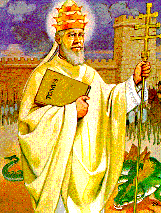
Pope St. Hormisdas, pictured left) exercised his jurisdiction over the whole Church in calling the schismatic Eastern bishops back to submission, compelling them by the power of his authority to sign his
Formula on the dotted line. There is no wiggle-room for quibbling about interpretations of words when the bold outline of his decisive act speaks so loudly and clearly: actions do speak louder than words. The rest is quibbling over secondary and tertiary details. And these details, of course, are the perennial focus of our Anti-Western Orthodox brethren, who wish to divert our attention, as well as their own, from the clear facts in question.
Accordingly, Robinson brings up the Fifth Ecumenical Council, which, he says, "makes clear that each one of the Patriarchates just as with the Apostles were sufficient to their task by their own office," and quotes the passage that includes the words, "... so that no one of [the Apostles] needed the counsel of another in the execution of his work." But how are we meant to infer from this that the prerogatives of the Petrine office amply attested both in Scripture (e.g., Mt. 16:18-19, Gal. 1:18, 2:1-2) and in Tradition (e.g., Clement I, Irenaeus, Julius, Boniface, Basil, Gregory Nazianzus, Ephrem, Leo I, Gelasius, Stephen of Dora, Agatho, Hormisdas, Maximus, Chrysostom, Theodore) are of no account, or reduced to some etiolated "primacy of honor" with no real authority, much as seen in the Queen of England? Why should anyone think this?
He also notes the moot point that the Fourth Council of Constantinople of 869 and the Council of Florence of 1439 (the Eighth and Seventeenth Ecumenical Councils) are not recognized by the Anti-Western Orthodox churches. Further, he notes that the Fourth Council of Constantinople was rejected by another Photian council in 879-880 (rejected as a "pseudo-synod" by the Catholic Church). Robinson says that this Photian council "had the assent of all sides, including Pope John VIII," that "it was not only upheld by Rome but also forbade the inclusion of the
Filioque," and that he does not see how Catholics by their own theological position "can admit that the council of 869 is a legitimate and general council since it was overturned by the Church whole and entire, including the Pope." Robinson refers here to a discussion by Fr. George Dion. Dragas ("
The Eighth Ecumenical Council: Constantinople IV (879/880) and the Condemnation of the Filioque Addition and Doctrine" (which originally appeared in
The Greek Orthodox Theological Review, Vol. 44, Nos. 1-4, 1999, pp. 357-369), who offers an Anti-Western Orthodox panegyric lauding Photius's revolt against Rome.

There is a good deal that neither Robinson nor Fr. Dragas tells us here--not least, the fact that as soon as Photius sent the Acts of his council to Rome for the Pope's ratification,
Pope John VIII (872-82) (pictured left) instead responded by excommunicating him, solemnly condemning him in 881, and permanently reinstating the ban on him in 882. Dragas has extensive notes on the decrees by which John VIII struck down the earlier censures of Photius by the synod of 869. He includes the detailed texts of John VIII rescinding the earlier decrees of the earlier synod. Dragas writes:
I have included these texts here because I repeatedly encounter comments in the works of Western scholars, especially Roman Catholics, who offer confusing and even disputed information about the unanimous Eastern and Western condemnation of the anti-Photian Council of 869-870. (Dragas, n. 7.)
But Dragas says nothing about the false pretenses under which Photius convened his council of 879-880 and petitioned Pope John VIII to send legates; and he is altogether mute about John VIII's refusal to confirm the Acts of the Photian council and excommunication of Photius after his discovery of Photius's true intentions in the council of 879-880. How Dragas (or Robinson) can continue to celebrate the "unanimous Eastern and Western condemnation of the anti-Photian Council of 869-870" as though it had any canonical standing under Roman canon law is anybody's guess. The fact that Rome later called the Photian council "
Conciliabrulum Oecumenicum Pseudooctavum" is hardly an acknowledgement of its canonical legitimacy, as Dragas seems to imply. What part of "
Pseudo" is not clear in "
Pseudooctavum"? My hunch is that such misinformation stems from the incestuous reliance of Anti-Western Orthodox writers exclusively on schalarship slanted to their cause, in this case, even reliance upon the otherwise excellent pioneering work of Francis Dvornic, which is highly problematic in certain respects, as well as those who have relied on his tendentious assumptions (such as Meijer, Phidas, Siamakis, etc.).

Photius was truly one of the most remarkable characters in all Church history; but he was also the chief architect of the great Eastern Schism. The Anti-Western Orthodox regard him rightly as the greatest historical champion of their cause against Rome. They went so far as to canonize him, and on Feb. 6th, when they observe his feast, their office overflows with his praise. He is the "far-shining radiant star of the church," the "most inspired guide of the Orthodox," "thrice blessed speaker of God," "wise and divine glory of the hierarchy, who broke the horns of Roman pride" ("Menologion" for Feb. 6, ed. Maltzew, I, pp. 916ff.).
There is far more to Photius than meets the eye in Anti-Western Orthodox accounts of him, however, and those who have not appraised themselves of "the rest of the story" would do well to investigate it for themselves. Certainly no well-informed Christian can help remembering Photius with mixed feelings. While it is true that there is no shadow of suspicion against his private life, he is also well-known for his insatiable and unscrupulous ambition--hardly qualities one typically finds in a saint--which more than anything else was responsible for the greatest schism in Church history. And schism, it will be recalled, was regarded by the Church Fathers as a sin worse than homicide. The conclusion of a detailed entry on "
Photius of Constantinople" in the Catholic Encyclopedia reads as follows:
... His insatiable ambition, his determination to obtain and keep the patriarchal see, led him to the extreme of dishonesty. His claim was worthless. That Ignatius was the rightful patriarch as long as he lived, and Photius an intruder, cannot be denied by any one who does not conceive the Church as merely the slave of a civil government. And to keep this place Photius descended to the lowest depth of deceit. At the very time he was protesting his obedience to the Pope he was dictating to the emperor insolent letters that denied all papal jurisdiction. He misrepresented the story of Ignatius's deposition with unblushing lies, and he at least connived at Ignatius's ill-treatment in banishment. He proclaimed openly his entire subservience to the State in the whole question of his intrusion. He stops at nothing in his war against the Latins. He heaps up accusations against them that he must have known were lies.  His effrontery on occasions is almost incredible. For instance, as one more grievance against Rome, he never tires of inveighing against the fact that Pope Marinus I (882-84) [pictured left], John VIII's successor, was translated from another see, instead of being ordained from the Roman clergy. He describes this as an atrocious breach of canon law, quoting against it the first and second canons of Sardica; and at the same time he himself continually transferred bishops in his patriarchate.
The whole Photian Council was an exercise in colossal bamboozlement, an art honed to masterful perfection in the Byzantine Photius. Photius rose to prominence when the Partiarch of Constantinople,
Ignatius (846-57), was deposed and banished by Emperor Michael III (842-67) in 857 for refusing communion to Bardas, a chief State official, for having incestuous relations with his daughter-in-law, and the more pliant Photius was intruded into his place. Photius was hurried through Holy Orders in six days. On Christmas Day, 857, Gregory Asbestas of Syracuse, a bishop who had been excommunicated for insubordination, illicitly ordained Photius patriarch. The emperor tried in vain to make Ignatius resign his See. Photius also did all he could to get the Pope to ratify their expulsion of Ignatius, the legitimate occupant of the Partriarchal See. The emperor sought to obtain from
Pope Nicholas I (858-67) recognition of Photius by a letter grossly misrepresenting the facts and requesting legates to be sent to settle the issue in a synod. The Pope sent two legates, Rodoald of Porto and Zachary of Anagni, with cautious instructions to hear both sides and report back to him. The synod occurred in St. Sophia's in May, 861. The legates were bribed, agreed to Ignatius's deposition and Photius's succession, and returned to Rome with letters for the Pope. The emperor's Secretary of State, Leo, followed the legates to Rome with further assurances and letters, in which both the emperor and Photius emphatically acknowledged Papal Primacy and categorically (and conveniently!) invoke the Pope's jurisdiction to confirm what has happened.
Meanwhile Ignatius, in exile, sent his friend the Archimandrite Theognostus to Rome in 862 with an urgent letter setting forth his own case. Nicholas, having heard both sides, decided for Ignatius and answered the letters from Emperor Michael III and Photius by insisting that Ignatius must be restored and the usurpation of his See must cease. Rome never wavered from this position, and this is what set the stage for the Photian schism. In 863 the Pope held a synod at the Lateran in which the two legates were tried and excommunicated. Nicholas's decision reinstating Ignatius as lawful Patriarch of Constantinople was reiterated. Photius was to be excommunicated unless he relinquished his usurpation at once.
However, instead of obeying the Pope, to whom he had just appealed, Photius resolved, with the emperor's backing, to deny Rome's authority altogether. Ignatius was not restored to his See, but kept in prison, and the Pope's letters were kept from publication. Photius collaborated with the emperor in notifying Rome that the Eastern Patriarchs were in support of Photius, in questioning the propriety of the Pope's excommunication of the legates, and threatening Rome with imperial military action unless the Pope altered his decision and gave his support to Photius. In 867, Photius went on the offensive by declaring his excommunication of the Pope and the Western churches. The pretexts given were that the Latin churches (1) fast on Saturday, (2) do not begin Lent until Ash Wednesday, (3) do not allow priest to marry, (4) do not allow priests to administer confirmation, and (5) have added the filioque clause to the creed (indeed, Photius's discovery of utility of the filioque grievance as a political weapon vastly disproportionate to its theological value seems to have been original with him). For these reasons, Photius's encyclical declared, the Latins are "forerunners of apostasy, servants of Antichrist who deserve a thousand deaths, liars, fighters against God."
Later in the same year (867), Emperor Michael III was murdered, and Basil I (867-86) succeeded him. Photius was ejected from the patriarchate, and Ignatius restored. Pope Adrian (867-72), who succeeded Nicholas, answered Ignatius's appeal for legates to attend a synod designed to examine the whole matter. The legates arrived in Constantinople in September of

869, and in October the synod was convened, which Catholics recognize as the
Eighth Ecumenical Council (the Fourth Council of Constantinople). This council tried Photius, confirmed his deposition, and, since he refused to renounce his claim, excommunicated him. He was banished to a monastery at Stenos on the Bosphorus, where he spent seven years, writing letters to supporters, organizing his party, and biding his time for another chance. Photius ingratiated himself with the emperor, who recalled him in 876 to the court. He feigned reconciliation with Ignatius and ingratiated himself within the Patriarch's circle to such an extent that when Ignatius died, a strong party demanded that Photius should succeed him. An imperial embassy was sent to Rome to explain that everyone at Constantinople wanted Photius to be patriarch. Pope John VIII, wishing to avoid provoking yet another conflict with Constantinople, agreed, absolved Photius from all censure, and acknowledged him as partriarch. A more fateful judgment cannot be imagined.
By 878 Photius had achieved lawfully the patriarchate that he had formerly usurped. Rome acknowledged him as Patriarch of Constantinople and restored him to her communion. There was no possible legitimate reason now for a fresh quarrel. But Photius used his new position to re-open his personal long-festering political vendetta against Rome. Accordingly, he applied to Rome for legates to come to another synod. There was no legitimate reason for a synod, but he persuaded Pope John VIII that it would clear up the last remains of the earlier schism, and bring healing and restore solidarity between East and West. His real motive, in cannot be doubted, was to undo the effect of the Eighth Ecumenical Council of 869 that had deposed him. The Pope sent three legates, Cardinal Peter of St. Chysogonus, Paul, Bishop of Ancona, and Eugene, Bishop of Ostia. The synod was opened in St. Sophia's in November of 879. This is the the council that has come to be known to Catholics as the
Pseudosynodus Photiana (Photian Pseudo-Synod) or
Conciliabulum Oecumenicum Pseudooctavum (Pseudo-Eighth Ecumenical Council) which the Anti-Western Orthodox count as the Eighth Ecumnical Council.
Photius had his own way throughout the council. He altered the letters sent to him, to the Emperor Basil, and to the Byzantine Church by Pope John VIII, which were read at the Council of 879-80 convoked to clear his name (Francis Dvornik attests to this in
Byzantium and the Roman Primacy. Photius revoked the acts of the former synod (of 869), repeated all his accusations against the Western churches, focusing especially on the filioque grievance, anathematized all who added anything to the creed, and claimed Bulgaria as part of the Byzantine Pariarchate. Given such data, it is a testament to the insular narrowness of Anti-Western Orthodox scholarship that Dragas could offer so naïve a description of Photius as this:
... the image of St. Photios [Photius] that emerges from the acts of the Eighth Ecumenical Council is one of moderation, sensitivity and maturity. Confrontation is avaoided but without compromising firmness in matters that relate to the faith. Generosity towards others is displayed and maturity permeates everyting.
Photius had rigged his council. He had garnered John VIII's support under the false pretense that he meant to heal the remains of the earlier schism by restoring Eastern dissenters to the one true fold of Rome. But the fact that there was a great majority for all of Photius's defiant measures in the synod shows the extent to which he had prepared for the synod by building up his Anti-Western party in the East. The legates, like their predecessors in 861, agreed to everything the majority desired, pending the ratification of the Pope. As soon as they had returned to Rome, Photius sent the Acts to the Pope for his confirmation. Instead, however, Pope John VIII naturally again excommunicated him, solemnly condemning him in 881 and reinstating the ban against him in 882. The successor of John VIII,
Pope Marinus I (882-884), who had presided over the Fourth Council of Constantinople in 869 as one of the legates of Adrian II, vigorously renewed John VIII's condemnation of Photius, rescinding the Acts of the Photian Council of 879 and formally reinstating the Fourth Council of Constantinople of 869 as the official Eighth Ecumenical Council of the Church. [See note below concerning these details, which are contested.] So the Photian Schism broke out in full force for several years until the death of Emperor Basil I in 886. In light of these details,
Dragas' declaration that Photian Council of 879-880 "is indeed the Eighth Ecumenical of the Catholic Church, Eastern and Western and Orthodox," that it is "a Council of Unity," carries little credibility, let alone intelligibility.
Emperor Basil was succeeded by his son, Leo VI (886-912), who intensely disliked Photius, accused him of treason and embezzlement of public money, and immediately deposed him and banished him. Photius's place as patriarch was then taken by Leo's younger brother, Stephen (886-93). Stephen's intrusion was no less a violation of canon law than that of Photius in 857, so Rome refused to recognize him. It was only under his successor Antony II (893-95) that a synod restored reunion for a century and a half, until the time of
Michael Cerularius (1045-58). At this point, Photius disappears from history. Not even the Armenian monastery in which he spent his last years is certainly known, although historical research shows that Photius (despite his liturgical and doctrinal quarrels with the Latin Franks in Bulgaria) died in communion with the Holy See (see James Likoudis, "
History of the Byzantine Greco-Slav Schism: Basic Facts and Events Giving Rise to the Eastern Orthodox Churches"). The date of his death is generally given as February 6, 897.
But Photius had left a large and influential anti-Roman party, eager to repudiate the Pope's primacy and embrace schism. It was this party, to which Cerularius belonged, which triumphed in Constantinople, so that Photius is rightly considered the architect of the the Great Schism--or as I prefer to call it, the Anti-Western Orthodox Schism--which still endures. A proud and obstinate Cerelarius was excommunicated by Rome in 1054, along with all the Eastern churches that followed him into Anti-Western schism. But the greatest credit for this fatal breach in Christendom must go to the brilliant and scheming Photius, who broke faith with Sacred Tradition by denying Peter in the office of his successors by means of his proud and obstinate "
non serviam!"
Note:The ecumenical status of the Fourth Council of Constantinople of 869-870 has long been contested by the Anti-Western Orthodox. During the ecumenically-charged milieu leading up to and following the Second Vatican Council, many Roman Catholic scholars and ecumenists, eager to mend relations with their Eastern Orthodox brethren, have been back-pedaling and down-playing their former criticisms of Photius, amending and revising their accounts of the Photian Schism. In this process, some further details have been brought to light, but in some instances earlier details have been obfiscated and covered over. One of the most prominent Catholic scholars during this period has been Francis Dvornik (or Dvornic), whose books,
The Photian Schism: History and Legend (Cambridge: Cambridge University Press, 1948; rpt. 1970) and
Byzantium and the Roman Primacy (New York: Fordham University Press, 1966; rpt. 1979) have been viewed by Anti-Western Orthodox scholars as having come a significant way towards accommodating some of their interpretations. To their delight, Dvornik accepts, for example, their claim that the belief that the successors of John VIII--Marinus I, Stephen V, and Formosus--had broken with Photius is a legendary invention. It must be conceded, in fact, that Photius did die in communion with Rome. Dvornik's claim that Photius never actually questioned Roman primacy seems well-attested. However, the notion that the ecumenical status of the Fourth Council of Constantinople in 869-870 is fundamentally compromised by the acts of the Photian Council of 879-880 cannot be seriously maintained. First, the matter is ultimately a question of authority, and whether the matter was immediately settled in the ninth century or not is in the final analysis irrelevant. Second, the Council claimed for itself an ecumenical status by calling itself the
universalis octava synodus; and it had at least the necessary geographical characteristics because of the authority of all the heads of the Church who were either present or represented.
Was it recognized as ecumenical by the Holy See? Three facts are certain and incontestable. First, Adrian II had already approved it in his letter of Nov. 10, 871, as well as in his letter to the faithful of Salerno and Amalfi in 875; and John VIII called it
sancta octava synodus, thereby formally recognizing its ecumenical status. Second, the Council has been listed among the ecumenical councils recognized by the Roman Catholic Church since the beginning of the 12th century. Third, the Byzantine Church itself accepted the Council as ecumenical until the Photian Synod of 879-880, which is thought to have abrogated its Acts; and those portions of the Byzantine Church that reunited with Rome since that time have considered it as ecumenical.
The crux of debate is reducible to the question whether Pope John VIII, by means of his supreme power of binding and loosing, actually annulled the acts of the Council of 869-870, thus depriving it of ecumenical status. This is of course what is claimed by Anti-Western Orthodox scholars, who have a curious (if convenient) interest at this point in the Roman primacy of John VIII. The answer is affirmative if the Greek text of the last two sessions of the Photian Synod are considered authentic, which may be doubted, not least because of Photius's history of altering the letters sent to him, to the Emperor Basil, and to the Byzantine Church by Pope John VIII, before having them read at the Photian Synod of 879-880. The answer is negative if takes into consideration other documents, such as the letter of Pope Stephen V to Emperor Basil I in 885-886. This letter states, in fact, that 20 years after the Fourth Council of Constantinople (869-870), Photius was still trying to have it annulled, a step that would be inexplicable if prior to this time John VIII had already taken the initiative in this matter.
While ecumenically-minded scholars such as Dvornik have written irenically in support of the thesis of abrogation by John VIII, others such as Venance Grumel and Martin Jugie have defended the thesis of non-abrogation and ecumenicity of the Fourth Council of Constantinople (869-870) as the Eighth Ecumenical Council of the Church. Ultimately, however, the issue is one of ecclesiastical authority, in testimony of which stands the record of decrees of the Holy See.


 A friend of mine, the Director of a Presbyterian (PCA) mission in France living in Marsaille, recently wrote me asking a number of questions about Catholic Marian beliefs, which, it was suggested, might send Protestants scurrying off to the nearest pub. I responded by suggesting that the idea of scurrying off to the nearest pub may be more Catholic than Protestant, citing the example of an Irish priest who, after Mass, would beat his parishioners in the twenty-yard dash to the local pub down the hill. What was it that Hilaire Belloc used to say? --
 Following up on
  In fact, I want to say that metaphor ("God is our Father," "Angelina Jolie is a bomb," "the Lion is the King of animals," etc.) can bring us CLOSER to reality than a clinical scientific description in many cases (cf. Thomas Howard's
  , or see
  John Hick (pictured below), in
  Church' (Clarkson 1961, 78: Denzinger, 714). But very few Catholics would dream of affirming this today, and most who are asked about it only find it embarassing." (p. 6)
 Perry Robinson is a former Anglican who converted to Eastern Orthodoxy after weighing his options carefully. Currently a student working on his doctorate at St. Louis University, he has recently offered criticisms of the Western understanding of absolute divine simplicity and other aspects of Catholic teaching on Al Kimel's blog (Pontifications). Robinson has written what Pontifications calls "a lengthy, substantive, complex, and challenging apologia on behalf of Eastern Orthodoxy" in the form of theological counsel for "Anglicans in Exile" and has made it available online. Kimel warns that it is "a difficult piece" that will "require slow and patient reading." Robinson's essay [in PDF format] is available online under the title "
 The basic question, of course, centers on the authority to define canonicity. The question of pseudonymity that he treats in his second post is a secondary detail, and I won't address it here. Rather, I wish to comment briefly on the question of circular reasoning that he raises in his second post.
 Al Kimel, at
 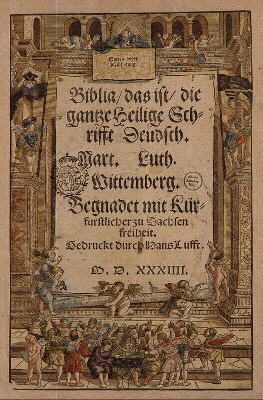 I know they taught that at Westminster Theological Seminary in Philadelphia when I attended there in the seventies. Like all those other ultimately subjectivist criteria (the "inner promptings of the Holy Spirit," "what preaches Christ," etc.), it ends up functioning as a wax nose that can be turned in nearly any direction the interpreter desires. Luther would have left out Hebrews, James, Jude and Revelation, which Luther classified in the first edition of his Deutche Bibel (pictured left) as non-canonical books, along with the Deuterocanonicals. Most Protestants today would be rightly scandalized by a Bible that omitted Hebrews, James, Jude, and Revelation. The one thing you didn't address is the bizarre fact that most Protestants do, however, omit the Deuterocanonical books without batting an eye. I say "bizarre" because they typically cite St. Athanasius' Easter encyclical of AD 367 as the first public record of the complete list of the twenty-seven books of the New Testament--as does the popular evangelical textbook by Walter A. Elwell and Robert W. Yarbrough, Encountering the New Testament (Grand Rapids, MI: Baker Books, 1998), p. 27--without batting an eye, either ignoring or ignorant of the fact that the same Athanasian list includes all of the Deuterocanonicals as well. It does them no help to cite the canon of ecclesiastical consensus at this point, because the consensus clearly recognized the Deuterocanonicals as Scripture.
  Greek was the lingua franca of the New Testament ethos, and the "Scripture" to which St. Paul referred in II Tim. 3:16 as "inspired," and the "Scripture" to which other NT writers quoted and cited in their epistles and gospels was for all practical purposes the Septuagint (LXX), which included the Deuterocanonicals. I think it's the Nestle-Alland edition of the Greek NT that contains the appendix listing the multitude of allusions in the NT to the Deuterocanonical books (worth checking out). Also every listing of the canonical books of the Bible in the Council of Rome (AD 382), Council of Carthage (AD 397), St. Innocent (405), and Council of Trent (AD 1546) includes all of the Deuterocanonicals, even though they are called by slightly different names (
 Pope John Paul II has referred to the Eastern Orthodox churches collectively as the "other lung" of the univeral Church. Rome permits Catholics in areas of the world where there are no Catholic churches to receive the Sacraments in these Eastern churches, thus recognizing their validity. The
  One good example of the Eastern Orthodox witness to Papal Primacy if found in what I shall call the
  These Byzantine emperors, emboldened by their frequent success in cowing into submission the bishops, archbishops and patriarchs of Constantinople, attempted to do the same with the bishops of Rome, some of whom they sent into exile, such as Martin I, who died in exile.
 insistent on orthodoxy and unity eventually called upon a later bishop of Rome,
  It is in the response of
  Pope Hormisdas uses the plural "We" to convey his identification of his own authority with that of his predecessors, who did not refrain from imposing doctrine and discipline on other bishops, whether from East or West. In the quotations from the Formula that follow, these key passages will be presented in Italics just as they are in Adrian Fortescue's
  "We receive and approve all the letters of the blessed Pope Leo, which he wrote about the Christian religion; and, as we have said, we follow the Apostolic See in everything and teach all its laws. Therefore, I hope that I may deserve to be with you in that one Communion taught by the Apostolic See, in which Communion is the whole, real and perfect solidity of the Christian Religion. And I promise that in the future I will not say in the holy Mysteries the names of those who are banished from the Communion of the Catholic Church, that is, who do not agree with the Apostolic See. And if in any way I ever attempt to depart from this my profession, I acknowledge that by my own sentence I shall be an accomplice of those whom I have condemned. This my profession I sign with my own hand and address to you, Hormisdas, the holy and venerable Pope of the City of Rome."
 initiating the Byzantine period by institutionalizing anti-Roman sentiments in Constantinople. The Formula was also signed by the bishops at the