Sunday, September 25, 2011

An Apology for the Confessional State


Crowning of Charlemagne


by James Tillman

There are perhaps but two views of the state's purpose. In the traditional view, the state helps men to some definite idea of perfection by inculcating virtue in them through good laws; such an ideal has been advanced by Aristotle, Aquinas, and various Popes. In the classical liberal view, the state allows men to pursue whatever they want by protecting their freedom of action; such an idea has been advanced by Locke and various Protestants.

The dispute between the two has nevertheless crept into Catholic circles, despite the church's historical preference for the traditional view of the state's purpose. In the middle of the previous century, for instance, American Catholics saw the conflict between John Courtney Murray, who through the American experiment in religious liberty to be a good thing, and the Roman Catholic Curia, which did not and which therefore silenced him. Later in the century, Frank Meyer, convert from Communism to secular conservatism, argued with Brent Bozell, convert to Catholicism and founder of the militant Catholic magazine Triumph, over whether government's ultimate end is promoting freedom or promoting virtue. Other modern Catholic figures have tried to reconcile the Church's teaching with principles amenable to the American mind. Notwithstanding the accusation that they reconcile only inasmuch as they obscure, such arguments have had a great deal of success.

It is not the purpose of this article to address these arguments.

Rather, it is to question a premise upon which the arguments have been based. For the argument over whether the state should promote some specific morality is founded upon the conviction that the state is able to not promote some specific morality. Agreement over the descriptive, therefore, founds disagreement over the prescriptive. I would like to question this agreement. I will argue that the state, in the course of its actual operation, must ultimately promote some specific idea of morality -- whether a secular ideal, a Protestant ideal, and Islamic ideal, or a Catholic ideal. It is impossible for it not to do so. Thus, debating whether the state ought to move men to a specific end is foolish: the state will do so, whether one wants it to do so or not. The question is only what sort of morality the state will promote.

This thesis may be very counter-intuitive; surely, most Americans will wish to plead, government is able simply to step back from issues of morality, religion, and man's final end? Why must these issues come into the laws in some way? More specifically, why cannot government simply limit itself to the protection of human rights, such as the right to life, liberty, and property?

If government does not pass laws to bring man to his good, government must aim laws at something else. In the classical liberal scheme, government passes laws meant to protect man's rights. The idea of secular government is therefore founded on both the existence of such rights and the enforceability of such rights by the government. The former is a very dubious proposition -- indeed, if rights do exist they would certainly seem not to be morally neutral things. In their modern form, rights historically sprang into being from anti-Catholic sources, as in the French Revolution's Declaration of the Rights of Man. But for now I will pass over whether rights exist and whether they are morally neutral and examine instead how these rights would be defended by a government that recognizes their existence.

Rights are meant to delimit a sphere of action, within which each individual may do what he wants and the bordrs of which government is supposed to protect. Under such a system, government does not look to whether property is used for good or for ill; it simply protects one's right to have it and use it. Government does not look to whether free speech spreads lies or truth; it simply protects one's ability/right to speak. Deliberation regarding laws centers on how best to protect the various rights, not onl whether laws will help men be better men. Like that of the Wiccans, the classical liberal motto is "If it harm none, do what ye will."

* * * * * * *
Everyone assaults everyone else with cries of intolerance. And everyone is right; everyone is intolerant. There can be no peace between those with different moralities, different ideas of human nature, and different ideas of God; the ideal of government as a neutral umpire has never existed and never can exist.

* * * * * * *

In reality, however, such an idea of rights cannot ultimately be enforced without appealing to a specific standard of morality and thus without enforcing a specific standard of morality. To see why government cannot enforce rights without an appeal to morality, we must examine a few rights in the concrete.

When such rights are examined, we find quickly that they are not absolute. Freedom of speech infamously does not give one the right to yell "Fire!" in a crowded theatre. Neither does it give one the right to put a sign on one's lawn advocating the lynching of African-Americans. The right to freedom of speech is outweighed by the right to life. The majority of cases, however, are not so clear. Does freedom of speech permit me to sell books advocating a subversive and Communist political philosophy? Does it permit me to sell books on how to conduct a coup d'état? Does it permit one to put up billboards quoting the Levitical laws against sodomy? Such cases are not easy to decide and will require significant prudential deliberation regarding the goods to be gained and lost by each course of action. In each case the so-called "right" to freedom of speech is clearly not an absolute right; those who make decisions do not make them based upon clear and unambiguous laws, but upon prudential weighing of the various goods involved.

Similarly, the right to freedom of religion requires prudential decision-making. Some religions involve smoking marijuana; others involve polygamy; others involve the execution of those who decide to leave that religion and the establishment of a world-wide theocracy beneath religious law. Such religions may be offensive to Catholics, just as the Catholic religion is offensive to those who believe that it teaches people to hate homosexuals, that it represses man's natural instincts, that it advocates the subjugation of women, or that it leaves one ultimately loyal to a monarch in the Vatican rather than to the United States. When government decides what sort of religion to allow and to what extent to allow it, then it does not simply take into account the right to religious freedom; one also takes into account a host of other moral evaluations regarding the importance of various goods. Similar instances might be given as regards education, the right to private property, and so on and so forth.


Pope Leo XIII

* * * * * * *
The Popes in the nineteenth and early twentieth century tried to keep men from giving up the fight for Christ's social reign, but their efforts failed. The secular state triumphed, in which a secular, humanistic morality is used as a basis for the laws, in which the Church is marginalized and forced to conform to rules that effectively muzzle and tame it, and in which men's loyalties are but nominally to the church and really for their government or careers.

* * * * * * *

Thus, in all cases the so-called rights to which people appeal are not absolute guidelines for government; they are simply things often considered good, which must be weighed and curbed when they interfere with other good things. Is freedom of speech more important than the harm caused by racism? Is it more important than the offense caused by Christian teaching on homosexuality? Is it more important thatn the injury to the innocence of children caused by indecent advertisements? Such decisions cannot be rationally evaluated unless one appeals to a specific, concrete, moral ideal; and so, the decisions and actions of government cannot be rationally evaluated unless one appeals to a specific, concrete, moral ideal; and so, the decisions and actions of government cannot be morally neutral. Whether those in government think religion to be important, think Catholicism to be true, think the family to be important, or think a thousand other things will alter their decisions as they weigh all the various variables involved in deciding upon a specific course of action. Government's action must therefore always favor one moral scheme above another.

Nor is it simply in controversial, high-profile issues that government must take into account various moral ideals. Consider tax laws. Government often taxes corporations at lower rates than it taxes the family; furthermore, corporations are generally taxed on the profits that they make -- on their sales minus expenses -- rather than simply on gross income. On the other hand, families are taxed on gross income without regard for the expenses the family incurs. Such laws favor the production of stuff rather than the production and raising of children; and while both are necessary to the economy, each is necessary in different ways and to different degrees. One might argue that the government's policy is just or is unjust, but in any event such argument would probably refer to the relative importance of the family and the corporation, the benefits of small-scale versus large-scale production, distributism and capitalism, and other moral issues. Even the blandest of governmental decisions, therefore, involve moral evaluation.

Consider, again, the government and the mandatory education of children. Few would disagree that children ought to be educated. Yet evaluating whether the government should mandate some sort of education and what the content of that mandated education should be; whether the government provide public schools and what the curricula of such schools should be is anything but a morally neutral affair: it involves one's idea of the relation of parents to children, the permanence and role of the family, the relative importance of the family and government, and even the differential treatment of men and women in society. To act on such an issue is to give an opinion on it: to mandate the public education of children unless parents meet certain stringent governmental requirements, for instance, is to rule that children are in some ways more the responsibility of government than of parents -- and thus that government ought to have more control over them. A morally neutral argument can be nothing but a farce under such circumstances.

The impossibility of governmental neutrality contributes to the often shrill accusations of bigotry flung from side to side in the current day. Homosexual activists accuse Christians of trying to impose their morality on others; Christians accuse homosexuals of trying to impose their views on school children; television advertisers accuse Christians of censorship while Christians accuse them of corrupting the youth; everyone assaults everyone else with cries of intolerance. And everyone is right; everyone is intolerant. There can be no peace between those with different moralities, different ideas of human nature, and different ideas of God; the ideal of government as a neutral umpire has never existed and never can exist. The classical liberal ideal of a government indifferent to man's final end seemed possible only because of the mostly Christian consensus found in the first liberal governments; the cracks cause by disagreement were few and far between and easily disguised. Yet centuries of secularity have done their work, and religious pluralism has introduced beliefs yet more and more divergent. The façade can no longer be maintained. The state cannot be neutral: one's own moral system must reign in it, or one will be crushed by that of another.

* * * * * * *
Inasmuch as the Republican -- or even the Democrat -- agenda agrees witht he Catholic, to that extent they can be made temporary allies; but we must never mistake such an alliance for a friendship. There is no agenda for the Catholic but the Catholic agenda ...

* * * * * * *


In light of this fact one must applaud the wisdom of the Church, which condemned the ideas of liberalism from its start. The Syllabus of Errors of Blessed Pius IX condemns the idea that "the Church ought to be separated from the State, and the State from the Church"; it condemns the idea that "in the present day it is no longer expedient that the Catholic religion should be held as the only religion of the State, to the exclusion of all other forms of worship." When one ceases trying to wrench society towards a state in which God and His rule is recognized, society must slide towards a denial of God and His rule. The Popes in the nineteenth and early twentieth century tried to keep men from giving up the fight for Christ's social reign, but their efforts failed. The secular state triumphed, in which a secular, humanistic morality is used as a basis for the laws, in which the Church is marginalized and forced to conform to rules that effectively muzzle and tame it, and in which men's loyalties are but nominally to the church and really for their government or careers.

The current political spectrum distorts this necessary conflict; it causes us to pretend that it can be sidestepped. Members of the Republican Party and members of the current Tea Party cry for government to cease its crawling -- and occasionally sprinting -- socializing of medicine and business, and inasmuch as they do so they are good. But will they admit that education cannot be neutral, and that our current concept of government-run education is flawed? Will they admit that the right to private property includes no right to sell products that help destroy family and society? Will they admit the principle of subsidiarity and admit that local communities need their power increased greatly, just as the federal and state governments must be shrunk? Inasmuch as the Republican -- or even the Democrat -- agenda agrees witht he Catholic, to that extent they can be made temporary allies; but we must never mistake such an alliance for a friendship. There is no agenda for the Catholic but the Catholic agenda, which would require decades of unremitting effort for its realization and which would require men to transcend most of the issues currently dividing political parties. The Catholic agenda requires us to admit what the rest of society yet hypocritically denies -- that between rival moral theories there can be no peace.

Catacombs or Christendom? Society slides and wavers between the two; but there can be no third way.

[James Tillman is a Catholic Journalist and graduate of Christendom College. The present article, "An Apology for the Confessional State," was originally published in The Latin Mass: A Journal of Catholic Culture and Tradition, Vol. 20, No. 1 (Winter 2011), pp. 60-63, and is reprinted here by kind permission of Latin Mass Magazine, 391 E. Virginia Terrace, Santa Paula, CA 93060.]

Thursday, July 14, 2011

The Great School of Spirituality: Learning to Love the Divine Office


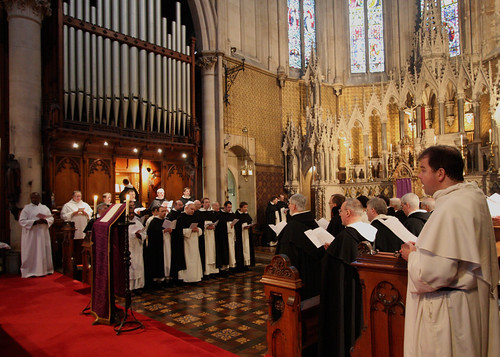
Dominican Vespers photo by Lawrence OP

By Michael P. Foley

During a recent Angelus address, the Holy Father referred to the liturgy as “a great school of spirituality.” By that the Pope meant not simply the Mass but the Divine Office. Together these two sacrifices—one of the altar, the other of praise—school the believer in the divine mysteries, shaping his sensibilities, honing his judgment, and conditioning his heart to a life of holiness. The Divine Office is also a key to unlocking the great secrets of the Catholic liturgical year: its prayers and readings perfectly complement the propers of the Mass.

Today, however, the Divine Office remains relatively unknown or unused by lay Catholics, even by those who otherwise savor every morsel of our grand and sacred tradition. To address this situation, we offer a brief overview of the Divine Office and discuss some available “back-to-school supplies.”

What It Is

The Divine Office consists of the hours of Matins (originally 12:00 a.m.) and Lauds (3 a.m.), Prime (6 a.m.), Terce (9 a.m.), Sext (12:00 p.m.), None (3 p.m.), Vespers (6 p.m.), and Compline (9 p.m.). Most of these predate Christianity by several centuries. Lauds and Vespers, for instance, are heirs to the grand morning and evening liturgies before the Ark of the Covenant ordered by King David, liturgies in which over a hundred Levites would chant the Psalms.1 Since their institution on Mount Zion, these services have never been discontinued: Solomon’s Temple, the Jewish Diaspora, and now the Church have kept up the daily praise of God in this form.2

The so-called “Little Hours” of Terce, Sext, and None, on the other hand, arose from the Jewish custom of going to the Temple for private prayer at the third (tertia), sixth (sexta), and ninth (nona) hours of the day (Sts. Peter and John were observing this custom when they cured the man lame since birth).3 Finally, Matins, Prime, and Compline were added in the early centuries of Christianity: Matins began as an anticipation of the Second Coming and a commemoration of the Resurrection, while Prime and Compline are the products of early monasticism.

Together, these eight daily sacrifices of praise fulfill Psalm 118:62 and 164 -- “I rose at midnight to give praise to Thee” and “seven times a day I have given praise to Thee.” Moreover, they punctuate the day, helping to keep the soul from becoming overwhelmed by worldly concerns, and they consecrate time itself with the fragrant incense of prayer.

* * * * * * *
Since their institution on Mount Zion, these services have never been discontinued: Solomon’s Temple, the Jewish Diaspora, and now the Church have kept up the daily praise of
God in this form.


* * * * * * *


God’s Prayer Book

The format of each Hour varies, but at their center is the chanting or reciting of the Psalms. As the only book of prayer written by God, the Psalms hold a unique place in the devout life. In the eloquent words of St. Augustine (354-430): “That God may be praised well by man, God Himself has praised Himself; and since He has been pleased to praise Himself, man has found the way to praise Him.”4 St. Basil (330-379) called the Psalter the natural voice of the Church,5 and St. Thomas Aquinas (1225-274) goes so far as to say that the Psalms contain the whole of theology.6 No wonder that St. John Chrysostom (347-407) wrote that the Christians of his time used the Psalms more than any other part of the Old or New Testament.7

Special mention must also be made of the Latin hymns in the Breviary (the name of the book that contains the Divine Office). Penned by saints as early as the fourth century, these hymns are, in the words of the great liturgist Fr. Adrian Fortescue, “immeasurably more beautiful than any others ever composed. Other religious bodies take all their best hymns from us. It would be a disgrace if we Catholics were the only people who did not appreciate what is our property.”8

Later History

The Divine Office essentially received its current configuration from Pope St. Gregory the Great, though it continued to develop long after and in somewhat diverging directions. The multiplication of saints’ days, for instance, ended up superseding the weekly rotation of the Psalms, with the result that the whole Psalter was no longer being recited within the year, let alone in a week, as intended by St. Gregory.9 The Council of Trent (1545-1563) was forced to deal with this problem, and calls for radical reform were legion. As Vilma Little, writing in 1957, notes with eerie relevance to our own times: “As so often happens in times of general abuses calling for redress, the suggested remedies would have been worse than the disease. Ruthless plans of wholesale alterations were put forward by certain French and German theorists.”10

Fortunately, Little continues, “the saner views of the more level-headed bishops prevailed.”11 Trent outlined a moderate plan for revising the Breviary, which was enacted by Pope St. Pius V. The Sunday and weekday offices were restored while not upsetting the arrangement as a whole.

Not all changes to the Breviary during the Tridentine period, however, were for the better. In 1632 Pope Urban VIII allowed the spirit of Renaissance humanism to affect the hymns of the Breviary, revising almost all of them so that they would conform to the rules of classical prosody. The original verses of St. Ambrose and the like were butchered on the grounds that they were not “good Latin,” yet the new versions were hardly improvements.

Speaking of the four Jesuits commissioned with revising these hymns, Fortescue writes: “They slashed and tinkered, they re-wrote lines and altered words, they changed the sense and finally produced the poor imitations that we still have in place of the hymns our fathers sang for over a thousand years. Indeed their confidence in themselves is amazing.”12 Fortunately, there is a note in the 1912 Antiphonale stating that the old hymns can be used where they are permissible “by law, custom, or indult.” It is difficult to say what this would mean after Vatican II, but it is my personal opinion that a certain latitude can be applied in good conscience.13

* * * * * * *
“As so often happens in times of general abuses calling for redress, the suggested remedies would have been worse than the disease. Ruthless plans of wholesale alterations were put forward by certain French and German theorists.”

* * * * * * *

But while the modifications made by Trent were sensible, they were not complete; it was left to Pope St. Pius X to enact further reforms. The Pope redistributed the entire Psalter, again with the goal of ensuring its recital within a single week. Further changes were made in 1956 and again in 1960 which simplified certain aspects of the Hours and accorded greater dignity to the Sunday Office.

Around the same time, some editions of the Breviary began to use the Psalterium Novum or Pius XII Psalter,14 which was an unfortunate repeat of the same classicist hubris that marred the hymns in 1632 now applied to the Psalms themselves.15 Fortunately, these Ciceronianized Psalms were made optional but never mandated.

Happily, all of the books considered in this article use only the traditional Vulgate Psalter. The Fraternity of St. Peter has published an impressive, new, two-volume edition of the Breviarium Romanum with the Vulgate and in accord with the rubrics of 1962, and so has Angelus Press. Both of these publications reflect the loving care that went into them: their only drawback, from a typical layman’s perspective, is that they are in Latin only. Baronius Press promises to remedy this with a new, three-volume version in English and Latin based on the popular Collegeville Breviary from 1963, which will be out in August. For bilingual alternatives currently in print, we must turn to the different variations of the Breviary.16

Variations

The celebration of the Divine Office has always admitted of greater variety than that of the Mass. To begin with, the Office used by the secular clergy and others (the “Roman Breviary”) was different from the Office used by various monastic orders (the “Monastic Breviary”). And even within this division there were further subdivisions. The Carmelites, Dominicans, Franciscans all had their own versions of the Roman Breviary, to say nothing of different regions and dioceses; and the Benedictines, Carthusians, and Cistercians all had their own versions of the Monastic Breviary.

One of these versions now back in print is St. Michael’s Abbey Press’s The Monastic Diurnal, Or the Day Hours of the Monastic Breviary.17 A diurnal is an abridged monastic Breviary containing only the “day Hours,” that is, every canonical hour except Matins. Diurnals were originally designed to be a handy single volume for monks and nuns to use when they were away from the cloister during the day, but they can also be used by laymen. This edition, originally compiled by the Benedictine monks of St. John’s Abbey in Collegeville, Minnesota and published between 1948 and 1963, has been lovingly reproduced according to the highest standards. Bound in Moroccan leather with gilt edges and six cloth marker ribbons, The Monastic Diurnal is a visual treasure. In addition to all of the Psalms one needs for the week, it contains all of the relevant propers for the entire liturgical year in both Latin and English.

Another variation to the Divine Office were the breviaria parva, or “little Breviaries,” abridged editions tailored to specific uses or devotions. The best known of these is the Little Office of the Blessed Virgin Mary, which was especially popular with the laity and with religious communities with active apostolates and not a great deal of time for communal or private prayer. A beautiful edition of the Little Office of the Blessed Virgin Mary has been reprinted by Baronius Press featuring a blue leather cover, gilt edges, all of the prayers in both Latin and English, and much helpful information. The Little Office is an exquisite prayer to our Lady: its only drawback is that it does not include the calendar’s various saints of the day and some of its seasons.

Another abridged Breviary, which has been specially published by Angelus Press for use by the laity, is Divine Office: Officium Divinum. This handsome, leather-bound volume contains, in both Latin and English, Sunday Lauds, Prime, Sext, Vespers, and Compline, as well as Prime, Sext, and Compline for the entire week. Each Office and Psalm are prefaced by brief and enlightening excerpts from Fr. Pius Parsch’s The Breviary Explained, the first book of its kind when it was published in the early 1950s. The Divine Office also includes musical notation for much of the chant. Like the Little Office and the other breviaria parva, its only drawback is the absence of feast days.

Not Just For Clerics

A common misconception is that the Divine Office is only for the clergy. It is true that clerics are required to say the Divine Office: indeed, priests and seminarians sometimes joke about this requirement by calling the Office the onus Dei (burden of God) instead of its more poetic title, opus Dei (the work of God).

However, this does not mean that the Church wants the clergy to have a monopoly on the Office. St. Augustine tells us that his mother St. Monica went twice a day to church for Lauds and Vespers in addition to daily Mass,18 and the crusader king St. Louis of France, a man with eleven children and a country to rule, is said to have grieved more about the loss of his Breviary than being taken captive by the Saracens. In addition to hearing Mass twice a day, St. Louis also rose at midnight for Matins and said Prime when he woke in the morning. More recently, the Dominican spiritual master Fr. A.G. Sertillanges recommended Prime to the layman first thing in the morning, for “there are no prayers more beautiful, more efficacious, more inspiring.”19

Solemn Vespers on the Lord’s Day was once so well known among the faithful that Sunday dinner was known in some parts of Europe as the Vespers meal. St. Alphonsus Liguori assumed Sunday Vespers would be available at most parishes when he wrote: “Although there is no express commandment which makes it a mortal sin to be absent from Vespers, yet every good Catholic will make it his duty to attend when he can, and see that his family are present also. We are commanded to sanctify the Lord’s day, and the other Holy days of obligation; but if a Catholic neglects the public service of the Church on Sunday afternoons, without any reasonable excuse, how can it be expected that he will apply himself to sanctity in other ways?”20


Vespers by Karl Brulloff

* * * * * * *
Making the effort to understand the Psalms is well worth it. With their exultations of joy or their impassioned pleas for mercy, help, and even vengeance, the Psalms speak from the heart.

* * * * * * *


How

The best way to learn any method of prayer is directly from an experienced practitioner. For those who do not have access to such a person, there are several useful resources available. Both Preserving Christian Publications (PCP) and the Fraternity of St. Peter offer reprints of Cardinal Cicognani’s Rubrics of the Roman Breviary and Missal, translated by Leonard Doyle. This booklet contains the English translation of the sections in the Rubricae Generales of the 1962 Missale Romanum and Breviarium Romanum, as well as the motu proprio of Pope John XXIII introducing the changes made to the liturgy in 1960. It explains both the Breviary and Mass in minute detail and contains all of the textual changes of 1960 so that one may use this book in tandem with an older edition of the Missal or Breviary and still stay current. The PCP reprint is more handsome and durable than its FSSP counterpart (which has a comb binding), and subsequently it costs a little more: $15 for the former, $10 for the latter.

PCP has also reprinted Bernard A. Hausman’s Learning the New Breviary, “new” referring to the changes of 1960. Hausman’s little book, which retails for $14, is an excellent introduction to the mechanics of reciting the hours and following the calendar: it is written in clear, accessible prose and follows a “user-friendly” order. In 2008, the Fraternity, on the other hand, came out with its own aptly named Pocket Guide for the Recitation of the Divine Office According to the 1962 Edition of the Breviarium Romanum. This tiny, 21-page booklet is a compendium of all you need to remember about the Breviary once you have already learned it from a more thorough source. It also has a helpful section titled, “Frequently Asked Questions about Reciting the 1962 Breviary.” The Pocket Guide sells for a mere $1.50.

Seeking Understanding

At first, praying the Divine Office can be confusing, but like any other form of prayer, once it becomes familiar, its value becomes apparent. The most valuable part of the Office, however, is also one of its lingering challenges: the Psalms. The Psalms are unquestionably beautiful, but they are often difficult to understand, since we are often ignorant of the context out of which they arose. It is not unusual to recite a Psalm verse and to find oneself asking: “What on earth does that mean?” Yet making the effort to understand the Psalms is well worth it. With their exultations of joy or their impassioned pleas for mercy, help, and even vengeance, the Psalms speak from the heart.

Fortunately, there are several fine aids to assist our efforts. Thomas Merton, before he went a bit screwy in the late 60s, wrote a lovely little book on the Psalms in general entitled Praying the Psalms. A more detailed alternative is St. Robert Bellarmine’s (1542-1621) A Commentary on the Book of Psalms, translated by John O’Sullivan and reprinted by PCP. This well-made, single volume is able to contain Bellarmine’s commentary on every Psalm because it omits some of his more arcane analyses of the Hebrew wording. The result is a readable commentary which, at $56, is an excellent value.

* * * * * * *
The Divine Office essentially received its current configuration from Pope St. Gregory the Great

* * * * * * *

There are also aids to understanding the hymns. Fr. Joseph Connelly’s 1957 Hymns of the Roman Liturgy explains the meaning and history of the 154 hymns of the Roman Breviary, as does Dom Matthew Britt’s 1922 Hymns of the Breviary and Missal. Both are still in print.

For those who pray the Office in Latin, Dom Britt’s A Dictionary of the Psalter is an essential resource. This meticulously researched volume, again reprinted by PCP, provides vital information about the peculiar Latin of the Vulgate not found in typical Latin dictionaries. To give but one example: years ago I used to recite Friday Vespers with my mentor, a priest who had suffered a stroke and was no longer able to read. When we came to Psalm 138:3, funiculum meum investigasti, he would sometimes ask, “What’s a funiculus?” I looked it up in a conventional Latin dictionary and discovered that it meant a thin cord or rope. Hence the verse literally says, “you have investigated my little rope” (the Douay Rheims renders it, “my line thou hast searched out”). That made us even more confused.

Had I only had Britt’s Dictionary, I could have learned that funiculus also signifies a measuring cord, and thus by way of metonymy it refers to one’s estate or inheritance, the portion of land measured out by surveyors’ lines. The verse, then, is stating that God has marked out my inheritance for me; God is not portrayed here not as a glorified string-inspector but a benevolent probate judge. Clearing up that ambiguity alone was worth the price of the book.

As for the Office itself, the text of Parsch’s The Breviary Explained is available online at Breviary.net;21 excerpts from it are also used in Baronius Press’s forthcoming Breviary and in Angelus Press’s abridged Divine Office. Votaries of the Little Office of the Blessed Virgin, on the other hand, have at their disposal Angelus Press’s reprint of Sr. Marianna Gildea’s 1955 Living the Little Office: Reflections on the Little Office of the Blessed Virgin Mary.This accessible book guides the reader through the prayers of the Office as it follows their order. Sr. Marianna’s commentary is insightful but not overbearing.

Conclusion

“It is good to give praise to the Lord,” the psalmist sings, “and to sing to Thy name, O most High: to shew forth Thy mercy in the morning, and Thy truth in the night” (Ps. 91:2-3). How true that is, as those who mold their daily lives to the rhythm of the canonical Hours know so well.

Resources Notes
  1. See 1 Paralip. 15 and 16. [back]
  2. The fact that incense may only be used at Lauds and Vespers hearkens to this Davidic tradition. [back]
  3. Acts 3:1-8. [back]
  4. In Ps. Cxliv, 1. [back]
  5. Homil. In Ps. I, 2. [back]
  6. Postilla super Psalmos, prologue. [back]
  7. Homily 6 on penitence. [back]
  8. Adrian Fortescue, quoted in Michael Davies, The Wisdom of Adrian Fortescue (Roman Catholic Books, 1999), p. 45. [back]
  9. Gregory, in turn, took this arrangement from St. Benedict, the founder of Western monasticism. [back]
  10. Vilma G. Little, The Sacrifice of Praise: An Introduction to the Meaning and Use of the Divine Office (P.J. Kennedy & Sons, 1957), pp. 17-18. [back]
  11. Little, p. 18. [back]
  12. Davies, pp. 30-31. As the old saying has it, Accessit latinitas, recessit pietas: When Latinity came in, piety went out. [back]
  13. It should also be mentioned that the changes of 1632 only affected the Roman Breviary, not the Monastic Breviary. [back]
  14. It is also called the Bea Psalter after its main author, the Jesuit priest Augustin Bea, Rector of the Pontifical Biblical Institute and confessor of Pius XII who was later made a cardinal by Pope John XXIII. [back]
  15. To be fair, these retranslations were often more accurate renderings of the Hebrew. [back]
  16. Online, however, the impressive divinumofficium.com contains the entire Breviary in both Latin and English. Musicasacra.com has a downloadable book of the Diurnale as well as other resources. [back]
  17. The FSSP and PCP also sell an all-Latin Diurnale Romanum. [back]
  18. Confessions 5.9.17. [back]
  19. A.G. Sertillanges, O.P., The Intellectual Life, trans. Mary Ryan (CUA Press, 1998), p. 89. [back]
  20. St. Alphonsus Liguori, The Mission Book: A Manual of Instructions and Prayers Adapted to Preserve the Fruits of the Mission, Drawn chiefly from the works of St. Alphonsus Liguori (NY: D & J Sadlier & Co., 1853), p. 67. [back]
  21. http://Breviary.net/comment/comment.htm. Unfortunately, the rest of the website is a sedevacantist mishmash. [back]
_____________________________________
Michael P. Foley is an associate professor of Patristics at Baylor University. He is author of Why Do Catholics Eat Fish on Friday?: The Catholic Origin to Just About Everything (Palgrave Macmillan, 2005) and Wedding Rites: A Complete Guide to Traditional Vows, Music, Ceremonies, Blessings, and Interfaith Services(Eerdmans, 2008). Dr. Foley's article, "The Great School of Spirituality: Learning to Love the Divine Office," Latin Mass: The Journal of Catholic Culture and Tradition Vol. 20, No. 2 (Spring 2011), is reproduced here by kind permission of Latin Mass, 391 E. Virginia Terrace, Santa Paula, CA 93060, and the author.

Sunday, July 10, 2011

Latin Will Always Be the Ideal Liturgical Language


Peter Kwasniewski

Many convincing arguments can be and have been given in favor of preserving the Latin language in the rites of the Roman Catholic Church—as even the Second Vatican Council’s Constitution on the Sacred Liturgy Sacrosanctum Concilium (1963) stated that it should be, following close on the heels of John XXIII’s remarkable Apostolic Constitution Veterum Sapientiae of 1962.1 As we all know, Pope John XXIII’s and the Council’s reaffirmations of Latin in the liturgy were more or less cancelled out completely by the ill-considered decisions of Pope Paul VI, who once more demonstrated to the world that if the pope enjoys the charism of infallibility when teaching the truths of faith and morals, he enjoys no such gift in regard to particular prudential judgments, including the dispositions of the liturgy in its changeable elements.2 In any case, my purpose in this article is not to catalog and review the many arguments in favor of Latin, a task that has already been well explored by traditionalist authors, but merely to speak of some of my own personal experiences of where and when the impressive unity of Latin would have made so much more sense in real life than the Babel of vernacular languages.

My wife and I lived in Austria for seven and a half years. Being in Europe convinced me past all doubt, if I had any doubts, that the switch after the Council to an exclusive use of the vernacular for the Mass was the dumbest change that could have been made. Not to mince words: the switch to vernacular is the utmost example of postconciliar near-sightedness. Instead of making the Mass more deeply accessible, it localizes, particularizes, and relativizes it, shutting off everyone who does not speak the local tongue; traveling or immigrant Catholics are thrust into a foreign environment that alienates them far more than the solemn Latin liturgy ever alienated the simplest peasant. In fact, due to its pervasive aura of sacredness and its perceptible focus on the mystery of the Eucharist, the traditional liturgy, even when the words are not fully understood, shapes the soul better than the new liturgy when cerebrally understood.

The irony can be seen on many levels.

* * * * * * *
Latin is universal and is not the daily language of any modern nation or people. There is no cultural imperialism in the use of Latin, but rather a visible sign of the Church of Christ reaching out to all nations, leading them back to unity in one faith, one communion, one worship of God.


* * * * * * *

First, Latin is universal and is not the daily language of any modern nation or people. There is no cultural imperialism in the use of Latin, but rather a visible sign of the Church of Christ reaching out to all nations, leading them back to unity in one faith, one communion, one worship of God. If the use of Latin were argued to be a form of cultural imperialism, we would have to go further and say that proclaiming and preaching the Trinity or the Incarnation is a form of theological imperialism destructive of pagan African, Asian, and European cultures and religions, or that the very use of the same Mass, the same missal (in however many vernacular tongues), is a form of liturgical imperialism destructive of the peculiar ways that an Aborigine might choose to worship Christ. There is no escaping this logic: if you deny the fittingness of a universal presence of Latin, a universality insisted on by none other than Blessed John XXIII, you are on the road to denying the universality of Christian doctrine and worship.

Second, modern Europeans in general are strongly multilingual,3 which makes Latin easy enough for them to get used to, as indeed they once were, not many decades ago. There has never been an age where Latin would be more accessible than now, precisely on account of the “globalization” taking place. If men of Switzerland or Denmark can and often must speak several languages, what would be the difficulty of liturgy in Latin? It would be a source of international unity among believers, far more than idiosyncratic local liturgies could ever be. In those years in Europe, I participated in many liturgies that would have gone far more smoothly had they simply been in Latin. On my sole visit to Lourdes, I attended a Mass in which the languages were being shifted constantly to accommodate the international congregation, a kind of elaborate show of linguistic gymnastics that I found highly distracting, almost impossible to pray with. The already overly verbal and self-involved character of the new liturgy was heightened all the more by this preoccupation with proportional coverage of language groups.

Third, and building on the last point, because literacy has spread everywhere, large numbers of people are in a position to follow along with a hand missal or a booklet that reproduces the Ordinary of the Mass. Even the illiterate, who often enjoy (in compensation, as it were) a rich oral culture and a high level of intuitive understanding, will benefit from sermons in their own tongue that explain the Mass, as Romano Guardini explained it to his German congregations. Moreover, as Jacques Maritain says in Peasant of the Garonne, the believer who, by simply kneeling at Mass and letting his mind be drawn to heavenly things, is caught up in silent worship of God, does not need words, missals, long readings and sermons; it is enough for him to be there. As the peasant of Ars put it: “He looks at me and I look at Him.” When the liturgy breaks this immediate spiritual contact in favor of the specious immediacy of verbal didacticism, it does the ultimate disservice to the spiritual lives of believers.

Fourth, the longed-for fraternity of nations and peace on earth — what could serve this aspiration better than a liturgy everywhere the same? An American traveling in France, a German traveling in Spain, an Italian traveling in Denmark, indeed an Asian in Africa or an Indian in Australia, all of them would find themselves “back home” in the local parish church. And given the importance G. K. Chesterton and Gabriel Marcel rightly place on this deep and inexpressibly consoling feeling of “being at home,” should not the Church do everything in her power to make the liturgy the very place where one can always be “at home,” no matter where one is? Not, of course, by making the liturgy chummy and casual, but by ensuring that it remains deeply familiar in its identity, coherence, consistency, and stability.

* * * * * * *
The believer who, by simply kneeling at Mass and letting his mind be drawn to heavenly things, is caught up in silent worship of God, does not need words, missals, long readings and sermons; it is enough for him to be there. As the peasant of Ars put it: “He looks at me and I look at Him.”


* * * * * * *

We are living in the age of travel, the age of the “global village.” At least in the Western world, almost everyone travels now at some point or another; there has never been a time in the entire history of the world when so vast a number of people take trips within their country as well as to foreign countries. How foolish it was to break down the universal mode of worship just when it has become more pertinent than ever! The ancient Roman rite emphatically illustrates and admirably furthers the purpose of human brotherhood — and, as Henri de Lubac observes, there is definitive brotherhood only in a common adoration of God. In the realm of the Novus Ordo, however, the liturgical celebrations illustrate a diversity or plurality that is not traced back to unity and universality, as is painfully evident to a traveler who speaks few or no other languages than his own. Once upon a time, parishes and chapels across the entire globe testified to the profound inner unity of the Catholic (that is, universal) Church; now there is only the tired Protestant phenomenon of localization.

This last point deserves a bit of development. The era of the old liturgy in fact left much room for inculturation or local adaptation, whether in the design of churches, in the style of vestments, in the layout and decoration of sanctuaries, or in popular hymns, carols, and processions. Nevertheless, the one constant axis was the Holy Sacrifice of the Mass, which remained the same from the rising of the sun to its setting, and testified in its very language to an unbroken unity with Rome, the mystical-historical seat of the Church founded by Christ. The incarnational scandal of the particular was never sacrificed in view of temporary and superficial gains; Christ was never declared to be an African or an Asian, a female or a hermaphrodite, in order to win converts from paganism, feminism, gnosticism, etc. The Faith is founded on the rock of Peter, by providence Bishop of Rome, and this utmost particularity will remain until the end of time, as an image of the even greater scandal of the particularity of Christ, a Jewish man born in Nazareth during the heyday of the Roman Empire. The Chinese Catholic, as a man and as Chinese, worships God in communion with Rome. This is what the old liturgy proclaimed, in blissful and holy ignorance of the shallow charge of “cultural imperialism,” which of course the proclamation of truth can never be, even though the Gospel was given to mankind through the most particular of all particular circumstances.


The Baptism of Christ by the Master of the Saint Bartholomew Altar

Some years ago, I was taken aback when a friend forwarded me a discussion by a conservative Catholic apologist who had come out in full arms and armor to defend the vernacularization of the Mass after the Council. My first impression was that his panoply of arguments, though reasonable-sounding, had already been rehearsed by the promoters of the Consilium’s “reform” back in the 1960s, and had not gained in truth or persuasiveness with the intervening decades. My second impression was that I was looking at a case of old-fashioned dissent. Pope John XXIII in his Apostolic Constitution Veterum Sapientiae, solemnly signed in St. Peter’s Basilica on the very eve of the Second Vatican Council, declares Latin to be the language of the Church’s worship, explains why it is the superior language for liturgy, and resolutely concludes that no other language could serve as well. This Constitution has been contradicted a million times over since its promulgation, but it has never been rescinded nor its contents abrogated. It may be that a future pope will be able to take it up again with praise when the full effects of Summorum Pontificum have permeated the Church.

In any case, the apologist argued that Latin was the common language of ancient Rome, and so we ought to be using the common language of our day and age. Well, Latin certainly was the common language of many members of the Catholic Church once upon a time, in the declining Roman Empire, but already in the early Middle Ages, with the invasions of barbarian tribes speaking a plethora of languages, Latin became more and more a monastic and academic tongue, and at the popular level morphed into early forms of the Romance languages, such as the Italian dialect in which Dante wrote his Divine Comedy, or the Neapolitan dialect St. Thomas Aquinas used when preaching in his native territory. Thus, we may safely say that for over a thousand years the Catholic Church was worshiping in a language that had become a fixed, formal, sacred language, just as Hindus use Sanskrit, Jews Hebrew, Moslems Arabic, and so on.

* * * * * * *
I was looking at a case of old-fashioned dissent. Pope John XXIII in his Apostolic Constitution Veterum Sapientiae, solemnly signed in St. Peter’s Basilica on the very eve of the Second Vatican Council, declares Latin to be the language of the Church’s worship, explains why it is the superior language for liturgy, and resolutely concludes that no other language could serve as well. This Constitution has been contradicted a million times over since its promulgation, but it has never been rescinded nor its contents abrogated.


* * * * * * *

It was also plain silly for this apologist to assert that most people in the old days didn’t understand what was going on at Mass. From what I can tell, it seems fair to say that far more people in the old days knew what was going on at Mass — essentially — and why it was important, than people know nowadays, even though the Mass is in their own language! Now, I don’t blame the language for this, I blame the clergy, as well as the mendacious translation that was foisted by the original ICEL on the English-speaking world. Still, the tectonic shift in language signified in the popular mind a shift in the very meaning of what was taking place in church, and hence, over time, a further deviation in the faith of the people regarding the Holy Sacrifice of the Mass.

Will it ever be possible to calculate the damage done to the Church by the banishment of Latin from her public worship? I think not. We have little conception of the true extent of the harm, just as we have trouble imagining the size of the earth, the solar system, or the galaxy we are in. By the sudden cessation and replacement of the solemn sacred language that for nearly 2,000 years had been the tongue, the voice, part of the inmost character, of the Western Church, the false attitude and opinion already circulating at the time of the Council that the past is utterly meaningless to the present and the present must be liberated from the past, must ignore the past, was confirmed and, as it were, forever institutionalized. In the very fact of vernacular worship is embodied the hermeneutic of discontinuity, a feeling of superior enlightenment and superior mission, as though now we finally understand, now we finally know what we are to do in the modern world. “Fools, for they have not far-reaching minds,” as Empedocles once said. What we ought to do in the modern world is nothing other than precisely what we have always been doing in every age. The mistake was made in thinking that we could do better. For our punishment, we have been permitted not only to do much worse, but to burn many of the bridges that lead back to doing better.

* * * * * * *
Will it ever be possible to calculate the damage done to the Church by the banishment of Latin from her public worship? I think not. We have little conception of the true extent of the harm, just as we have trouble imagining the size of the earth, the solar system,
or the galaxy we are in.


* * * * * * *

Although he hated many features of the Catholic liturgy after his break from Rome, Martin Luther retained respect for the Latin tongue that he was compelled to use when addressing intellectuals. Actually, the case is even more embarrassing for today’s Latin-loathing Catholics, inasmuch as Luther had the basic psychological insight to realize that Latin adds something to the liturgy and that it should not simply be thrown out, as can be seen in his preservation of the Latin language in Lutheran worship—a custom that lasted well into the time of Johann Sebastian Bach, whose more compact settings of the Gloria and Sanctus are not crypto-Catholic oddities but perfectly useful Lutheran church music. I wouldn’t be surprised if there are pockets of conservative Lutherans out there who still sing in Latin, when their Catholic neighbors have long since forgotten even how to pronounce, let alone sing, “Agnus Dei.” Is it not long past the time when the Pope and the appropriate dicasteries at the Vatican should do something about this travesty, this amnesia of our own identity, history, culture, and mother tongue of worship?

Maybe someday historians will be able to look back and see that Summorum Pontificum marked a decisive shift in the “language wars” — a phrase by which I advert not to the more pedestrian, albeit still important, question of whether the ordinary form is well translated, but rather, to the more intriguing and more consequential question of whether a liturgy that has been cut off from its age-old roots in the Latin language and the piety of the Latin rite can survive in the long run. Maybe the motu proprio marks the beginning of a movement that will culminate, decades or centuries later, in the rightful triumph of the Roman liturgy, the Mass of our forefathers, the Mass of the ages. For this quixotic but, with God’s power, manifestly achievable goal, we should certainly not fail to get on our knees to pray: Miserere nobis, Domine.

Notes
  1. Vatican II’s Constitution on the Sacred Liturgy, Sacrosanctum Concilium, states: “Particular law remaining in force, the use of the Latin language is to be preserved in the Latin rites” (36.1); “steps should be taken so that the faithful may also be able to say or to sing together in Latin those parts of the Ordinary of the Mass which pertain to them” (54); “In accordance with the centuries-old tradition of the Latin rite, the Latin language is to be retained by clerics in the divine office” (101.1). Even Annibale Bugnini writes in his memoirs: “The conclusion reached in this debate [between partisans of Latin and partisans of the vernacular] was ultimately set forth in Chapter I of the Constitution on the Liturgy, where the question is answered in a way that reconciles the rights of Latin and the need of the vernaculars in celebrations with the people” (The Reform of the Liturgy [Collegeville: Liturgical Press, 1990], 25). Would that the rights of Latin had been respected by Paul VI. [back]

  2. Although I sympathize with many arguments given by the “reform of the reform” people, I cannot agree with their contention that Latin has always remained the language of the liturgy. It is, of course, the language of the editio typica on which translations are based, but the Vatican has done next to nothing in the past forty years to ensure that Latin remain the language of the Novus Ordo Mass anywhere. Already when Paul VI introduced the new missal, he lamented the loss of Latin it would bring, and said it was a valid sacrifice because of how greatly the vernacular would serve the contemporary needs of the Church. Whenever John Paul II mentioned Latin, he reserved for it a small place, not the dominant place given it by John XXIII and Vatican II. It is not clear to me that Pope Benedict XVI has made great efforts yet to see that the Ordinary Form be celebrated far and wide using the Latin typical edition; rather, he has encouraged the use of the Extraordinary Form, which, Deo gratias, remains in the Church’s mother tongue. [back]

  3. The time is not far distant when Americans will have to get used to being bilingual, so the points I make in this paragraph will be relevant to our English-Spanish situation. [back]

[Dr. Peter A. Kwasniewski is Professor of Theology and Philosophy at Wyoming Catholic College. The present article, "Latin Will Always Be the Ideal Liturgical Language," was originally published in The Latin Mass: A Journal of Catholic Culture and Tradition, Vol. 20, No. 2 (Spring 2011), pp. 6-9, and is reprinted here by kind permission of Latin Mass Magazine, 391 E. Virginia Terrace, Santa Paula, CA 93060, and the author.]

Thursday, June 23, 2011

The Political Problem of Religious Pluralism


Christopher Oleson reviews Thaddeus Kozinski, The Political Problem of Religious Pluralism: And Why Philosophers Can't Solve It

To the typical inhabitant of a modern liberal democracy, the title of Thaddeus Kozinski's intriguing new book will probably sound a little puzzling, inasmuch as, within contemporary democractic culture, religious pluralism is not generally understood to be a "political problem." On the contrary, for the democratic soul, religious pluralism seems to be more a positive good, something to be protected and celebrated, rather than "solved" or overcome. One's religious commitments would have to be "extreme" and thus "anti-democratic" to take issue with liberalism's positive affirmation of religious diversity, for it is one of democratic modernity's greatest achievements to have crafted institutional arrangements that allow for the easy co-existence of various religious groups both with one another and with the overarching liberal political order.

* * * * * * *
Secular democratic modernity can only claim not to have a religious pluralism problem because it has already implicitly solved this problem by subtly emasculating traditional religious identity

* * * * * * *

One of the many insights of Thaddeus Kozinski's valuable contribution to the on-going conversation about the relationship between Faith and politics is to articulate with precision how secular democratic modernity can only claim not to have a religious pluralism problem because it has already implicitly solved this problem by subtly emasculating traditional religious identity and establishing, under the false veil of political neutrality, institutional arrangements charged with theological and metaphysical significance.

Thus, only by becoming enculturated to re-interpret religious belief in such a way that it can have no substantive implications for the social and political order, and correspondingly, by becoming miseducated to not notice the tacit establishment of a quite partisan sense of the good, freedom, and selfhood, do the citizens of secular democracies think that they have a neutral social order that need not view religious pluralism as politically problematic. For those whose religious creed is not merely an emotional accoutrement, this situation is obviously deeply troublesome, for the logic of secular liberalism, as Kozinski makes clear, would force the believer to treat his Faith commitments as merely therapeutic preferences of an autonomous self.

Clarifying this situation and working towards articulating a solution to it which is at once both honest about its principles, coherent in working them out, and politically expressive of the truth and ultimate happiness of man is the task that Kozinski sets himself in his book. He does this by successively engaging the thought of three influential and progressively illuminating political philosophers. John Rawls, Jacques Maritain, and Alasdair MacIntyre. Rawls serves as the quintessential philosophical voice of secular democratic liberalism, Maritain as the exponent of a Catholic hybridization of Thomistic political philosophy and modern democratic ideals, and MacIntyre as the most penetrating philosophical critic of liberal modernity and advocate of a local Thomistic politics of the common good against the bureaucratic nation-state.

Of the three, Kozinski is by far the most sympathetic to MacIntyre. Nevertheless, even his proposal falls short in Kozinski's eyes, for MacIntyre's vision of small communities of virtue does not quite attain to the level of truly political existence, remaining as it does, Kozinski claims, too local in its aspirations. More importantly for Kozinski, MacIntyre's thought problematically remains at the level of mere philosophy. Studiously avoiding the role of theologian, MacIntyre deprives himself of the resources of political theology, and thereby fails to affirm the necessity of a public recognition of divine revelation and Magisterial teaching as the most propitious conditions for a stable and morally healthy political state. As Kozinski's subtitle indicates, philosophy as such can offer little or no light on how to move a community of seriously diverse worldviews to a unified political order of virtue and human happiness. Only the eventual achievement of a confessionally Catholic state, Kozinski concludes, can overcome the limitations of political philosophy in general, and liberal modernity in particular.

Kozinski begins his argument by unpacking the hidden premises of John Rawls' mature work, Political Liberalism. Rawls' primary aim in this book is to articulate how, given the "fact of a reasonable pluralism," citizens with rival "comprehensive views" can equally affirm a unified democratic political order. Paradoxically, Rawls attempts to accomplish this by self-consciously not providing an account of the truth or goodness of his liberal conception of justice. Consequently, he invites each private citizen to affirm and justify it from within their own particular comprehensive view.

One might reasonably ask: what precisely is the "it" that such citizens are being asked to affirm, and where does the recognition of "it" come from? Rawls' answer is the purely political conception of justice implicitly embedded in the public political culture animating contemporary liberal democracies and giving us our sense of what is "free," "equal," and "fair." In other words, there simply is a customary way we democratic liberals politically order our lives that does not, and need not, have any intrinsic theoretical foundation or justification. In this way, Rawls does not defend this conception as "true" and indeed, he does not even think it can be defended as true in some universal, philosophical sense. It is simply the way "we," who inhabit the democracies of the modern west, publicly regard it as good to associate together as a political community. Hence, each citizen can accept and justify "our" liberal sense of justice in whatever way he wants to, so long as he does, in fact, accept it.

This prescinding altogether from the truth of political liberalism is what Kozinski calls Rawls' "postmodern turn." It is a pragmatic attempt to articulate a "politics for the post-enlightened" democratic societies whose political assumptions, Rawls believes, already functionally exist in good working order within the political culture. While these assumptions are not philosophically "true" for Rawls, they are nevertheless "reasonable," at least "for us." Kozinski quotes Richard Rorty's formulation of Rawls' position: "given our history and the traditions embedded in our public life, it is the most reasonable doctrine for us."

In this way Rawls claims to be making room for the comprehensive views of the religiously diverse members of a democracy, and thus not to be imposing anything unreasonable on others. However, this self-image of toleration is thoroughly dispelled by Kozinski, who points out that, for Rawls, the "public political culture" exists as an exclusive and unimpeachable authority beyond which there is no appeal. Accordingly, any comprehensive view that does not correspond to the public political culture, or which regards political cultures as subject to dialectical scrutiny or some higher authority, are ipso facto deemed "unreasonable" and thus unacceptable within a liberal order. Not surprisingly, any traditional Christian "comprehensive view" falls under this category.

Even more objectionable, as Kozinski points out, is the fact that the very idea of the public political culture functioning in this totalizing and exclusivist way is not even a real aspect of our actual political culture, and so, as Kozinski points out, it is "a private belief of Rawls' own comprehensive doctrine, and thus inadmissible, according to Rawls' own criteria, as a public political authority." In other words, Rawls' position, if honestly and consistently viewed, is self-refuting. At the end of the day, Kozinski concludes, Rawls' project involves smuggling controversially foundatinalist and theologically charged principles into the political order under the guise of a purely "reasonable" and "non-theological pragmatism."

It is perhaps worth mentioning here another line of criticism which Kozinski later in the book levels against Maritain, but which perhaps applies even more to Rawls. It involves challenging the very idea that we have a coherent and commonly understood "public political culture" at all. Such an idea entails the existence within our culture of one, conceptually unified and commonly accepted set of political ideas. Yet, one of MacIntyre's most consistent and trenchant criticisms of liberal modernity is that no such thing exists. We may all use the words "freedom," "equality," "rights," "dignity," "law," "responsibility," "justice," but when pushed to be clear about the meaning of such terms, our culture has not common meaning for them.

What contemporary secular democracies actually have is an inconsistent and ultimately incommensurable mélange of fragmentary moral and political concepts derived from diverse and incompatible traditions (e.g., Biblical, Lockean, Puritan, Thomistic, Utilitarian, Marxist, Weberian, Feminist). What we do have in common is what MacIntyre calls a "common moral rhetoric," but this only serves to disguise our deep and interminable disagreements and confusions. If this is, in fact, the case, then Rawls cannot invoke the "public political culture" supposedly operative within modern democracies, as though there were actually such a thing providing us with a common understanding of liberal justice. What we really get from Rawls is not a formulation of our common political culture, but Rawls' own tendentious Ivy League brand of secular democratic socialism.

Far superior in Kozinski's eyes, and yet still inadequate to meet the challenges of authentic political order, is Jacques Maritain's call for a New Christendom that is both democratic and pluralistic. It is superior in that, whereas Rawls sought to craft a political philosophy that supposedly remained agnostic about the human good, Maritain maintained that "exact knowledge of the ends of human life" is essential for a sound understanding of the right order of the state. And since man is ordered to a Good which transcends the political, the political common good must recognize and integrate this truth into its actuality. Thus, for Maritain, political philosophy must become "subalternated" (i.e., dependent for some of its principles) to theology.

Nevertheless, this does not entail a return to the sacral order of Medieval Christendom in Maritain's mind. As Kozinski makes clear, this is because " there is a convergence, for Maritain, of the accepted core of values of today's liberal democracies with the temporal prescriptions of the Gospel." In other words, the democratic notions of human rights, equality, and religious freedom are exactly what the Gospel demands, so there can exist a happy co-existence of a Christian social order with constitutionally pluralistic democratic politics. While a Thomistic political philosophy is thus the de facto justification, and indeed the only coherent grounding, for such a political order, citizens of other religious and philosophical perspectives are free to provide their own understanding of its truth and goodness, no matter how false or incoherent, for Maritain's democratic charter does not prescribe the expression of alternative political self-understandings.

Kozinski argues that this hybridization of Thomistic political philosophy and democratic pluralism is ultimately unsuccessful for a number of reasons, not all of which can be discussed here, but all of which are worth listening to. To begin with, Kozinski claims that Maritain simply misjudged and seriously overestimated the lasting Christian content of modern democratic sensibilities. He mistook the emergent moral sobriety and spiritual openness of devastated, post-war Europe for the settled convictions and habits of Western democracies. In this way he underestimated the past and present countervailing, anti-Christian currents operative in modern culture and politics.
As a result, Maritain was far too sanguine about the desacralization of the modern state and far too unwary about the consequent subjugation of the Church to a purely private (and hence irrelevant) sphere once the secular state came to possess a complete monopoly of temporal power. As a result, Maritain's formulation does not have the resources to recognize the gradual subversion and transposition of operative moral and political priniciples that has taken place within Western democracies during the modern period.

* * * * * * *
The consequence of Maritain's vision, Kozinski reasons, is to create a "morally obligatory divorce" between a citizen's religious truth claims and his social and political life

* * * * * * *

More problematically, Kozinski asks, "would not active participation in a political order that a priori precludes the political implementation of religiously particularistic political theologies tend to habituate the citizen into privatizing his politically relevant religious truth claims, at least in his political habits, but even in his private thoughts?" The consequence of Maritain's vision, Kozinski reasons, is to create a "morally obligatory divorce" between a citizen's religious truth claims and his social and political life. The consequence will be the unwitting establishment of a liberal political theology, a "democratic faith," Kozinski argues, that is unreconcilable with a fully Catholic understanding of political life. Kozinski sites William Cavanaugh: "Although Maritain wishes to purge rights language of its basis in liberalism and locate its inspiration in the Gospel, it is the Gospel which ends up being supplanted, precisely because it is banished in effect from explicit insertion into public discourse."

While I am sympathetic to Kozinski's concerns and agree that any democratic order that categorically forbids its citizens from advocating and working toward the realization, within political society, of their moral and religious commitments, will harmfully tend to compartmentalize and privatize those beliefs, I wonder whether this criticism of Maritain might not be stating things a bit too categorically. Perhaps it's not, but I wonder if, at least on this specific issue, Kozinski and Maritain are really more divided in cultural and historical judgment rather than in philosophical and theological principle. For the latter to be the case, it would have to be true that Maritain would not want every citizen to embrace the Gospel and then to publicly reason morally and politically from its principles. I am not entirely persuaded that this is true.

The difference, at least as it seems to me, lies in their contrasting assessment of the practical insurmountability of the modern condition of religious pluralism. Maritain thinks that it is not going to be overcome in any foreseeable future, and so he reasons accordingly. Kozinski, on the other hand, envisions and proposes a path to its eventual transcendence. I could be wrong, but were the latter to actually happen within a political community, I doubt that Maritain would have a problem with such a society giving political recognition to its common Catholic Life, especially because such a political recognition would ipso facto recognize the right and duty of every human being to seek the truth about God free from political coercion. If Kozinski himself regards it as imprudent to force a Catholic establishment upon a predominantly non-Catholic society, then perhaps their ositions on this issue are less starkly opposed than might otherwise appear to be the case. This is not to say that there are not other problems with Maritain's position, and it needs to be said that Kozinski's treatment of all this is much fuller and more nuanced than I can here do credit to. I would only caution that Maritain might apply his political principles differently if his cultural and historical assessment were different.

The final thinker Kozinski analyzes is, as we have mentioned, Alasdair MacIntyre. I will not begin to pretend that I can adequately do justice to Kozinski's wide-ranging and provocative treatment of this eminent philosopher. Suffice it to say that Kozinski provides a nice background to the development of MacIntyre's critique of liberal modernity and lays out the principal reasons why MacIntyre regards it as conceptually bankrupt. Kozinski then explains the nature of MacIntyre's understanding of rationality as "tradition constituted." This conception of rational enquiry sees the human intellect as capable of grasping objective truth, but of always doing so only within a particular community characterized by a particular and developing history. There are many profound issues and pertinent questions to be raised about MacIntyre's tradition-constituted rationality, but they cannot be adequately treated here. Suffice it to say that there is much insight in MacIntyre's formulation of the matter, although there are places in his writings where his formulation appears, at least to me, to be in danger of reducing philosophy to dialectic.

As MacIntyre is at pains to show, the fullest and most perfect expression of tradition-constituted rationality is to be found in the tradition of Aristotelian-Thomism, for not only has it been able to continually confront and overcome the questions and problems that have internally arisen within it, but it is also only in light of the principles and explanatory power of this particular tradition that the problems and failures of the philosophical traditions that have subsequently emerged in Western intellectual life are adequately explained and resolved. In other words, in the internal and external dialectical engagements that have characterized the history of the Thomistic tradition, Thomism has shown itself again and again as singularly successful.

Applying this to politics, MacIntyre uses the resources of this tradition to mount a fierce critique of modern liberalism and from it to lay down the outlines of a healthy political philosophy rooted in an authentic understanding of the common good. Such a politics is, for MacIntyre, localist, virtue-based, and rooted in the natural law. Moreover, it can only be truly lived within a community that shares a common tradition of rational enquiry, which is to say, that accepts a common understanding of what is virtuous and what is according to nature. If such communities are to survive under the conditions of the modern nation state, they will always have to maintain an uneasy and merely pragmatic modus vivendi with the large-scale bureaucracies and powerful financial interests that presently exercise a disintegrating monopoly over contemporary nation-states and the market.

While Kozinski is deeply sympathetic to MacIntyre's critique and to the broad contours of his positive proposal, he nevertheless has some very substantive criticisms of his overall project. I will only mention two. First, MacIntyre has "a defective notion of the state" inasmuch as he unreasonably rejects large-scale instantiations of it as legitimate vehicles of political life. His local, tradition-constituted communities are "insufficiently political" because they are, according to Kozinski, simply too small to embody the "law, authority, and citizenship" necessary for real political life in the face of the liberal state. "if MacIntyre's practical model could be adjusted for a larger-scale application, it could acquire a genuinely political character." As it is, "MacIntyre is left with no possible site for overarching political community compatible with the basic condition of modernity -- he offers Aristotelianism without a polis."

This criticism appears to me to be rooted in an ambiguity. Its cogency, it seems to me, depends upon not recognizing a distinction in MacIntyre's writings, which I have always (although perhaps mistakenly) presumed to be operative in them. This distinction is one Aristotle himself makes between the best constitution simply speaking, and the best constitution for a particular people existing within particular circumstances here and now. Thus, there is a difference between what would be the best form of tradition-constituted political community all other things being equal, and what would be the best form of tradition-constituted political community forced to exist under the omnipresent hegemony of secular, emotivist, bureaucratic nation-states. I take "the communities of moral and intellectual virtue" whose formation MacIntyre regards as necessary in this "new Dark Ages" ruled by managerial barbarians to be the latter variety. Given that there is not immediate, realistic prospect of forming truly independent, tradition-constituted and small-scale political communities on the order of the fifth century Athenian polis or the Republic of Venice as it existed from the seventh to the end of the eighteenth century, it is inevitable that MacIntyre's communities will not be able to embody a fully political existence. But of course, one could make the same criticism of Benedictine monasteries during the first Dark Ages. They too were not fully political inasmuch as they existed under intolerable external conditions which prevented the full actualization of political life around them by those of its members striving to keep civilization alive as best they could under such hostile circumstances.

Nevertheless, even if a MacIntyrean tradition-constituted community could come into existence without having to worry about external factors like the surrounding Nanny State or the threat of being swallowed by China, MacIntyre would still affirm that such a community still needs to be small-scale in order to be authentically political. Here MacIntyre is simply being a true Aristotelian, for in Book VII of the Politics Aristotle asks the question of the proper size of a polis' population and geographical boundaries. He writes, "certainly experience shows that it is difficult and perhaps impossible for a polis with too large a population to be well-governed." This is because real political order requires mutual recognition and common deliberation. When a state gets too large it cannot be inhabited by citizens jointly sharing in political life, but only subjects of a distant and relatively anonymous power. I think this, at least in part, is what MacIntyre is getting at in the text quoted by Kozinski: "The second condition for an acceptable political order is its size, 'a relatively small scale society whose relationships are not deformed by compartmentalization'" (166).

It seems to be that the United States had something like this authentically local politics back in the 1830s when Tocqueville visited our shores. Speaking of New England townships, Tocqueville wrote in Democracy in America, "In that part of the Union, political life was born in the very heart of the townships; one might almost say that in origin each of them was a little independent nation... In all that concerns themselves alone the townships remain independent bodies, and I do not think one could find a single inhabitant of New England who would recognize the right of the government of the state to control matters of purely municipal interest."

These are truly remarkable words for a twenty-first century American ear. What citizen of New Haven, for example, would now think it preposterous for the state of Connecticut or the federal government to try to regulate his city's internal affairs in significant matters relating to education, public health, standards of public decency, or economic policy? What citizen of Hartford, Concord, or Providence still thinks of their political life and identity as primarily bound up in their township? And who would now regard their town or city as a kind of independent political community whose right to govern its internatl affairs in these matters is both substantive and protected? The answer, of course, is "no one today," and yet Tocqueville could write that, in America, where the instinct for independence was especially pronounced, "every village is a sort of republic accustomed to rule itself."

Further highlighting the political distance separating our modern, centralized nation-state from earlier American political existence is the way in which Tocqueville describes the nature and role of the individual states. Summing up their political status, Tocqueville says succinctly: "In a word, there are twenty0four little sovereign nations who together form the United States." Tocqueville could make this astounding statement because, for our earlier American brothers and sisters, "interest, custom, and feelings are united in concentrating real political life in the state, and not in the Union," for the latter "is in the peculiar position that it only forms one people in relation to certain aims; for all other purposes it is no such thing."It is this kind of political life which I think MacIntyre is calling us to attempt to recover. The fact that we cannot fully do so in any way "compatible with the basic condition of modernity" is not a flaw in MacIntyre's proposal, but a lamentable reality of the unpolitical condition which is modernity. If MacIntyre is offering us "Aristotelianism without a polis," it is not by choice.

The second criticism that I will mention touches on the central thesis of Kozinski's book. It pertains to the inability of philosophy by itself to solve the problem of political order. Kozinski writes, "MacIntyre the philosopher is unable to argue effectively against any anti-Thomistic or anti-Catholic prescription for an ideal political order because such a prescription would inevitably involve theological judgments and commitments... The methodological avoidance of theological judgments and commitments is the primary weakness in MacIntyre's project, for it attenuates the effectiveness of both the vindication of his own theologically based and informed Thomistic tradition, and its dialectical challenge to rival traditions. Any intellectual tradition articulating an ideal political order must necessarily include a judgment as to whether God has communicated His will to man regarding the political order." Accordingly, as MacIntyre himself recognizes, "a purely secular, purely philosophical understanding of the moral life of man is inevitably insufficient." There can be no political wisdom that is not ultimately theological in its scope and political in its aspirations.

Rooted as it is in perennial Catholic teaching on the nature of the political community and its right relation to God, there is a great deal of truth in Kosinzski's conclusion. Surely the most stable, healthy, and politically wise society is one where its people are both publicly and personally united in the true Faith, illumined by Divine Revelation, and able to be sanctified by Sacramental Grace. My only concern here is a potentially misleading sense of philosophy that one might take away from Kozinski's book. As a final reflection, I would only urge a greater caution, or at least more explicit qualification, in how Kozinski formulates the limitations of philosophy. Limitations there certainly are, but a "purely philosophical" understanding of the moral life of man is not a "purely secular" understanding.

It is Saint Thomas' correct understanding that the natural light of the intellect is able to see that the perfection of human nature, and the only thing that can ultimately fulfill human nature's desire for happiness, is to see the essence of God. Accordingly, it is, for Saint Thomas, a prudential dictate of moral philosophy and a precept of the natural law that one should seek to contemplate God as best one can if one is to be as happy as possible and move toward one's end. Indeed, prayer, devotion, and sacrifice are all, for Saint Thomas, dictates of the natural law, for unaided human reason can come to see philosophically that God exists, is the creator and governor of the universe, the giver of all good things, and the ultimate source from whom we derive our being, to whom we owe our obedience, and in whom we find our joy. Because of this, Saint Thomas annexes the virtue of religion under the cardinal virtue of justice. In other words, it is a natural virtue, before it is, like the other virtues, taken up and perfected by grace.

What all of this means is that philosophy, understood properly, is not a secular activity, if "secular" means having no theoretical or practical reference to God as the beginning and end of all things. As Saint Thomas sees it, the deliverances of both the theoretical and practical activity of natural reason, which is to say, the conclusions of metaphysics and moral philosophy, are ultimately theological and religious in nature. Indeed, the very name Aristotle gives to first philosophy is "theology," for the end of the speculative intellect is the contemplation of God. Similarly, the virtue of "religion" is the perfection of reason's moral activity. Saint Thomas argues that religion is the greatest of the moral virtues because it directs all of the other virtues to be done for the sake of adoring, obeying, and giving thanks to God. That these natural activities of the intellect are hindered by our sinful condition and made dramatically easier by the infusion of grace and the light of revelation does not change their being properly philosophical conclusions of the natural intellect. If Saint Thomas is right about all this, and I believe that he is, then I think philosophy might have more to say about the right ordering of a political community than Kozinski's argument seems to allow.

I do not mean to claim that Kozinski is denying philosophy's legitimate role in the dialectical conversation between rival traditions. Indeed, he explicitly criticizes the "Radical Orthodox" theologian, John Milbank, for his fideistic assertion that philosophy can play no role in the adjudication between competing narratives. Kozinski clearly does not think, as Milbank does, that the Christian story can only "out-narrate" the liberal-nihilistic story, as thought it were only a more attractive mythos. Nevertheless, it is sometimes hard to avoid the impression that, for Kozinski, natural reason can accomplish noticeably less than what Saint Thomas, for instance, thought it could. Whether, and in what way, this might be the case remains to be further developed in Kozinski's future contributions to this conversation.

Even with this caveat in mind, Thaddeus Kozinski's book remains a gold mine of rich reflection on the dilemma of articulating a just political order in the condition of secular, pluralistic modernity. As such, it has been a difficult struggle to limit my reactions to this book, for there is so much in it to provoke and challenge one to think more deeply and fruitfully about the issues it treats. There are few thinkers out there astute enough to call into question the regnant assumptions of liberal modernity and open enough to avail themselves of the Church's perennial teaching on these matters. For anyone seeking insight into the deeper philosophical issues of our present political conundrum, The Political Problem of Religious Pluralism: And Why Philosophers Can't Solve It is a worthy book that deserves a careful reading. +

Christopher Oleson is a tutor at Thomas Aquinas College. He received his Ph.D. in philosophy from the Catholic University of America. He lives with his wife, Rachel, and their six children in Santa Paula, CA. The Political Problem of Religious Pluralism is published by Lexington Books, 2010. Dr. Oleson's review, originally published in Latin Mass: The Journal of Catholic Culture and Tradition Vol. 20, No. 2 (Spring 2011), is reproduced here by kind permission of Latin Mass, 391 E. Virginia Terrace, Santa Paula, CA 93060.