Sunday, January 31, 2010

How Sweet are Thy Words

The Bible lesson by Gerrit Dou

by Peter A. Kwasniewski

Let me begin with a massive understatement: the Bible is not an easy book, and few, too few, are Catholics who make the study of it a regular part of their spiritual lives. Indeed, before we even delve into it, we are confronted by the fact that the Bible is really many books of many different styles, periods, and particular purposes, so just opening it anywhere and starting to read will not prove the best approach for most of us. Because it was written under the inspiration of the one God, however, the Bible is also fundamentally one book: it deals with the one history of salvation for mankind and it has one goal in view—the knowledge and the love of God, leading to an ever more perfect union with Him. Since, as the Church teaches, “the ‘study of the sacred page’ should be the very soul of sacred theology,”1 there is nothing more important in theological studies and in our lifelong education as Catholics than turning and returning to the revealed Word. We must therefore regularly set apart time for this task—or, as the saints see it, this great privilege—of reading the only words that have God as their primary author.

Why read the Bible and make it a familiar companion? There are two kinds of answers to this question. One is merely human—a literary, sociological, or cultural answer. It’s good to be familiar with the Bible stories, they have formed Western culture, they are eloquent and moving, they illustrate the great problems of human existence. This answer is really beside the point, because all great literature does this; one could make exactly the same argument for reading Homer, Dante, or Shakespeare. Moreover, as both Saint Augustine and Saint Jerome observed long ago, the Bible is not always, at least for most of us, a “delightful” reading experience, the way poetry tends to be. It is full of perplexing obscurities, remote historical details, repetitions, seeming contradictions, not to mention brutalities and sensualities of a most unedifying nature, such that even the stuffed new Lectionary does not attempt to include them. It demands of us much effort if we are to crack the shell and reach the meat inside.

The other answer is that of faith. We read Scripture because it is what the Church claims it to be—God’s word, true and trustworthy, showing us the path of life, revealing to us something of who God is. In this respect it is unlike any other book we have. The Summa theologiae of St. Thomas Aquinas is well worth studying and one can easily devote one’s entire life to mastering its contents. But note how Saint Thomas says in the very first question of the Summa that all his efforts are placed at the service of sacra doctrina, the “holy teaching” that God Himself communicates to us through Scripture and Tradition, safeguarded and handed down by the Church. Saint Thomas had no illusions about the relative importance of his secondary text to the one and only primary source. If God had wanted to reveal either the Summa theologiae or the Catechism of the Catholic Church on Mount Sinai or, some centuries later, on the mount of the beatitudes, He could very easily have done so. The fact that He did not should make us wonder why He persists in speaking to us through so complicated an instrument.

In the end, therefore, it is really the conviction of faith that moves us, or should move us, to take up this book and persevere in reading it. Scripture rewards diligence (meaning, from the Latin diligere, a free and serious love), and it opens itself only to those who show their perseverance.

In What Spirit We Should Read

Scripture itself expresses well the spirit we should ask the Lord to give us as we strive to read and understand His words. The longest and most elaborately crafted Psalm is 119 (Vulgate 118), a hymn in praise of the law of the Lord and a plea for the grace to live according to it. The Psalm again and again mentions “thy word(s),” as in these verses:
11 I have laid up thy word in my heart, that I might not sin against thee.
16 I will delight in thy statutes; I will not forget thy word.
17 Deal bountifully with thy servant, that I may live and observe thy word.
25 My soul cleaves to the dust; revive me according to thy word!
103 How sweet are thy words to my taste, sweeter than honey to my mouth!
105 Thy word is a lamp to my feet and a light to my path.
130 The unfolding of thy words gives light; it imparts understanding to the simple.
160 The sum of thy word is truth; and every one of thy righteous ordinances endures for ever.
Echoing verse 160 above, Jesus prays to His Father: “Sanctify them in the truth; thy word is truth” (John 17:17). The prophet Jeremiah perfectly captures the appetite that we should have for this sanctifying and truthful word: “When I found your words, I devoured them; they became my joy and the happiness of my heart, because I bore your name, O Lord, God of hosts” (Jeremiah 15:16). In his second letter to Saint Timothy, Saint Paul discusses the important role that the “sacred writings” will have in the lives of those who strive to “live a godly life”:
All who desire to live a godly life in Christ Jesus will be persecuted, while evil men and impostors will go on from bad to worse, deceivers and deceived. But as for you, continue in what you have learned and have firmly believed, knowing from whom you learned it and how from childhood you have been acquainted with the sacred writings which are able to instruct you for salvation through faith in Christ Jesus. All scripture is inspired by God and profitable for teaching, for reproof, for correction, and for training in righteousness, that the man of God may be complete, equipped for every good work. (2 Timothy 3:12-17)
Old Woman Reading a Lectionary by Gerrit Dou

A Word of Life, Bread for the Soul

All of Scripture is based on the experience of the Holy by the Holy. Its overriding goal is that we, joining the saints of the old and new covenants, should likewise enter into communion with the living God. It was written by those who became saints for those who are now striving to become saints. Scripture speaks everywhere about vice and error, but it positively teaches only virtue and truth, which it receives directly from the source. As Saint Peter writes in his second epistle:
For we did not follow cleverly devised myths when we made known to you the power and coming of our Lord Jesus Christ, but we were eyewitnesses of his majesty. … You will do well to pay attention to this as to a lamp shining in a dark place, until the day dawns and the morning star rises in your hearts. First of all you must understand this, that no prophecy of scripture is a matter of one’s own interpretation, because no prophecy ever came by the impulse of man, but men moved by the Holy Spirit spoke from God. But false prophets also arose among the people, just as there will be false teachers among you, who will secretly bring in destructive heresies, even denying the Master who bought them, bringing upon themselves swift destruction. And many will follow their licentiousness, and because of them the way of truth will be reviled. (2 Peter 1:16, 19-21, 2:1-2)
This passage also begins to teach us about the need for an authorized, trustworthy interpreter of the holy writings, if they are to be a “lamp shining in a dark place,” rather than the false teaching and false prophecy that brings “swift destruction” and discredits the “way of truth.”

Consider, in conjunction with the foregoing text from Saint Peter, the following text from the first epistle of Saint John:
That which was from the beginning, which we have heard, which we have seen with our eyes, which we have looked upon and touched with our hands, concerning the word of life—the life was made manifest, and we saw it, and testify to it, and proclaim to you the eternal life which was with the Father and was made manifest to us—that which we have seen and heard we proclaim also to you, so that you may have fellowship with us; and our fellowship is with the Father and with his Son Jesus Christ. (1 John 1:1-3)
What Saint John is concerned to deliver is not bits of ephemeral information, a beautiful story or lyric; he is neither a modern journalist nor a novelist-poet. John heard, saw, and touched Jesus, and reclining at table against His breast, He received the ineffable gift of the Lord Himself in the most holy Eucharist. The next day he stood beneath the gibbet of the cross and watched the same Lord spill His Blood in atonement for our sins and those of the whole world. Two days later, John and Peter saw the empty tomb. That evening, the Lord newly risen from the dead stood before ten of the apostles locked in the upper room and said, “Peace be with you,” showing them His pierced hands and side. “That which was from the beginning, which we have heard, which we have seen with our eyes, which we have looked upon and touched with our hands . . .” It was out of these unforgettable, life-changing experiences that the beloved disciple, aided by the Spirit of truth, was able to draw forth his Gospel, Epistles, and Apocalypse.

Like all who follow the apostles, Saint John did not merely hear a word of life, He fed upon the ever-living Word of God and was transformed into a living image of Him. Jesus says: “I am the living bread come down from heaven . . . He who eats my flesh and drinks my blood abides in me, and I in him” (John 6:51, 56). Jesus did not come to bring us a message; He came to give us Himself. The good news is that “God so loved the world that He gave us His only-begotten Son.” In its origin, in its content, and in its purpose, therefore, Scripture is given to us for our salvation; it orients us toward Christ, teaches us about Him, urges, reproves, and consoles, all for the sake of furthering this communion with the Word-made-flesh. It is truly a great mercy that, as our Lord said, we are not left orphans—in any way. We are given infallible teaching to nourish our minds and guide our steps; we are given direct access to the eternal High Priest, who stooped to the nothingness of our flesh in order to raise us up to His divine glory; we are given the perfect gift that encompasses all gifts, the Holy Spirit. We are given all that we need to be holy: not slaves trembling in fear, but friends of God, purified of all that is not pleasing to Him. “Blessed be the Lord our God, for He has come to His people and set them free . . . that being delivered from the hand of our enemies we may serve Him without fear, holy and righteous in His sight all the days of our lives” (Luke 1:68, 74–75).2
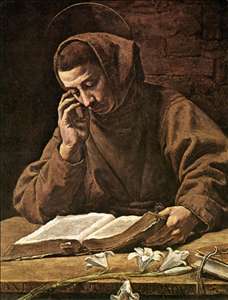
Saint Anthony Reading by Marcantonio Bassetti

Six Important Truths about Scripture

In conclusion, I would like to leave the reader with helpful points of orientation that I found some years ago in the work of a now-forgotten French Dominican, Fr. Chifflot.3 This balanced and traditional exegete presents six important truths about Scripture that serve as reliable principles for us while we study the sacred page.

1. The Bible is a sacred history. It is not metaphysics; it is a history, the history of a people. But as its protagonist is the Eternal One, it is necessarily unlike any secular history. It is the history of a “love affair” between the Infinite and the Finite. And so it evokes all the grandeur and beauty of God and all the misery, horror, desperation, and darkness of fallen man.

2. The Bible is a promise. The People of God has a history, and it is a forward-moving history, a journey towards a goal, a promised land. It is a book of hope which springs from past deliverance and longs for future fulfillment. There is thus always a tension in the text; it is not “merely” about the past, nor is it simply “news” about the present, or “predictions” of the future. It is about all time in its purposeful movement—the past and the future breaking into the present, the present stretching towards eternity.

3. The Bible is the book of Christ. The written word of God is about the personal Word of God, Jesus Christ, Son of the Father, who breaks into history as the Messiah or Anointed One. Saint Jerome famously says: “To be ignorant of Scripture is to be ignorant of Christ.” Pope Leo XIII adds: “In its pages His Image stands out, living and breathing; diffusing everywhere around consolation in trouble, encouragement to virtue and attraction to the love of God.” Blaise Pascal likewise speaks of “Jesus Christ, whom both Testaments concern: as the expectation of the Old, as the model of the New, and as the center of both.” As Saint Augustine says, the Old Testament is the New Testament hidden under a veil, while the New is the Old now made manifest. This being so, the Old Testament is thoroughly Christian, because it tells of the preparation of the chosen people for their Messiah, their unconquerable Davidic ruler. Since Christianity is the fulfillment of the Jewish religion, all that belonged to the Jews now belongs by right to us, including the Hebrew Scriptures. The Second Vatican Council’s Constitution on Divine Revelation Dei Verbum expresses these points beautifully.4

4. The Bible is the book of the Church. The Church opens the Bible for us. As Dei Verbum teaches:
There exists a close connection and communication between Sacred Tradition and Sacred Scripture. For both of them, flowing from the same divine wellspring, in a certain way merge into a unity and tend toward the same end. For Sacred Scripture is the word of God inasmuch as it is consigned to writing under the inspiration of the divine Spirit, while Sacred Tradition takes the word of God entrusted by Christ the Lord and the Holy Spirit to the Apostles, and hands it on to their successors in its full purity . . . Sacred Tradition and Sacred Scripture form one sacred deposit of the word of God, committed to the Church. . . . [T]he task of authentically interpreting the word of God, whether written or handed on, has been entrusted exclusively to the living teaching office [Magisterium] of the Church, whose authority is exercised in the name of Jesus Christ.5
History has borne abundant witness to this last claim: wherever the authority of the Catholic Church has been assailed or rejected, the authority of Scripture has grown progressively weaker, in some instances disappearing altogether. Conversely, wherever Scripture is accepted as divine truth, there is an awareness, bright or dim, of some supernatural reality called “the Church,” and a desire to belong to it, as if implicitly recognizing that a book by itself doesn’t make a religion. John Henry Newman made a similar observation in regard to Marian devotion, saying in his Letter to Pusey that, as a matter of historical fact, wherever the cultus of the Virgin Mary was abandoned, sooner or later faith in the very divinity of Christ was abandoned. Because of the ineffable mystery of the Incarnation, Mother and Son can never be parted, no more than Father and Son.

5. The Bible is a mirror. It holds up to us a mirror that reveals who we are, where we have come from, what we are destined for. It is a sword that penetrates the secret places of the heart: “For the word of God is living and active, sharper than any two-edged sword, piercing to the division of soul and spirit, of joints and marrow, and discerning the thoughts and intentions of the heart” (Hebrews 4:12).

6. The Bible is the book of prayer.6 The Bible is full of prayer; it is about men of prayer and their faithful worship, as well as men who are unfaithful and idolatrous. It shows us the pattern of life and the false paths of death. It gives us the words of so much of our liturgy. The Divine Office or Liturgy of the Hours consist chiefly of psalms, canticles, and short readings; the traditional Roman Missal is shot through with Scriptural verses from Introit to the Last Gospel. Unlike the new Lectionary, a repository of artificially segmented texts, and unlike the new Missal, a stripped and shivering product of rationalism, the great Missale Romanum is a living testament of Tradition, saturated with Divine Revelation, resonant, fragrant, irreducibly complex, united to the Word of God as bone of its bone and flesh of its flesh. Traditional Catholics have no need to feel “left out” of the movement to “recover” the Bible, for our Faith was already there, and it goes deeper than the moderns. Generations upon generations have been nourished and informed by the Word of God expressed with vibrant diversity and density in the liturgy itself, in architecture and the other plastic arts, in sacred music and religious hymns, in Catholic culture and its customs. Wherever the traditional Faith has been strong, the Bible has received the devotion its holy content deserves, the veneration its saving message demands. Now that our Holy Father Pope Benedict XVI is leading the way with a genuine reform of the Church, let us not fail to do our part to live a genuinely traditional Catholic life—not the truncated version that modernity sought to produce from the Enlightenment to the present, but the robust life of Faith practiced by our ancient and medieval forefathers, rooted in the Word of God and the Sacraments of the Church.
_______

Notes

  1. CCC 132, citing DV 24. [back]

  2. Zechariah is speaking here of servile or slavish fear, not of the filial or reverential fear that suits a child in relation to his parent and, all the more, a creature in relation to its creator. [back]

  3. T.G. Chifflot, O.P., Water in the Wilderness, trans. Luke O'Neill (Herder and Herder, 1967), 55-78. [back]

  4. See Dei Verbum, 14-16. [back]

  5. Dei Verbum 9-10; cf. the opening paragraph of Leo XIII's Providentissimus Deus. [back]

  6. See Chifflot, pp. 75-76. [back]

[Dr. Peter A. Kwasniewski is Professor of Theology and Philosophy at Wyoming Catholic College in Lander, Wyoming. The present article, "How Sweet are Thy Words," was originally published in Latin Mass: A Journal of Catholic Culture and Tradition, Vol. 18, No. 4 (Fall 2009), pp. 6-9, and is reprinted here by kind permission of Latin Mass Magazine, 391 E. Virginia Terrace, Santa Paula, CA 93060, and the author.]

Friday, January 15, 2010

How the Old Mass Shaped the New World


By Michael P. Foley

The fortieth anniversary of the Novus Ordo is a few weeks away, as it was Pope Paul VI’s wish that his new form of the rite take effect on the first Sunday of Advent in 1969.1 While the Pauline Missal was not published until the following year (and its translations much later), this date is as good as any to reflect on a momentous change to the Roman Church’s worship. Because forty is the biblical number for a generation, I would like to devote this column to a reflection on what we may have subsequently lost, not theologically or spiritually, but culturally. My point of departure is a brusque statement from Doctor John Senior: “from the cultural point of view, the new Catholic Mass established in the United States has been a disaster.”2 What could Senior have meant by such a harsh conclusion, and is there any justification for his opinion?

Sacrifice and Civilization

To understand Senior’s position, we must first surmise his view of Western culture:
Whatever we do in the political and social order, the indispensable foundation is prayer, the heart of which is the Holy Sacrifice of the Mass, the perfect prayer of Christ himself, Priest and Victim, recreating in an unbloody manner the bloody, selfsame Sacrifice of Calvary. What is Christian Culture? It is essentially the Mass. That is not my or anyone’s opinion or theory or wish but the central fact of two thousand years of history. Christendom, what secularists call Western Civilization, is the Mass and paraphernalia which protect and facilitate it.3
Senior goes on to describe the Mass as emanating outwards to all aspects of life. What is done on a stone altar inspires the construction of a beautiful church. The church inspires a garden and clerics to tend the church and the people who flock to it. Next to the church and the garden is built a cemetery for those who died as faithful servants of what is done on that altar; and around the church-grounds people build their houses and sow their fields, until a community is formed. That community needs laws, and the laws cannot help but be influenced by the sense of justice that radiates from the center of its citizens’ lives. And before you know it, you have a Christian world built around the Mass.

What Senior calls the “central fact of two thousand years” can indeed be confirmed in the history of several towns and cities in Europe, the most famous of which is Munich, Germany, which honors the Benedictine abbey that led to its creation with its very name, Munchen or Munich being German for “monk.” Nor is this a phenomenon unique to the Middle Ages. Fittingly, it is being enacted by several of John Senior’s former students who converted to Catholicism and became Benedictine monks observing the traditional Roman rite. At the invitation of the local bishop, they founded Clear Creek Monastery in a remote corner of Oklahoma ten years ago, and already neighboring lands are being bought and developed by lay Catholics as the monks build a Romanesque church they wish to last a thousand years. If you want to see how the new West, the West not of ancient Greece and Rome but of Christian Europe, became the most astounding civilization in the history of the world, take a trip to rural Oklahoma.

And if you want to know why, then consider more closely the nature of Christianity. As Father Frederick Faber points out, Christianity is “eminently a religion of sacrifice,” and hence, he says, "Where there is no Mass, there is also no Christianity.” Faber sees all of Christian life as an extension of the sacrifice that is the Mass. All of the Church’s charitable works, all of her vows of religious life, all of her teachings, are “nothing but a glorious and unmistakable preaching of sacrifice,” a sacrifice that flows from “the vital force and omnipotent energy of the Mass. That far reaching Sacrifice is everywhere, and does everything for everyone.”4

The Arts


It certainly did something for architecture. Romanesque and Gothic architecture, the Spanish mission style of the American Southwest, the Baroque style of seventeenth-century Europe: all flow from the Mass. The beauty, order, and proportion of the traditional Latin Mass is reflected in the beauty, order, and proportion of the churches in which it was celebrated, and this in turn went on to inspire architecture outside the church. Even basic architectural terminology owes a debt to the Mass. Romanesque and Gothic churches had several levels of allegorical pictures, reliefs, and sculptures on their façades that each told a story. And since several levels of these representations told several stories, it became the custom to indicate the height of a building by how many “stories” it had.5

We also see the impact of the Mass on the Western legal tradition, not only in the weighty matters of jurisprudence and the rule of law but in the tiniest of details. Have you ever noticed a striking similarity between a traditional church design and a courtroom? Public seating in a courtroom gallery, for example, is akin to the pews in the nave of a church; the space for the lawyers and judge is similar to the sanctuary where traditionally only the clergy would be allowed (note that many courtrooms demarcate this space with a “bar” similar in appearance and function to a communion rail); the judge’s bench, elevated and set apart, assumes the same importance as the high altar, which only certain members of the clergy are permitted to approach and only at certain times; the jury benches resemble the choir stalls found in many medieval churches; and the personnel who move in and out of the bench area, such as the bailiffs, resemble the acolytes serving the priest.

And then there is music. It is not just that without the august sacrifice of the Mass, we would be missing out on two of the grandest and most magnificent categories of classical music, the Missa and the Requiem, categories that have been filled with awesome splendor by the likes of Bach, Haydn, Mozart, Verdi, Berlioz, Fauré, and Dvorak. It is not just that we would be missing out on Passion music or Lamentations pieces.

No, it is more basic than that. Without the Mass, there would probably be no Western tonal scale as we know it, for it was the Gregorian chant enshrining the Mass that preserved the eight modes of ancient Greek music, and it is on two of those modes that our major and minor keys are based. Without the Mass, there would probably be no musical notation, which developed in the Middle Ages because the body of Gregorian chant for the liturgical year was growing too large for any one person to remember in its entirety. Without the Mass, there would be no polyphony, no oratorios such as Handel’s Messiah (a genre invented by the founder of the Oratorians, Saint Philip Neri), and no opera as we know it, which developed with the help of the early Jesuits. Without the Mass, there would be no solmization, that is, no simplified way of reading music by sight with the use of the do-re-mi scale, for this method was invented by an Italian monk using the hymn for the Feast of Saint John the Baptist.

And without the Mass, there would not be even some popular secular music, such as carnivale, which developed as a way of bidding adieu to fun right before Lent, and jazz, which developed because slaves in New Orleans were allowed to assist at Mass and express their culture on Sundays and holy days, which in turn allowed for a new synthesis of African and European sounds to emerge at the beginning of the twentieth century. Without the Mass, there would also not be the current style of tobacco auctioneering, which was developed in the nineteenth century after its creator heard Gregorian chant at a High Mass.

Reply to an Objection

At this point we might wonder whether what I have been saying could apply to any form of the Mass, that it need not have been the extraordinary form of the Roman rite behind these developments. While I do not deny this possibility, I would nevertheless indicate three reasons why the traditional Latin Mass, and not some other form of the Eucharistic liturgy, has proved to be such a powerful leavening agent.

1. Stability

First, the extraordinary form is the product of slow and gradual change which gives it stability and continuity, and all without being fossilized like a butterfly in amber. This stability, in turn, provides a reliable springboard for dynamic cultural change. As the philosopher Michael Oakeshott points out, in order to undertake vast new projects, even the most progressive of dreamers must be conservative with his tools, for it is familiarity with one’s tools that enables one to effect sweeping changes successfully.6 Think of how little Microsoft or Apple would accomplish if the order of the letters on their employees’ keyboards were changed every week, an order that has remained the same since it first appeared on a manual typewriter in 1874.

In this analogy, the liturgy is not the project but the tool: it should not be the object of change, but the agent of change, and as such it should not be subject to much change itself. You would think that a changing liturgy would be good for a changing culture, but it is not. For it is not the liturgy that should change dramatically at the hands of the faithful; it is the faithful that should change dramatically at the hands of the liturgy. It is they that should be shaped and reshaped by the sacred mysteries made present in divine worship, a reshaping that goes on to affect the way they perceive reality, make decisions, and live their lives—in other words, the way they produce a culture and a civilization. Conversely, when the liturgy changes all the time, people do not, and the culture suffers accordingly.

2. Manliness

Second, the traditional Latin Mass exudes a healthy understanding of Christian manhood. This is important from a cultural perspective, not because men are the only contributors to human culture (for they are not), but because great cultures thrive when its men view themselves as called to protect the things and persons that produce great culture. This male presumption, I hasten to add, is in no way prejudicial against women; on the contrary, a world in which biological fathers act as good spiritual fathers and in which even single men comport themselves not as predators or playboys but as potential fathers would be a world which allows both sexes to flourish, protected from the evils that uncivilized manliness brings.7


But encouraging the right kind of manliness is difficult because men do not have the same obvious cues from nature as women do about how precisely they are indispensable to the flourishing of the human race; they are thus more prone to overlook their higher, noble calling or, to put it in more modern jargon, they are more likely to have an identity crisis. This is a point I would like to develop in a later article, but let me for the moment simply state that traditional, apostolic liturgy helps greatly in promoting the Christian notion of chivalry that goes so far in resolving this crisis. This is obvious in the Byzantine rite: while the West is seeing fewer and fewer men in the pews, Orthodox and Eastern Catholic churches consistently retain roughly equal numbers of men and women, in large part because their liturgy is demanding, hierarchical, non-pandering, and disciplined, all the things that appeal to a manly spirit.8 And while lay women are active in the life of the Eastern churches, their sanctuaries are generally reserved to male priests, male servers, and male lectors.

This is apparent in the Tridentine rite as well, which not only has a clear hierarchical structure and sense of discipline that boys and men find appealing, but is guarded by boys and men in the form of the priest and his ministers. The new Mass, by contrast, does not send the same clear signal. A focus on meal rather than sacrifice, for instance, deprives men of an important manly concept, for it was men and men alone who sacrificed rams and bullocks and calves to the Lord God in the Old Testament, and it was the Son of Man who offered the ultimate sacrifice of Himself on the cross in what is world history’s greatest manly act. Second, Mass facing the people gives the impression that Mass is about the people rather than God, and with this comes the loss of a vertically-oriented hierarchy. And third, the relatively few rubrics of the new Mass give it less structure and less discipline, especially where reverence of the Eucharist is concerned.

These are all internal characteristics of the Missal which have been magnified by external modifications to its execution, namely, the inclusion of female lectors, distributors of Holy Communion, and altar servers. Father James McLucas has written eloquently in this magazine of the effect that this “outsourcing” of the celebrant’s privileges has had on the priesthood: “The notion that the Church can offer the work of the priest to others without doing harm to both his masculinity and personality is a gross presumption.”9 Others are quick to point out that using female altar servers is bad for priestly vocations, since boys are naturally drawn by the example of other males serving and protecting God’s sacred things, and if you add even one girl to the mix, it spoils the entire ethos of a chivalrous band of brothers. But I would go one step further: having female ministers in the sanctuary is not only bad for priests and for potential priests, it is bad for the men and boys who have no vocation to the priesthood whatsoever. And what is bad for men and boys is bad for the culture.

3. God at the Center

The third and final reason is the simple fact that the extraordinary form makes it unmistakably clear that, in the other words of my pastor Father David Leibham, “it is about God—period.” This is true about the traditional Latin Mass even when it is celebrated, as Father Jonathan Robinson puts it, “carelessly, stupidly, or perhaps, sometimes, wickedly.”10 Robinson, who does not write as a friend of the extraordinary form, nevertheless admits that “the perennial attraction of the Old Rite is that it provided a transcendental reference, and it did this even when it was misused in various ways.”11 His example is Mass with the king of France at the palace of Versailles, in which the king sat in a tribune that was more prominent than the altar. The king’s nobles would sometimes form a circle around him at the foot of the altar, their backs to the sanctuary as they gazed attentively at their monarch. Needless to say, this is “messed up,” but Robinson notes that even here the “Mass held its own” against this twisted arrangement. The nobles were there to worship their earthly king, not God, and yet the king they were worshipping was worshipping the true God. Hence, even if they were there to fulfill a worldly end, the king’s orientation “was a living testimony that there was another power that even the absolute monarch was forced to acknowledge.”12


By contrast, Robinson observes, while the Novus Ordo can be celebrated in a reverent way that directs us to the transcendent, “there is nothing in the rule governing the way the Novus Ordo is to be said that ensures the centrality of the celebration of the Paschal mystery.”13 Indeed, there are professional liturgists who prefer the new form of the rite because it allows them to engraft all sorts of non-liturgical agenda onto the liturgy. One priest, for example, sees the Mass as a great opportunity to bolster ethnic self-esteem, address ecological degradation, and encourage economic empowerment.14 Note that he prefers the ordinary form because it is a more malleable vehicle for cultural development; yet ironically, great culture has not exactly sprung from the celebration of the ordinary form.

Conclusion

We are now in a better position to understand Senior’s harsh remark about the new Mass. Without denying that significant cultural goods may yet come out of the Pauline Missal, we can at least identify the secret behind the old Missal’s influence. That secret is found in Luke 12:31—“Seek ye first the kingdom of God and His justice, and all these things shall be added unto you.” As we approach the fortieth anniversary of a kind of wandering in the wilderness, let us at the beginning of a new liturgical year renew our appreciation for the extraordinary form and the paradox behind it: When you seek God first and find Him in a Mass that points to Him vividly, the results are simply marvelous.

Notes

  1. November 30, 1969. Cf. Paul VI’s Apostolic Constitution, Missale Romanum. [back]

  2. The Restoration of Christian Culture(Ignatius Press, 1983; reprinted, Roman Catholic Books), 38. [back]

  3. Ibid., 16-17. [back]

  4. Father Frederick Faber, The Blessed Sacrament, bk. 2. [back]

  5. For more details on the historical facts mentioned in this article, see my Why Do Catholics Eat Fish on Friday?: The Catholic Origin to Just About Everything(Palgrave Macmillan, 2005). [back]

  6. Michael Oakeshott, “On Being Conservative,” in Rationalism in Politics, ed. Timothy Fuller (Liberty Fund, 1991), 179f. [back]

  7. Cf. Harvey Mansfield, Manliness (Yale University Press, 2006), 242. [back]

  8. For a fascinating discussion on men and Eastern Orthodoxy, cf. the prologue of Frederica Mathewes-Green’s Facing East: A Pilgrim's Journey into the Mysteries of Orthodoxy, available at http://www.frederica.com/facing-east-excerpt-1/, and “Men and Church,” available at http://www.frederica.com/writings/men-and-church.html. [back]

  9. 22. [back]

  10. Jonathan Robinson, The Mass And Modernity (Ignatius Press, 2005), 308. [back]

  11. Ibid., 307. [back]

  12. Ibid., 308. [back]

  13. Ibid., 311, italics added. [back]

  14. Reverend David William Antonio, An Inculturation Model of the Catholic Marriage Ritual (The Liturgical Press, 2002), 98-100. [back]

[Michael P. Foley is associate professor of patristics at Baylor University. He is author of Why Do Catholics Eat Fish on Friday?: The Catholic Origin to Just About Everything(Palgrave Macmillan, 2005). Dr. Foley's article, "How the Old Mass Shaped the New West," Latin Mass: The Journal of Catholic Culture and Tradition Vol. 18, No. 4 (Fall 2009), pp. 38-41, is reproduced here by kind permission of Latin Mass, 391 E. Virginia Terrace, Santa Paula, CA 93060, and the author.]

Saturday, November 21, 2009

Undoing the Dismal: Liberating Sunday's Soul

by Michael P. Foley


One of the recurring themes of Benedict XVI is the vital nature of Sunday. At the 2005 Eucharistic Congress, at the 2005 World Youth Day, and in a 2007 sermon in Vienna, the Pope repeated an arresting line from the acts of the martyrs. In A.D. 304, forty-nine Christians were apprehended for assembling on Sunday, in violation of imperial law. When the Procounsul asked them "why on earth they had disobeyed the Emperor's severe orders," one of them, a man named Emeritus, replied: "Sine dominico non possumus."1 Emeritus' response has been justifiably translated "Without Sunday we cannot live," but its literal meaning is even more astonishing: "Without Sunday, we cannot exist."

Sustaining Life

Why make such a fuss over a day of the week? Pope Benedict was reflecting on this question years before his elevation to the throne of Peter. For the early persecuted Christians, he wrote in 1996, it was not "a case of choosing between one law and another, but of choosing between the meaning that sustains life and a meaningless life."2 We may get a sense of this meanng by applying one of the things that Yahweh said about the Hebrew Sabbath to the Christian Sunday: "If thou turn away... from doing thy own will in My holy day, and call the Sabbath delightful, and the holy of the Lord glorious, and glorify Him... Then shalt thou be delighted in the Lord, and I will lift thee up above the high places of the earth, and will feed thee with the inheritance of Jacob thy father" (Is 58: 13, 14).

Note the essential elements of God's promise: The Lord has established a holy day, and man's proper response is to: 1> turn away from his own will and conform it to the will of God; 2. delight in that holy day; and 3. glorify God. If these conditions are fulfilled, God will be someone we truly love rather than merely obey, and we will be lifted up above our earthly drudgery and fed with a heavenly inheritance. A proper observance of the Lord's holy day, in other words, is a life-transforming experience that gives new meaning to our existence. No wonder that as early as the second century, Saint Ignatius of Antioch was defining Christians as those "who live in accordance with Sunday."3

The Christian Sabbath?

As our use of Isaiah would suggest, it is tempting to think of Sunday as the "Christian Sabbath." One must be careful here, however. While it is true that the duties of the Third Commandment regarding the Sabbath (Saturday) have been transferred to Sunday, Sunday springs not from the Old Covenant but from the Resurrection. The Day of the Resurrection falls on the first day of the week, in which God created light, and thus it marks a new beginning and a new creation. Every Sunday is a little Easter, or better yet, every Easter is a big Sunday. The risen Christ's sanctification of Sunday was a reality the Church appropriated slowly but surely: in the Acts of the Apostles, the first Christians observed the Jewish Sabbath along with their own services the next day (Acts 18:4; 20:7); but by the time the Book of the Apocalypse was written, Saint John could speak of "the Lord's Day" (Apoc. 1:10) with the expectation that his readers would know exactly what day he was talking about.4

Freedom from Servility

Sunday also became a day of rest. In 321 the Emperor Constantine, wishing to extend the same honor to Sunday traditionally accorded to pagan feasts, forbade courts to be in session and most kinds of material labor. Interestingly, canon law lagged behind civil law in regulating Sunday as a work-free day, though church officials eventually came to see Sunday, like the Sabbath it replaced, as a way of conforming ourselves to God's will by refraining from the busywork that we, laden with cares, have become addicted to.

Fundamental to this rest is the distinction between servile labor (the kind of work a servant or hired hand does) and liberal activity, that which liberates the soul or is befitting a free man -- reading and writing, arts and entertainment, sports and games, hobbies. Hence the 1917 Code of Canon Law forbids on Sundays and holy days of obligation all "servile work, judicial proceedings and, unless legitimate custom or special indults permit them, public trafficking, public markets, and all other public buying and selling (1248).

The prohibition of servile work had a tremendous impact on Western life, for it meant, among other things, that once a week a slave was his master's equal. As early as the fourth century, many masters would even release their slaves from work on Saturday so that they could better prepare for the Lord's Day, a custom that foreshadows our modern weekend.5 And because a slave's labor was his own on Sunday, he could eventually earn enough money to buy his freedom. In 1724, King Louis XV of France issued the Code Noir, a set of laws protecting slaves and free persons of color in Louisiana. As a result, many slaves and free blacks could gather every week at the old Congo Square in New Orleans, where they would dance and sing to the beat of an African drum, and instrument banned in most other parts of the Protestant-dominated American South. From this freedom to foster and develop culture came the eventual formation of that uniquely American music: jazz. The joy and genius that springs from Sunday is a perfect illustration of Aristotle's paradoxical observation that all action begins in contemplation.

Savoring the Useless

Aristotle privileges contemplation because it is the activity of what is highest in us, our capacity to transcend space, time, and matter and to revel in wonder and discovery. As Josef Pieper argues in his magnificent study Leisure: The Basis of Culture,any attempt to deny this "divine spark" ultimately dehumanizes us, reducing us to mere economic or social units. Servile labor is obviously a good thing, but its prohibition on Sunday reminds us that it is not the highest thing. The servile arts are around because they are useful, but that means we are using them to get to some other, greater good we want more.

A good, on the other hand, that we want or its own sake is something we enjoy: it is a worthy choice regardless of its utilitarian value. When I read my favorite author, it is not because he can help me with my job or my relationships or my car problems, but because his work brings me delight; it is a joy to read, even if there are no practical applications to be derived from it. All of our useful skills and pursuits are there to serve our enjoyment of what is, strictly speaking, useless.

Sunday rest is therefore an essential weekly reminder of the true hierarchy of goods, an admonition to make sure we are not is taking the means for the end. In our consumerist society, this is not easy task. For the last three hundred years the West has placed an exorbitant emphasis on productivity and practicality, portraying the useful as good and the useless as bad.

But the Catholic intellectual tradition, lifting a page or two from classical philosophy, sees through the falseness of this view. It affirms that while the useful is indeed good, it is not a good as a certain category of the useless. Man is meant for something far higher than being a mere consumer or producer, as the two giants of capitalism and communism would both have us believe: man is meant to contemplate the face of God and be happy. As the new Catechism succinctly puts it, the Sabbath "is a day of protest against the servitude of work, and the worship of money" (2172).6 While six days of the week enable us to pay the bills and maybe ensure a decent retirement, Sunday enables us to anticipate the ultimate freedom of enjoying the bliss of the Beatific Vision in eternity.

Sunday, therefore, is a gift that God gives all of us every week to add dignity to our lives and to elevate our natures. And it is our privilege to accept this gift. In the words of Cardinal Faulhaber, "Give the soul its Sunday, and give Sunday its soul."7

Lands Without a Sunday

In the modern era the dramatic increase of white-collar professions and new fields of knowledge sometimes makes it difficult to identify what activities are and are not suitable for Sunday. As Cardinal Newman noted over a century ago, there "are bodily exercises which are liberal, and mental exercises which are not so."8 If I practice woodworking as a hobby, I am engaging in the same manual labor as professional carpenter but in a liberating, non-servile way. Conversely, if I am studying theology (the most liberal of all the arts) in order to meet a publishing deadline, I am taking the liberating luster off my activity; "for Theology thus exercised," Newman writes, "is not simple knowledge," but "an art or a business making use of Theology."9 Whatever we do n Sunday, be it with the hand or the mind, we must be careful that it not be "cut down to the strict exigencies"10 of utilitarian ends, but wrought purely for the sake of relaxation and enjoyment.

Sunday's decline in modern life is not due to an increasingly complex workforce, however. As Pieper notes, the modern doctrine of "total work" has left little room for a genuine celebration of Sunday. This was true even fifty years ago, when Christians of all stripes adhered to the principle of Sunday rest11 and when civic laws still protected Sunday from consumerist encroachment.

Maria von Trapp, inspiration behind the Sound of Music, gives a concrete example of this in her excellent essay, "The Land Without Sunday."12 The title is ostensibly a description of life in the Soviet Union, which ruthlessly suppressed the Lord's Day, but as becomes clear from reading on, it also applies to contemporary America.13 The Trapp family, which started preparing for Sunday the day before by refraining from work and by reading the texts of the Mass together and then spending the Lord's Day in joyous leisure, was shocked by what they saw when they came to the U.S. in 1938: Saturday nights spent in revelry and Sunday mornings spent hung over; farmers doing work on the Lord's Day as on any other; and the bells of Saint Patrick's Cathedral in New York City silent because "it would be too much noise" -- in New York City, mind you.14 "When we lived in a suburb of Philadelphia," Maria von Trapp writes, "we found that the rich man's Dunday delight seemed to consist of putting on his oldest torn pants and cutting his front lawn, or washing his car with a hose."15

Mrs. von Trapp also discovered another cause behind the demise of the traditional Sunday: Calvinism. Her children were stunned when a woman told them how much she "hated Sundays." The reason, they learned, is that she was brought up in a Puritan household where her mother would lock up all the toys on Saturday night. On Sunday morning, after a long sermon in church, the children were forbidden to play any games, listen to any music, or have any kind of fun. The lady went on to say that she vowed permanent rebellion against this upbringing and would never force her children to go to church.16

The Trapp's friend was not describing an isolated incident. After the Reformation, sports and popular amusements (to say nothing of open pubs) were forbidden in several countries.17 Sunday was now defined as a time for instruction, not enjoyment.

And alas, the Catholic Church has not fared well in counter-acting these tendencies. The post-conciliar allowance of Vigil Masses, some as early as 3 p.m. on a Saturday afternoon, has compromised Sunday's integrity,18 while for the past several decades the Magisterium has omitted virtually all references to servile work in discussions on the Lord's Day: the term has been dropped from the 1983 Code of Canon Law19 and from the new Catechism. My guess is that there was a concern over confusing servile work and manual labor, yet as we saw with Cardinal Newman's remarks, the concept of servile work actually clarifies rather than conflates the difference between working with one's hands and working for a mercenary or utilitarian end.

Whatever the motive, the absence of the servile/liberal distinction and the concrete parameters that flow from it make it easy for the individual to bend Sunday to his will rather than vice versa and contribute to the deterioration of a more socially-shared observance. The new Catechism, for example, speaks eloquently of Sunday's purpose and of the fact that "sanctifying Sundays and holy days requires a common effort" (2187); yet working in common is more difficult when there is no concrete, common understanding of what should and should not be done.20

Take Back the Day

Instead of dwelling on our current "dismal" situation (a word that, incidentally, means "bad day"), I would like to offer five practical suggestions for giving Sunday back its soul.

Resist commercial temptations. Louis Martin, the father of Saint Thérèse of Lisieux, refused to open his jewelry shop on Sunday even though his confessor permitted it, nor did he buy anything on the Lord's Day. One Sunday, when he was an item he really needed, he asked the vendor to hold it for him until the following day.21 While it is true that sometimes Sunday shopping (e.g., for one's hobby) can be a leisurely activity, the more we can resist the temptations to earn or spend money, the better.

Agape. The agape meal was the primitive Church's banquet after the conclusion of the Eucharistic liturgy. The family Sunday dinner, celebrated with extra festivity, is a good adaptation of this Apostolic custom and perhaps in the spirit of relieving the downtrodden, it could be spearheaded by Dad and the kids instead of Mom). Similarly commendable is the coffee-and-donuts hour which many churches offer after Mass. this fosters Catholic fellowship as well as the leisurely quality of the day by discouraging the race-out-of-the-parting-lot mentality so many American Catholics have the moment their Sunday obligation has been fulfilled.

More than Mass. Another way to avoid reducing Sunday to one begrudgingly conceded hour at church is to punctuate it with other forms of prayer. In Europe many churches held Solemn Vespers on Sunday evening, so much so that Sunday dinner was often called the "vesper meal." Exposition of the Blessed Sacrament, the family Rosary, and the recitation of Lauds and Vespers are the other ways of sanctifying the entire day to God.

Attend the Latin Mass. While saying this in The Latin Mass is preaching to the converted, it bears mention nonetheless. A friend of mine found himself attending the Latin Mass several years after his conversion. It was at that point, he told me, that the concept of a "Sunday obligation" no longer made sense to him. He could not see Sunday Mass as an obligation any more: it was instead the highpoint of his week, the one thing he really looked forward to. There is something about the traditional Latin Mass, especially the High Mass, that slips the surly bonds of necessity or compulsion of utilitarianism or functionality. It is there to be enjoyed, to give us an experience of Heaven. The Pope has spoken of how the "Sunday precept is not ... an externally imposed duty, a burden on our shoulders," but "a joy."22 For more than a few Catholics, this is easy to see, thanks to the Latin Mass.

Fill your day with merriment. Plan games for your children (croquet is a Foley Sunday favorite) and find fun ways to bring the sacred meaning of the day to their level. We have "sacred theatre," which is something like a puppet show of the Epistle and Gospel readings performed with home-made cardboard cutouts. Another personal recommendation is reading Pieper's Leisure: The Basis of Culture.Early in our marriage, my wife and I would read chapters of it to each other after we came home from Mass and brunch with friends. It is one of my happiest memories of our salad days. And how fitting to learn the theory of leisure while practicing it.

Conclusion

The nineteenth-century poet Ahad Ha'am is said to have made the famous observation, "As much as the Jews kept the Sabbath, the Sabbath kept the Jews." No doubt something similar can be said of Catholics and the Lord's Day. Nowadays Sunday is honored, even by practicing Catholics, more in the breach than in the observance, and the only ones that seem to have responded to the Pope's admonitions are a splinter-group of Seventh Day Adventists worried that this ominously signals a return to the Holy Roman Empire.23 While there may not be easy answers for the proper way to observe the Lord's Day int he contemporary age, one thing is clear: The first step to any recovery, not just of the liturgical year but of the Catholic life of Faith, is the reconquista of Sunday.

Notes
  1. Homily of His Holiness Benedict XVI, 24th National Eucharistic Congress, Bari, Italy, 29 May 2005 [retrieved November 2009]. [back]

  2. Joseph Cardinal Ratzinger, A New Song for the Lord: Faith in Christ and Liturgy.trans. Martha M. Matesich (New York: Crossroad Publishing, 1996), 60. [back]

  3. juxta dominicam viventes. Ep. ad Magnesios, 9, 1-2. Cited in the Bari Homily (see footnote 1). [back]

  4. Though the supremacy of Sunday to Christian life was well-established by the second century, the double observance of the Sabbath and the Lord's Day persisted in some parts of the Church into the fourth century. To this day the Greek Church considers Saturday as well as Sunday exempt form all laws of fasting and abstinence. [back]

  5. Francis X. Weiser, S.J., Handbook of Christian Feasts and Customs: The Year of the Lord in Liturgy and Folklore(New York: Harcourt, Brace & World, Inc., 1958), 9. [back]

  6. Judging by the context, this applies to the Lord's Day as well. [back]

  7. Quoted by Pope Benedict XVI in his homily delivered during Mass at Saint Stephen's Cathedral, Vienna, 9 September 2007 [retrieved November 2009]. [back]

  8. John Henry Cardinal Newman, The Idea of a University(London: Longmans, Green, and Co, 1907), 107. [back]

  9. Ibid, 109. [back]

  10. Ibid. [back]

  11. The one notable exception are the Seventh Day Adventists. [back]

  12. See Maria Augusta von Trapp, Around the Year with the Trapp Family(New York: Pantheon, 1955), 186-202. [back]

  13. It is ironic that two such antithetical systems of human organization should breed such similar vices. [back]

  14. Trapp, 198. [back]

  15. Ibid, 199. [back]

  16. Ibid, 200. [back]

  17. Weiser, 10. [back]

  18. Saturday vigil Masses are not per se bad (in early Christian Rome they occurred every Ember Saturday); it is the way they are used today that is problematic. [back]

  19. The new Code of Canon Law states that the faithful "are to abstain from those works and affairs which hinder the worship to be rendered to God, the joy proper to the Lord's Day, or the suitable relaxation of mind and body" (1247). An excellent formulation, but why not retain the notions of servility and liberality? [back]

  20. The new Catechism has perhaps also conceded too much to our consumerist economy by not speaking with sufficient verve against the market's increasing tendency to treat Sunday as any other day. [back]

  21. Celine Martin, The Father of the Little Flower,trans. Michael Collins (Tan Books, 2005), 11-12. [back]

  22. The Bari Homily (footnote 1). [back]

  23. For a good laugh, see Gerald Flurry, "The Pope Trumpets Sunday," The Trumpet (November 2005) [retrieved November 2009]. [back]
[Michael P. Foley is associate professor of patristics at Baylor University. He is author of Wedding Rites: A Complete Guide to Traditional Vows, Music, Ceremonies, Blessings, and Interfaith Services(Eerdmans, 2008) and Why Do Catholics Eat Fish on Friday?: The Catholic Origin to Just About Everything(Palgrave Macmillan, 2005). Dr. Foley's article, "Undoing the Dismal: Liberating Sunday's Soul," Latin Mass: The Journal of Catholic Culture and Tradition Vol. 18, No. 2 (Spring 2009), pp. 32-35, is reproduced here by kind permission of Latin Mass, 391 E. Virginia Terrace, Santa Paula, CA 93060.]
All Hallows' Eve (October 31)

"One may not think of the month of daylight savings time, breast cancer awareness, and Oktoberfest as particularly controversial, but beneath the surface of several Catholic holidays in October are truths and memories that bring a maelstrom of protest from the modern world," writes Michael P. Foley in "The Controversial Holidays of October" (Latin Mass magazine, Summer 2009).

The first of those we reviewed in "The Controversial Founding of Columbus Day" (Musings, October 11, 2009). Here we resume the rest of Foley's article on the holiday popularly known as "Halloween."
Controversy also surrounds another well-known American holiday, with various voices denouncing or defending it as darkly pagan, harmlessly secular, liturgically Catholic, or historically anti-Catholic. In a sense, they are all right, for Halloween is a fascinating combination of all of the above.

Halloween began as the Celtic festival of Samhain,the Lord of the dead in Celtic mythology. It was believed that on the night before the feast, the gates of the underworld were opened and that ghosts, demons, and witches were allowed to roam freely. In response to this otherworldly menace, the Celts followed the principle "if you can't beat 'em, join 'em" and disguised themselves as various kinds of ghouls to escape harm. (From this practice comes our custom of Halloween masquerading.) And in addition to blending in with the infernal, the Celts also tried to appease evil spirits by offering them food and wine.

The Catholic Takeover

After the Catholic Faith came to Celtic lands, the old Druidic festival came to be associated with the night before All Saints' Day and was thus called All Hallows' Eve (a name that gives us the modern appellation of Halloween), even though the institution of All Saints' Day on November 1st was a complete coincidence. Church officials were gradually able to wean the Celts from their sacrifices, replacing the food offerings to the gods with "soul cakes" that would be made on Halloween and offered to the poor in memory of the faithful departed. This was centuries before the Western Church instituted November 2nd as All Souls' Day, the day commemorating the souls suffering in Purgatory.

The original intention of distributing soul cakes was doubly charitable, ensuring that the poor would be fed on this day, in exchange for which they would pray for the doner's dead. But eventually, "souling," as it was called, became more frolicsome as groups of young men and boys began going from house to house and demanding food, money, or ale instead of cakes. The Church, incidentally, also transformed the nature of masquerading during this time from the evasion of evil spirits to the emulation of Christian saints. Large processions in honor of all the saints were held in England and Ireland on the Vigil of the Feast, with participants either carrying relics or dressing up as angels and saints.

The Irish put an additional spin on the feast with their story about a deceased scamp named Jack. Jack had been kicked out of heaven because he was not good enough and out of hell because he kept playing tricks on the devil. It was thus arranged that Jack would roam the earth with only a lantern to guide him until the Last Judgment, when God would finally decide what to do with him. Hence the ubiquitous Halloween jack-o'-lantern, which in Ireland is made out of the potato and in America out of the more commodious pumpkin.

Modern Changes

The Reformation all but eliminated Halloween, since most Protestant ecclesial communities removed the Feast of All Saints from their calendar. In England, however, many of the old Catholic customs were transferred to Guy Fawkes Day six days later. Guy Fawkes Day commemorates a failed plot by several English Catholics to blow up Parliament on November 5, 1605. After the plot was foiled, the British government declared November 5 "a holiday for ever in ... detestation of the Papists.1 In the United States, the anniversary was known as Pope's Day, and despite George Washington's admonitions, it continued to be celebrated in some parts of the country well into the late nineteenth and early twentieth centuries.

Of the customs that were transferred, the principal one concerns door-to-door begging. Instead of souling, boys in England and later America would solicit lumps of coal on the night before the holiday in order to burn effigies of Guy Fawkes or the pope. After the Irish emigrated to the United States in the nineteenth century, bringing with them their old Halloween customs, the coal-begging of Guy Fawkes Day gradually elided back into the souling of October 31. It is from this combination of Irish Catholic and British anti-Catholic observances that our modern custom of trick-or-treating has emerged.2

What to Do

Halloween today can be celebrated in any number of ways, from innocent costumes and customs (such as bobbing for apples) to teenage vandalism to truly satanic cultic practices. It is because of this checkered past and present that many traditional Catholics prefer to host more explicitly religious events in addition to Halloween or not to observe the standard American Halloween at all. Adapting the old tradition of All Saints' masquerading, they host costume parties in which children dress as saints and in which games and contests are held and prizes rewarded.

Others infuse the old Christian meaning back into the holiday. Since it precedes the first class solemnity of All Saints' Day, October 31 was once a day of fasting and abstinence. One family we know teaches their children to think of trick-or-treating as a kind of harvest gathering for the real holiday of All Saints' and indeed for the entire first week of November. This not only keeps them from gorging themselves on their sweet plunder in a single night, it yokes their harmless fun to a deeper spiritual meaning. In former ages, All Saints' Day was celebrated for eight days, and though this octave was removed from the calendar by the time of the 1962 Missal, paraliturgical traditions continue to thrive in connection with All Souls' Day on November 2. Plenary indulgences, for example, are still offered from November 1 through 8 for visiting a cemetery and praying for the dead; and several Catholic cultures have long had special funereal foods and customs for this week. American Catholics of Western European descent have never had a robust "week of the dead" unlike, say, the Mexican people; and so saving Halloween candy for the saints and the poor souls in purgatory could be a way to fill this void and correct the abuses of Halloween to boot. One thing is certain: if the Church can snatch Halloween away from the Druids, she can certainly take it back from secular America.
Notes

  1. George William Douglas, The American Book Of Days,revised by Helen Douglas Compton (New York: The H.W. Wilson Company, 1948), p. 584. [back]

  2. Lesley Pratt Bannatyne, Halloween: An American Holiday, an American History(Gretna, Louisiana: Pelican Publishing Company, 1998), pp. 2-4, 9-11, 15-16, 142-143. [back]

[Michael P. Foley is associate professor of patristics at Baylor University. He is author of Wedding Rites: A Complete Guide to Traditional Vows, Music, Ceremonies, Blessings, and Interfaith Services(Eerdmans, 2008) and Why Do Catholics Eat Fish on Friday?: The Catholic Origin to Just About Everything(Palgrave Macmillan, 2005). Our present post was excerpted from Dr. Foley's article, "The Controversial Holidays of October," Latin Mass: The Journal of Catholic Culture and Tradition Vol. 18, No. 3 (Summer 2009), pp. 36-39, and is reproduced here by kind permission of Latin Mass, 391 E. Virginia Terrace, Santa Paula, CA 93060.]

The controversial founding of Columbus Day

"One may not think of the month of daylight savings time, breast cancer awareness, and Oktoberfest as particularly controversial, but beneath the surface of several Catholic holidays in October are truths and memories that bring a maelstrom of protest from the modern world," writes Michael P. Foley in "The Controversial Holidays of October" (Latin Mass magazine, Summer 2009). In a previous article, Foley already discussed one of these: the Feast of the Holy Rosary's commemoration of the defeat of the Turks at Lepanto (October 7). In the current issue, he turns to two more "October surprises" -- Columbus Day (October 12 or the second Monday in October) and All Hallows' Eve (October 31).1 Here we limit our attention to Columbus Day:
I should probably be given the stake for discussing a secular holiday in a column on the liturgical year, but Columbus Day merits our attention for several reasons. First the holiday owes its existence to the efforts of U.S. Catholic citizens, particularly the Knights of Columbus. In the 1900s the Knights lobbied state legislatures throughout the country to make the anniversary of America's discovery a holiday; not only did most states acquiesce, but the federal government eventually did as well, first as a national holiday in 1937 and then as a legal holiday (on which banks close) in 1971. Though they were instituted as a fraternal benefits organization, the Knights of Columbus were also keen to dispel anti-Catholic prejudice in the United States. One way to meet this goal was to emphasize America's debt to Catholic figures, starting with its papist discoverer. Not coincidentally, this fraternity, founded by an Irish priest, was named not after Saint Patrick but after the daring Italian who reached the shores of our hemisphere on a Spanish ship.

The Knights' strategy of claiming Columbus as a most Catholic of heroes was also a well-aimed counterattack. American historians had tried mightily to turn the famous seafarer into an Enlightenment figure, a secular saint championing scientific progress in the face of a superstitious Church still clinging to outdated ideas of a "flat earth." As it turns out, Columbus had nothing to do with the flat-earth debate; the story was invented out of whole cloth by Washington Irving in 1828 and later used as anti-Catholic propaganda to "prove" that that clerical religion was inherently hostile to rational inquiry.2 Queen Isabella's geographical advisers knew the globe was globular; they rejected Columbus' proposal because they had a much more accurate grasp of it's massive circumference, rightly concluding that his plan to reach China via a western route in a matter of weeks was unsound.

Given the prevalence of the anti-Catholic flat-earth myth, it is not surprising that Pope Leo XIII celebrated the four hundredth anniversary of Columbus' maiden voyage with these stirring (and perhaps overly generous) remarks:
But there is, besides, another reason, a unique one, why We consider that this immortal achievement should be recalled by Us with memorial words. For Columbus is ours; since if a little consideration be given to the particular reason of his design in exploring the mare tenebrosum ... it is indubitable that the Catholic faith was [his] strongest motive ... so that for this reason also the whole human race owes not a little to the Church.3
Take that, Know Nothings!

Pall Over the Holiday

Ironically, after winning the battle for Columbus Day, many Catholics today would prefer not to be associated with either the man or his holiday. While most Latin American countries commemorate the date of Columbus' discovery as the Día de la Raza (the Day of the Race, that is, the day the races met), Hugo Chávez's Venezuela observes observes Día de la Resistencia Indigena (Day of Indigenous Resistance). Similarly, Ward Churchill, the Colorado professor who made headlines for calling the victims of September 11 "little Eichmans,"4 has led the American Indian Movement's protests against the Columbus Day in Denver.

What Chavez and Churchill, in their characteristically understated ways, are alluding to the bleak events that followed Columbus' discovery. Despite the friendliness of the natives, Columbus' men initiated hostilities with them that culminated in a massacre, while Columbus himself enslaved a thousand Indians and instituted the repartimiento system that led to the serfdom of countless others for years to come. Combined with a wave of unintentionally imported diseases the local immune system had never encountered before, such treatment quickly decimated the Native American population.

Assessing Columbus

What, then, should we make of Columbus in light of his spotty record? I suggest five things.

First, it is clear that Columbus was not a good administrator on the land, and his incompetence led to cruelty. In fairness, however, before his undisciplined men destroyed relations with the native Taino or Arawaks, his goal was to protect them from the cannibalistic Caribs (one of the most savage peoples in the Americas) who were fast advancing. Indeed the Caribs remind us that the first step in assessing the Columbian legacy is overcoming any assumption that either side in the conflict has a monopoly on evil.

Second, it is important to remember that many of Columbus' contemporaries also deplored his deeds. Queen Isabel certainly did, which is why Columbus' third return to Spain was in chains, and Spanish law, thanks in large part to the Church's teaching about the full humanity of Native Americans, consistently condemned the actions of rapacious colonists. This is significant, for no other civilization has shown such a capacity for healthy self-criticism as the Christian. Indeed, the shrill condemnations of a Chavez or a Churchill are possible only because of the tradition of public self-examination first developed in Catholic societies.

Third, despite tragic costs, the benefits of European contract with the New World did far more good than harm. This is particularly true in the realm of evangelization. Columbus' genuine zeal to convert all peoples to Christianity should be commended rather than condemned. To depict all New World conversions as forced and foreign is, ironically, to patronize people of color, who were and are every bit as capable of seeing the beauty, truth, and goodness of the Gospel as their unwashed invaders.

Fourth, despite his flaws Columbus was a devout Catholic who, as Pope Leo XIII noted, was motivated by his Faith. His favorite prayers was Jesus cum Maria sit nobis in via -- "may Jesus, along with Mary, be with us on the way."5 Columbus chose to depart into the unknown the morning after August 2, the feast of Our Lady of the Angels, so that his men could celebrate this Marian feast with their families; he even made sure that they received confession and Holy Communion in order to obtain the plenary indulgence available that day.6 Columbus' prayers were apparently answered: his tiny fleet reached land on October 12, the day after the Feast of the Maternity of the Blessed Virgin.

Finally, Columbus Day praises not Columbus' explorations on land but his exploits at sea. We know that a single-minded man convinced the monarchs of Spain to fund an extremely hazardous journey with little likelihood of return, and that he pulled it off, not once but four times. We know that he was exceptionally courageous and resourceful, and we know that he was an outstanding seaman. There is nothing wrong with raising a glass to genuine courage and persistence, as long as one does not go on to use these to excuse other crimes and misdemeanors. I wonder if much of the animus against Columbus today really springs from a contemporary disdain for honor that would like to purge manhood of its chivalry and daring. As the historian William Carroll notes, "It is right to criticize the failings [of heroes], but wrong to deny their greatness and the inspiration they can give."7

And if there is any note of sorrow or regret to be struck on this otherwise celebratory occasion, it should not be fore the exceptional evil of the white man or the Catholic faith but for the universal darkness in man's heart so aptly explained by the doctrine of original sin. Yet, thanks be to God, this spiritual blight is never allowed to dwarf the triumph of the Cross, which providentially uses both vessels of honor and dishonor to meet its goals.

What to Do

How should one celebrate Columbus Day? In 1892 Pope Leo decreed that the four hundredth anniversary of Columbus' discovery should be marked with a Solemn High Mass of the Most Holy Trinity either on October 12 or on the following Sunday.8 (This was mandatory for Spain, Italy, and the two Americas, and recommended for the rest of the world, since "it is fitting that an even from which all have derived benefit should be piously and gratefully commemorated by all"). Certainly Mass would be a good idea today as well, along with a fervent prayer for the spiritual future of both the Old and New Worlds. And all of the documents I have cited are worth reading for more information on Christopher Columbus.

Perhaps one could even enjoy these readings with one of the items rumored to have returned with Columbus on his first voyage: tobacco. I would recommend a pipe for the occasion, as a cigarette is far too lowly a thing for honoring either the noble savage or the noble explorer. As for food, one could turn to any of the nationalities involved: American, Italian, Spanish, or even Caribbean. And for the little ones, miniature Niñas, Santa Marias, and Pintas can be made out of walnut shells, toothpick masts, and paper sails and used to adorn a cake or have a race in the bathtub.(To be continued ...)
Notes

  1. "The Feast of Our Fearsome Lady," TLM 16:4 (Fall 2007), pp. 60-61. [back]

  2. For the fascinating history of this myth, see Burton Russell, Inventing the Flat Earth: Columbus and Modern Historians(New York: Praeger, 1991). [back]

  3. Quarto Abeunte Saeculo (1892), 2, italics added. [back]

  4. He has also been sanctioned by his university for repeated acts of "serious research misconduct." [back]

  5. For more on Columbus' fascinating Catholicism, see Fr. John Hardon's lectures on Columbus at http://www.therealpresence.org/archives/Christopher_Columbus.htm. [back]

  6. The indulgence of the Portiuncula. [back]

  7. "Honoring Chrisopher Columbus," http://www.ewtn.com/library/HOMELIBR/COLUMBUS.HTM [back]

  8. Quarto Abeunte Saeculo (1892), 9. [back]

[Michael P. Foley is associate professor of patristics at Baylor University. He is author of Wedding Rites: A Complete Guide to Traditional Vows, Music, Ceremonies, Blessings, and Interfaith Services(Eerdmans, 2008) and Why Do Catholics Eat Fish on Friday?: The Catholic Origin to Just About Everything(Palgrave Macmillan, 2005). Our present post was excerpted from Dr. Foley's article, "The Controversial Holidays of October," Latin Mass: The Journal of Catholic Culture and Tradition Vol. 18, No. 3 (Summer 2009), pp. 36-39, and is reproduced here by kind permission of Latin Mass, 391 E. Virginia Terrace, Santa Paula, CA 93060.]

Related
New Catholic offers has posted a copy of Leo XIII's encyclical on the Columbus quadricentennial, Quarto abeunte saeculo highlighting those parts of the text of special interest at "COLUMBUS NOSTER EST" (Rorate Caeli, October 12, 2009).