Showing posts with label Bible. Show all posts

Sunday, January 31, 2010

How Sweet are Thy Words

The Bible lesson by Gerrit Dou

by Peter A. Kwasniewski

Let me begin with a massive understatement: the Bible is not an easy book, and few, too few, are Catholics who make the study of it a regular part of their spiritual lives. Indeed, before we even delve into it, we are confronted by the fact that the Bible is really many books of many different styles, periods, and particular purposes, so just opening it anywhere and starting to read will not prove the best approach for most of us. Because it was written under the inspiration of the one God, however, the Bible is also fundamentally one book: it deals with the one history of salvation for mankind and it has one goal in view—the knowledge and the love of God, leading to an ever more perfect union with Him. Since, as the Church teaches, “the ‘study of the sacred page’ should be the very soul of sacred theology,”1 there is nothing more important in theological studies and in our lifelong education as Catholics than turning and returning to the revealed Word. We must therefore regularly set apart time for this task—or, as the saints see it, this great privilege—of reading the only words that have God as their primary author.

Why read the Bible and make it a familiar companion? There are two kinds of answers to this question. One is merely human—a literary, sociological, or cultural answer. It’s good to be familiar with the Bible stories, they have formed Western culture, they are eloquent and moving, they illustrate the great problems of human existence. This answer is really beside the point, because all great literature does this; one could make exactly the same argument for reading Homer, Dante, or Shakespeare. Moreover, as both Saint Augustine and Saint Jerome observed long ago, the Bible is not always, at least for most of us, a “delightful” reading experience, the way poetry tends to be. It is full of perplexing obscurities, remote historical details, repetitions, seeming contradictions, not to mention brutalities and sensualities of a most unedifying nature, such that even the stuffed new Lectionary does not attempt to include them. It demands of us much effort if we are to crack the shell and reach the meat inside.

The other answer is that of faith. We read Scripture because it is what the Church claims it to be—God’s word, true and trustworthy, showing us the path of life, revealing to us something of who God is. In this respect it is unlike any other book we have. The Summa theologiae of St. Thomas Aquinas is well worth studying and one can easily devote one’s entire life to mastering its contents. But note how Saint Thomas says in the very first question of the Summa that all his efforts are placed at the service of sacra doctrina, the “holy teaching” that God Himself communicates to us through Scripture and Tradition, safeguarded and handed down by the Church. Saint Thomas had no illusions about the relative importance of his secondary text to the one and only primary source. If God had wanted to reveal either the Summa theologiae or the Catechism of the Catholic Church on Mount Sinai or, some centuries later, on the mount of the beatitudes, He could very easily have done so. The fact that He did not should make us wonder why He persists in speaking to us through so complicated an instrument.

In the end, therefore, it is really the conviction of faith that moves us, or should move us, to take up this book and persevere in reading it. Scripture rewards diligence (meaning, from the Latin diligere, a free and serious love), and it opens itself only to those who show their perseverance.

In What Spirit We Should Read

Scripture itself expresses well the spirit we should ask the Lord to give us as we strive to read and understand His words. The longest and most elaborately crafted Psalm is 119 (Vulgate 118), a hymn in praise of the law of the Lord and a plea for the grace to live according to it. The Psalm again and again mentions “thy word(s),” as in these verses:
11 I have laid up thy word in my heart, that I might not sin against thee.
16 I will delight in thy statutes; I will not forget thy word.
17 Deal bountifully with thy servant, that I may live and observe thy word.
25 My soul cleaves to the dust; revive me according to thy word!
103 How sweet are thy words to my taste, sweeter than honey to my mouth!
105 Thy word is a lamp to my feet and a light to my path.
130 The unfolding of thy words gives light; it imparts understanding to the simple.
160 The sum of thy word is truth; and every one of thy righteous ordinances endures for ever.
Echoing verse 160 above, Jesus prays to His Father: “Sanctify them in the truth; thy word is truth” (John 17:17). The prophet Jeremiah perfectly captures the appetite that we should have for this sanctifying and truthful word: “When I found your words, I devoured them; they became my joy and the happiness of my heart, because I bore your name, O Lord, God of hosts” (Jeremiah 15:16). In his second letter to Saint Timothy, Saint Paul discusses the important role that the “sacred writings” will have in the lives of those who strive to “live a godly life”:
All who desire to live a godly life in Christ Jesus will be persecuted, while evil men and impostors will go on from bad to worse, deceivers and deceived. But as for you, continue in what you have learned and have firmly believed, knowing from whom you learned it and how from childhood you have been acquainted with the sacred writings which are able to instruct you for salvation through faith in Christ Jesus. All scripture is inspired by God and profitable for teaching, for reproof, for correction, and for training in righteousness, that the man of God may be complete, equipped for every good work. (2 Timothy 3:12-17)
Old Woman Reading a Lectionary by Gerrit Dou

A Word of Life, Bread for the Soul

All of Scripture is based on the experience of the Holy by the Holy. Its overriding goal is that we, joining the saints of the old and new covenants, should likewise enter into communion with the living God. It was written by those who became saints for those who are now striving to become saints. Scripture speaks everywhere about vice and error, but it positively teaches only virtue and truth, which it receives directly from the source. As Saint Peter writes in his second epistle:
For we did not follow cleverly devised myths when we made known to you the power and coming of our Lord Jesus Christ, but we were eyewitnesses of his majesty. … You will do well to pay attention to this as to a lamp shining in a dark place, until the day dawns and the morning star rises in your hearts. First of all you must understand this, that no prophecy of scripture is a matter of one’s own interpretation, because no prophecy ever came by the impulse of man, but men moved by the Holy Spirit spoke from God. But false prophets also arose among the people, just as there will be false teachers among you, who will secretly bring in destructive heresies, even denying the Master who bought them, bringing upon themselves swift destruction. And many will follow their licentiousness, and because of them the way of truth will be reviled. (2 Peter 1:16, 19-21, 2:1-2)
This passage also begins to teach us about the need for an authorized, trustworthy interpreter of the holy writings, if they are to be a “lamp shining in a dark place,” rather than the false teaching and false prophecy that brings “swift destruction” and discredits the “way of truth.”

Consider, in conjunction with the foregoing text from Saint Peter, the following text from the first epistle of Saint John:
That which was from the beginning, which we have heard, which we have seen with our eyes, which we have looked upon and touched with our hands, concerning the word of life—the life was made manifest, and we saw it, and testify to it, and proclaim to you the eternal life which was with the Father and was made manifest to us—that which we have seen and heard we proclaim also to you, so that you may have fellowship with us; and our fellowship is with the Father and with his Son Jesus Christ. (1 John 1:1-3)
What Saint John is concerned to deliver is not bits of ephemeral information, a beautiful story or lyric; he is neither a modern journalist nor a novelist-poet. John heard, saw, and touched Jesus, and reclining at table against His breast, He received the ineffable gift of the Lord Himself in the most holy Eucharist. The next day he stood beneath the gibbet of the cross and watched the same Lord spill His Blood in atonement for our sins and those of the whole world. Two days later, John and Peter saw the empty tomb. That evening, the Lord newly risen from the dead stood before ten of the apostles locked in the upper room and said, “Peace be with you,” showing them His pierced hands and side. “That which was from the beginning, which we have heard, which we have seen with our eyes, which we have looked upon and touched with our hands . . .” It was out of these unforgettable, life-changing experiences that the beloved disciple, aided by the Spirit of truth, was able to draw forth his Gospel, Epistles, and Apocalypse.

Like all who follow the apostles, Saint John did not merely hear a word of life, He fed upon the ever-living Word of God and was transformed into a living image of Him. Jesus says: “I am the living bread come down from heaven . . . He who eats my flesh and drinks my blood abides in me, and I in him” (John 6:51, 56). Jesus did not come to bring us a message; He came to give us Himself. The good news is that “God so loved the world that He gave us His only-begotten Son.” In its origin, in its content, and in its purpose, therefore, Scripture is given to us for our salvation; it orients us toward Christ, teaches us about Him, urges, reproves, and consoles, all for the sake of furthering this communion with the Word-made-flesh. It is truly a great mercy that, as our Lord said, we are not left orphans—in any way. We are given infallible teaching to nourish our minds and guide our steps; we are given direct access to the eternal High Priest, who stooped to the nothingness of our flesh in order to raise us up to His divine glory; we are given the perfect gift that encompasses all gifts, the Holy Spirit. We are given all that we need to be holy: not slaves trembling in fear, but friends of God, purified of all that is not pleasing to Him. “Blessed be the Lord our God, for He has come to His people and set them free . . . that being delivered from the hand of our enemies we may serve Him without fear, holy and righteous in His sight all the days of our lives” (Luke 1:68, 74–75).2
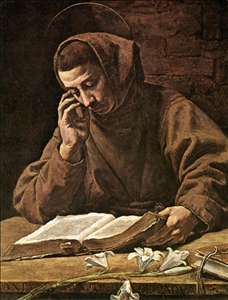
Saint Anthony Reading by Marcantonio Bassetti

Six Important Truths about Scripture

In conclusion, I would like to leave the reader with helpful points of orientation that I found some years ago in the work of a now-forgotten French Dominican, Fr. Chifflot.3 This balanced and traditional exegete presents six important truths about Scripture that serve as reliable principles for us while we study the sacred page.

1. The Bible is a sacred history. It is not metaphysics; it is a history, the history of a people. But as its protagonist is the Eternal One, it is necessarily unlike any secular history. It is the history of a “love affair” between the Infinite and the Finite. And so it evokes all the grandeur and beauty of God and all the misery, horror, desperation, and darkness of fallen man.

2. The Bible is a promise. The People of God has a history, and it is a forward-moving history, a journey towards a goal, a promised land. It is a book of hope which springs from past deliverance and longs for future fulfillment. There is thus always a tension in the text; it is not “merely” about the past, nor is it simply “news” about the present, or “predictions” of the future. It is about all time in its purposeful movement—the past and the future breaking into the present, the present stretching towards eternity.

3. The Bible is the book of Christ. The written word of God is about the personal Word of God, Jesus Christ, Son of the Father, who breaks into history as the Messiah or Anointed One. Saint Jerome famously says: “To be ignorant of Scripture is to be ignorant of Christ.” Pope Leo XIII adds: “In its pages His Image stands out, living and breathing; diffusing everywhere around consolation in trouble, encouragement to virtue and attraction to the love of God.” Blaise Pascal likewise speaks of “Jesus Christ, whom both Testaments concern: as the expectation of the Old, as the model of the New, and as the center of both.” As Saint Augustine says, the Old Testament is the New Testament hidden under a veil, while the New is the Old now made manifest. This being so, the Old Testament is thoroughly Christian, because it tells of the preparation of the chosen people for their Messiah, their unconquerable Davidic ruler. Since Christianity is the fulfillment of the Jewish religion, all that belonged to the Jews now belongs by right to us, including the Hebrew Scriptures. The Second Vatican Council’s Constitution on Divine Revelation Dei Verbum expresses these points beautifully.4

4. The Bible is the book of the Church. The Church opens the Bible for us. As Dei Verbum teaches:
There exists a close connection and communication between Sacred Tradition and Sacred Scripture. For both of them, flowing from the same divine wellspring, in a certain way merge into a unity and tend toward the same end. For Sacred Scripture is the word of God inasmuch as it is consigned to writing under the inspiration of the divine Spirit, while Sacred Tradition takes the word of God entrusted by Christ the Lord and the Holy Spirit to the Apostles, and hands it on to their successors in its full purity . . . Sacred Tradition and Sacred Scripture form one sacred deposit of the word of God, committed to the Church. . . . [T]he task of authentically interpreting the word of God, whether written or handed on, has been entrusted exclusively to the living teaching office [Magisterium] of the Church, whose authority is exercised in the name of Jesus Christ.5
History has borne abundant witness to this last claim: wherever the authority of the Catholic Church has been assailed or rejected, the authority of Scripture has grown progressively weaker, in some instances disappearing altogether. Conversely, wherever Scripture is accepted as divine truth, there is an awareness, bright or dim, of some supernatural reality called “the Church,” and a desire to belong to it, as if implicitly recognizing that a book by itself doesn’t make a religion. John Henry Newman made a similar observation in regard to Marian devotion, saying in his Letter to Pusey that, as a matter of historical fact, wherever the cultus of the Virgin Mary was abandoned, sooner or later faith in the very divinity of Christ was abandoned. Because of the ineffable mystery of the Incarnation, Mother and Son can never be parted, no more than Father and Son.

5. The Bible is a mirror. It holds up to us a mirror that reveals who we are, where we have come from, what we are destined for. It is a sword that penetrates the secret places of the heart: “For the word of God is living and active, sharper than any two-edged sword, piercing to the division of soul and spirit, of joints and marrow, and discerning the thoughts and intentions of the heart” (Hebrews 4:12).

6. The Bible is the book of prayer.6 The Bible is full of prayer; it is about men of prayer and their faithful worship, as well as men who are unfaithful and idolatrous. It shows us the pattern of life and the false paths of death. It gives us the words of so much of our liturgy. The Divine Office or Liturgy of the Hours consist chiefly of psalms, canticles, and short readings; the traditional Roman Missal is shot through with Scriptural verses from Introit to the Last Gospel. Unlike the new Lectionary, a repository of artificially segmented texts, and unlike the new Missal, a stripped and shivering product of rationalism, the great Missale Romanum is a living testament of Tradition, saturated with Divine Revelation, resonant, fragrant, irreducibly complex, united to the Word of God as bone of its bone and flesh of its flesh. Traditional Catholics have no need to feel “left out” of the movement to “recover” the Bible, for our Faith was already there, and it goes deeper than the moderns. Generations upon generations have been nourished and informed by the Word of God expressed with vibrant diversity and density in the liturgy itself, in architecture and the other plastic arts, in sacred music and religious hymns, in Catholic culture and its customs. Wherever the traditional Faith has been strong, the Bible has received the devotion its holy content deserves, the veneration its saving message demands. Now that our Holy Father Pope Benedict XVI is leading the way with a genuine reform of the Church, let us not fail to do our part to live a genuinely traditional Catholic life—not the truncated version that modernity sought to produce from the Enlightenment to the present, but the robust life of Faith practiced by our ancient and medieval forefathers, rooted in the Word of God and the Sacraments of the Church.
_______

Notes

  1. CCC 132, citing DV 24. [back]

  2. Zechariah is speaking here of servile or slavish fear, not of the filial or reverential fear that suits a child in relation to his parent and, all the more, a creature in relation to its creator. [back]

  3. T.G. Chifflot, O.P., Water in the Wilderness, trans. Luke O'Neill (Herder and Herder, 1967), 55-78. [back]

  4. See Dei Verbum, 14-16. [back]

  5. Dei Verbum 9-10; cf. the opening paragraph of Leo XIII's Providentissimus Deus. [back]

  6. See Chifflot, pp. 75-76. [back]

[Dr. Peter A. Kwasniewski is Professor of Theology and Philosophy at Wyoming Catholic College in Lander, Wyoming. The present article, "How Sweet are Thy Words," was originally published in Latin Mass: A Journal of Catholic Culture and Tradition, Vol. 18, No. 4 (Fall 2009), pp. 6-9, and is reprinted here by kind permission of Latin Mass Magazine, 391 E. Virginia Terrace, Santa Paula, CA 93060, and the author.]

Monday, March 17, 2008

Jesus of Nazareth

by Pope Benedict XVI, a featured book review by Michael P. Foley


[Christ Pantocrator -- St. Catherine's Monastery, Sinai]


During an interview, Peter Seewald once asked Joseph Cardinal Ratzinger a pointed question: How many ways are there to God? Seewalt, a lapsed Catholic, was perhaps hoping to catch the author of the "infamous" document Dominus Iesus--which reaffirms Jesus Christ as the only source of salvation--in a "gotcha" moment of intolerance and rigidity.

But the Cardinal surprised him. "As many as there are people," he replied. "For even within the same faith each man's way is an entirely personal one."1 Though Ratzinger also made clear that the only way to God is through Christ, it was his focus on each man's encounter with the Way that discombobulated the jaded journalist. That same disarming blend of the orthodox and the individual is evident in Ratzinger/Benedict XVI's latest book, Jesus of Nazareth, which the author describes not as an "exercise of the Magisterium" but an "expression of [his] personal search 'for the face of the Lord.'"2

The Historical-Critical Method

The Holy Father's salutary distinction between his office and his opinions does not mean that Jesus of Nazareth has little to do with the teachings of the Church. One of the book's central aims is to rectify that form of biblical exegesis known as historical criticism. Begun in the eighteenth century as an
enlightenment attempt to strip revealed religion of its claims to the supernatural and the miraculous, historical criticism now dominates biblical studies both Catholic and Protestant and shows no sign of abating, despite the rise of other schools of interpretation such as literary criticism.

* * * * * * *
Though Ratzinger also made clear that the only way to God is through Christ, it was his focus on each man's encounter with the Way that discombobulated the jaded journalist.

* * * * * * *

As its ideological beginnings make clear, historical criticism is a mixed blessing for Christianity. On the one hand, it was designed to undermine the believer's confidence in the reliability of the sacred text, and consequently it has destroyed not only many a man's orthodox convictions but his entire faith. For contemporary examples of this one need only think of the twaddle advanced by the "Jesus Seminar" or the articles gracing the covers of Time and Newsweek every Easter that deny the Resurrection on the authority of renowned biblical "experts."

On the other hand, it is thanks to the methodology of modern biblical studies that we have made enormous strides in understanding our biblical manuscripts, in our grasp of the original languages, andin our knowledge of Scripture's historical and cultural context. At its best, historical criticism helps exegetes better understand the literal sense of the text.

Benedict makes clear in his preface that he is aware of historical criticism's "indispensable dimension" as well as its significant "limits" (xv, xvi). Undergirding the conflict between historical-critical studies and Christian orthodoxy, however, is a deeper issue: who is the ultimage interpreter of the Bible--the Church, with its rule of faith, or the Academy, with its own canons of judgment? One of the most chilling passages in Jesus of Nazareth is Benedict's reflections on a short story by Vladimir Soloviev in which the Antichrist comes as a renowned Scripture scholar who believes that one should "measure the Bible against the so-called modern worldview" (35):

The Antichrist, with an air of scholarly excellence, tells us that any exegesis that reads the Bible from the perspective of faith in the living God, in order to listen to what God has to say, is fundamentalism; he wants to convince us that only his kind of exegesis, the supposedly pure scientific kind, in which God says nothing and has nothing to say, is able to keep abreast of the times (36).

It is no doubt statements like this that led Cardinal Renato Martino to say that Jesus of Nazareth is not only a book with "salt and pepper" but with "hot peppers."3

* * * * * * *
Most of the controversy generated by Jesus of Nazareth so far has been not over any of Benedict's interpretations of this or that passage but his underlying conviction that the Church is in a beter position to understand its own sacred texts than the Academy.

* * * * * * *

For Benedict, only eyes fortified by Faith, Hope, and Charity can truly see the living mysteries disclosed in the Scriptures.4 While historical criticism can be useful, it must be firmly subordinated to the Apostolic Faith (xxiii), and it must remain cognizant of the fact that its own reconstructions of the past are hypothetical and hence tentative (xix). Most of the controversy generated by Jesus of Nazareth so far has been not over any of Benedict's interpretations of this or that passage but his underlying conviction that the Church is in a beter position to understand its own sacred texts than the Academy. That this should come as a surprise or a scandal to anyone indicates the extent of the crisis we are in and why the Pope is wise to address it.


[Saint Jerome from a mural]

On the whole, however, Benedict's own approach is more constructive than critical. His Holiness highlights the auspicious "fact that the inner nature of the [historical-critical] method points beyond itself" (xviii). Just as modern science, when it is understood properly, points to the need for a science or scientia greater than itself, so too does historical criticism implicitly (and perhaps unwittingly) reveal the possibility that every word in the Scriptures "contains more than the author may have been immediately aware of at the time" (xix).

A Master Exegete

Hence, there will always be a need to examine what the Church Fathers called the sensus plenior, the fuller Christological meaning of both Testaments made present through the inspiration of the Holy Spirit. To hold this involves no blind appeal to authority or voluntaristic suspension of discernment. On the contrary, Pope Benedict masterfully demonstrates that the most rational and reasonable way to read the Scriptures is with the recognition that the so-called "Jesus of history" is the "Christ of faith" (xxii), that the dichotomy between the two created by many exegetes invariably butchers the very text they purport ot understand and thus undercuts their own claims to competency. Two examples will suffice to illustrate this point.

In his chapter on the Baptism in the Jordan, Benedict takes advantage of the spectacular discovery of the Qumran or "Dead Sea" scrolls in the 1940s, reflecting on the possible connections between the desert Essenes (an ascetical, quasi-monastic Jewish community) and Saint John the Baptist. But while many scholars tend to reduce John's ministry to that of the Essences, Benedict, looking at the same data, more convincingly argues that in light of what we know from Qumran, "the Baptist's appearance on the scene was something completely new; the baptism he enjoined is different fromthe usual religious ablutions" (14). The Essenes had frequent ritual washings to be sure, but these stand in contrast to the unrepeatable act by the Baptist that is "meant to be the concrete enactment of a conversion that gives the whole of life a new direction forever" (ibid.). Like any good Catholic missionary, John was taking preexisting symbols and transforming their use and meaning to betoken a new and divine reality.

Second, in his chapter on the Gospel of Saint John, Benedict reviews the commonplace contention that while the other three Gospels are more or less historical, John's Gospel is a much later product of theological speculation and hence does not reflect the "real" Jesus. Yet as Benedict points out, this conjecture presupposes that theological reflection is a hindrance rather than an aid to knowing who this Man is, and this is absurd: if Christ is who He says He is, the only way to know him is through faith. Ultimately undergirding the "historical Jesus" obsession is a remarkably naive understanding of history as something that can be captured in a series of transcripts. But as John himself points out in his Gospel through his use of the conceept of memory, "remembering" the story of the Christ can only happen through an awakening of the Spirit that makes the data of the past intelligible (231-34). Benedict's careful exploration of the biblical author's self-understanding provides a key to unlocking the text that modern exegetes have been trying in vain to pick.

Genuine Dialogue

It is no coincidence that Jesus of Nazareth is itself an excellent example of how historical criticism, purified of its pretensions to high science and rightly reordered, can bear much fruit. But the book, which covers the earthly ministry of Our Lord from His baptism to His transfiguration (a second volume on the infancy narratives and the Passion is forthcoming), boldly engages a number of other controversies as well. Perhaps the most fascinating example of this is the Pope's response to Rabbi Jacob Neusner, whom Benedict calls a "great Jewish scholar" (69) and a "truly attentive listner" (118). Neusner is the author of the 1994 book A Rabbi Talks With Jesus (reprinted 2000), in which he imagines himself in the crowd listening to Jesus' Sermon on the Mount. As Benedict summarizes:
He listens to Jesus... and he speaks with Jesus himself. He is touched by the greatness and the purity of what is said, and yet at the same time he is troubled by the ultimate incompatibility that he finds at the heart of the Sermon on the Mount.... Again and again he talks with Him. But in the end, he decides not to follow Jesus. He remains--as he himself puts it--withthe 'eternal Israel'" (103-4).
Neusner, a distinguished professor of Judaism at Bard College, was unimpressed with the "Judeo-Christian dialogue [that] served as the medium of a politics of social conciliation" rather than a "religious inquiry into the convictions of the other."5 He lamented the post-WWII "conviction that the two religions say the same thing" and the Enlightenment "indifference to the truth-claims of religion."6 In other words, he was tired of the very same things that make a traditional Catholic bristle when he hears the words "interreligious dialogue."

Neusner's response was A Rabbi Talks with Jesus, in which he takes with the utmost seriousness and respoect the teachings of Jesus even though he ultimately cannot accept them. Why not? Because "the Torah was and is perfect and beyond improvement,"7 whereas Jesus, with His frequent "You have heart it said... But I say unto you" emendations, is clearly going beyond the Torah and hence daring to improve it. Neusner rightly recognizes that with these statements Jesus is claiming to be God, and this astonishing assertion is something to which he cannot assent.

Rabbi Neusner later said of his book that he wanted to explain to Christians why he believed in Judaism, and that this explanation "ought to help Christians identify the critical convictions that bring them to church every Sunday."8 It certainly did for one reader. Benedict writes: "More than other interpretations known to me, this respectful and frank dispute between a believing Jew and Jesus, the son of Abraham, has opened my eyes to the greatness of Jesus' words and to the choice that the Gospel places before us" (69).

* * * * * * *
This is interreligious dialogue at its very best, the kind of serious conversation reminiscent of Saint Thomas Aquinas' turn to Rabbi Moses Maimonedes, where respect for the other does not devalue respect for the truth.

* * * * * * *


In what is the longest treatment of any living author in Jesus of Nazareth, the Pope joins "in the rabbi's conversation with Jesus" (70). He argues that Neusner is absolutely right in his analysis of what Jesus is saying, but he contends that this does not constitute a violation of the Torah. On the contrary, drawing from the testimony of the Hebrew Bible the Pope argues that the Torah points beyond itself, beyond the borders of Israel, that God's "one great definitive promise to Israel and the world" was the "gift of universality" which is made possible by the God-man who comes to save both Jew and Gentile (116).


This is interreligious dialogue at its very best, the kind of serious conversation reminiscent of Saint Thomas Aquinas' turn to Rabbi Moses Maimonedes, where respect for the other does not devalue respect for the truth. Neusner himself was amazed that the Pope should honor him in this way. In responding to Jesus of Nazareth, the rabbi wrote, "Someone once called me the most contentious person he had ever known. Now I have met my match. Pope Benedict XVI is another truth-seeker. We are in for interesting times."9

Theological Wisdom

To dwell as I have done on the Holy Father's disputations with contemporary issues such as biblical criticism and Judeo-Christian dialogue should not, however, obscure the more fundamental fact that Jesus of Nazareth is first and foremost a treasure of timeless theological wisdom. Benedict is a master reader of Holy Writ, a sleuth of the sacred who artfully connects seeminly disparate scriptural passages or Patristic interpretations to reveal a deep and rich teaching. No matter how well you think you know the Bible, the Pope will surprise you.

* * * * * * *
For Benedict, only eyes fortified by Faith, Hope, and Charity can truly see the living mysteries disclosed in the Scriptures. While historical criticism can be useful, it must be firmly subordinated to the Apostolic Faith, and it must remain cognizant of the fact that its own reconstructions of the past are hypothetical and hence tentative.

* * * * * * *

To mention just two examples: Benedict's explanation of why Jesus deigned to be baptized is not that He wished to rid Himself of His guilt (for He obviously had none) but that He wished to "load the burden of all mankind's guilt upon his shoulders" (18). Like Jonah the prophert, Our Lord inaugurated His public ministry by being thrown into the sea so that others may live. Benedict notes that in Eastern icons depicting Christ's baptism, the river Jordan appears "as a liquid tomb," a Hades into which Christ descends and out of which He rises to be greeted by the Father and the Holy Spirit" (19).


Similarly, Benedict offers a powerful exegesis of the three temptations in the desert by framing this event with a difficult question: Why didn't Jesus turn stone into bread (if not to feed Himself then at least others) or take control of all nations in order to bring peace on earth? Indeed "What did Jesus actually bring, if not world peace, universal prosperity, and a better world?" (44). "The answer," Benedict continues, "is very simple: God. He has brought God. He has brought the God who formerly unveiled his countenance gradually, first to Abraham and then to Moses and the Prophets, and then in the Wisdom literature.... It is this God, the God of Abraham, Isaac, and Jacob, the true God, whom he has brought to the nations of the earth" 944).

As this answer suggests, the Pope is never far from the face of the Lord in his exegesis. Everything that Christ says, such as his preaching on the Kingdom of God (ch. 3) or His parables (ch. 7) brings us primarily, not to a doctrine, but to Himself. When Our Lord speaks of the Kingdom of God, for example, He is speaking about His own kingship, Himself. And when He tells the Parable of the Prodigal Son, He is indicating how He Himself is the "concrete realization of the father's" mercy towards the sinner (208).

I mentioned earlier that Peter Seewald was disarmed by Cardinal Ratzinger's answer about the ways of seeking god, and now I should add that that experience reignited his own search for the Lord and his return to the Church. Let us hope that the hot but nourishing peppers in Jesus of Nazareth will have the same effect on those of us whose love of the Lord has grown cool.

Notes
  1. Joseph Ratzinger, Salt of the Earth: The Church at the End of the Millennium: An Interview With Peter Seewald, trans. Adrian J. Walker (San Francisco: Ignatius Press, 1997), 32. [back]

  2. p. xxiii. Cf. Ps. 27:8. [back]

  3. "Cardinal: Pope's Book Goes Against Grain," Zenit.org, 22 July 2007. [back]

  4. Looking at the logical lapses of Rudolf Bultmann, for example, "we see how little protection the highly scientific approach can offer against fundamental mistakes" (220). [back]

  5. Ibid. [back]

  6. Ibid. [back]

  7. Ibid. [back]

  8. Ibid. [back]

  9. Ibid. [back]

[Dr. Michael P. Foley is a professor of Patristics at Baylor University and the author of Why Do Catholics Eat Fish on Friday? The Catholic Origin to Just About Everything (Palgrave Macmillan, 2005). The present review of Jesus of Nazareth by Pope Benedict XVI was originally published in Latin Mass: A Journal of Catholic Culture and Tradition (Winter 2008), pp. 34-37, and is reprinted here by permission of Latin Mass Magazine, 391 E. Virginia Terrace, Santa Paula, CA 93060.]

Monday, March 10, 2008

Is God's Love Unconditional?

By Carmelo Fallace

Is it true that, as many a modern homilist is wont to say, "God's love is unconditional"? It is true without question that the love of God, as stated in the Old and New Testaments, is rich, it abounds, it fills the earth, is unfailing, is faithful, is steadfast, it endures forever, is great, is higher than the Heavens, it surpasses knowledge, is better than life, etc. It is comforting and reassuring to hope that God's love is unconditional -- and it must be true, otherwise, many priests and homilists wouldn't say so. Right?

Let us begin our inquiry by defining our terms. According to the Merriam-Webster Unabridged Dictionary, "unconditional" means not conditional or not limited, but absolute, unqualified. When we add the word "love" to unconditional, it becomes, by definition, love with no conditions, now and forever more. Accordingly then, "unconditional love" means that no matter what we do or don't do, we will continue to be loved in exactly the same way. In other words, unconditional love means, as far as God is concerned, that whatever we do -- good or bad -- does not matter, and we can expect God to love us the same as He always has.

Many claim that "unconditional love," or something similar, has a biblical basis, that it is written or implied in the Bible, or perhaps in some other Church document. But of the more than 800 instances of "love" in the Bible, none states or implies that God's love is unconditional. Furthermore, there is no official Church document that uses the word "unconditional" to describe God's love. There must be some mistake! some might demur. How could this be? Yes, there has been an enormous mistake, but it is not in the Bible or Church documents. The real mistake regarding unconditional love has been made by those dissenting and rebellious teachers who try to appear more loving and compassionate than God and His Church. And these imposters have succeeded in attracting good Catholics to follow them into a fantasy world where the only reward is endless misery in the deepest furnace below.

If there is any doubt, ask anyone who spreads this false teaching to show you the evidence that God's love is unconditional, chapter and verse, please -- or to provide the proper citation in the Catechism of the Catholic Church, or any other official Church document. But do not take anyone's word for it. Neither be deceived by the argument that such-and-such a book explains God's unconditional love in detail. False beliefs have been used by God's enemies since the time of the Apostles, and have usually, if not always, originated from Catholic people, often from priests and even bishops. Recall the words of St. Paul: "There are some who are disturbing you and wish to pervert the gospel of Christ. But even if we or an angel from heaven should preach to you a gospel other than the one that we preached to you, let that one be accursed! As we have said before, and now I say again, if anyone preaches to you a gospel other than the one that you received, let that one be accursed!" (Gal. 1:7-9).

Let us look at what God loves, then at what He does not love. According to Scripture, God loves:
- His servants who are faithful (1 Kgs. 8:23)
- Those who trust in Him (Ps. 32:10)
- Justice (Ps. 37:28)
- The righteous (Ps. 146:8)
- He who pursues righteousness (Prov. 15:9)
- Those who love Him (Dan. 9:4)
- Those who keep His commandments (Dan. 9:4)
- His Son Jesus (Mt. 3:17)
- Those who show their love for Jesus is genuine by obeying His teachings (Jn. 14:21-23)
- His sons through Jesus Christ (Eph. 1:4-5)
- A cheerful giver (2 Cor. 9:7)
- Those for whom He gave up His life as a sacrificial offering (Eph. 5:2)
- His children who act in righteousness and love their brothers (1 Jn. 3:1,10)
- Those who have been called (Jude 1:1)
- Those kept safe for Jesus Christ (Jude 1:1)
- Those He has freed from sin by His blood (Rev. 1:5)
- Those He has made priests for His Kingdom (Rev. 1:6)
- Those He reproves and chastens (Rev. 3:19)
Instead of mentioning so many different qualifiers, why does the Bible not say that God loves everyone, regardless of what they have said or done? The reason, it seems, that God did not make such a blanket statement is because He does not love everyone -- precisely because of what they have said or done. If Scripture had made only a blanket statement, that could possibly indicate that God's love is unconditional. Unfortunately, for all of us, the whole truth is that nowhere does the Bible state as much, or anything close to it.

Now, let us examine what God does not love. The Bible has 137 references to hate, but we will use only those pertaining to our discussion of the things God hates. For example:
- Wickedness (Heb. 1:9)
- Seeing His people worship other gods (Jer. 44:3-4)
- The burning of sons and daughters in the fire as sacrifices to gods (Deut. 12:31)
- Haughty eyes, a lying tongue, hands that shed innocent blood, a heart that devises wicked schemes, feet that are quick to rush into evil, false witnesses, a man who stirs up dissensions (Prov. 6:16-19)
- He who plots evil against his neighbor and he who swears falsely (Zec. 8:17)
- Robbery and iniquity (Is. 61:8)
- Divorce (Mal. 2:16; see also Mt. 5:31-32, 19:3-9; Lk. 16:18; 1 Cor. 7:10-11)
- The practices of the Nicolaitans (imposters) (Rev. 2:6)
- Esau (Mal. 1:3; Rom. 9:13)
- The wicked person and all who do evil (Ps. 5:5)
- Those who love violence (Ps. 11:5)
It may astound some to learn that the "God of love" hates some people for any number of good reasons. But does God ever love someone today and hate him tomorrow? Again, let us look at Scripture. In Jeremiah 16:5, God says, "I have withdrawn my blessing, my love, and my pity from this people." In Hosea 1:6, the Lord says, "I will no longer show love to the house of Israel, that I should at all forgive them." Again, in Hosea 9:15, "Because of all their wickedness in Gilgal, I hated them there. Because of their sinful deeds, I will drive them out of my house. I will no longer love them; all their leaders are rebellious."

And, in 1 Samuel, although King Saul had been anointed by God, when Saul disobeyed Him, God took away His love from Saul, and he died ignominiously by his own hand on the battlefield.

So, what does all this mean to us today? It means the same as it has always meant, that God says to us, Here is what I expect of you, and in return, here is what I will give to you. If we fulfill our part of the contract, He will fulfill His. That condition includes God's mercy for us, as He says, "You shall therefore carefully observe the commandments, the statutes and the decrees which I enjoin on you today. As your reward for heeding these decrees and observing them carefully, the Lord, your God, will keep with you the merciful covenant which he promised on oath to your fathers" (Deut. 7:11-12).

But, one might argue, doesn't St. Paul state that nothing can separate us from the love of God? St. Paul says, "What will separate us from the love of Christ? Will anguish, or distress, or persecution, or famine, or nakedness, or peril, or the sword?… No, in all these things we conquer overwhelmingly through him who loved us. For I am convinced that neither death, nor life, nor angels, nor principalities, nor present things, nor future things, nor powers, nor height, nor depth, nor any other creature will be able to separate us from the love of God in Christ Jesus our Lord" (Rom. 8:35, 37-39).

Paul here lists the things that cannot separate us from God's love. But is there anything or anyone that can separate us from the love of God? Yes. Only we, as individuals, can separate ourselves from God! Even God will not interfere with our choices -- though our choices may take us to Hell. It is true that God respects our choices, but His Law says that for every action by us, there is a reaction from Him, as history and Scripture indicate. We can restore God's love only by repentance and conversion to His ways. As Jesus said, "As the Father loves me, so I also love you. Remain in my love. If you keep my commandments, you will remain in my love, just as I have kept my Father's commandments and remain in His love. I have told you this so that my joy may be in you and your joy may be complete" (Jn. 15:9-12; italics added).

St. Jude echoes this: "Keep yourselves in God's love" (1:21-23). St. Jude reminds us that God's love is assured if we obey His commandments. Of course, everyone of good will hopes that our joy will be complete some day, but it cannot happen without observing God's commandments -- that is the condition for His eternal love.

Therefore, when we go astray and sin, we must repent sooner rather than later, make use of the Sacrament of Confession, and then, if we are truly repentant, He will forgive our sins, for St. John says, "If we acknowledge our sins, He is faithful and just and will forgive our sins and cleanse us from every wrongdoing. If we say, 'We have not sinned,' we make Him [Jesus] a liar, and His word is not in us" (1 Jn. 1:9-10).

He will always forgive us, if we are repentant. Only the God of love can do that for those who have chosen to be His people.

The Long Island Catholic, the official paper of the Diocese of Rockville Centre, N.Y., published a column by Msgr. James McNamara (March 28, 2007), in which the phrase "unconditional love" was used several times. I responded to Msgr. McNamara's column in a letter to the editor (April 4, 2007), challenging him to provide the biblical or other official Church reference indicating that God's love is unconditional. Amazingly, Msgr. McNamara responded in the same issue that "…The writer [Mr. Fallace] is correct," and repentance is required to be forgiven by God. Nevertheless, Msgr. McNamara still insisted that "God's love is unconditional." But is repentance not itself a condition?

God's love is conditional upon the following of His commandments. When we fail, God may withdraw His love from us. But we may restore God's love only by repentance. Is not repentance what Satan and his devils refused to do? Will He not be as just with us for our lack of repentance? He will demand true repentance on our part for every sin we have committed.

God's love, then, should be considered conditional upon repentance. What follows is a partial list that should be more than enough to confirm that God insists on our repentance before He forgives us, and that we must ask for it each time we sin and before we die:
- "People of the whole Judean countryside and all the inhabitants of Jerusalem were going out to him [John the Baptist] and were being baptized by him in the Jordan River as they acknowledged their sins" (Mk. 1:5)
- Jesus said, "But I tell you, if you do not repent, you too will all perish" (Lk. 13:3)
- St. Peter said, "Repent, therefore, and be converted, that your sins may be wiped away" (Acts 3:19)
- "You overlook the sins of men that they may repent" (Wisd. 11:24)
- St. Paul said, "I preached the need to repent and turn to God, and to do works giving evidence of repentance" (Acts 26:20)
- "For it is written: 'As I live, says the Lord, every knee shall bend before me, and every tongue shall give praise to God.' So then each of us shall give an account of himself to God" (Rom. 14:11-12)
- "No creature is concealed from him, but everything is naked and exposed to the eyes of him to whom we must render an account" (Heb. 4:13)
If the "unconditional love of God" is a fallacy, why do so many clergy and laity seem eager to proclaim it? That they persist in proclaiming something contrary to Church teaching could indicate a heretical or rebellious attitude on their part. Such attitudes can be very dangerous to these people and to those who hear them proclaim mistaken religious beliefs. God has said, "If I tell the wicked man that he shall surely die, and you do not speak out to dissuade the wicked man from his way, he [the wicked man] shall die for his guilt, but I will hold you responsible for his death. But if you warn the wicked man, trying to turn him from his way, and he refuses to turn from his way, he shall die for his guilt, but you shall save yourself" (Ezek. 33:8-9).

Jesus Christ reiterated this when He said, "Things that cause sin will inevitably occur, but woe to the person through whom they occur. It would be better for him if a millstone were put around his neck and he be thrown into the sea than for him to cause one of these little ones to sin. Be on your guard! If your brother sins, rebuke him; and if he repents, forgive him" (Lk. 17:1-3; italics added).

So God's love is not unconditional. If God's love were unconditional, there would be no Hell and all the unrepentant sinners, no matter how evil, would go to Heaven. So, what is God's love if it's not unconditional? It is covenantal. This means that if we want to continue to experience His love, we have to meet His conditions. God's love is eternal, it is constant, but He makes it absolutely clear what He loves and what He hates, and whom He loves and whom He hates. That God's love is unconditional is a modern deception invented by the devil; it is designed to blur our vision so that we can join him in the underworld.

As individuals we have to choose one of two options. Either we choose to accept, follow, and obey the god of the modern secular culture, or we choose to accept, follow, and obey the God of the Bible as taught by the official teaching of the Catholic Church. Are these not the only two choices in life?

In paragraph 33 of Pope Benedict XVI's apostolic exhortation Sacramentum Caritatis ("The Sacrament of Love," Feb. 22, 2007), he explains very clearly that "Mary of Nazareth appears as someone whose freedom is completely open to God's will. Her immaculate conception is revealed precisely in her unconditional docility to God's word. Obedient faith in response to God's word shapes her life at every moment…. She is the Immaculata, who receives God's gift unconditionally and is thus associated with his work of salvation. Mary of Nazareth, icon of the nascent Church, is the model for each of us, called to receive the gift that Jesus makes of himself in the Eucharist" (#33).

On February 2, 2007, Pope Benedict addressed the 11th annual World Day of Consecrated Life. His speech included a passage on unconditional love and its application: "Consecrated life, therefore, is by its nature a total and definitive, unconditional and passionate response to God."

The Pope has indicated the proper use of the word "unconditional": Unconditional love is the relationship we must have toward God -- not God toward us. Furthermore, because He is the Creator and we are the created, we are His servants and He is our Master -- and He owes us nothing.

Let us pray for our proper response to God's love: O God our Father, let our Christian hope to be with You in Heaven open our minds, decrease our pride, and encourage us to obey Your will. Help us to follow the example of Mary who finished the race and won the prize of Your true love. We ask this in Jesus' name. Amen.


[Carmelo Fallace, the author of several books on family life issues and past director of Natural Family Planning and associate director of Marriage Preparation for the Archdiocese of New York, is the Editor of Catholic Family Life Messenger (CFLM), from which this article was adapted with permission (April-May 2007). To receive CFLM free of charge, write to CFLM, PO Box 115, Lake Grove NY 11755, or visit www.CFLM.blogspot.com. He is coordinator of the independent New Oxford Reading Clubs (for information, phone 631-588-7495). He and his wife have seven children and 20 grandchildren. The present article was originally published in the New Oxford Review (February 2008), and is reproduced here by kind permission of New Oxford Review, 1069 Kains Ave., Berkeley, CA 94706.]