Saturday, March 01, 2008

Solemnity: The Crux of the Matter (Part One)

by Peter A. Kwasniewski


[Recessional, Solemn High Mass, St. John Cantius, Chicago]


At a recent conference on the sacramental theology of Saint Thomas Aquinas, I heard a speaker make the following statement:
It seems to me that most of the disagreements about the liturgy since the implementation of the reform initiated by the Second Vatican Council concern solemnity in one way or another.... Whether the arguments assert too much, not enough, or a wholly new understanding of the shape it should take, the question of a certain solemnity in the liturgy has been at the heart of almost all of the controversy.
Now, one might wonder if there could ever be "too much" solemnity, and one might also wonder if most of the committees who autocratically determine the fate of poor parishioners at Mass have given much or any through to the notion of solemnity in the past few decades. Still, the speaker was stating an important truth. The difference between good liturgy and bad liturgy, as far as the mind of the Church is concerned, often does come down to a difference between worship that is solemn, formal, and devout, and worship that is slipshod and superficial, with a decidedly casual air. So, I began to wonder: Why is the contemporary liturgy, as celebrated in churches across the world, generally so lacking in anything that could merit the description "solemn"?

* * * * * * *
The difference between good liturgy and bad liturgy, as far as the mind of the Church is concerned, often does come down to a difference between worship that is solemn, formal, and devout, and worship that is slipshod and superficial, with a decidedly casual air.

* * * * * * *

At first, I asked myself if this might be a fault endemic to the ordinary form of the Roman rite of the Mass, that which follows the Missal of Paul VI. But my happy memories of Oratorian liturgies in which the same Missal was employed with splendor and gravitas compelled me to acknowledge that the problem was not--at least not simply and altogether--a problem with that Missal as such, flawed though it is in many respects.1 It seemed to be more a problem with the people and their shepherds. It was caused by what parents call a "bad attitude."

This attitude might be characterized as embarrassment or (may the good Lord help us) boredom when it comes to the very idea of solemnity, the treating of anything with utmost reverence--the kind of reverence that issues in angelic music or silent contemplation. The result is, alas, more than a mere "lack" of solemnity: it is negligence or contempt of the solemnity demanded by the Eucharistic mystery. Even though it might be done properly, the ordinary form of the Roman rite is but rarely done in a spirit of comprehensive solemnity, whereas solemnity, or at a minimum, sacred dignity, is the very atmosphere in which the extraordinary form of the same rite lives and moves and has its being. The "Solemn High Mass" illustrates this truth with particular forcefulness, although High Mass (or a Sung Mass) and Low Mass are not far behind. Supported by the rich liturgical culture of thirteenth-century Europe, Saint Thomas Aquinas could calmly state: "Because the whole mystery of our salvation is comprised in this Sacrament [of the Eucharist], it is therefore performed with greater solemnity than the other Sacraments."2 Implied is that all Sacraments were (and should be) celebrated solemnly.

The death of solemnity--as witnessed by the schlocky music used at vernacular Masses, the way priests and servers are dressed and their relaxed bearing, the placement of a clunky table to function as a turned-around altar, the sign of peace (please find me a single layman out of a hundred who invests this ceremonial interruption with anything like a sacred meaning), and other such things--comes, ultimately, from a loss of faith, a loss of confidence, a loss of responsibility and spiritual authority. The priest seems no longer confident of his role as teacher, ruler, sanctifier sub et cum Christo. Such a crisis of confidence reflects the more general loss of faith in the ministerial priest's sublime vocation of standing in Christ's place, representing the Eternal High Priest.3 Loss of solemnity is directly traceable to loss of faith in the Real Presence, in the sacrificial nature of the Mass, and in the spiritual authority of the sacerdotal office. It is thus connected with a passive or active advocacy of the vice of insouciance toward divine things that makes them cease to appear divine in our eyes, even though they remain divine in themselves. Weakened, is the earnestness, undermined the solemnity, that comes naturally to a confident priesthood humbly serving the Holy Mysteries of God.4

The Fear of Ritual

One of the many errors that poisoned the liturgical reform was the fear of ritual, stemming from the view that ritual keeps people away, prevents the priest from "getting in touch" with the people. The new missal has been deritualized, or at least allows and even encourages the priest to deritualize the Mass by injecting the liturgy with extemporaneous remarks, by moving about in a causal manner, and by inviting into the sanctuary numerous unvested laity, which is totally contrary to the spirit of ritual or divine cultus. In Thomas Day's Why Catholics Can't Sing, there is an hilarious (and appallingly true) description of the schizophrenic liturgies generated by the current rubrics together with poor training and clueless custom: a clearly ritual ceremony performed by people who act as though the ceremony were not a ritual. The priest, wearing ritual vestments, processes down the aisle to the tune of a hymn. He arrives at the altar. He adjusts his microphone. He looks out to the congregation. He smiles, and then descends into utter banality: "Good morning, everyone!" Back to ritual: "In the name of the Father ..." Back to chatter: "Today, we remember that we are trying our best but are still failing, and so we go to the Lord for mercy." Back to ritual: "Lord, have mercy." Back and forth it goes, until he dismisses the congregation with "Have a nice day, everybody!"

* * * * * * *
The new missal has been deritualized, or at least allows and even encourages the priest to deritualize the Mass by injecting the liturgy with extemporaneous remarks, by moving about in a causal manner, and by inviting into the sanctuary numerous unvested laity, which is totally contrary to the spirit of ritual or divine cultus.

* * * * * * *

For a long time it struck me as bizarre that so few should sense the utter discontinuity between ritual and quotidian modes of address and bearing, but as I better sized up the mess of modernity, I saw how markedly anti-ritualistic and indeed anti-spiritual our age has become: anything outside the comfort zone of everyday speech about business or pleasure is alien, dangerous, and threatening, and people avoid that region of dissimilitude as much as possible. The Catholic liturgy, which is all about the sacred, the numinous, the mysterious, is diametrically opposed to the mentality of the Western "marketplace of ideas"; it runs against the grain of the ubiquitous modern lifestyle of indulgent materialism. Any traditional liturgy, whereby eyes and souls are focused on that which is above and beyond, is a serious threat to the triumph of egoism that the government, the school systems, and the private sector are all mightily struggling to bring about in every town and home. Never before have I appreciated so much the slogan: "Save the liturgy, save the world."5

We should be clear about this: There has been a war in modern times against martyrial meaning, that is, absolute truth worth dying for, worth giving up everything for. One of the main objectives of the nihilist Jean-Paul Sartre was to convince his readers that there was no "truth" to serve, worship, and die for, or put differently, that the only reason to live was to serve the "truth" of oneself. Perhaps this is why Sartre was such a notorious womanizer and drug-user, and so callously selfish: he did serve himself, with utmost consistency.

The Sartrean war against ultimate, transcendent meaningfulness has also been at work in the horizontalization and secularization of the liturgy. In many instances, liturgical celebrations are no longer intensely focused on God and spiritual realities--Angels and Saints, grace, sin, Heaven, hell. Adherence to spiritual truth is a martyrdom for the carnal ego: if one truly believes in the transcendent truths of the Faith, one must crucify the "flesh," which in this case means fallen man's tendency to cheapen, neglect, forget, or treat lightly the dogmas and rituals of the faith. Every phrase of the traditional Mass is worth dying for, because every phrase brings to us (and brings us to) Christ the Lord. The moment one looks upon it as a merely human construct to be tinkered with, to be socially engineered, one has abandoned the martyrial stance toward tradition and truth that has marked all the saints of our holy Church. Can you for a moment imagine Saint Augustine, Saint Thomas Aquinas, Saint Francis de Sales or Saint Pio of Pietrelcina tinkering with the text of the Mass, or sitting down to a committee meeting that has on its agenda the creation of new Eucharistic prayers? (As the saying goes: "God so loved the world that He did not send a committee.") The saints accepted with grateful hearts what was handed down to them and used it to sanctify their lives. They were ready to explain and defend the prayers and practices of their ancestors, even if it meant enduring torture and death at the hands of infidels or heretics.

I sometimes wonder about the Consilium or the original ICEL team: what were their spiritual credentials--not their academic qualifications, their pseudo-scientific blustering, their convenient curial connections, but, I repeat, their spiritual credentials--to undertake tasks as delicate, demanding, and dreadfully earnest as those of "reforming" and then "translating" the liturgy of the Catholic Church? Was this a question anyone even thought of or bothered to ask? On the contrary, it would not have been amiss to ask Padre Pio (who lived until 1968) to suggest one or two changes to the Missal, but I am almost certain the saintly stigmatist, in his mystical intimacy with Christ, would have respectfully, even vociferously, declined.6

Al his life Jean-Paul Sartre warred against the belief that something can be so good, so true, so worthy, that one should embrace and defend it with utter seriousness and self-sacrifice. Yet if there is any accurate description of what the ancient liturgy does with respect to the divine mysteries, it is precisely this: it embraces and defends them with utter earnestness, solemnity, and self-surrender.

Music and Vessels Worthy of the House of God

Consider two case studies: Gregorian chant and beautiful vessels.

The main reason Gregorian chant was thrown out of the churches is not that it was in Latin (for the music could have been patiently adapted for English texts7) but that it is not "happy" music, it is not "stirring" in the Hollywood sense. Plainchant is not for happy cats but for God-thirsting monastic souls--the kind of monastic soul that is demanded of every Christian according to his mode of life. Chant presupposes a fundamental seriousness of soul, and fosters this condition more and more until it becomes what the mystics call "sober inebriation," sobria inebrietas. A person steeped in chant actually comes to perceive the world around him differently--with the eyes of faith, with a contemplative readiness, penetration, and serenity. Chant is a powerful agent of spiritual change and maturity: it suffuses the soul with an earnest spiritual longing for God, a longing embodied and expressed in every curving melody, reflecting the nameless nuances, the subtle currents, of the human soul.8 How mature the anonymous composers must have been, how strong and soaring were their aspirations toward God, compressed into these wonderfully diverse and gracious melodies!

One morning when singing the chants for the Common of Doctors I was especially filled with a sense of awe at their beauty, their sweetness, their melancholy edge, as if to express in music what the Salve Regina captures in words: the blending of love, trust, joy, with longing, sorrow, tears. Yes, this is music that can, over time, make those who sing it or hear it grow mature in their faith, which means: grow into contemplatives who know how to suffer and how to rejoice in the Lord. With quite different means, Byzantine chant accomplishes the same goal. In stark contrast, contemporary liturgical music, with its second-rate sentimental lyrics, schmaltzy melodies, superficial emotions, and strident accompaniments, is not only incapable of producing spiritual maturity, but harms the Christian soul by muddying clarity of intellect, diminishing the sense of beauty, drawing the will into the grip of feelings, and creating dispositions contrary to the love of solitude and silence.9 In short, it could neither engender nor sustain a monastic community dedicated to a fervent life of meditation and contemplation. That alone is reason enough to "banish it from the sanctuary of the temple," as the Popes poetically say.10 If it's not healthy for people who dedicate their lives to God, it's not healthy for any of us, since we're all supposed to be a priestly people.

This was brought home to me powerfully one morning in Austria by a bizarre experience. In the baroquified Gothic church there was an upper chapel built atop a lower chapel, in such a way that occasionally two liturgies or services were taking place simultaneously. On that day, a group of us were worshiping in the upstairs chapel at a Tridentine Mass, singing the ancient melodies of Gregorian chant, when suddenly from the downstairs chapel there began to emanate the cacophonous caterwauling of youngsters singing the horrible ditties of the past few decades. It was a vivid study in contrasts: a traditional manner of worship that is noble, restrained, full of awe, focused on mystery, lovingly conveying in lilting Latin lines, and a modern way of worship, hyperactive, monotonous and raucous, without measure, beauty, dignity. The fanciful idea occurred to me that upstairs we were fortunate to be caught up in a foretaste of the heavenly liturgy, while taking place downstairs, unbeknownst to its participants, was an image of the ceremonies (for some such there must surely be) of the underworld.
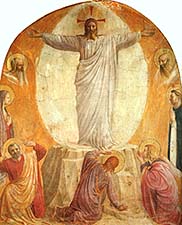

[The Transfiguration by Fra Angelico]


As for sacred vessels, I will never forget a homily by a Swiss priest, preaching on the gift of gold brought by one of the Magi, in which he remarked: "If we do not give the very best we have to God, we do not really believe in God at all. If we have gold, which is precious and costly and beautiful, we must use it for His glorification; if we make sacred vessels out of wood or glass or clay, we are in effect saying that we do not think of Him as all-excelling, beyond everything we can give, so that we must give Him the best we can possibly manage to give, even (or especially) when it pinches our pockets. We have cut God down to our size and placed Him in a tidy budget, just as we would do when stocking our kitchen at home; we believe in Him weakly, or maybe not at all."

This homily was memorable not only because I had never heard a priest say anything like it--expounding venerable traditions of the Catholic Church is not, alas, to be counted among the more common homiletic strategies nowadays--but also because it helped me to understand why Christians have always tried to give God the best. An honest effort in this direction produced the sublime art and architecture of the Middle Ages, next to which their modern equivalents look, on the whole, shallow and rude. It is impossible to exaggerate the importance, for the entire ethos of the liturgy, of the sacred vessels appearing worthy (as much as it is possible for us to make them so) of the Mysteries they are honored to contain. The elevation of the consecrated Victim at Mass is the pinnacle of the many-versed hymn that mankind and all of creation raises to God; that is the time when the supernatural inward reality of the gifts ought to be most evidently symbolized in the external beauty of the chalice and other vessels on the altar. Of the holy Curé of Ars, Saint John Vianney, who wore tattered clothes, slept on the floor, and subsisted on potatoes, we read:
When it was a question of the objects destined for divine worship, he could not find anything beautiful enough.... His joy was unspeakable when he received from the Vicomte d'Ars a magnificent canopy, superb chasubles, banners, a large monstrance in silver gilt, a tabernacle of gilded copper, some beautiful candlesticks, and six reliquaries.11
Jesus was born in a humble stable and placed in a manger, true; but the Wise Men did not bring him straw, dirt, and dung, they brought him costly royal gifts of gold, frankincense, and myrrh. The way in which our Lord was born revealed His humility, which disdains earthly pomp; the way in which the three kings adored Him revealed their humility, which looked for the best they could offer, knowing in their wisdom that it was far beneath what He deserved. It is not for us to behave as if we were Jesus come into the world and thus to create churches that look like barns or stables or caves to receive us. It is rather our business to join the Magi and shepherds in heeding the divine call that beckons us beyond our limits. Responding in faith, we must give our utmost to the Word-made-flesh. The same thing can be said of sacred music. Modern man is no different in essence from man of any age, and therefore has no valid excuse for producing or perpetuating eyesores and earaches. Such unworthy stuff is not what most of our contemporaries would want, had they any chance to choose; it is certainly not what any of them need.

* * * * * *
The Mass is a living image or efficacious likeness of the perfect worship offered by Jesus Christ as Head of the Church--the sinless Lamb slain on Calvary, now reigning in the heavenly Jerusalem--and so it makes present in our midst the glorified Savior whose second coming will not be in quiet poverty but in earth-shattering splendor.

* * * * * * *

As was said, it is true that Our Lord first appeared on earth in a humble manger, hidden and poor. The sacred liturgy, however, is not time-travel to Bethlehem circa 6-4 B.C. The Mass is a living image or efficacious likeness of the perfect worship offered by Jesus Christ as Head of the Church--the sinless Lamb slain on Calvary, now reigning in the heavenly Jerusalem--and so it makes present in our midst the glorified Savior whose second coming will not be in quiet poverty but in earth-shattering splendor. For this reason the instinct of our faith has always been to maximize the beauty of the liturgy and its diverse furnishings and surroundings, yearning for what is to come rather than indulging in backward glances. From that point of view, the liturgists who clamor for a return to evangelical or apostolic "simplicity" are the ones guilty of nostalgia, not the faithful who desire the traditional Roman rite. They want to go back, we want to press forward. It is the difference between archaeology and eschatology. The irony, in fact, is greater: one of the most ancient liturgical customs of all, and one that survived all ages and cultures until it met its match in the hubris of the modern West, is that of facing eastwards when we pray to Christ, the True Light that enlightens every many (cf. Jn 1:9). In having the priest turn his back on the Sun of Justice and "face the people" in a closed circle, as if he were the coming light, advocates of the new liturgical style disdain universal symbolism and banish one of the few customs we can be certain the church of the early centuries practiced. Once again, those who defend Tradition find that they are more capable than their adversaries of preserving what the latter claim to value most--in this instance, antiquity.

To be continued in the next issue.

Notes

  1. I say "not simply and altogether," because on the one hand it is possible to bring the celebration of the ordinary rite into manifest visible continuity with the extraordinary rite (as some Oratorians do), but on the other hand, there are many ways in which the Missal of Paul VI neither encourages nor demands solemnity whereas the traditional Missal does this, indeed methodically. This is a key reason why some preists today are unwilling to learn the old Mass: it is too demanding in its regularions of speech, posture, gesture. But it is also a key reason why a good many young seminarians and priests are eager to learn it: what person in good physical shape could hear about a nearby steep mountain with a beautiful view from the top, and not feel the urge to climb it? [back]


  2. Summa theologiae III, q. 83, a. 4. [back]


  3. All of these comments could be applied also to the death of homiletics in our age. There is hardly a priest left in the world who can preach as the Fathers of the Medievals did. Where is a Saint Gregory, a Saint Augustine, a Saint Bernard, a Saint Bonaventure! They are gone; there is hardly such a thing as preaching anymore. We hear stories, jokes, platitudes, generic newspaper advice, but little in the way of sustained and robust exegesis of Scripture, little in the way of provocative challenges against popular culture, little in the way of urging asceticism for penance and reparation. The clergy have by and large grown soft and their message is softness. The need for clergy who can effectively preach the Word in season and out of season, stirring up the people to conversion of heart, is as great now as it was at the time of Saint Dominic and the Albigensian crisis. [back]


  4. It is important to realize that there are cultural and political reasons for the loss of solemnity that do not exactly correspond to the Novus Ordo's own weaknesses. We might well have witnessed a similar decay of solemnity in the Tridentine rite had it never been supplanted by the Novus Ordo (e.g., attempts at "inculturated" Latin Masses, which were already happening before the Council). Perhaps the Tridentine Mass has retained the power to stand firm against these cultural-political forces because its distinctive cultivation of solemnity has been officially marginalized and is now attractively countercultural. Its solemnity, which would have been secularization's most inviting target, has only been underlined and guaranteed, due to the old rite's wholesale mainstream abandonment. [back]


  5. This is not to say that there could not be a preoccupation with ritualism that would diminish the joy, zeal, and charity characteristic of a healthy Christian spiritual life. Lovers of tradition may also suffer from the compromise of compartmentalization, whereby what happens in church has little or nothing to say to their consumerist lifestyle and neoconservative ideology. However, my purpose here is not to diagnose lapses or distortions of traditionalism, but on the contrary, to point out that its fundamental instinct is sound--the desire to worship God with the very best that our deep and rich tradition has given us. Relativism is not the final word; certain customs, rituals, sacred songs, and so forth are objectively more beautiful and more fitting for divine worship than others. [back]


  6. Lest I be misunderstood: I am aware that there have been comissions appointed by Popes with the view to evaluating, researching, restoring, or augmenting aspects of the liturgy. My point is not to say that there is never a place for such consultations. Rather it is a question of the minimum qualification required of someone who dares to sit on such a commission. I think it would be impossible to refute the claim that the minimum qualification is the most profound respect and reverence for Tradition, such that one would almost rather cut off one's hand than tamper with what has been handed down. As the Notitiae or official notices along with documents like Bugnini's memoirs reveal, however, this spirit of veneration was shockingly absent from the Consilium, the body of theolgians entrusted with revising the liturgical books of the Roman rite. The most disgraceful example, to my mind, is the reply published in Notitiae responding to a query about why the old offertory prayers were removed. The Consilium said, in short: "The Offertory Prayers are redundant and unnecessary, as they anticipate the sacrificial action that is to occur later." With one smug reply, centuries of worship and theology are swept aside, as if nobody had ever understood the offertory before the enlightenmed gurus of the Consilium came along to explain it. Such a union of hubris and idiocy might possibly be unique in the history of Catholic theology. [back]


  7. As Father Samuel Weber, O.S.B. and Jeffrey Ostowski are each doing with considerable success these days. [back]


  8. For further reflections along these lines, see the wonderful little book Reflections on the Spirituality of Gregorian Chant by Dom Jacques Hourlier, trans. Dom Gregory Casprini and Robert Edmonson (Orleans, MA: Paraclete Press, 1995), as well as two classics: Richard R. Terry's Catholic Church Music (1907) and Marie Pierik's The Spirit Of Gregorian Chant (1939), both republished in 2007 by The Church Music Association of America. [back]


  9. For a detailed treatment of the problems mentioned here, see my article "Contemporary Music in Church?" Homiletic & Pastoral Review 107.1 (October 2006): 8-15, available at http://www.ignatius.com/magazines/hprweb/kwasniewski.htm. [back]


  10. For documented summaries of what the Magisterium has taught about sacred music, see my articles "Cantate Domino Canticum Novum: Aspects of the Church's Liturgical Magisterium," The Catholic Faith 6.2 (March-April 2000): 14-23 and "John Paul II on Sacred Music," Sacred Music vol. 133, n. 2 (Summer 2006): 4-22. These are available at http://www.catholicculture.org/library/view.cfm?recnum=4440 and http://www.musicasacra.com/publications/sacredmusic/pdf/sm133-2.pdf. Magisterial interventions of Benedict XVI have only underlined the conclusions made in these articles. [back]


  11. Abbé H. Convert, Eucharistic Meditations: Extracts from the Writings and Instructions of Saint John Vianney, trans. Sister Mary Benevenuta, O.P. (Wheathampstead, Hertfordshire: Anthony Clarke Books, 1964), 100. [back]


Dr. Peter A. Kwasniewski is Associate Professor of Theology at Wyoming Catholic College in Lander, Wyoming. The present article, "Solemnity: The Crux of the Matter," was originally published in Latin Mass: A Journal of Catholic Culture and Tradition (Winter 2008), pp. 8-12, and is reprinted here by permission of Latin Mass Magazine, 391 E. Virginia Terrace, Santa Paula, CA 93060.
Sunday, February 24, 2008

Motus Magnus: An Analysis of Summorum Pontificum


by Michael Foley


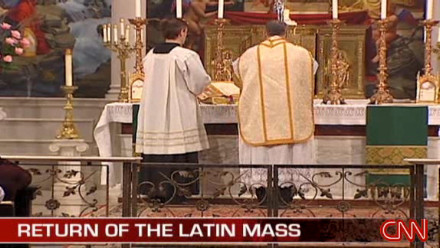
July 7th is the traditional feast of Saints Cyril and Methodius, the missionaries who introduced a venacular liturgy to the Slavic Church. And now, July 7th may also be remembered as the day when Pope Benedict XVI reintroduced a Latin liturgy to the Roman Church.

The Motu Proprio Summorum Pontificum is finally here, set to take effect on the exquisitely appropriate feast of the Exaltation of the Holy Cross (September 14th). The Pope tells us in his accompanying letter to the Bishops that "the document is the fruit of much reflection ... and prayer," and it shows.

What Didn't Happen

Summorum, though, has not met all expectations. Contrary to earlier press reports, it does not contain a numerical figure (previously rumored to have been thirty) for how many are required to petition for a Tridentine Mass. This frees the document from unnecessary regimentation, which is reasonable for a Church whose parishes vary widely in size.

Nor, thank goodness, was there any change to the Good Friday prayer for the conversion of the Jewish people -- though at the time of this writing (mid-July) protestations from lobbyists like the ADL's Abe Foxman continue unabated. Needless to say, if the prayer ever served as an occasion of bigotry (which has never been proved), what is needed is not further tinkering but a deeper understanding of its meaning.

* * * * * * *
By making the traditional liturgy universally accessible, the Holy Father is affirming that the Mass of the Ages belongs to every Catholic, not just those with a particular spirituality or vocation.

* * * * * * *

Contrary to some hopes, Summorum did not create a personal prelature or apostolic administration along the lines of Opus Dei, one that would safeguard the classical liturgy from the harassment of hierarchs and liturgists. Yet what the Pope has given us is far greater, even if it means having to endure some of the same difficulties as before. By making the traditional liturgy universally accessible, the Holy Father is affirming that the Mass of the Ages belongs to every Catholic, not just those with a particular spirituality or vocation. It lies at the center of the Catholic patrimony, not ina carefully sequestered ghetto for a few eccentrics and malcontents.

Further, thought the 1962 Missal is now universally available, no mention is made of a universal indult. This is a subtle yet tremendous change in language. In Church parlance an indult denotes permission to do something not allowed by the common law. It is thus an exception to the rule, an exception that, int he case of Pope John Paul II's 1988 Ecclesia Dei indult, was conceded begrudgingly. By speaking instead of two forms of the same rite, one extraordinary (the 1962 Missal) and the other ordinary (1970), Benedict has redrawn the map. No longer is the old Mass an exception to the rule; it is an established part of it. True, it will be a less frequently occurring form of Catholic worship, but there is a significant legal and even psychological difference between more frequent and less frequent on the one hand and a rule and its exception on the other. And as one blogger wryly remarked, "Let's hope that the term 'extraordinary' when referring to the 1962 Missal will be as broadly applied as it is when referring to 'extraordinary ministers of Holy Communion'!"

Power to the People

Another way in which Summorum redraws the map is by locating the initiative with the faithful and requiring the pastor and Bishop to address their needs (Article 5, para. 1). As Cardinal Dario Castrillon Hoyos explained, "If a group ... having a priest available to do it, asks to celebrate this Mass, the pastor or rector of the church cannot oppose it."1 Indeed, the entire trajectory of Summorum is from the ground up: the faithful petition their pastor, and if he cannot accommodate them, they are to appeal to the Bishop; if the Bishop does not help, the matter should be referred to an expanded Ecclesia Dei Pontifical Commission (5 para. 1, 7). In a twist that some might consider ironic, Summorum performatively reaffirms Vatican II's teaching on not only the clergy but the laity as the people of God.

Vindictated

Summorum also offers a robust vindication of the legitimate aspirations and claims that traditional Catholics have been making for decades. The Pope gently reminds the Bishops that it was their own failure to implement Pope John Paul II's indult that led to the Motu Proprio, and he laments the liturgical "deformations" that betrayed the aims of Vatican II and caused great suffering among the faithful -- including, he adds in a touching personal note, himself.2 His Holiness also rejects the old canard that attachment to the classical liturgy is geriatric nostalgia by speaking of all the young who have been drawn to it, and he accords greater intellectual respect to traditionalists by mentioning those whose attachments have been "formed by the liturgical movement," that is, by study and prayer rather than mindless habit or mere allergy to the new."3

* * * * * * *
The Pope gently reminds the Bishops that it was their own failure to implement Pope John Paul II's indult that led to the Motu Proprio, and he laments the liturgical "deformations" that betrayed the aims of Vatican II and caused great suffering among the faithful -- including, he adds in a touching personal note, himself.

* * * * * * *

Most significantly, Summorum explicitly states that the 1962 Missal was "never abrogated" (Article 1).4 A special group of Cardinals studying the issue in 1986 arrived at the same conclusion, but their report was gagged by protests from several national Bishops' conferences. For the past few years Cardinals Estevez and Castrillon Hoyos have reasserted the group's findings, but they were politely ignored. No more.

The Holy Father, however, is not blind to the vices that plague some traditionalists, who might be prone to "exaggerations and [unsavory] social aspects."5 Yet even here Benedict tells his Bishops that the best way to help them is by responding with charity. Put differently, if you want people to stop acting like freaks and fanatics, stop treating them like freaks and fanatics.

Restrictions

Summorum does not provide a carte blanche for the 1962 Missal. The group petitioning for the old Mass must be "stable" (5 para. 1), or as the Latin puts it, coetus ... qui continenter existit: "a group that exists consistently."6 Ordination is the only Sacrament not mentioned as one that can be conferred according to the old usage, but no matter: the traditional seminaries will be able to continue their current practices, as Summorum is primarily addressing parish life. The priest must be capable of celebrating the classical form and be juridically unimpeded (5 para. 4), and he can privately celebrate the Mass every day of the year except during the Sacred Triduum --- a reasonable restriction, since this is the practice for all private Masses on those days (and note that it does not forbid public Tridentine services during the Triduum).

Though the priest is obliged to accommodate the requests of the faithful for a traditional Mass, he must harmonize their welfare with the rest of the parish's (5 para. 1). No doubt the desire for peaceful harmony also prompted the limitation of the only one Tridentine Mass on Sundays and feast days (5 para. 2). Since Summorum is principally concerned with the Sunday celebrations that will be created by it, this should except churches that currently have more than one Sunday Tridentine Mass.7

All of these things are to be carried out "under the guidance of the Bishop in accordance with Canon 392" (5 para. 1). The Pope is quick to stress that his decision in no way undermines the Bishop's authority: though the rules of the game may have changed, the Bishop remains its referee.8 Given the intrinsic nature of episcopal orders, this is as it should be. And it is significant that His Holiness contextualizes this guidance in terms of Canon 392, which does not elucidate a Bishop's right to curtail liturgies but his duty to protect them for abuse. Bishops, in other words, are being instructed to promote a proper observace of the 1962 Missal in the dioceses.

No Rupture

One of the reasons Pope Benedict define the 1962 and 1970 Missals as two forms of the same rie is to underscore that there has been no "rupture" in the Church's liturgy. This, of course, might sound like an inaccurate claim, for do not the many novelties in the 1970 Missal mark a sharp departure from the Church's tradition of organicliturgical development?

* * * * * * *
As is clear from his writings as cardinal, the Holy Father is aware that not everything in the Novus Ordo is the fruit of organic development, but also needs a viable framework in which the new Missal can
be evaluated dispassionately.


* * * * * * *


As is clear from his writings as cardinal, the Holy Father is aware that not everything in the Novus Ordo is the fruit of organic development, but also needs a viable framework in which the new Missal can be evaluated dispassionately. By speaking of a single rite with two forms, Benedict is advancing what he elsewhere calls a "hermeneutic of continuity," an interpretation of vatican II and its aftermath in light of the great tradition rather than vice versa. In the long run, this approach will do much good in restoring the very continuity that has been breached by the distorted beliefs and practices rampant today.

Article 6

The most potentially problematic clause of Summorum is Article 6, which states that at a Tridentine Mass "the readings may be given in the vernacular, using editions recognized by the Apostolic See."

At the time of this writing, it remains unclear as to whether this refers simply to duly approved translations of the 1962 readings or to the use of the 1970 new Lectionary. The Ecclesia Dei commission has apparently authorized the latter in the past, so Article 6 could be referring to this as well.9 Such is the interpratation that the United States Conference of Catholic Bishops (USCCB) has given10 (see inset on page 19).

It would certainly be strange if this were the article's meaning, especially in light of the Vatican's own understanding of the 1962 Missal. The day the Motu Proprio was released, the Holy See Press Office issued a statement explaining the extraordinary form of the Roman rite to the media. One of the things the explanatory note states is that the 'form' is a 'complete' Missal in the Latin language, that is, it also contains readings for the celbrations (that is it is not disctinct from the 'Lectionary' as the later 1970 Missal is).

Is it then the Church's intention to allow a break int he very integrity it acknowledges? Grafting onto the old Missal the new Lectionary, which is based on a completely different set of organized principles and is incongruous with the collects and other propers of the 1962 calendar, would constitute precisely the kind of contrived dallying that Pope Benedict so eloquently rejected as a cardinal. And it saddles the extraordinary form with the Notoriously poor English. translations currently difiguring the 1970 Missal. Clearly the matter requires greater clarification from Ecclesia Dei.

Nevertheless, even if Article 6 should permit the new Lectionary, the good news is that it will probably not have much impact. Ecclesia Dei, as we have just noted, has been offering this same option for years, and it has never, to my knowledge, been acted upon. Moreover, since the entire trajectory of Summorum is from the ground up, the initiative for such a move would remain with the faithful themselves. And I am fairly confident that traditionalists will use this option for their Masses as much as progressive priests use the now optional maniple for theirs.

What Article 6 clearly does allow, however, is the biblical readings from the 1962 Missal to be proclaimed in the vernacular instead of Latin. This, too, is not unprecedented (Ecclesia Dei has always allowed this), nor does it necessarily constitute a disregard for ritual purity. Indeed, the late Michael Davies (if only he had lived to see this day!) spoke favorably of this possibility.11 My own sense is that many traditionalists, having been scarred by one too many liturgical deformations, will be loathe to adopt this practice and that it might be prudent to defer the issue; either way, charity should prevail in determining the best local course of action.

Authentic Development

One change that all parties can welcome, however, is the statement that "new Saints and some of the new Prefaces can and should be inserted in the old Missal."12 This is not a recipe for reckless alteration but for careful and authentic development, especially since it is to be carried out in cooperation with traditional bodies like the Priestly Fraternity of Saint Peter and the Institute of Christ the King.13 Until now, one could not celebrate in the traditional form the feast of Saint Padre Pio (a bitter irony given the Saint's love for the old Mass), of Saint Thomas More (which was not on the universal calendar in 1962), of Saint Faustina, or of the many other saints recently canonized. Similarly, it is not unreasonable to add prefaces to the 1570/1962 Missal, which has fewer than its medieval predecessors. In the 1962 Missal, for example, there is no proper preface for Advent, and thus the generic Common Preface or the Preface of the Holy Trinity is used from June all the way up to Christmas Eve.

* * * * * * *
Until now, one could not celebrate in the traditional form the feast of Saint Padre Pio (a bitter irony given the Saint's love for the old Mass)

* * * * * * *

But the deeper significance to this move is that the classical form is finally "unfrozen." As long as the Tridentine Missal was petrified in the year 1962, it could be seen as a museum piece, something as beautiful but as lifeless as a butterfly in amber -- and something that could be quietly put back into storage once this whole traditionalist brouhaha faded. But now, the traditional Missal will yet again reflect the ever growing roster of God's saints; it will yet again be capable of an authentic development that adds to rather than subtracts from its richness. Though seeminly minor, these proposals decisively ensure the ancient form's dynamic and ongoing vitality.

Conclusion

Because Summorum Pontificum does not and cannot provide a panacea for the current liturgical crisis, the dark night of abuse is far from over and the progress will remain slow. If experience is any guide, papal documents do not so much make things happen as set the conditions for making them happen. The onus, then, is on the grass-roots level, with the priests and faithful.

Finally, we should not forget Pope Benedict XVI. It was hiis vision and his determination in the face of stultifying opposition that made this outstanding document possible; and for this gift to the Church he now faces an escalating wave of hostility from enemies within and without. Let us fervently pray for our Supreme Pontiff and gladly heed his call for boundless charity as we work towards that "inner reconciliation in the heart of the Church" animating his liturgical largesse.


Notes

  1. From an interview in the Intalian magazine 30 Giorni, translated and cited by Catholic News Service. Emphasis mine. [back]

  2. Cf. the Pope's "Letter to the Bishops on the Occasion of the Publication of the Apostolic Letter 'Motu Proprio Data' Summorum Pontificum," Vatican translation. The letter does not contain official paragraph numbers, and so I am unable to cite it more precisely. [back]

  3. Ibid. [back]

  4. The Holy Father repeats this in the letter as well. [back]

  5. Letter. [back]

  6. With the exception of my literal rendering here of the Latin, all citations of Summorum are taken from the unofficial English translation of the Vatican Information Services. [back]

  7. Similarly, it should exempt "personal parishes" such as those run by the FSSP (1). The matter, however, may require greater clarification from Ecclesia Dei. [back]

  8. Cf. the letter. [back]

  9. Cf. Michael Davies, "The Missal of 1962: A Rock of Stability," TLM 10:2 (Spring 2001), 12. [back]

  10. USCCB Newsletter, Vol. XLIII (June-July 2007), q. 12, p. 24. [back]

  11. Unfortunately I cannot locate the passage. As attested by Alcuin Reid's amazon.com book reviews, both Monsignor Klaus Gamber in his Reform of the Roman Liturgy and Aidan Nichols in his Looking at the Liturgy "accept the appropriateness of vernacular readings." The Ordinances of the Society of Saint Pius X, signed by Archbishop Lefebvre, purportedly permit readings exclusively in the vernacular, and at least one SSPX priest, Fr. Basil Wrighton, speaks of the practice as "reasonable" (cf. "Roman Protestants," Angelus, August 1982). [back]

  12. Letter. [back]

  13. Ibid. [back]

[Dr. Michael P. Foley is a professor of Patristics at Baylor University and the author of Why Do Catholics Eat Fish on Friday? The Catholic Origin to Just About Everything (Palgrave Macmillan, 2005). The present article, "Motus Magnus: An Analysis of Summorum Pontificum," was originally published in Latin Mass: A Journal of Catholic Culture and Tradition (Advent/Christmas 2007), pp. 32-34, and is reprinted here by permission of Latin Mass Magazine, 391 E. Virginia Terrace, Santa Paula, CA 93060.]

Saturday, February 23, 2008

Grazie, Benedetto XVI

by Alice von Hildebrand


The date of July 7th, 2007 will be remembered with gratitude by all those who treasure the Traditional Mass. Not only is it likely that the Motu Proprio Summorum Pontificum will bring back into the fold many who have been rightly distressed and grieved by the shocking abuses which have taken place in the Sacred Liturgy since Vatican II (e.g. "Halloween" Masses), but also because it contains treasures of spirituality which have been buried. In spite of the fact that the "Tridentine" Mass never was, and could not be abrogated, some bishops, in the early 1970s, declared that those attending the "old" Mass on Sunday were not fulfilling their Sunday obligation.

When in January 1980, I had the priviledge of having a private audience with John Paul II, I drew this fact to his attention, and mentioned that, shortly before his death, my husband said to me, "I believe that to prohibit a holy traidition is morally illegitimate." John Paul was silent for a moment and then said, "Your husband is definitely one of the very great ethical thinkers of the twentieth century." Later, the Holy Father granted an indult to priests wishing to celebrate in the "old" rite, but permission had to be obtained from the local bishop. In spite of the pope's explicit request that bishops be "generous" in granting this request, many of them were deaf to his plea. Nevertheless, the sacred Tridentine Mass refused to die.

Cardinal Ratzinger, whose magnificent book on the liturgy, testifies to his profound understanding of its importance for man's religious life, clearly indicated that he regretted some of the changes that had taken place since 1969, many of which could not claim to be requested by Vatican II.

As head of the Congregation of the Faith, Cardinal Ratzinger became aware that the de facto prohibition of the "Tridentine" Mass had nefarious effects. When I was once again granted the incredible privilege of having a private audience iwth another pope, Benedict XVI, I repeated to him what I had said to John Paul II twenty seven years earlier. He told me that the Motu Proprio would be released in May 2007. (Apparently problems of translation delayed somewhat this ardently awaited proclamation.)

His Holiness was clearly aware that the legitimate wishes of innumerable faithful had been totally disregarded. He also knew that the congregations faithful to the "old" rite were flourishing, whereas many religious orders and seminaries had great difficulties recruiting young men for the priesthood.

Let us mention one parish whose story deserves to be told. In the early nineties, Saint John Cantius in Chicago was a moribund parish; at best, some fifty parishioners showed up for Mass on Sundays. Clearly it seemed to be doomed. But one dedicated priest, Father Frank Phillips, offered to take charge of it. He first introduced the Novus Ordo in Latin, the traditional language of the Church. Then he re-introduced the traditional Mass. Almost miraculously, more and more parishioners attended Mass on Sundays. A couple of times, I was privileged to go to Saint John Cantius on a Sunday. There is a low Tridentine Mass at 7 AM, then 12 PM. To my joy I witnessed that the Church was packed with young couples with children. The Parish of Saint John Cantius has literally "risen from the dead." The Institute of Christ the King is enjoying a similar success; it now has a house in Africa, several in Europe, and six in the United States, with more int he wings. More and more young men are responding to a call to the priesthood. The [Priestly] Fraternity of Saint Peter also deserves to be mentioned.

* * * * * * *
The Tridentine Mass is uniquely God-centered and is a perfect formulation of our faith: lex orandi, lex credendi. It is bathed in sacredness and
young people long for it.


* * * * * * *

The question is: why is the "old" Mass attracting so many young people who are definitely not suffering from what some bishops call "a sentimental attachment to the past"? May I venture to answer? What is attracting them is that the Tridentine Mass is uniquely God-centered and is a perfect formulation of our faith: lex orandi, lex credendi. It is bathed in sacredness and young people long for it; they have been deprived of this blessed atmosphere since their youth. One feels the awesomeness of this form of worship: God's house is experienced as a locus terribilis. It is truly the "house of the Lord," where we should take off our sandals and adore. Moreover, its liturgy is rich in symbolisms so important in religious life. Many of these symbols ahve been eliminated in the Novus Ordo. In the Tridentine Mass, the priest begins Mass at the foot of the altar. The symbolism is clear: before ascending the steps leading to the altar (where the Divine Sacrifice will be offered), he has to purify himself by reciting the magnificent 42nd Psalm: Introibo ad altare Dei.

After this purification, he dares to ascend to the altar (now a table), facing east together with his whole congregation. Once again, the symbolism is luminous: Christ is the Sol Justitiae. (Malachy, 3-20). The sun rises from the East and it is proper and just that His people should therefore look up to the East. This is a long standing tradition which has been arbitrarily abolished. That this is regrettable has been clearly formulated in Cardinal Ratzinger's book: The Spirit of the Liturgy. He writes: "The common turning toward the East was not a 'celebration toward the wall'; it did not mean that the priest 'had his back to the people'; the priest himself was not regarded as so important. For just as the congregation in the synagogue looked together toward Jerusalem, so in the Christian liturgy the congregation looked together 'toward the Lord'" (p. 80).

The Holy Sacrifice of the Mass -- a non-bloody repetition of the Sacrifice of Christ on Calvary -- takes place on the altar, the traditional place where in the Old Testament sacrifices were offered to God, replaced and fulfilled in the New Testament by the One Sacrifice of the One and only True Priest: Christ.

Today, the priest faces the congregation. Not only has a deep symbolism been lost, but moreover, this fact can tempt some priests to assume that "they should be performing," and unwittingly attract attention to themselves. The Tridentine Mass is vertical in the deepest sense of this term: totally God-centered. The individual personality of the priest is totally inimportant. He is no acting in persona Christi.

Genuflecting has traditionally been viewed as a visible expression of adoration. It plays much less of a rule in the Novus Ordo, even though Josef Cardinal Ratzinger had written in the book just cited above "... bending the knee before the presence of the living God is something we cannot abandon." (The Spirit of the Liturgy, Ignatius, p. 191.) Moreover, for no legitimate reason, altar rails have been removed. (Unless I am mistaken, this was not ordered by Vatican II.) This was not only a costly venture, but it also prevented people from adopting a posture that many of us feel to be the only adequate "body language" when approaching the Eucharist. Now the faithful are supposed to receive their Lord and Savior standing.

* * * * * * *
Many repetitions in liturgical prayers have been abolished; they were viewed as "unnecessary." That repetitions have a
profound meaning is ignored.


* * * * * * *

Many repetitions in liturgical prayers have been abolished; they were viewed as "unnecessary." That repetitions have a profound meaning is ignored. Granted that repeating a piece of neutral information is meaningless and boring, words such as "Lord have mercy<' cannot be repeated often enough. A wife once complained to me that her husband never said to her that he loved her. In a roundabout way, I tried to make him understand that she would appreciate hearing these sweet words, to which he answered, "I told her so when I asked her to marry me. She therefore knowls it. Why should I repeat it?" He was missing the point. The key words in a deep human relationship are, "I love you," "Thank you" and "Forgive me." Marriages in which these wors are never uttered are doomed.

Prior to Vatican II, women entering church wore a veil, whereas men took off their hats. Feminists interpreted this as a clear sign of discrimination. Now women go bare-headed like men. By allowing this change, according to the feminists, the Church is "slowly" trying to correct her ill-treatment of the female sex. But once again, a profound symbolism has been eliminated. Not only are we now disregarding a recommendation of Saint Paul, but we no longer understand its deep meaning. Because Mary, the Woman par excellence, was privileged to carry the Savior of the world in her sacred womb, and sacredness calls for veiling, women wearing a veil were reminded that their bodies have the very same structure as the one of the Theotokos. Mary has given life to the Savior; women are also "mothers of life" and this implies a unique closeness between them and the One who is the Life of the world. To be veiled indicated clearly the sacredness of the female body, and once again, this sublime message has been lost.

That girls are now allowed to serve on the altar is a manifestation of the same tendency to confuse the role of men and women in Holy Church. Women, under the nefarious influence of feminism totally forget that receptivity is their special charisma (for Mary said: "... be it done to me ...") and an essential feature of religious life. In our secularized world, only "doing" is appreciated. Silence, receptivity, contemplation are "inefficient."

Another reason why the Traiditonal Mass has such a posserful attraction is that it incorporates what Plato calls: "the colden chord of tradition." In a society where marriage and the family are breaking down, in which innumerable people are "uprooted," in which the "deprivation syndrome" is endemic, the awareness of participating in religious celebration that goes back for centuries, that has been the spiritual food of innumerable, cherished saints, is a powerful incentive to "feeling at home," in a deeply spiritual sense. One feels embedded in the "Communion of Saints" and experiences that saints living centiries ago are our spiritual contemporaries. Our poor prayers are joined to those of beloved saints and carried by them to God. It is such a consolation to those of us who daily feel the imperfection of their praise of God. The Traditional Mass has a note of "eternal youth" (... qui laetificat juventutem meam ...); this is why it could not die.

There is no doubt that Pope Paul VI, whose deepest wish was to achieve reconcilication with Protestants during his pontificate, was, in modifying the liturgy, making a gesture of good will toward our "separated brothers" by replacing the altar by a table (the Eucharist is now viewed primarily as a meal), and thereby weakening the sacrificial dimension of the Mass.

My husband's nephew, Dieter Sattler was named German Ambassador at the Holy See in 1966 during Pope Paul's pontificate. He repeatedly invited my husband and myself to be his guests at the German embassy. This is why we had the privilege of being close to the Pope, when He proclaimed his "Credo."

* * * * * * *
Because Mary, the Woman par excellence, was privileged to carry the Savior of the world in her sacred womb, and sacredness calls for veiling, women wearing a veil were reminded that their bodies have the very same structure as the one of the Theotokos. Mary has given life to the Savior; women are also "mothers of life" and this implies a unique closeness between them and the One who is the Life of the world. To be veiled indicated clearly the sacredness of the female body, and once again,
this sublime message has been lost.


* * * * * * *

Dieter told us that one day, Paul VI had assembled the whole diplomatic corps in the Vatican and told them that reconciliation with the Protestants was a cherished aim of his Pontificate. For this reason, several Protestant periti were invited to assist at the debates concerning the liturgy. They were denied the right to vote, but we were told that the changes that were about to be introduced met with their approval. It is now rare that in Catholic parish bulletins the word "Mass" is used: it is usually replaced by "Eucharistic Celebration."

Another concern of traditional Catholics is that several prayers of the Tridentine Mass, have been omitted: mostly those mentioning the Blessed Virgin Mary (whom Protestants do not honor), and also intercessory prayers to the saints. To a Protestant, there should be no "intermediary" between God and the individual faithful.

The omission of several key symbols, the omission of several prayers has been wrongly interpreted by "ultra" traditionalists as invalidating the Holy Sacrifice. This was a most regrettable error that my husband rejected from the very beginning. But Pope Benedict XVI, in his loving concern for all his sheep, has now granted them (and all of us) the gift of a treasure that has been the liturgical glory of the Holy Roman Catholic Church for centuries. For this reason, we should pray a Te Deum, and all say in unison: Grazie, Benedetto XVI!

[Alice von Hildebrand, wife of famed philosopher Dietrich von Hildebrand, is an internationally known philosopher and author of numerous books, most recently The Privilege of Being a Woman. The present article, "Grazie, Benedetto XVI," was originally published in Latin Mass: A Journal of Catholic Culture and Tradition (Advent/Christmas 2007), pp. 32-34, and is reprinted here by permission of Latin Mass Magazine, 391 E. Virginia Terrace, Santa Paula, CA 93060.]

Thursday, October 25, 2007

The Loss of Liturgical Riches in the Sanctoral Cycle

by Peter A. Kwasniewski

One year, a friend and I had the blessing of attending two celebrations of the Feast of Saint Thérèse of Lisieux, for in the old calendar her feast is October 3rd, and in the new calendar, October 1st. In fact, neither date is apropos. Thérèse actually died on September 30th, but this has long been the feast of Saint Jerome, qui non movetur, while October 1st, which might be styled the first day of her eternal reward, had been occupied by Saint Remigius, Bishop and Confessor, the one responsible for baptizing King Clovis, thereby bringing the Frankish kingdom into the bosom of Holy Mother Church. This latter feast - so relevant in our days when the "eldest daughter of the Church" has become, sad to say, a silly strumpet for whose conversion the whole Church should be offering up prayers and penances -- was removed from the universal calendar in the 1969 reform. I shall have more to say later about the removal of "obscure" or "local" saints. Meanwhile, to come back to the Little Flower, it was hard not to feel blessed by the opportunity to celebrate her memory twice. Surely, the saint of heroic humility would be smiling at the inopportuneness of both dates.

Still in the Novus Ordo celebration (which was, I might add, just about as Oratorian as could be, complete with a schola singing the chant), it was hard not to notice how absolutely unsuitable the readings were; they were simply the "readings for the day." The readings from Baruch had to do with the wickedness of the cities who reject God; the reading from the Gospel was "Woe to you, Tyre and Sidon." Admitting that a preacher with Origen's exegetical ingenuity could make any Scripture passage illustrate any mystery he pleased, the ordinary layman is left asking: Does this really have much to do with Thérèse? In the old rite, the readings always linked up with the saint whose feast was being celebrated. In the other Mass I attended, the Epistle was Isaiah 66:12-14 ("As one whom his mother comforts, so I will comfort you"), and the Gospel was Matthew 18:1-4 ("Amen I say to you, unless you convert and become like little children, you shall not enter the kingdom of heaven"). The abandonment of the inner unity of Scripture and feastday is one of the greatest disasters of the new rite. It makes the prayers, the readings, and the sacrifice seem like three different things, when they ought to be clearly woven together, as in the old rite, making one seamless garment.

But there was something more, and worse: the proper chants for her feastday, in the new Graduale Romanum, are, in some cases (like the Alleluia verse) irrelevant, and in other cases barely relevant -- that is, bearing no special relation to Saint Thérèse. A comparison with the propers of the old rite for Thérèse's feastday will make apparent the magnitude of the loss suffered by the faithful when the ancient liturgy and its organic development were cast aside.

The Graduale Romanum (the Novus Ordo) offers the following propers for Saint Thérèse:
Introit (Ps. 30:7-8,2) -- I however have hoped in the Lord: I shall exult and rejoice in Thy mercy, because Thou hast looked upon my humility. V: In Thee, O Lord, I have put my hope, I shall not be confounded for ever; in Thy justice free me. I however have hoped in the Lord: I shall exult and rejoice in Thy mercy, because Thou hast looked upon my humility.

Gradual (Ps. 26:4) -- One thing I have asked of the Lord, this I shall seek: that I may dwell in the house of the Lord. V. That I may see the delight of the Lord, and be protected by His holy temple.

Alleluia (Ps. 116:1) -- Praise the Lord, all ye nations, and rejoice in Him, all ye peoples. Alleluia.

Offertory (Ps. 102:2,5) -- Bless the Lord, O my soul, and forget not all of His gifts: and thy youth shall be renewed like the eagle's.

Communion (Ps. 9:2,3) -- I shall tell of all Thy wonders: I shall rejoice and exult in Thee: I shall sing Thy name, O most High.1
It goes without saying that the translations given above are not, in fact, the ones given in the ICEL text that still, after all these years, perpetrates on English-speaking Catholics a fraud the magnitude of which has never been equaled in the history of liturgical abuses. The faithful are deprived even of the benefit that would accrue to them from having in their ears the actual texts that the Church has chosen for her celebrations. Besides, probably fewer than 10 percent of the faithful today actually hear these (or any) "Propers," least of all in the resplendent clothing of Gregorian chant. Instead, they might sing lame songs that are even less relevant to the feastday being celebrated. In other words, the "reform" has resulted, in most instances, in a wholesale abandonment in practice of the very notion of Propers.

No, my complaint is not at this level; it is at the level of the Latin text. In her masterful studies of recent years, Dr. Lauren Pristas has helped us to see that the radical difference between the old and new Missals has to be assessed on the "pure" ground of the Latin editio typica of each. And this is where I, too, stake my claims. I prescind entirely from the insulting travesty of the ICEL translation and focus on the Latin.

* * * * * * *
Comparing the two sets of propers, I ask: Is this an example of liturgical progress, of a "successful" reform? The Novus Ordo propers are vague and generic, ready for application to any female saint; the Tridentine propers are majestic, poetic, and exactly apropos to the Little Flower.
* * * * * * *


Now, consider the Propers appointed in the old rite for the feast of Saint Thérèse. In stark contrast to the sad situation that obtains with the new rite, in the old rite the Propers were always recited or sung, because they are, and were treated as, an integral part of the liturgy. Moreover, people often had their handheld missals with them, so that everyone who cared to pay attention -- and this was certainly an ever-growing number right up to the eve of the Council -- was nourished by these verses from Scripture, beautifully applied to the Little Flower:
Introit (Cant. 4:8-9) -- Come from Libanus, my spouse, come from Libanus, come; thou hast wounded my heart, my sister, my spouse, thou hast wounded my heart. V. (Ps. 112:1) Praise the Lord, ye children; praise ye the name of the Lord. Glory be. Come from Libanus, my spouse, etc.

Gradual (Mt. 11:25) -- I confess to Thee, O Father, Lord of heaven and earth, because Thou hast hid these things from the wise and prudent, and hast revealed them to the little ones. V. (Ps. 70.5) [Thou hast been] my hope, O Lord, from my youth.

Alleluia (Ecclus. 39:17-19) -- Bud forth as the rose planted by the brooks of waters: Give ye a sweet odor as frankincense. Send forth flowers as the lily, and yield a smell, and bring forth leaves in grace, and praise with canticles and bless the Lord in His works. Alleluia.

Offertory (Lk. 1:46,48-49) -- My soul doth magnify the Lord, and my spirit hath rejoiced in God my Savior: because He hath regarded the humility of His handmaid. He that is mighty hath done great things to me.

Communion (Deut. 32:10,12) -- He led her about and taught her, and He kept her as the apple of His eye. As an eagle He has spread His wings and hath taken her on His shoulder. The Lord alone was her leader.
Comparing the two sets of propers, I ask: Is this an example of liturgical progress, of a "successful" reform? The Novus Ordo propers are vague and generic, ready for application to any female saint; the Tridentine propers are majestic, poetic, and exactly apropos to the Little Flower.


The Loss of Liturgically Suitable Readings

Let us turn to the subject of readings and how they are to be selected. A first principle for lovers of liturgical tradition is that the cycle of feasts of our Lord, our Lady, and the saints must take precedence over a cycle of Scripture readings. There is no liturgy in existence that privileges a rationalistically-conceived march through books of the Old and New Testaments. All liturgies, Eastern and Western, look to the mysteries of Christ and of His Mother, and to the lives and virtues of that bright "cloud of witnesses" who incarnate, so to speak, the reality of Jesus again and again throughout history. Recitation of the text of Scripture is made decisively subordinate to the historical embodiment of Scripture's message in holy persons. The readings serve, in other words, to frame, adorn, and bring to light the face of Christ and the faces of all His imitators. The use of Scripture is iconic, not homiletic. We are not being lectured at, but rather summoned to worship, to bow down before mysteries. The readings are to function as verbal incense, not verbose information. That is why a relatively narrow selection of Scripture passages, and usually shorter rather than longer ones, is perfectly adequate and even preferable for the sacred liturgy. Not all passages are equally suited to the purpose of the liturgy per se. With all due respect to the inspired word of God, probably only about 10 percent of the Bible is liturgically suitable. The other 90 percent is fertile ground for lectio divina, the practice that all of us should be engaged upon in some of the hours when we're not at Mass.

With these all too brief considerations in mind, we can see the fallacy lurking behind one of the most common complaints the liturgical movement made against the Tridentine Missal, namely that it did not contain a sufficient diversity of Scripture readings. Apart from the general refutation of the argument -- namely, that liturgy is not meant to be a Scripture study session, that Scripture serves an important but still subordinate role in the Holy Sacrifice -- the real solution would have been to undertake with great patience the long-term task of composing Masses more "proper" to individual saints or liturgical seasons, so that a carefully augmented use of Scripture would have been able to retain the iconic function that we glimpsed in the propers of Saint Thérèse. I do not necessarily mean composing new chants, although in some cases this would certainly have been possible, but selecting chants more directly relevant to the life and teaching of the particular saint, and expanding the readings by appointing previously unread passages for the feastdays of saints whom they suit the most.2

For example, the feast of Saint John on December 27 might have been enhanced by the use of a different entrance antiphon than In medio ecclesiae. As beautiful an introit as this is, it was used indiscriminately for all the Doctors of the Church, whose numbers have greatly increased in recent centuries, with no attempt made to craft propers for them.3 A properly Johannine introit would refer, using verses from his Gospel, to the sublimity of his teaching on the divinity of Christ. In general, the feasts of the Evangelists could have been improved simply by making the propers more, if you will, "proper." Or again, why must every holy woman get the mulier fortis reading of Proverbs? It seems odd to apply the selfsame reading to very distinctive saints for whom one could find other more appropriate passages. This would have been the way to expand the liturgy's readings while respecting the intrinsic connection between scripture and sanctity. As long as you preserve the mulier fortis for, say, three women (rather than for twelve or however many!), daily Mass-goers will still hear or read this fine reading every year, but there will not be overkill on the one hand, and undervaluation of the distinctiveness of the saints on the other. The pattern had already been set by the feasts of those saints who, in the Missal of 1955 or 1962, already had a perfectly adapted set of propers special to them: for example, Saint Thérèse herself, where all the chants and readings are exquisitely suitable, or Saint Margaret Mary in her special relationship with the Sacred Heart. Yes, to do this would have made the Missal somewhat larger or demanded its publication in two volumes, but it would have greatly enriched it, and one of the arguably legitimate goals of the liturgical movement -- that Scripture be more fully represented -- would have been satisfied in a manner wholly consistent with the tradition and its best models.

The new lectionary, in contrast, is a failure, for three fundamental reasons.

First, the guiding principles were Cartesian, that is to say, mathematical order, a technical completeness (we have to "get through" the Scriptures), and a typically materialistic disregard for the organic unity of the soul-body complex which is the liturgy -- its soul being the Eucharistic sacrifice-sacrament, the dual motion of offering to the Father and receiving in communion, while its body is the surrounding prayers, readings, and chants.

Second, there is the basic human problem of having more than one year's worth of readings. A single year is a natural period of time; it is healthy, pedagogically superior, and deeply consoling to come back, year after year, to the same readings for a given Sunday or weekday. This has been my experience. You get to know the Sunday readings especially; they become bone of your bone. You start to think of Sundays in terms of their readings, chants, and prayers, which stick in the mind all the more firmly because they are both spoken or chanted and read in the missal you are holding (more senses engaged). In this way the traditional Western liturgy shows its affinity to the Eastern liturgies, which go so far as to name Sundays after their Gospels or after some particular dogma emphasized. In the old days, the fourteenth Sunday after Pentecost had a distinctive identity: Protector noster was the introit, you knew its melody, and the whole Mass grew to be familiar, like a much-loved garden or a trail through the woods. Nowadays, who knows what the "tenth Sunday of Ordinary Time" is about! It's anyone's guess.

Third, the men who chose the readings were a committee of "experts," biblical scholars with sociological leanings, who should be distrusted when it comes to spiritual matters. The only reverent way of augmenting a missal would be to entrust to contemplative monks the task of proposing new readings and propers for certain saints' feasts, for the weekdays of Advent, and so on -- to entrust it to traditional Benedictines, Cistercians, Carthusians, whose daily bread (after the Eucharist) is lectio divina, whose every thought is permeated by the words, the rhythms, the doctrine of Sacred Scripture. For these men and women, Scripture is not a "project," a book to be divided and conquered; it is their food and drink. Feeling the spiritual weight of what they read, they would be able to recommend readings that are most fitting for a given saint, or for the ferial days in Advent and Paschaltide. So the process could have gone like this: monks at many monasteries propose, after much prayer and meditation, new readings for feastdays or ferials in the old calendar; then, final decisions are rendered by a board composed of monks, bishops, and experienced preachers, but not "scholars" and "liturgists."

* * * * * * *
The abandonment of the inner unity of Scripture and feastday is one of the greatest disasters of the new rite. It makes the prayers, the readings, and the sacrifice seem like three different things, when they ought to be clearly woven together, as in the old rite, making one seamless garment.
* * * * * * *


What are some areas of the old calendar where new readings could be appointed without undermining the spirit, the unity, the internal pedagogy, and the traditional perfection of the liturgy as a whole?

Weekdays during Advent. The Roman church in the early ages adopted the practice of daily Mass during Lent at a time when daily Mass was unusual and when the Eastern churches adopted precisely the opposite custom, having prayer services instead of Mass for weekdays of Lent. With the increasing modern emphasis on assisting at daily Mass, and the constant though lesser theme of Advent as a time of penance, comes the need to enrich this segment of the calendar. Here, then, is a beautiful open field for the assigning of Advent lessons from the Pentateuch, the Prophets, and the Wisdom books, and new graduals from the Psalms, all of them pointing as with one voice to the coming feast of Christmas and testifying to the mystery of the Incarnation. The saints' feastdays during Advent should not, however, be interfered with; only the "empty" days should have readings assigned to them. If the Church decided to add a new saint's day to the universal calendar, the readings could be adjusted accordingly.

Weekdays during Paschal time. Again, not to the prejudice of the saints, new readings could be used for the ferial days of this season.

In general, many of the saints' feastdays could be furnished with apposite readings, in the way that Saint Monica's feast has the Gospel about the widow's son raised from the dead, or Saint Gregory Thaumaturgas, a saint famous for having literally moved a mountain, has the Gospel about the moving of mountains by men of faith.


Suppressing "Archaic" Saints

I would like to turn to a related theme: the suppression in the new Missal of so many saints' days, and their partial replacement with "new" saints supposedly more "relevant" to our times and to modern Catholics. The fact is, there are thousands of saints; John Paul II canonized hundreds more. There could never be room in the calendar for even the modern saints (19th and 20th centuries), let alone a representative sampling from all centuries. The whole problem with the reformers' mentality is that they felt that the calendar has to reflect in almost mathematical proportions, by a quantitative sampling, the various periods of Church history, with weight being given to the modern because it is nearer to us. The "reform" betrays a false notion of sacred time. We are the contemporaries of Christ, the Apostles, and the early Christians who died in agony for sake of the Faith, and yet we are most likely to forget about them and to need their prayers and their example ever before us. The early Christians are the perennial witnesses to the Faith, the first great standardbearers after its sudden appearance in the fallen world. There is something especially glorious about them, and that is why the old calendar is filled with their names. We are ever being led back to the first ages, the infancy of our faith, the childhood of our religion.
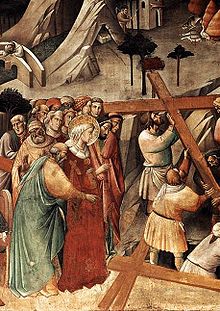
The calendar's main purpose is not to keep up with the ongoing march of saints; there are devotional books, prayer manuals, biographies, and much more to help us deepen our knowledge of that vast assembly. No, the saints whom the Holy Spirit moved the Church to include in the universal calendar are there for special reasons which cannot be grasped by a sociological or historical analysis; the reasons are intuited by one who prays long and faithfully with the old missal. The very appearance of randomness, of an unlikely gathering of some few more recent saints with the much larger number of saints from the earliest times, gives pause for reflection: Am I numbering myself with the ancients, the wise men, the first martyrs? Am I remembering my forefathers, who would otherwise pass out of human memory? The continual recollection of the earliest saints corrects our modern habit -- a habit that all "moderns" have in their own period, regardless of whether we are speaking of the Renaissance or the 21st century -- of thinking that the new is more real, and the old is a distant shadow no longer distinct and discernible. No, the missal brings us immediately into the company of the Romans and Greeks and barbarians who converted to the Faith, who were great bishops or virgins or martyrs, and who bring us outside of our age into the agelessness of the faith, its eternal youth that sings the praises and begs the intercession of these ancient men and women just as though they were sitting next to us in the pew. It ever joins the end to the beginning, and keeps today rooted int he first day; it brings into sharp relief the awesome fact that the Christian religion is ever-present and transhistorical, there is neither yesterday, nor today, nor tomorrow, but Christ is always and forevermore coming to us in the manger and dying for us on the Cross, and his saints, even those whom our human instincts would place at a distance, are not dead strangers but living friends. the old calendar does all this with a remarkable subtlety of force: it works at you day by day, quietly, until you begin to recognize those names, and remember the collects, and spontaneously turn to the men and women who bore the names, who are now not only your models but your contemporaries. Clock time loses its hegemony, and sacral time, which participates in the changeless now of God, gains on your soul. That is the kind of calendar we need.

One who is attentive to the old liturgical calendar will perceive many instances of the subtle unity and harmony that pervades this noble work of the Holy Spirit, in which many great souls participated but, thanks be to God, no committee had a part. Note, as a palpable but by no means isolated example, the magnificent progression of feasts from September 14th to September 18th, which form a miniature catechesis of the mystery of the passion and death of our Lord and its saving power throughout all ages -- beginning with Mary and John at the foot of the cross, and continuing in all the heroic imitators of Christ whom divine grace raises up when the faith has begun to grow cold.(I do not reproduce here the texts in full, but merely sketch out each day, to show how well they cohere.)
September 14: The Exaltation of the Holy Cross. Introit: cf. Gal. g:14: It behooves us to glory in the Cross of our Lord Jesus Christ, in whom is our salvation, life, and resurrection, by whom we are saved and delivered. Collect: O God, who on this day dost gladden us by the yearly feast of the Exaltation of the Holy Cross: grant, we beseech Thee, that we who on earth acknowledge the mystery of redemption wrought upon it, may be found worthy to enjoy the rewards of that same redemption in heaven. Through the same Our Lord Jesus Christ. . . Epistle: Phil. 2:5-11: Let this mind be in you which was also in Christ Jesus . . . Gospel: Jn. 12:31-36: And I, if I be lifted up from the earth, will draw all things to myself . . . . While you have the light, believe in the light, that you may be the children of light.

September 15: The Seven Sorrows of the Virgin Mary. Introit: Jn. 19:25: there stood by the cross of Jesus his mother, and his mother's sister Mary of Cleophas, and Salome, and Mary Magdalen. Woman, behold thy son, said Jesus: and to the disciple, Behold thy Mother. Collect: O God, at whose Passion according to the prophecy of Simeon, a sword of sorrow pierced the most sweet soul of the glorious Virgin and Mother Mary, mercifully grant that we who honor with devotion her sorrows, may obtain the happy fruit of Thy Passion: who livest and reignest with God the Father . . . Epistle: Jud. 13:22, 23-25: The Lord hath blessed thee by his power, who by thee hath brought our enemies to nought. . . . for thou hast not spared thy life by reason of the distress and tribulation of thy people, but hast prevented our ruin in the presence of our God. Gospel: Jn. 19:25-27.

September 16: Saints Cornelius and Cyprian, Martyrs. Introit: Ps. 78:11,12,10: Let the sighing of the prisoners come in before thee, O Lord; render to our neighbors sevenfold in their bosom; revenge the blood of thy saints, which hath been shed. Epistle: Wis. 3:1-8: The souls of the just are in the hand of God, and the torment of death shall not touch them. . . . As gold in the furnace he hath proved them, and as a victim of a holocaust he hath received them . . . Gospel: Lk. 2:9-19: They will lay their hands on you and persecute you, delivering you up to the synagogues and into prisons, dragging you before kings and governors, for my name's sake. . . . In your patience you shall possess your souls.

September 17: Impression of the Holy Stigmata on the Body of Saint Francis. Introit: Gal. 6:14: But God forbid that I should glory, save in the cross of the Lord Jesus Christ: by whom the world is crucified to me, and I to the world. Collect: O Lord Jesus Christ, who when the world was growing cold, in order to enkindle in our hearts the fire of thy love, didst renew the sacred marks of thy passion on the body of blessed Francis: mercifully grant that with the aid of his merits and prayers we may ever bear our cross, and bring forth worthy fruits of penance: who livest and reignest with God the Father . . . Epistle: Gal. 6:14-18: But God forbid that I should glory, save in the cross of our Lord Jesus Christ . . . From henceforth let no man be troublesome to me; for I bear the marks of the Lord Jesus in my body. Gospel: Mt. 16:24-27: If any man will come after me, let him deny himself and take up his cross and follow me. For he that will save his life shall lose it; and he that shall lose his life for my sake shall find it. Postcommunion: O god, who in diverse ways didst show forth in blessed Francis thy confessor the wondrous mysteries of thy cross, grant, we beseech thee, that ever following the example of his devotion, we may be strengthened by constant meditation on the same cross. Through our Lord Jesus Christ . . .

September 18: Saint Joseph of Cupertino, Confessor. Introit: Eccl. 1:14-15: The love of God is honorable wisdom, and they to whom she shall show herself, love her by the sight, and by the knowledge of her great works. Collect: O God, who has ordained that thine only-begotten Son when lifted up from the earth should draw all things to Himself, mercifully grant, through the merits and example of thy seraphic confessor Joseph, that we may be lifted up above all earthly desires and be found worthy to come unto Him, who liveth and reigneth with God the Father . . .4 Epistle: 1 Cor. 13:1-13: If I should have prophecy, and should know all mysteries and all knowledge; and if I should have faith so that I could move mountains, and have not charity, I am nothing. . . . Gospel: Mt. 22:1-14: Many are called, but few are chosen.
This sequence of profoundly coordinated and mutually reinforcing prayers, readings, and propers is only one example among many of the quiet working of the Holy Spirit on the calendar over the centuries, perfecting the liturgical expression of the mysteries of faith and intensifying its pedagogical power on receptive souls. I recall how a highly perceptive priest who celebrated the Tridentine Mass every morning told me that such treasures of beauty and order could be found throughout the calendar. We should not be surprised; we should even have expected that a liturgy that had grown organically for centuries would exhibit refinements of this degree.


Preserve, Study, and Pray

What, then, is the conclusion we can derive from the foregoing observations? First, there is the obvious truth that we must preserve, with all our might, the riches of the Latin liturgical heritage for future generations who deserve to know what the Western liturgy really is, and who long to worship God in spirit and truth according to His gifts to the Church. The words of John Paul II in Ecclesia Dei, now almost twenty years old, ring out with a relevance ever-new: "respect must everywhere be shown for the feelings of all those who are attached to the Latin liturgical tradition." Could anyone with mind aware and heart aflame fail to be attached to so rich a tradition, and disturbed by so impoverished a revision? The recently promulgated Summorum Pontificum beyond all expectation, transforms the late pope's counsel into a veritable law for the Latin Church, down to each and every parish, and in this way gives the reigning pope's official sanction to the apostolate of a living and life-giving preservation of our inheritance.

* * * * * * *
The readings serve, in other words, to frame, adorn, and bring to light the face of Christ and the faces of all His imitators. The use of Scripture is iconic, not homiletic. We are not being lectured at, but rather summoned to worship, to bow down before mysteries.
* * * * * * *


Second, and less obviously, we need to take the time and make the effort to study the traditional liturgy to the extent that our state in life permits, so that we can peacefully, intelligently, and persuasively defend its superiority, and help those who are unfamiliar with it to see the vital spiritual lessons, the poetic beauty, the catechetical instruction, the consolation of soul it plentifully affords.

Finally, and least obviously, we need to support with prayers and good will the may priests and laity who are doing their utmost to bring the celebration of the Novus Ordo into conformity with the Latin liturgical tradition, however much this may seem to be a quest to square the circle. Ultimately, for the very survival of orthodox Catholicism, there has to be return to the ancient heritage that has been spurned, yet this can happen in a pure way and in a piecemeal way. The readers of this journal strive to follow a purer way, but they must not scorn the piecemeal (or Adoremus) way, for it, too, is capable of leading souls in the right direction. It is not for us to judge how the victory will be won. Our task is only to promote the good we know. May Saint Thérèse -- and all the saints nourished on the Tridetine rite -- pray for us.


Notes

  1. Of course, the very fact that the altar missal can have still other texts than those given in the Graduale Romanum, and ones not especially better than the selection made by Solesmes, underlines the lack of coordination and unity which has effectively made it impossible to say the Roman rite is unified and universal. Put simply: When I walk into a church anywhere in the world, I do not know what I am going to get, regardless of the so-called universal calendar -- there are so many options, dispensations, derogations, cycles, and what have you. This is a deplorable situation. [back]


  2. Every five years, a supplement could have been published, to be used alongside the missal on those particular feastdays, until after twenty years or so it was time to put all the new propers/readings into the missal itself. One sees in old missals how certain universal or regional feasts were introduced by appendices pasted into the back of the books. [back]


  3. Note that I am not advocating liturgical experimentation, but only the augmentation of a Missal otherwise left intact in its beauty and riches. This is exactly what the Church herself did for a century and more prior to Vatican II: new feasts were introduced, often with new propers, with relevant readings appointed, and even new chants composed. It could only be snobishness or squeamishness that would prevent us from seeing the wisdom of this kind of truly organic development. Who could not imagine a suitable Mass in honor of Mother Teresa of Calcutta, drawing from the sayings of the prophets (such as Amos) and of our Lord on the poor (the epistle of the rich young man comes to mind)? [back]


  4. Let the reader be reminded that Saint Joseph of Cupertino was especially famous for his much-witnessed levitations that literally "lifted him high" above the ground, even to the very rooftops. So, the Collect is using the saint's "levity" as a symbol of how we, too, must rise above merely earthly goods and cleave to those of heaven. It is a splendid example of multiple layers of meaning deliberately planted in a text, which presupposes an audience awake and intelligent enough to parse out the meaning. [back]

Photo credits

Dr. Peter A. Kwasniewski is Associate Professor of Theology at Wyoming Catholic College in Lander, Wyoming. The present article, "The Loss of Liturgical Riches in the Sanctoral Cycle," was originally published in Latin Mass: A Journal of Catholic Culture and Tradition (Fall 2007), pp. 30-35, and is reprinted here by permission of Latin Mass Magazine, 391 E. Virginia Terrace, Santa Paula, CA 93060.