Friday, January 15, 2010

How the Old Mass Shaped the New World


By Michael P. Foley

The fortieth anniversary of the Novus Ordo is a few weeks away, as it was Pope Paul VI’s wish that his new form of the rite take effect on the first Sunday of Advent in 1969.1 While the Pauline Missal was not published until the following year (and its translations much later), this date is as good as any to reflect on a momentous change to the Roman Church’s worship. Because forty is the biblical number for a generation, I would like to devote this column to a reflection on what we may have subsequently lost, not theologically or spiritually, but culturally. My point of departure is a brusque statement from Doctor John Senior: “from the cultural point of view, the new Catholic Mass established in the United States has been a disaster.”2 What could Senior have meant by such a harsh conclusion, and is there any justification for his opinion?

Sacrifice and Civilization

To understand Senior’s position, we must first surmise his view of Western culture:
Whatever we do in the political and social order, the indispensable foundation is prayer, the heart of which is the Holy Sacrifice of the Mass, the perfect prayer of Christ himself, Priest and Victim, recreating in an unbloody manner the bloody, selfsame Sacrifice of Calvary. What is Christian Culture? It is essentially the Mass. That is not my or anyone’s opinion or theory or wish but the central fact of two thousand years of history. Christendom, what secularists call Western Civilization, is the Mass and paraphernalia which protect and facilitate it.3
Senior goes on to describe the Mass as emanating outwards to all aspects of life. What is done on a stone altar inspires the construction of a beautiful church. The church inspires a garden and clerics to tend the church and the people who flock to it. Next to the church and the garden is built a cemetery for those who died as faithful servants of what is done on that altar; and around the church-grounds people build their houses and sow their fields, until a community is formed. That community needs laws, and the laws cannot help but be influenced by the sense of justice that radiates from the center of its citizens’ lives. And before you know it, you have a Christian world built around the Mass.

What Senior calls the “central fact of two thousand years” can indeed be confirmed in the history of several towns and cities in Europe, the most famous of which is Munich, Germany, which honors the Benedictine abbey that led to its creation with its very name, Munchen or Munich being German for “monk.” Nor is this a phenomenon unique to the Middle Ages. Fittingly, it is being enacted by several of John Senior’s former students who converted to Catholicism and became Benedictine monks observing the traditional Roman rite. At the invitation of the local bishop, they founded Clear Creek Monastery in a remote corner of Oklahoma ten years ago, and already neighboring lands are being bought and developed by lay Catholics as the monks build a Romanesque church they wish to last a thousand years. If you want to see how the new West, the West not of ancient Greece and Rome but of Christian Europe, became the most astounding civilization in the history of the world, take a trip to rural Oklahoma.

And if you want to know why, then consider more closely the nature of Christianity. As Father Frederick Faber points out, Christianity is “eminently a religion of sacrifice,” and hence, he says, "Where there is no Mass, there is also no Christianity.” Faber sees all of Christian life as an extension of the sacrifice that is the Mass. All of the Church’s charitable works, all of her vows of religious life, all of her teachings, are “nothing but a glorious and unmistakable preaching of sacrifice,” a sacrifice that flows from “the vital force and omnipotent energy of the Mass. That far reaching Sacrifice is everywhere, and does everything for everyone.”4

The Arts


It certainly did something for architecture. Romanesque and Gothic architecture, the Spanish mission style of the American Southwest, the Baroque style of seventeenth-century Europe: all flow from the Mass. The beauty, order, and proportion of the traditional Latin Mass is reflected in the beauty, order, and proportion of the churches in which it was celebrated, and this in turn went on to inspire architecture outside the church. Even basic architectural terminology owes a debt to the Mass. Romanesque and Gothic churches had several levels of allegorical pictures, reliefs, and sculptures on their façades that each told a story. And since several levels of these representations told several stories, it became the custom to indicate the height of a building by how many “stories” it had.5

We also see the impact of the Mass on the Western legal tradition, not only in the weighty matters of jurisprudence and the rule of law but in the tiniest of details. Have you ever noticed a striking similarity between a traditional church design and a courtroom? Public seating in a courtroom gallery, for example, is akin to the pews in the nave of a church; the space for the lawyers and judge is similar to the sanctuary where traditionally only the clergy would be allowed (note that many courtrooms demarcate this space with a “bar” similar in appearance and function to a communion rail); the judge’s bench, elevated and set apart, assumes the same importance as the high altar, which only certain members of the clergy are permitted to approach and only at certain times; the jury benches resemble the choir stalls found in many medieval churches; and the personnel who move in and out of the bench area, such as the bailiffs, resemble the acolytes serving the priest.

And then there is music. It is not just that without the august sacrifice of the Mass, we would be missing out on two of the grandest and most magnificent categories of classical music, the Missa and the Requiem, categories that have been filled with awesome splendor by the likes of Bach, Haydn, Mozart, Verdi, Berlioz, Fauré, and Dvorak. It is not just that we would be missing out on Passion music or Lamentations pieces.

No, it is more basic than that. Without the Mass, there would probably be no Western tonal scale as we know it, for it was the Gregorian chant enshrining the Mass that preserved the eight modes of ancient Greek music, and it is on two of those modes that our major and minor keys are based. Without the Mass, there would probably be no musical notation, which developed in the Middle Ages because the body of Gregorian chant for the liturgical year was growing too large for any one person to remember in its entirety. Without the Mass, there would be no polyphony, no oratorios such as Handel’s Messiah (a genre invented by the founder of the Oratorians, Saint Philip Neri), and no opera as we know it, which developed with the help of the early Jesuits. Without the Mass, there would be no solmization, that is, no simplified way of reading music by sight with the use of the do-re-mi scale, for this method was invented by an Italian monk using the hymn for the Feast of Saint John the Baptist.

And without the Mass, there would not be even some popular secular music, such as carnivale, which developed as a way of bidding adieu to fun right before Lent, and jazz, which developed because slaves in New Orleans were allowed to assist at Mass and express their culture on Sundays and holy days, which in turn allowed for a new synthesis of African and European sounds to emerge at the beginning of the twentieth century. Without the Mass, there would also not be the current style of tobacco auctioneering, which was developed in the nineteenth century after its creator heard Gregorian chant at a High Mass.

Reply to an Objection

At this point we might wonder whether what I have been saying could apply to any form of the Mass, that it need not have been the extraordinary form of the Roman rite behind these developments. While I do not deny this possibility, I would nevertheless indicate three reasons why the traditional Latin Mass, and not some other form of the Eucharistic liturgy, has proved to be such a powerful leavening agent.

1. Stability

First, the extraordinary form is the product of slow and gradual change which gives it stability and continuity, and all without being fossilized like a butterfly in amber. This stability, in turn, provides a reliable springboard for dynamic cultural change. As the philosopher Michael Oakeshott points out, in order to undertake vast new projects, even the most progressive of dreamers must be conservative with his tools, for it is familiarity with one’s tools that enables one to effect sweeping changes successfully.6 Think of how little Microsoft or Apple would accomplish if the order of the letters on their employees’ keyboards were changed every week, an order that has remained the same since it first appeared on a manual typewriter in 1874.

In this analogy, the liturgy is not the project but the tool: it should not be the object of change, but the agent of change, and as such it should not be subject to much change itself. You would think that a changing liturgy would be good for a changing culture, but it is not. For it is not the liturgy that should change dramatically at the hands of the faithful; it is the faithful that should change dramatically at the hands of the liturgy. It is they that should be shaped and reshaped by the sacred mysteries made present in divine worship, a reshaping that goes on to affect the way they perceive reality, make decisions, and live their lives—in other words, the way they produce a culture and a civilization. Conversely, when the liturgy changes all the time, people do not, and the culture suffers accordingly.

2. Manliness

Second, the traditional Latin Mass exudes a healthy understanding of Christian manhood. This is important from a cultural perspective, not because men are the only contributors to human culture (for they are not), but because great cultures thrive when its men view themselves as called to protect the things and persons that produce great culture. This male presumption, I hasten to add, is in no way prejudicial against women; on the contrary, a world in which biological fathers act as good spiritual fathers and in which even single men comport themselves not as predators or playboys but as potential fathers would be a world which allows both sexes to flourish, protected from the evils that uncivilized manliness brings.7


But encouraging the right kind of manliness is difficult because men do not have the same obvious cues from nature as women do about how precisely they are indispensable to the flourishing of the human race; they are thus more prone to overlook their higher, noble calling or, to put it in more modern jargon, they are more likely to have an identity crisis. This is a point I would like to develop in a later article, but let me for the moment simply state that traditional, apostolic liturgy helps greatly in promoting the Christian notion of chivalry that goes so far in resolving this crisis. This is obvious in the Byzantine rite: while the West is seeing fewer and fewer men in the pews, Orthodox and Eastern Catholic churches consistently retain roughly equal numbers of men and women, in large part because their liturgy is demanding, hierarchical, non-pandering, and disciplined, all the things that appeal to a manly spirit.8 And while lay women are active in the life of the Eastern churches, their sanctuaries are generally reserved to male priests, male servers, and male lectors.

This is apparent in the Tridentine rite as well, which not only has a clear hierarchical structure and sense of discipline that boys and men find appealing, but is guarded by boys and men in the form of the priest and his ministers. The new Mass, by contrast, does not send the same clear signal. A focus on meal rather than sacrifice, for instance, deprives men of an important manly concept, for it was men and men alone who sacrificed rams and bullocks and calves to the Lord God in the Old Testament, and it was the Son of Man who offered the ultimate sacrifice of Himself on the cross in what is world history’s greatest manly act. Second, Mass facing the people gives the impression that Mass is about the people rather than God, and with this comes the loss of a vertically-oriented hierarchy. And third, the relatively few rubrics of the new Mass give it less structure and less discipline, especially where reverence of the Eucharist is concerned.

These are all internal characteristics of the Missal which have been magnified by external modifications to its execution, namely, the inclusion of female lectors, distributors of Holy Communion, and altar servers. Father James McLucas has written eloquently in this magazine of the effect that this “outsourcing” of the celebrant’s privileges has had on the priesthood: “The notion that the Church can offer the work of the priest to others without doing harm to both his masculinity and personality is a gross presumption.”9 Others are quick to point out that using female altar servers is bad for priestly vocations, since boys are naturally drawn by the example of other males serving and protecting God’s sacred things, and if you add even one girl to the mix, it spoils the entire ethos of a chivalrous band of brothers. But I would go one step further: having female ministers in the sanctuary is not only bad for priests and for potential priests, it is bad for the men and boys who have no vocation to the priesthood whatsoever. And what is bad for men and boys is bad for the culture.

3. God at the Center

The third and final reason is the simple fact that the extraordinary form makes it unmistakably clear that, in the other words of my pastor Father David Leibham, “it is about God—period.” This is true about the traditional Latin Mass even when it is celebrated, as Father Jonathan Robinson puts it, “carelessly, stupidly, or perhaps, sometimes, wickedly.”10 Robinson, who does not write as a friend of the extraordinary form, nevertheless admits that “the perennial attraction of the Old Rite is that it provided a transcendental reference, and it did this even when it was misused in various ways.”11 His example is Mass with the king of France at the palace of Versailles, in which the king sat in a tribune that was more prominent than the altar. The king’s nobles would sometimes form a circle around him at the foot of the altar, their backs to the sanctuary as they gazed attentively at their monarch. Needless to say, this is “messed up,” but Robinson notes that even here the “Mass held its own” against this twisted arrangement. The nobles were there to worship their earthly king, not God, and yet the king they were worshipping was worshipping the true God. Hence, even if they were there to fulfill a worldly end, the king’s orientation “was a living testimony that there was another power that even the absolute monarch was forced to acknowledge.”12


By contrast, Robinson observes, while the Novus Ordo can be celebrated in a reverent way that directs us to the transcendent, “there is nothing in the rule governing the way the Novus Ordo is to be said that ensures the centrality of the celebration of the Paschal mystery.”13 Indeed, there are professional liturgists who prefer the new form of the rite because it allows them to engraft all sorts of non-liturgical agenda onto the liturgy. One priest, for example, sees the Mass as a great opportunity to bolster ethnic self-esteem, address ecological degradation, and encourage economic empowerment.14 Note that he prefers the ordinary form because it is a more malleable vehicle for cultural development; yet ironically, great culture has not exactly sprung from the celebration of the ordinary form.

Conclusion

We are now in a better position to understand Senior’s harsh remark about the new Mass. Without denying that significant cultural goods may yet come out of the Pauline Missal, we can at least identify the secret behind the old Missal’s influence. That secret is found in Luke 12:31—“Seek ye first the kingdom of God and His justice, and all these things shall be added unto you.” As we approach the fortieth anniversary of a kind of wandering in the wilderness, let us at the beginning of a new liturgical year renew our appreciation for the extraordinary form and the paradox behind it: When you seek God first and find Him in a Mass that points to Him vividly, the results are simply marvelous.

Notes

  1. November 30, 1969. Cf. Paul VI’s Apostolic Constitution, Missale Romanum. [back]

  2. The Restoration of Christian Culture(Ignatius Press, 1983; reprinted, Roman Catholic Books), 38. [back]

  3. Ibid., 16-17. [back]

  4. Father Frederick Faber, The Blessed Sacrament, bk. 2. [back]

  5. For more details on the historical facts mentioned in this article, see my Why Do Catholics Eat Fish on Friday?: The Catholic Origin to Just About Everything(Palgrave Macmillan, 2005). [back]

  6. Michael Oakeshott, “On Being Conservative,” in Rationalism in Politics, ed. Timothy Fuller (Liberty Fund, 1991), 179f. [back]

  7. Cf. Harvey Mansfield, Manliness (Yale University Press, 2006), 242. [back]

  8. For a fascinating discussion on men and Eastern Orthodoxy, cf. the prologue of Frederica Mathewes-Green’s Facing East: A Pilgrim's Journey into the Mysteries of Orthodoxy, available at http://www.frederica.com/facing-east-excerpt-1/, and “Men and Church,” available at http://www.frederica.com/writings/men-and-church.html. [back]

  9. 22. [back]

  10. Jonathan Robinson, The Mass And Modernity (Ignatius Press, 2005), 308. [back]

  11. Ibid., 307. [back]

  12. Ibid., 308. [back]

  13. Ibid., 311, italics added. [back]

  14. Reverend David William Antonio, An Inculturation Model of the Catholic Marriage Ritual (The Liturgical Press, 2002), 98-100. [back]

[Michael P. Foley is associate professor of patristics at Baylor University. He is author of Why Do Catholics Eat Fish on Friday?: The Catholic Origin to Just About Everything(Palgrave Macmillan, 2005). Dr. Foley's article, "How the Old Mass Shaped the New West," Latin Mass: The Journal of Catholic Culture and Tradition Vol. 18, No. 4 (Fall 2009), pp. 38-41, is reproduced here by kind permission of Latin Mass, 391 E. Virginia Terrace, Santa Paula, CA 93060, and the author.]

Saturday, November 21, 2009

Undoing the Dismal: Liberating Sunday's Soul

by Michael P. Foley


One of the recurring themes of Benedict XVI is the vital nature of Sunday. At the 2005 Eucharistic Congress, at the 2005 World Youth Day, and in a 2007 sermon in Vienna, the Pope repeated an arresting line from the acts of the martyrs. In A.D. 304, forty-nine Christians were apprehended for assembling on Sunday, in violation of imperial law. When the Procounsul asked them "why on earth they had disobeyed the Emperor's severe orders," one of them, a man named Emeritus, replied: "Sine dominico non possumus."1 Emeritus' response has been justifiably translated "Without Sunday we cannot live," but its literal meaning is even more astonishing: "Without Sunday, we cannot exist."

Sustaining Life

Why make such a fuss over a day of the week? Pope Benedict was reflecting on this question years before his elevation to the throne of Peter. For the early persecuted Christians, he wrote in 1996, it was not "a case of choosing between one law and another, but of choosing between the meaning that sustains life and a meaningless life."2 We may get a sense of this meanng by applying one of the things that Yahweh said about the Hebrew Sabbath to the Christian Sunday: "If thou turn away... from doing thy own will in My holy day, and call the Sabbath delightful, and the holy of the Lord glorious, and glorify Him... Then shalt thou be delighted in the Lord, and I will lift thee up above the high places of the earth, and will feed thee with the inheritance of Jacob thy father" (Is 58: 13, 14).

Note the essential elements of God's promise: The Lord has established a holy day, and man's proper response is to: 1> turn away from his own will and conform it to the will of God; 2. delight in that holy day; and 3. glorify God. If these conditions are fulfilled, God will be someone we truly love rather than merely obey, and we will be lifted up above our earthly drudgery and fed with a heavenly inheritance. A proper observance of the Lord's holy day, in other words, is a life-transforming experience that gives new meaning to our existence. No wonder that as early as the second century, Saint Ignatius of Antioch was defining Christians as those "who live in accordance with Sunday."3

The Christian Sabbath?

As our use of Isaiah would suggest, it is tempting to think of Sunday as the "Christian Sabbath." One must be careful here, however. While it is true that the duties of the Third Commandment regarding the Sabbath (Saturday) have been transferred to Sunday, Sunday springs not from the Old Covenant but from the Resurrection. The Day of the Resurrection falls on the first day of the week, in which God created light, and thus it marks a new beginning and a new creation. Every Sunday is a little Easter, or better yet, every Easter is a big Sunday. The risen Christ's sanctification of Sunday was a reality the Church appropriated slowly but surely: in the Acts of the Apostles, the first Christians observed the Jewish Sabbath along with their own services the next day (Acts 18:4; 20:7); but by the time the Book of the Apocalypse was written, Saint John could speak of "the Lord's Day" (Apoc. 1:10) with the expectation that his readers would know exactly what day he was talking about.4

Freedom from Servility

Sunday also became a day of rest. In 321 the Emperor Constantine, wishing to extend the same honor to Sunday traditionally accorded to pagan feasts, forbade courts to be in session and most kinds of material labor. Interestingly, canon law lagged behind civil law in regulating Sunday as a work-free day, though church officials eventually came to see Sunday, like the Sabbath it replaced, as a way of conforming ourselves to God's will by refraining from the busywork that we, laden with cares, have become addicted to.

Fundamental to this rest is the distinction between servile labor (the kind of work a servant or hired hand does) and liberal activity, that which liberates the soul or is befitting a free man -- reading and writing, arts and entertainment, sports and games, hobbies. Hence the 1917 Code of Canon Law forbids on Sundays and holy days of obligation all "servile work, judicial proceedings and, unless legitimate custom or special indults permit them, public trafficking, public markets, and all other public buying and selling (1248).

The prohibition of servile work had a tremendous impact on Western life, for it meant, among other things, that once a week a slave was his master's equal. As early as the fourth century, many masters would even release their slaves from work on Saturday so that they could better prepare for the Lord's Day, a custom that foreshadows our modern weekend.5 And because a slave's labor was his own on Sunday, he could eventually earn enough money to buy his freedom. In 1724, King Louis XV of France issued the Code Noir, a set of laws protecting slaves and free persons of color in Louisiana. As a result, many slaves and free blacks could gather every week at the old Congo Square in New Orleans, where they would dance and sing to the beat of an African drum, and instrument banned in most other parts of the Protestant-dominated American South. From this freedom to foster and develop culture came the eventual formation of that uniquely American music: jazz. The joy and genius that springs from Sunday is a perfect illustration of Aristotle's paradoxical observation that all action begins in contemplation.

Savoring the Useless

Aristotle privileges contemplation because it is the activity of what is highest in us, our capacity to transcend space, time, and matter and to revel in wonder and discovery. As Josef Pieper argues in his magnificent study Leisure: The Basis of Culture,any attempt to deny this "divine spark" ultimately dehumanizes us, reducing us to mere economic or social units. Servile labor is obviously a good thing, but its prohibition on Sunday reminds us that it is not the highest thing. The servile arts are around because they are useful, but that means we are using them to get to some other, greater good we want more.

A good, on the other hand, that we want or its own sake is something we enjoy: it is a worthy choice regardless of its utilitarian value. When I read my favorite author, it is not because he can help me with my job or my relationships or my car problems, but because his work brings me delight; it is a joy to read, even if there are no practical applications to be derived from it. All of our useful skills and pursuits are there to serve our enjoyment of what is, strictly speaking, useless.

Sunday rest is therefore an essential weekly reminder of the true hierarchy of goods, an admonition to make sure we are not is taking the means for the end. In our consumerist society, this is not easy task. For the last three hundred years the West has placed an exorbitant emphasis on productivity and practicality, portraying the useful as good and the useless as bad.

But the Catholic intellectual tradition, lifting a page or two from classical philosophy, sees through the falseness of this view. It affirms that while the useful is indeed good, it is not a good as a certain category of the useless. Man is meant for something far higher than being a mere consumer or producer, as the two giants of capitalism and communism would both have us believe: man is meant to contemplate the face of God and be happy. As the new Catechism succinctly puts it, the Sabbath "is a day of protest against the servitude of work, and the worship of money" (2172).6 While six days of the week enable us to pay the bills and maybe ensure a decent retirement, Sunday enables us to anticipate the ultimate freedom of enjoying the bliss of the Beatific Vision in eternity.

Sunday, therefore, is a gift that God gives all of us every week to add dignity to our lives and to elevate our natures. And it is our privilege to accept this gift. In the words of Cardinal Faulhaber, "Give the soul its Sunday, and give Sunday its soul."7

Lands Without a Sunday

In the modern era the dramatic increase of white-collar professions and new fields of knowledge sometimes makes it difficult to identify what activities are and are not suitable for Sunday. As Cardinal Newman noted over a century ago, there "are bodily exercises which are liberal, and mental exercises which are not so."8 If I practice woodworking as a hobby, I am engaging in the same manual labor as professional carpenter but in a liberating, non-servile way. Conversely, if I am studying theology (the most liberal of all the arts) in order to meet a publishing deadline, I am taking the liberating luster off my activity; "for Theology thus exercised," Newman writes, "is not simple knowledge," but "an art or a business making use of Theology."9 Whatever we do n Sunday, be it with the hand or the mind, we must be careful that it not be "cut down to the strict exigencies"10 of utilitarian ends, but wrought purely for the sake of relaxation and enjoyment.

Sunday's decline in modern life is not due to an increasingly complex workforce, however. As Pieper notes, the modern doctrine of "total work" has left little room for a genuine celebration of Sunday. This was true even fifty years ago, when Christians of all stripes adhered to the principle of Sunday rest11 and when civic laws still protected Sunday from consumerist encroachment.

Maria von Trapp, inspiration behind the Sound of Music, gives a concrete example of this in her excellent essay, "The Land Without Sunday."12 The title is ostensibly a description of life in the Soviet Union, which ruthlessly suppressed the Lord's Day, but as becomes clear from reading on, it also applies to contemporary America.13 The Trapp family, which started preparing for Sunday the day before by refraining from work and by reading the texts of the Mass together and then spending the Lord's Day in joyous leisure, was shocked by what they saw when they came to the U.S. in 1938: Saturday nights spent in revelry and Sunday mornings spent hung over; farmers doing work on the Lord's Day as on any other; and the bells of Saint Patrick's Cathedral in New York City silent because "it would be too much noise" -- in New York City, mind you.14 "When we lived in a suburb of Philadelphia," Maria von Trapp writes, "we found that the rich man's Dunday delight seemed to consist of putting on his oldest torn pants and cutting his front lawn, or washing his car with a hose."15

Mrs. von Trapp also discovered another cause behind the demise of the traditional Sunday: Calvinism. Her children were stunned when a woman told them how much she "hated Sundays." The reason, they learned, is that she was brought up in a Puritan household where her mother would lock up all the toys on Saturday night. On Sunday morning, after a long sermon in church, the children were forbidden to play any games, listen to any music, or have any kind of fun. The lady went on to say that she vowed permanent rebellion against this upbringing and would never force her children to go to church.16

The Trapp's friend was not describing an isolated incident. After the Reformation, sports and popular amusements (to say nothing of open pubs) were forbidden in several countries.17 Sunday was now defined as a time for instruction, not enjoyment.

And alas, the Catholic Church has not fared well in counter-acting these tendencies. The post-conciliar allowance of Vigil Masses, some as early as 3 p.m. on a Saturday afternoon, has compromised Sunday's integrity,18 while for the past several decades the Magisterium has omitted virtually all references to servile work in discussions on the Lord's Day: the term has been dropped from the 1983 Code of Canon Law19 and from the new Catechism. My guess is that there was a concern over confusing servile work and manual labor, yet as we saw with Cardinal Newman's remarks, the concept of servile work actually clarifies rather than conflates the difference between working with one's hands and working for a mercenary or utilitarian end.

Whatever the motive, the absence of the servile/liberal distinction and the concrete parameters that flow from it make it easy for the individual to bend Sunday to his will rather than vice versa and contribute to the deterioration of a more socially-shared observance. The new Catechism, for example, speaks eloquently of Sunday's purpose and of the fact that "sanctifying Sundays and holy days requires a common effort" (2187); yet working in common is more difficult when there is no concrete, common understanding of what should and should not be done.20

Take Back the Day

Instead of dwelling on our current "dismal" situation (a word that, incidentally, means "bad day"), I would like to offer five practical suggestions for giving Sunday back its soul.

Resist commercial temptations. Louis Martin, the father of Saint Thérèse of Lisieux, refused to open his jewelry shop on Sunday even though his confessor permitted it, nor did he buy anything on the Lord's Day. One Sunday, when he was an item he really needed, he asked the vendor to hold it for him until the following day.21 While it is true that sometimes Sunday shopping (e.g., for one's hobby) can be a leisurely activity, the more we can resist the temptations to earn or spend money, the better.

Agape. The agape meal was the primitive Church's banquet after the conclusion of the Eucharistic liturgy. The family Sunday dinner, celebrated with extra festivity, is a good adaptation of this Apostolic custom and perhaps in the spirit of relieving the downtrodden, it could be spearheaded by Dad and the kids instead of Mom). Similarly commendable is the coffee-and-donuts hour which many churches offer after Mass. this fosters Catholic fellowship as well as the leisurely quality of the day by discouraging the race-out-of-the-parting-lot mentality so many American Catholics have the moment their Sunday obligation has been fulfilled.

More than Mass. Another way to avoid reducing Sunday to one begrudgingly conceded hour at church is to punctuate it with other forms of prayer. In Europe many churches held Solemn Vespers on Sunday evening, so much so that Sunday dinner was often called the "vesper meal." Exposition of the Blessed Sacrament, the family Rosary, and the recitation of Lauds and Vespers are the other ways of sanctifying the entire day to God.

Attend the Latin Mass. While saying this in The Latin Mass is preaching to the converted, it bears mention nonetheless. A friend of mine found himself attending the Latin Mass several years after his conversion. It was at that point, he told me, that the concept of a "Sunday obligation" no longer made sense to him. He could not see Sunday Mass as an obligation any more: it was instead the highpoint of his week, the one thing he really looked forward to. There is something about the traditional Latin Mass, especially the High Mass, that slips the surly bonds of necessity or compulsion of utilitarianism or functionality. It is there to be enjoyed, to give us an experience of Heaven. The Pope has spoken of how the "Sunday precept is not ... an externally imposed duty, a burden on our shoulders," but "a joy."22 For more than a few Catholics, this is easy to see, thanks to the Latin Mass.

Fill your day with merriment. Plan games for your children (croquet is a Foley Sunday favorite) and find fun ways to bring the sacred meaning of the day to their level. We have "sacred theatre," which is something like a puppet show of the Epistle and Gospel readings performed with home-made cardboard cutouts. Another personal recommendation is reading Pieper's Leisure: The Basis of Culture.Early in our marriage, my wife and I would read chapters of it to each other after we came home from Mass and brunch with friends. It is one of my happiest memories of our salad days. And how fitting to learn the theory of leisure while practicing it.

Conclusion

The nineteenth-century poet Ahad Ha'am is said to have made the famous observation, "As much as the Jews kept the Sabbath, the Sabbath kept the Jews." No doubt something similar can be said of Catholics and the Lord's Day. Nowadays Sunday is honored, even by practicing Catholics, more in the breach than in the observance, and the only ones that seem to have responded to the Pope's admonitions are a splinter-group of Seventh Day Adventists worried that this ominously signals a return to the Holy Roman Empire.23 While there may not be easy answers for the proper way to observe the Lord's Day int he contemporary age, one thing is clear: The first step to any recovery, not just of the liturgical year but of the Catholic life of Faith, is the reconquista of Sunday.

Notes
  1. Homily of His Holiness Benedict XVI, 24th National Eucharistic Congress, Bari, Italy, 29 May 2005 [retrieved November 2009]. [back]

  2. Joseph Cardinal Ratzinger, A New Song for the Lord: Faith in Christ and Liturgy.trans. Martha M. Matesich (New York: Crossroad Publishing, 1996), 60. [back]

  3. juxta dominicam viventes. Ep. ad Magnesios, 9, 1-2. Cited in the Bari Homily (see footnote 1). [back]

  4. Though the supremacy of Sunday to Christian life was well-established by the second century, the double observance of the Sabbath and the Lord's Day persisted in some parts of the Church into the fourth century. To this day the Greek Church considers Saturday as well as Sunday exempt form all laws of fasting and abstinence. [back]

  5. Francis X. Weiser, S.J., Handbook of Christian Feasts and Customs: The Year of the Lord in Liturgy and Folklore(New York: Harcourt, Brace & World, Inc., 1958), 9. [back]

  6. Judging by the context, this applies to the Lord's Day as well. [back]

  7. Quoted by Pope Benedict XVI in his homily delivered during Mass at Saint Stephen's Cathedral, Vienna, 9 September 2007 [retrieved November 2009]. [back]

  8. John Henry Cardinal Newman, The Idea of a University(London: Longmans, Green, and Co, 1907), 107. [back]

  9. Ibid, 109. [back]

  10. Ibid. [back]

  11. The one notable exception are the Seventh Day Adventists. [back]

  12. See Maria Augusta von Trapp, Around the Year with the Trapp Family(New York: Pantheon, 1955), 186-202. [back]

  13. It is ironic that two such antithetical systems of human organization should breed such similar vices. [back]

  14. Trapp, 198. [back]

  15. Ibid, 199. [back]

  16. Ibid, 200. [back]

  17. Weiser, 10. [back]

  18. Saturday vigil Masses are not per se bad (in early Christian Rome they occurred every Ember Saturday); it is the way they are used today that is problematic. [back]

  19. The new Code of Canon Law states that the faithful "are to abstain from those works and affairs which hinder the worship to be rendered to God, the joy proper to the Lord's Day, or the suitable relaxation of mind and body" (1247). An excellent formulation, but why not retain the notions of servility and liberality? [back]

  20. The new Catechism has perhaps also conceded too much to our consumerist economy by not speaking with sufficient verve against the market's increasing tendency to treat Sunday as any other day. [back]

  21. Celine Martin, The Father of the Little Flower,trans. Michael Collins (Tan Books, 2005), 11-12. [back]

  22. The Bari Homily (footnote 1). [back]

  23. For a good laugh, see Gerald Flurry, "The Pope Trumpets Sunday," The Trumpet (November 2005) [retrieved November 2009]. [back]
[Michael P. Foley is associate professor of patristics at Baylor University. He is author of Wedding Rites: A Complete Guide to Traditional Vows, Music, Ceremonies, Blessings, and Interfaith Services(Eerdmans, 2008) and Why Do Catholics Eat Fish on Friday?: The Catholic Origin to Just About Everything(Palgrave Macmillan, 2005). Dr. Foley's article, "Undoing the Dismal: Liberating Sunday's Soul," Latin Mass: The Journal of Catholic Culture and Tradition Vol. 18, No. 2 (Spring 2009), pp. 32-35, is reproduced here by kind permission of Latin Mass, 391 E. Virginia Terrace, Santa Paula, CA 93060.]
All Hallows' Eve (October 31)

"One may not think of the month of daylight savings time, breast cancer awareness, and Oktoberfest as particularly controversial, but beneath the surface of several Catholic holidays in October are truths and memories that bring a maelstrom of protest from the modern world," writes Michael P. Foley in "The Controversial Holidays of October" (Latin Mass magazine, Summer 2009).

The first of those we reviewed in "The Controversial Founding of Columbus Day" (Musings, October 11, 2009). Here we resume the rest of Foley's article on the holiday popularly known as "Halloween."
Controversy also surrounds another well-known American holiday, with various voices denouncing or defending it as darkly pagan, harmlessly secular, liturgically Catholic, or historically anti-Catholic. In a sense, they are all right, for Halloween is a fascinating combination of all of the above.

Halloween began as the Celtic festival of Samhain,the Lord of the dead in Celtic mythology. It was believed that on the night before the feast, the gates of the underworld were opened and that ghosts, demons, and witches were allowed to roam freely. In response to this otherworldly menace, the Celts followed the principle "if you can't beat 'em, join 'em" and disguised themselves as various kinds of ghouls to escape harm. (From this practice comes our custom of Halloween masquerading.) And in addition to blending in with the infernal, the Celts also tried to appease evil spirits by offering them food and wine.

The Catholic Takeover

After the Catholic Faith came to Celtic lands, the old Druidic festival came to be associated with the night before All Saints' Day and was thus called All Hallows' Eve (a name that gives us the modern appellation of Halloween), even though the institution of All Saints' Day on November 1st was a complete coincidence. Church officials were gradually able to wean the Celts from their sacrifices, replacing the food offerings to the gods with "soul cakes" that would be made on Halloween and offered to the poor in memory of the faithful departed. This was centuries before the Western Church instituted November 2nd as All Souls' Day, the day commemorating the souls suffering in Purgatory.

The original intention of distributing soul cakes was doubly charitable, ensuring that the poor would be fed on this day, in exchange for which they would pray for the doner's dead. But eventually, "souling," as it was called, became more frolicsome as groups of young men and boys began going from house to house and demanding food, money, or ale instead of cakes. The Church, incidentally, also transformed the nature of masquerading during this time from the evasion of evil spirits to the emulation of Christian saints. Large processions in honor of all the saints were held in England and Ireland on the Vigil of the Feast, with participants either carrying relics or dressing up as angels and saints.

The Irish put an additional spin on the feast with their story about a deceased scamp named Jack. Jack had been kicked out of heaven because he was not good enough and out of hell because he kept playing tricks on the devil. It was thus arranged that Jack would roam the earth with only a lantern to guide him until the Last Judgment, when God would finally decide what to do with him. Hence the ubiquitous Halloween jack-o'-lantern, which in Ireland is made out of the potato and in America out of the more commodious pumpkin.

Modern Changes

The Reformation all but eliminated Halloween, since most Protestant ecclesial communities removed the Feast of All Saints from their calendar. In England, however, many of the old Catholic customs were transferred to Guy Fawkes Day six days later. Guy Fawkes Day commemorates a failed plot by several English Catholics to blow up Parliament on November 5, 1605. After the plot was foiled, the British government declared November 5 "a holiday for ever in ... detestation of the Papists.1 In the United States, the anniversary was known as Pope's Day, and despite George Washington's admonitions, it continued to be celebrated in some parts of the country well into the late nineteenth and early twentieth centuries.

Of the customs that were transferred, the principal one concerns door-to-door begging. Instead of souling, boys in England and later America would solicit lumps of coal on the night before the holiday in order to burn effigies of Guy Fawkes or the pope. After the Irish emigrated to the United States in the nineteenth century, bringing with them their old Halloween customs, the coal-begging of Guy Fawkes Day gradually elided back into the souling of October 31. It is from this combination of Irish Catholic and British anti-Catholic observances that our modern custom of trick-or-treating has emerged.2

What to Do

Halloween today can be celebrated in any number of ways, from innocent costumes and customs (such as bobbing for apples) to teenage vandalism to truly satanic cultic practices. It is because of this checkered past and present that many traditional Catholics prefer to host more explicitly religious events in addition to Halloween or not to observe the standard American Halloween at all. Adapting the old tradition of All Saints' masquerading, they host costume parties in which children dress as saints and in which games and contests are held and prizes rewarded.

Others infuse the old Christian meaning back into the holiday. Since it precedes the first class solemnity of All Saints' Day, October 31 was once a day of fasting and abstinence. One family we know teaches their children to think of trick-or-treating as a kind of harvest gathering for the real holiday of All Saints' and indeed for the entire first week of November. This not only keeps them from gorging themselves on their sweet plunder in a single night, it yokes their harmless fun to a deeper spiritual meaning. In former ages, All Saints' Day was celebrated for eight days, and though this octave was removed from the calendar by the time of the 1962 Missal, paraliturgical traditions continue to thrive in connection with All Souls' Day on November 2. Plenary indulgences, for example, are still offered from November 1 through 8 for visiting a cemetery and praying for the dead; and several Catholic cultures have long had special funereal foods and customs for this week. American Catholics of Western European descent have never had a robust "week of the dead" unlike, say, the Mexican people; and so saving Halloween candy for the saints and the poor souls in purgatory could be a way to fill this void and correct the abuses of Halloween to boot. One thing is certain: if the Church can snatch Halloween away from the Druids, she can certainly take it back from secular America.
Notes

  1. George William Douglas, The American Book Of Days,revised by Helen Douglas Compton (New York: The H.W. Wilson Company, 1948), p. 584. [back]

  2. Lesley Pratt Bannatyne, Halloween: An American Holiday, an American History(Gretna, Louisiana: Pelican Publishing Company, 1998), pp. 2-4, 9-11, 15-16, 142-143. [back]

[Michael P. Foley is associate professor of patristics at Baylor University. He is author of Wedding Rites: A Complete Guide to Traditional Vows, Music, Ceremonies, Blessings, and Interfaith Services(Eerdmans, 2008) and Why Do Catholics Eat Fish on Friday?: The Catholic Origin to Just About Everything(Palgrave Macmillan, 2005). Our present post was excerpted from Dr. Foley's article, "The Controversial Holidays of October," Latin Mass: The Journal of Catholic Culture and Tradition Vol. 18, No. 3 (Summer 2009), pp. 36-39, and is reproduced here by kind permission of Latin Mass, 391 E. Virginia Terrace, Santa Paula, CA 93060.]

The controversial founding of Columbus Day

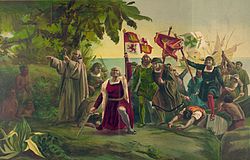
"One may not think of the month of daylight savings time, breast cancer awareness, and Oktoberfest as particularly controversial, but beneath the surface of several Catholic holidays in October are truths and memories that bring a maelstrom of protest from the modern world," writes Michael P. Foley in "The Controversial Holidays of October" (Latin Mass magazine, Summer 2009). In a previous article, Foley already discussed one of these: the Feast of the Holy Rosary's commemoration of the defeat of the Turks at Lepanto (October 7). In the current issue, he turns to two more "October surprises" -- Columbus Day (October 12 or the second Monday in October) and All Hallows' Eve (October 31).1 Here we limit our attention to Columbus Day:
I should probably be given the stake for discussing a secular holiday in a column on the liturgical year, but Columbus Day merits our attention for several reasons. First the holiday owes its existence to the efforts of U.S. Catholic citizens, particularly the Knights of Columbus. In the 1900s the Knights lobbied state legislatures throughout the country to make the anniversary of America's discovery a holiday; not only did most states acquiesce, but the federal government eventually did as well, first as a national holiday in 1937 and then as a legal holiday (on which banks close) in 1971. Though they were instituted as a fraternal benefits organization, the Knights of Columbus were also keen to dispel anti-Catholic prejudice in the United States. One way to meet this goal was to emphasize America's debt to Catholic figures, starting with its papist discoverer. Not coincidentally, this fraternity, founded by an Irish priest, was named not after Saint Patrick but after the daring Italian who reached the shores of our hemisphere on a Spanish ship.

The Knights' strategy of claiming Columbus as a most Catholic of heroes was also a well-aimed counterattack. American historians had tried mightily to turn the famous seafarer into an Enlightenment figure, a secular saint championing scientific progress in the face of a superstitious Church still clinging to outdated ideas of a "flat earth." As it turns out, Columbus had nothing to do with the flat-earth debate; the story was invented out of whole cloth by Washington Irving in 1828 and later used as anti-Catholic propaganda to "prove" that that clerical religion was inherently hostile to rational inquiry.2 Queen Isabella's geographical advisers knew the globe was globular; they rejected Columbus' proposal because they had a much more accurate grasp of it's massive circumference, rightly concluding that his plan to reach China via a western route in a matter of weeks was unsound.

Given the prevalence of the anti-Catholic flat-earth myth, it is not surprising that Pope Leo XIII celebrated the four hundredth anniversary of Columbus' maiden voyage with these stirring (and perhaps overly generous) remarks:
But there is, besides, another reason, a unique one, why We consider that this immortal achievement should be recalled by Us with memorial words. For Columbus is ours; since if a little consideration be given to the particular reason of his design in exploring the mare tenebrosum ... it is indubitable that the Catholic faith was [his] strongest motive ... so that for this reason also the whole human race owes not a little to the Church.3
Take that, Know Nothings!

Pall Over the Holiday

Ironically, after winning the battle for Columbus Day, many Catholics today would prefer not to be associated with either the man or his holiday. While most Latin American countries commemorate the date of Columbus' discovery as the Día de la Raza (the Day of the Race, that is, the day the races met), Hugo Chávez's Venezuela observes observes Día de la Resistencia Indigena (Day of Indigenous Resistance). Similarly, Ward Churchill, the Colorado professor who made headlines for calling the victims of September 11 "little Eichmans,"4 has led the American Indian Movement's protests against the Columbus Day in Denver.

What Chavez and Churchill, in their characteristically understated ways, are alluding to the bleak events that followed Columbus' discovery. Despite the friendliness of the natives, Columbus' men initiated hostilities with them that culminated in a massacre, while Columbus himself enslaved a thousand Indians and instituted the repartimiento system that led to the serfdom of countless others for years to come. Combined with a wave of unintentionally imported diseases the local immune system had never encountered before, such treatment quickly decimated the Native American population.

Assessing Columbus

What, then, should we make of Columbus in light of his spotty record? I suggest five things.

First, it is clear that Columbus was not a good administrator on the land, and his incompetence led to cruelty. In fairness, however, before his undisciplined men destroyed relations with the native Taino or Arawaks, his goal was to protect them from the cannibalistic Caribs (one of the most savage peoples in the Americas) who were fast advancing. Indeed the Caribs remind us that the first step in assessing the Columbian legacy is overcoming any assumption that either side in the conflict has a monopoly on evil.

Second, it is important to remember that many of Columbus' contemporaries also deplored his deeds. Queen Isabel certainly did, which is why Columbus' third return to Spain was in chains, and Spanish law, thanks in large part to the Church's teaching about the full humanity of Native Americans, consistently condemned the actions of rapacious colonists. This is significant, for no other civilization has shown such a capacity for healthy self-criticism as the Christian. Indeed, the shrill condemnations of a Chavez or a Churchill are possible only because of the tradition of public self-examination first developed in Catholic societies.

Third, despite tragic costs, the benefits of European contract with the New World did far more good than harm. This is particularly true in the realm of evangelization. Columbus' genuine zeal to convert all peoples to Christianity should be commended rather than condemned. To depict all New World conversions as forced and foreign is, ironically, to patronize people of color, who were and are every bit as capable of seeing the beauty, truth, and goodness of the Gospel as their unwashed invaders.

Fourth, despite his flaws Columbus was a devout Catholic who, as Pope Leo XIII noted, was motivated by his Faith. His favorite prayers was Jesus cum Maria sit nobis in via -- "may Jesus, along with Mary, be with us on the way."5 Columbus chose to depart into the unknown the morning after August 2, the feast of Our Lady of the Angels, so that his men could celebrate this Marian feast with their families; he even made sure that they received confession and Holy Communion in order to obtain the plenary indulgence available that day.6 Columbus' prayers were apparently answered: his tiny fleet reached land on October 12, the day after the Feast of the Maternity of the Blessed Virgin.

Finally, Columbus Day praises not Columbus' explorations on land but his exploits at sea. We know that a single-minded man convinced the monarchs of Spain to fund an extremely hazardous journey with little likelihood of return, and that he pulled it off, not once but four times. We know that he was exceptionally courageous and resourceful, and we know that he was an outstanding seaman. There is nothing wrong with raising a glass to genuine courage and persistence, as long as one does not go on to use these to excuse other crimes and misdemeanors. I wonder if much of the animus against Columbus today really springs from a contemporary disdain for honor that would like to purge manhood of its chivalry and daring. As the historian William Carroll notes, "It is right to criticize the failings [of heroes], but wrong to deny their greatness and the inspiration they can give."7

And if there is any note of sorrow or regret to be struck on this otherwise celebratory occasion, it should not be fore the exceptional evil of the white man or the Catholic faith but for the universal darkness in man's heart so aptly explained by the doctrine of original sin. Yet, thanks be to God, this spiritual blight is never allowed to dwarf the triumph of the Cross, which providentially uses both vessels of honor and dishonor to meet its goals.

What to Do

How should one celebrate Columbus Day? In 1892 Pope Leo decreed that the four hundredth anniversary of Columbus' discovery should be marked with a Solemn High Mass of the Most Holy Trinity either on October 12 or on the following Sunday.8 (This was mandatory for Spain, Italy, and the two Americas, and recommended for the rest of the world, since "it is fitting that an even from which all have derived benefit should be piously and gratefully commemorated by all"). Certainly Mass would be a good idea today as well, along with a fervent prayer for the spiritual future of both the Old and New Worlds. And all of the documents I have cited are worth reading for more information on Christopher Columbus.

Perhaps one could even enjoy these readings with one of the items rumored to have returned with Columbus on his first voyage: tobacco. I would recommend a pipe for the occasion, as a cigarette is far too lowly a thing for honoring either the noble savage or the noble explorer. As for food, one could turn to any of the nationalities involved: American, Italian, Spanish, or even Caribbean. And for the little ones, miniature Niñas, Santa Marias, and Pintas can be made out of walnut shells, toothpick masts, and paper sails and used to adorn a cake or have a race in the bathtub.(To be continued ...)
Notes

  1. "The Feast of Our Fearsome Lady," TLM 16:4 (Fall 2007), pp. 60-61. [back]

  2. For the fascinating history of this myth, see Burton Russell, Inventing the Flat Earth: Columbus and Modern Historians(New York: Praeger, 1991). [back]

  3. Quarto Abeunte Saeculo (1892), 2, italics added. [back]

  4. He has also been sanctioned by his university for repeated acts of "serious research misconduct." [back]

  5. For more on Columbus' fascinating Catholicism, see Fr. John Hardon's lectures on Columbus at http://www.therealpresence.org/archives/Christopher_Columbus.htm. [back]

  6. The indulgence of the Portiuncula. [back]

  7. "Honoring Chrisopher Columbus," http://www.ewtn.com/library/HOMELIBR/COLUMBUS.HTM [back]

  8. Quarto Abeunte Saeculo (1892), 9. [back]

[Michael P. Foley is associate professor of patristics at Baylor University. He is author of Wedding Rites: A Complete Guide to Traditional Vows, Music, Ceremonies, Blessings, and Interfaith Services(Eerdmans, 2008) and Why Do Catholics Eat Fish on Friday?: The Catholic Origin to Just About Everything(Palgrave Macmillan, 2005). Our present post was excerpted from Dr. Foley's article, "The Controversial Holidays of October," Latin Mass: The Journal of Catholic Culture and Tradition Vol. 18, No. 3 (Summer 2009), pp. 36-39, and is reproduced here by kind permission of Latin Mass, 391 E. Virginia Terrace, Santa Paula, CA 93060.]

Related
New Catholic offers has posted a copy of Leo XIII's encyclical on the Columbus quadricentennial, Quarto abeunte saeculo highlighting those parts of the text of special interest at "COLUMBUS NOSTER EST" (Rorate Caeli, October 12, 2009).

Friday, August 28, 2009

Two Great Apologists for the Catholic Faith

Peter A. Kwasniewski


The Meeting of the Countess Matilda and Anselm of Canterbury in
the Presence of Pope Urban II
, by Giovanni Francesco Romanelli

Whoever has followed the speeches and homilies of Pope Benedict even to a limited extent is aware that one of his major themes is the harmony of faith and reason—and not just their harmony, but the dependence of human reason on the creative divine Reason or Logos. For Pope Benedict, it is not merely the case that faith does not contradict reason, as if the two are compatible partners on an equal footing. Human reason is a finite and fallible light that derives from the prior, all-encompassing light of God, who is also the font of life, love, freedom, and wisdom. Therefore men can be truly reasonable and free only when they must submit their intellects and wills to this light and live in its radiance. Without this light, men are doomed to the darkness of self-will, the tempest of irrational urges, and ultimately the madness of nihilism. Put differently, unless we embrace God’s revelation in faith, which purifies and elevates the natural light of our mind, our own reason is fated to be its undoing. By refusing or abandoning faith, we undermine reason at its foundation. Those who labor to sweep clean the rooms of their minds, thinking to find in scientific and technical prowess a kind of secular salvation, end up verifying the somber words of our Lord Jesus Christ when he speaks of the demon who, finding his old house “empty, swept, and garnished,” takes with him “seven other evil spirits more wicked than himself” and enters in to dwell there.1 Is this not what we are seeing all around us as our beloved country plummets with accelerating speed into the folly, nay the insanity, of liberalism unbounded, which refuses allegiance even to reason and to nature in its insatiable quest for self without soul, liberty without loyalty?

To the “enlightened” of recent centuries, the Catholic Church was the great enemy of reason, progress, liberty; wrapped in her dark robes of medieval superstition, she sought to enslave men with her dogmas and decrees, despising the goodness of raw nature. From our vantage in the twenty-first century, when for the first time large numbers of people seem incapable of recognizing, much less assenting to, the ironclad results of a valid syllogism or the normalcy of heterosexual love, it is sweetly ironic that the Catholic Tradition is increasingly the only bastion and defender even of nature’s integrity and of the luminosity of reason properly employed. Even while I recognize that rational argument is a dying art with a steadily diminishing potential audience and that the appeal to reason can never be an exclusive means of approach or the last word because, as Pascal observed, “the heart has reasons of which reason knows nothing,” still, I have often thought that our day and age is exactly the right time for a major revival of intelligent apologetics. And, it seems to me, we need to hit the books and begin studying anew the great theological apologists of our incomparable Tradition, both for the deepening of our own faith and for the missionary work Vatican II rightly called each of us to undertake. The stakes are higher than ever: not faith alone, but reason too is besieged. Christian faith is ridiculed as utterly irrational, when in reality, as the best minds have seen for the past 2,000 years, it is supreme and sovereign Reason — God’s Reason. Our own minds can begin to discern this beautiful reasonableness if only we will make the effort. We owe it to our Lord and to ourselves to prize and nurture the gift of reason as we do the gift of faith, so that we can be sane within and talk sanity to a world hell-bent on going mad.

In this article I would like to introduce (or, for some, re-introduce) two towering figures in the history of Catholic theology and apologetics: Saint Anselm and Blaise Pascal—one medieval, one modern, both committed to explaining and defending the mysteries of our holy religion through a judicious use of the God-given gift of reason, always submitting to the primacy of divine revelation and in this way exemplifying what Saint Paul calls the “obedience of faith.”2 Unlike Saint Augustine or Saint Thomas Aquinas, each of whom wrote so much that the official editions of their works run to dozens and dozens of volumes, Anselm and Pascal wrote relatively little; their major religious writings amount to about one modest volume apiece. Since we moderns, surrounded by the constant distraction of emails, cell phones, Twitter, and who knows what else yet to come, simply do not read as much as our forebears (a tragic decline on which the Antichrist is heavily relying in his endgame strategy), this relative brevity is a mercy and an incentive to buy those single volumes and set about reading them. Even so, their works are tough going at times, and perseverance is called for. Those seven demons mentioned by our Lord would, of course, prefer to see the room of your mind “empty, swept, and garnished” with the latest fads and fictions, but you know better than to yield to their desires. In reading Anselm and Pascal (and, needless to say, Augustine, Aquinas, Leo XIII, Benedict XVI, or any Catholic master worth reading), you will furnish your mind with solid truth that no demons, or their unwitting human captives, can gainsay.

The Father of Scholasticism

The future Saint Anselm of Canterbury (1033–1109), the 900th anniversary of whose death we are celebrating this very year, was born at Aosta in the Italian Alps. As a young man he traveled from place to place for his education, a life of “wandering scholarship” not uncommon in the Middle Ages. In 1060 Anselm became a Benedictine monk at the Norman monastery of Bec, where he was made prior in 1063 and abbot in 1078. From 1063 to 1093 he led the quiet life of a monk and scholar, writing several treatises destined to have a huge impact on the intellectual life of Europe, among them two works on the existence of God (Monologion and Proslogion), a work on truth (De veritate), and another on free will (De libertate arbitrii). In the main Anselm followed Augustine as his master, but he incorporated much from the logic of Boethius and Aristotle as well as from the theology of his monastic predecessors. In 1093 Anselm was consecrated Archbishop of Canterbury, in spite of his repeated protests against entering the active life, and in his new role he fought a long battle against the liberties taken by English kings in appointing Bishops apart from papal authority. Nevertheless, in the midst of the duties and controversies of his episcopacy Anselm managed to complete his treatise on the Incarnation, Cur Deus homo (Why God became man), along with a number of smaller works. He died in 1109 and was canonized in 1494. In 1720 Pope Clement XI declared him a Doctor of the Church.


Saint Anselm of Canterbury


Although much scholarly discussion has centered around the writings of this brilliant theologian, the central characteristic of his life is often forgotten. Anselm was above all a man of intense prayer who placed his entire intellectual life in the hands of God like a child trusting in his father for guidance. He sought rational or logical arguments not because his mind was clouded with doubts but as a way of using his God-given mind to probe the foundations of the faith he already accepted, and to clarify what our language and concepts mean when adapted to mysteries above the domain of natural reason. The contemporary Catholic apologist should therefore learn his first lesson from Anselm’s very life, which wedded prayer and study, words and silence, wisdom and charity.

Anselm’s most important works, the Monologion, the Proslogion, and the Cur Deus homo, each deserves close study. The relevance of the Proslogion’s ontological argument for the existence of God—namely, that all men are capable of forming the concept “that than which no greater can be thought,” to which existence must belong if it is truly that than which no greater can be thought—is rather limited, for three reasons. First, later Western theologians, among them Saint Thomas Aquinas, found the proof defective. Second, a careful reading of the treatise as a whole shows that Anselm is seeking to deepen his grasp of a truth he already accepts in faith, making the argument a meditative response of reason to God’s self-revelation rather than a proof directed towards unbelievers. Finally, most modern people are not patient or schooled enough to follow Anselm’s abstract reasoning or would be tempted to dismiss it as playing with words. Yet the spirit of the treatise has an abiding relevance, and the prayers it contains help the reader to dwell within the luminous truth of God. Anselm’s Monologion, a profound exploration of the divine nature and the mystery of the Trinity, is more immediately useful to an apologist preparing to present or defend the existence of one God in three divine Persons. Anselm’s dialogue on the fittingness of the Incarnation, Cur Deus homo, contributes to an apologetic tradition stretching back to the earliest Fathers of the Church. The infinite holiness of God deserves perfect honor, but man, by sinning against God, has failed to render this honor; therefore God’s majesty is infinitely offended and man is infinitely guilty. If man is to be rescued from his plight, then this perfect honor must be given by him, canceling out his guilt and restoring his friendship with God; but God alone can restore what man has lost, and God alone can forgive the guilt of an infinite offense. Jesus Christ, Word made flesh, true God and true man, undertakes the work of redemption by offering Himself to the Father in an oblation of love on the Cross for the sake of mankind, an oblation fully acceptable to God because it is made by God; man is redeemed by man, the Father’s wrath is appeased and His mercy poured out, and the path to heaven is opened through Christ, the way, the truth, and the life.

Saint Anselm’s generous and positive attitude towards the integration of faith and reason is much needed now, as the encyclical Fides et Ratio repeatedly emphasized, and his humble way of “questioning God” is a model for the Christian thinker seeking to penetrate the mysteries of faith. Consider these words from chapter 2 of Cur Deus homo: “As the right order requires us to believe the deep things of Christian faith before we undertake to discuss them by reason, so to my mind it appears a neglect if, after we are established in the faith, we do not seek to understand what we believe.”

The Grandeur and Misery of Man

Blaise Pascal (1623–1662) was unquestionably one of the most eminent modern apologists for the Christian faith. Despite his poor health, Pascal was a prodigy in mathematics and science from his earliest youth. He performed ground-breaking experiments with water and air pressure, invented a calculating machine, and made striking advances in theoretical mathematics, especially probability theory. However, he came to see more and more that burgeoning empirical-mathematical knowledge could not satisfy yearnings for the ultimate meaning of life, nor could its technological counterpart deliver the earthly paradise it promised. Through his keen observations of people and their self-deceiving efforts to escape the unhappiness that lingers beneath the glitter of distracting pleasures, he became acutely aware of man’s radical need for God and the meaninglessness of life without faith. On November 23, 1654, Pascal underwent an intense spiritual experience, during which he wrote down some phrases on a piece of paper he later sewed into his jacket and always wore about with him:
God of Abraham, God of Isaac, God of Jacob, not of philosophers and scholars. God of Jesus Christ. He can only be found in the ways taught in the Gospel. Joy, joy, joy and tears of joy. This is life eternal, that they might know you, the only true God, and him whom you sent, Jesus Christ. I have cut myself off from him. I have fled from him, denied him, crucified him. Let me never be cut off from him. He can only be kept by the ways taught in the Gospel.3
After receiving this tremendous grace, he retired into seclusion, placed himself under the direction of spiritual advisors at the Port Royal monastery, and turned his attention to the practice of religion and the composition of apologetic works. The greatest of these is entitled Pensées, a collection of notes for a massive apologetic which Pascal did not live to complete. The notes he preserved, ranging in length from a few words to a few pages, contain some of the most profound insights into the heart of man ever written, and deserve to be read and pondered time and time again. He sketches arguments for the truth of the Christian faith and the divine authority of the Catholic Church from a variety of angles: experience of sin and error in the world, the futility of life without a final purpose, the inability of man to save himself from suffering and death, the incongruity between ideals and facts, proofs of natural reason, the correspondence of Old Testament prophecies to the Messiah who fulfills them, the compelling beauty of Jesus and his Covenant, the miracles performed by Christ and the saints throughout the ages. Warring against the rationalism that was starting to conquer European culture, Pascal emphasizes the primacy of the heart in search for God—that is, the centrality of will, conviction, submission—over cold intellectual arguments. “Reason’s last step is to recognize that there is an infinite number of things which surpass it. It is simply feeble if it does not go as far as realizing that.” “Reason would never submit unless it perceived that there are occasions when it should submit. It is right, therefore, that it should submit when it perceives that it ought to submit.”4


Blaise Pascal by Philippe de Champaigne

No apologist has so powerfully insisted on the truth of original sin and, in the face of it, the need for a Redeemer:
If man had never been corrupted, he would enjoy in his innocent state both truth and happiness with confidence. And if man had never been other than corrupted, he would have no notion of either truth or happiness. But in the wretched state in which we are . . . we have an idea of happiness and we cannot achieve it, we feel an image of truth and we possess only untruth. We are incapable both of total ignorance and certain knowledge, so obvious is it that we were once in a state of perfection from which we have unhappily fallen.5
And again:
Certainly nothing shocks us more deeply than this doctrine [of original sin]. Never­the­less without this most incomprehensible of all mysteries we are incomprehensible to ourselves. Within this gnarled chasm lie the twists and turns of our condition. So, humanity is more inconceivable without this mystery than this mystery is conceivable to humanity.6
“Not only is it through Jesus Christ alone that we know God but it is only through Jesus Christ that we know ourselves. We know life and death only through Jesus Christ. Without Jesus Christ we do not know what our life, nor our death, nor God, nor ourselves really are.”7 In the end, one who wants to be honest with himself must either believe in and submit wholly to God, accepting the Messiah whom the Father sent to redeem mankind, or be an atheist in despair, abandoning the search for truth and happiness, substituting in its place a routine of shallow diversions to mask the emptiness of a life poised for immanent death. “It is good to be weary and tired from the useless search for the true good, in order to stretch ones arms out to the Redeemer.”8

The most famous argument in the Pensées has been called Pascal’s Wager. If God exists and the Christian religion is true, then those who believe gain eternal life and those who do not believe earn eternal damnation. Since eternity is infinitely greater than the meager span of one’s life, one ought to wager on the truth of Christianity and embrace it. If it proves to be true, one gains everlasting life. If it proves to be false, then one has merely lost a short life that one had to lose anyhow. But if the religion is true, and one did not embrace it, one has lost infinitely more—one has lost everything. How could an infinitesimal fraction of time have any value in comparison with even the possibility of an eternity of bliss or woe? Here we see Pascal ingeniously using probability theory against the very agnosticism generated by the modern scientific mentality. This argument, like many others in Pascal, was intended to startle and provoke, so that an inquirer after religious truth would search all the more earnestly; it was not intended to be sufficient by itself or to supplant other classical arguments leading in the same direction.

In the later part of his life, Pascal became heatedly involved in political and ecclesiastical controversies surrounding the theology of Cornelius Jansen (1585-1638), Bishop of Ypres, whose interpretation of Saint Augustine’s doctrine of predestination, grace, and free will formed the basis of a heresy, or at least a heretical tendency, subsequently known as Jansenism. Although Pascal fiercely attacked the Jesuits of his time as traitors to Christianity and may have held some questionable theological positions associated with the Port Royal school, by the end of his life he had withdrawn from public controversy to spend his time in prayer, meditation, and works of charity. In the six-month period of his final prolonged sickness, Pascal sold off his carriage, horses, tapestries, furniture, silver, and most of his books, giving the money to the poor. In spite of his own physical sufferings, he earnestly requested those nursing him to go out and find a poor man who might be sheltered under the same roof with him. He died in peace of soul on August 19, 1662, shortly after receiving the last sacraments.

The Editions to Buy

As mentioned above, the major works by Saint Anselm fit snugly in a single volume. Two affordable paperback editions on the market contain almost exactly the same items in different translations: the Thomas Williams edition published by Hackett and the Brian Davies-Gillian Evans edition published by Oxford. While both translations are reliably faithful to the Latin originals and quite readable, on balance my preference goes to the Davies-Evans, for the simple reason that Williams insists on using inclusive language throughout in a way that uglifies the prose and needlessly complicates the theological points Anselm is making. In keeping with centuries of English usage and just plain good sense, Anselm’s famous question Cur Deus homo deserves to be rendered “Why God became man,” not “Why God became a human being.” Is anyone so witless as to think that “man” in this expression means only males of the species? And, more to the point, if anyone does think it, do they not need a lesson in grammar more than a clunky politically-correct translation?

With Pascal, however, the choices for an English Pensées are more numerous, and I can claim no expertise in recommending the best edition. I have always found the Penguin edition by Krailsheimer serviceable; the language is appropriately eloquent for a master controversialist like Pascal, and the content well-organized.9 One could likely find other good translations of this work as well.

A last piece of advice: skip the modern introductions to the volumes and go straight to the author’s own words. Without a doubt some introductions are interesting and helpful, especially for students doing research, but life is short, time is precious, and the wisdom we stand to gain is found in the primary sources, the original writings, of our great Catholic Tradition. Do yourself a favor and make time to read Pascal’s Pensées and, of Anselm’s works, at least Why God Became Man. A noble goal, faith seeking understanding, with two noble guides. May the gracious Lord, Father, Son, and Holy Spirit, grant each of us a consoling foretaste of His sovereign Reason as we walk through this vale of tears toward the light of glory.

Notes

  1. See Mt 12:43-45. [back]

  2. Rom 1:5, 16:26. [back]

  3. From Pascal’s “Memorial” of the event. [back]

  4. Nos. 220 and 205 in the Penguin edition. [back]

  5. No. 164. [back]

  6. Ibid. [back]

  7. No. 36. [back]

  8. No. 524. [back]

  9. Recall that Pascal’s original text is, in fact, a huge assembly of scattered notes, which gives rise to disputes about how best to arrange and present the material. [back]

[Dr. Peter A. Kwasniewski is Associate Professor of Theology and Philosophy at Wyoming Catholic College in Lander, Wyoming. The present article, "Two Great Apologists for the Catholic Faith," was originally published in Latin Mass: A Journal of Catholic Culture and Tradition, Vol. 18, No. 3 (Summer 2009), pp. 6-10, and is reprinted here by kind permission of Latin Mass Magazine, 391 E. Virginia Terrace, Santa Paula, CA 93060.]