Wednesday, December 06, 2006

True and False Liturgical Reform: Part I


The First of Two Parts

by Michael Davies

The second part of this essay appeared in the Fall 2002 issue of The Latin Mass, and was reproduced on this blog on December 13, 2006, under the title of "True and False Liturgical Reform: Part II."

The word liturgy is derived from a Greek composite word (leitourgia) meaning originally "a public duty, a service to the state undertaken by a citizen." From this we have leitourgos, "a man who performs a public duty," "a public servant." At Athens public services would be performed by the wealthier citizens at their own expense, such as the office of the trierarchus, who provided a war-ship for the state. The meaning of the word liturgy was extended to cover any general service of a public kind.

In the Septuagint, the most influential Greek version of the Old Testament, it is used for the public service of the temple (e.g., Ex. 38:27; 39:12, etc.). Thence it comes to have a religious sense as the function of the priests, the ritual service of the temple (e.g., Joel 1:9; 2:17, etc.). In the New Testament this religious meaning has become definitely established. In Luke 1:23, Zachary goes home when "the days of his liturgy" are over. In Hebrews 8:6, Our Lord Jesus Christ is designated as the leitourgos of the New Law, who has obtained for us "a better liturgy," that is, a better kind of public religious service than that of the Temple. So in Christian use liturgy meant the public official service of the Church, that corresponded to the official service of the Temple in the Old Law.1


The Sacrifice of the Mass

This article will address only the Mass, the Eucharistic sacrifice, the most important of our liturgical rites. The Eucharist is the center of Christian life just as Christ is the central figure in the Christian religion. As well as being a sacrifice it is the greatest of all the sacraments, as it contains Christ Himself, while in the other sacraments Christ acts and applies the merits of His Passion for a particular purpose. St. Thomas Aquinas points out that all the other sacraments are ordained to this sacrament as to their end.2 It not only symbolizes or represents the Passion and death of Christ, but also contains it. The Mass is the Sacrifice of the Cross, a fact that St. Thomas illustrates by quoting St. Ambrose: "In Christ was offered up a sacrifice capable of giving eternal salvation; what then do we do? Do we not offer it up ever day in memory of His death?"3 "The Passion of the Lord is the Sacrifice we offer," wrote St. Cyprian.4 Not only is the Sacrifice of the Cross made present in the Mass, and the Divine Victim of that sacrifice offered to the Blessed Trinity, but just as Our Lord offered Himself upon the Cross He is the true High Priest of every Mass and offers Himself through the ministry of the priest at the altar. "Christ is offered today," writes St. Ambrose, "and He Himself as priest offers Himself in order that He may remit our sins."5 Monsignor George Smith observes:
Truly, really and substantially present upon the altar under the appearances of bread and wine, Christ our High Priest offers Himself, the infinite Victim, to His Father through the ministry of His priests. This indeed a sacrifice unto the odor of sweetness, which Christ, God and man, offers to His Father an infinite adoration, a prayer of unbounded efficacy, propitiation and satisfaction superabundantly sufficient for the sins of all mankind, thanksgiving in a unique manner proportionate to God's unstinted generosity to men.6

The First Four Centuries

The first source for the history of the Mass is the account of the Last Supper in the New Testament. It is because Our Lord told us to do what He had done, in memory of Him, that Christian liturgies exist. No matter in what respect there are differences in the various Eucharistic liturgies, they all obey His command to do this, namely what He Himself had done. A definite pattern for the celebration of the Eucharist had developed within decades of the death of Our Lord, a pattern that was carried on well past the conclusion of the first century, and that can still be discerned clearly in the finalized Roman Mass of 1570.

The early Christians assembled for divine worship in the house of one of their number that possessed a large dining room -- a coenaculum, as the Vulgate puts it. This was because, as a persecuted minority, they could erect no public buildings. Our knowledge of the details of the liturgy increases from the earliest Fathers and with each succeeding century. There is a gradual and natural development. The prayers and formulas and eventually the ceremonial actions develop into set forms. There are varying arrangements of subsidiary parts. Greater insistence on certain elements in different regions produce different liturgies; but all go back eventually to the biblical pattern.

Liturgical books were certainly being used by the middle of the fourth century, and possibly before the end of the third. The only book known with certainty to have been used until the fourth century was the Bible, from which the lessons were read. Father Adrian Fortescue, England's great historian of the Mass, explains that Psalms and the Lord's Prayer were known by heart; otherwise the prayers were extempore. There was little that could be described as ceremonial in the sense that we use the term today, but everything would evidently have been done with the greatest possible reverence. Gradually and naturally certain gestures and practices became established customs; in other words, liturgical actions became ritualized. The Lavabo or washing of hands is an evident example. In all rites the celebrant washes his hands before handling the offerings, an obvious precaution and sign of respect. St Thomas Aquinas remarked: "We are not accustomed to handle any precious things save with clean hands; so it seems indecent that one should approach so great a sacrament with hands soiled."7 The washing of the hands almost inevitably came to be understood as a symbol of cleansing the soul, as is the case with all ritual washing in any religion. There were originally no particular prayers mandated for the washing of hands, but it was natural that the priests should say prayers for purity at that moment, and that eventually such prayers should find their way into the liturgical books. What prayer could be more appropriate than Psalm 25, Lavabo inter innocentes manus meas? All ritual grew naturally out of these purely practical actions, just as vestments evolved out of ordinary dress. The only distinctly ritual actions we find in the first two centuries are certain postures, kneeling or standing for prayer, and such ceremonies as the kiss of peace, all of which were inherited from the Jews. It is easy to understand that the order, the general outline of the service, would become constant almost unconsciously. People who do the same thing continually, naturally do it in much the same way. There was no reason for changing; to reverse the order suddenly would disturb and annoy people. A younger bishop, when his turn came to celebrate, could do no better than continue to use the very words (as far as he remembered them) of the venerable predecessor whose prayers the people, and perhaps himself as deacon, had so often followed and answered with reverent devotion.


The End of Persecution

Historical factors played a crucial role in the manner in which the liturgy was celebrated. During times of persecution brevity and simplicity would, for obvious reasons, be its principal characteristics. The toleration of Christianity under Constantine I, and its adoption as the religion of the Empire under Theodosius I (379-95), had a dramatic effect on the development of ritual. Congregations increased in size; and benefactions for the building and furnishing of churches resulted in the enrichment of vessels and vestments. Those presenting such gifts would naturally want them to be of the richest and most beautiful nature possible. In a parallel and natural development the liturgical rites became more elaborate, with solemn processions and stress upon the awesome nature of the rite. This elaboration of the liturgy proceeded faster and further in the East than in the West during the fourth century, but the universal change in style was initiated throughout the Christian world by the change from an illegal and private ritual into a state-supported public one. From about the fourth century, complete liturgical texts were compiled. By this time, the old fluid uniform rite had crystallized into different liturgies in different places. These different liturgies all bear the marks of their common descent and follow the same general outline.


The Gregorian Sacramentary

The earliest Roman Sacramentaries are the first complete sources for the Roman rite. These were written in the Latin language, which had gradually replaced Greek as the language of the Roman liturgy. Scholars differ as to the precise time when the transition was complete, giving dates from the second half of the third century up to the end of the fourth. Both languages must have been used side by side during a fairly long period of transition. Of the Sacramentaries the most important is that of St. Gregory the Great (590-604). His achievements during those fourteen years almost defy credibility. Prominent among the many important reforms that he undertook was that of the liturgy. His pontificate marks an epoch in the history of the Roman Mass, which, in every important respect, he left in the state that we still have it.

The keynote of the reform of St. Gregory was fidelity to the traditions that had been handed down (the root meaning of the Latin word traditio is to had over or hand down). His reform consisted principally of the simplification and more orderly arrangement of the existing rite, not the composition of a new one. The Order of Mass as found in the 1570 Missal of St. Pius V (1566-1572), apart from minor additions and amplifications, corresponds very closely to the order established by St. Gregory. It is also to this great Pope that we owe to a large extent, the codification of the incomparable chant that bears his name. From this time forward there is little to chronicle of the nature of change in the order of the Mass itself, which had become a sacred and inviolable inheritance, its origin forgotten. Although the rite of Mass did continue to develop after the time of St. Gregory, Father Fortescue explains: "All later modifications were fitted into the old arrangement, and the most important parts were not touched. From, roughly, the time of St. Gregory we have the text of the Mass, its order and arrangement, as a sacred tradition that no one has ventured to touch except in unimportant details."8 The prayers at the foot of the altar "are in their present form the latest part of all. They developed out of medieval private preparations and were not formally appointed in their present state before the Missals of Pius V (1570)."9


The Protestant Reformation

The first radical reform of the liturgy in more than 1500 years of the Christian faith occurred during the sixteenth-century Protestant Reformation, when the principle of fidelity to tradition was rejected in favor of the principle of the destruction of tradition. The founders of the various Protestant sects were, in fact, revolutionaries rather than reformers. Their concern was not to reform the existing order but to introduce a new one that conformed to their heretical beliefs. Monsignor Philip Hughes, in his classic study The Reformation in England, notes that all revolutionaries are motivated by a common spirit: "The mania to ensure that all future history should date from their own reconstruction of primitive glory as they imagined this, characterized these revolutionaries, as it has characterized all the rest, the social and political rebels as truly as the religious…. They were determined to destroy all that lay between themselves and the restoration of primitive Christianity as they conceived this to have been."10

The principal author of the Anglican liturgy was Thomas Cranmer, the apostate Archbishop of Canterbury. His first communion service contained in the 1549 Book of Common Prayer, "The Lord's Supper or Holy Communion, commonly called the Mass," was of an ambiguous nature. Dr. Francis Clark emphasizes this ambiguity in the most authoritative study of the Eucharistic doctrines of the Protestant Reformers yet undertaken:
The first Prayer book of Edward VI could not be convicted of overt heresy, for it was adroitly framed and contained no express denial of pre-Reformation doctrine. It was, as one Anglican scholar puts it, "an ingenious essay in ambiguity," purposely worded in such a manner that the more conservative could place their construction upon it, and reconcile their consciences to using it, while the Reformers would interpret it in their own sense and would recognize it as an instrument for furthering the next state of the religious revolution....11
This was a conscious and deliberate strategy, he notes:
In the earlier and critical period Cranmer and his friends saw that it was wisest to introduce the Reformation by stages, gradually preparing men's minds for more radical courses to come. At times compulsion or intimidation was necessary in order to quell opposition, but their general policy was first to neutralize the conservative mass of the people, to deprive them of their Catholic-minded leaders, and then accustom them by degrees to the new religious system.12
There was little enthusiasm for the changes among the mass of the faithful, and sometimes fierce opposition. Commenting on the introduction of Cranmer's first (1549) Prayer Book, the Protestant historian Sir Maurice Powicke explains with admirable clarity why this was something that tens of thousands of humble Catholics would not tolerate, and why the peasants of the west rose in rebellion: "The real cause of the opposition of country clergy and Devonshire peasants was the proof which the Prayer Book seemed to give that all the agitations and change of the last few years really were going to end in a permanent cleavage between the past and the present, and the familiar was to give way to something strange, foreign, imposed."

According to Father Fortescue, "The Protestant Reformers naturally played havoc with the old liturgy. It was throughout the expression of the very ideas (the Real Presence, Eucharistic Sacrifice and so on) they rejected. So they substituted for it new Communion services that expressed their principle but, of course, broke away utterly from all historic liturgical evolution."13 It would be difficult to exaggerate the importance of Father Fortescue's insistence that in composing new services the Protestant Reformers "broke away utterly from all historic liturgical evolution." In 1898, referring to the reform of Cranmer, the Catholic Bishops of the Province of Westminster insisted that local churches are not entitled to devise new rites:
They must not omit or reform anything in those forms which immemorial tradition has bequeathed to us. For such an immemorial usage, whether or not is has in the course of ages incorporated superfluous accretions, must, in the estimation of those who believe in a divinely guarded, visible Church, at least have retained whatever is necessary; so that in adhering rigidly to the rite handed down to us we can always feel secure: whereas, if we omit or change anything, we may perhaps be abandoning just that element which is essential.... [T]hat they were permitted to subtract prayers and ceremonies in previous use, and even to remodel the existing rites in a most drastic manner, is a proposition for which we know of no historical foundation, and which appears to us absolutely incredible.14
An accepted principle with regard to liturgical worship is that the doctrinal standpoint of a Christian body must necessarily be reflected in its worship. Liturgical rites should express what they contain. It is not necessary for the Catholic position to be expressly contradicted for a rite to become suspect; the suppression of prayers that had given liturgical expression to the doctrine behind the rite is more than sufficient to give cause for concern. This principle is embodied in the phrase legem credendi lex statuat supplicandi ("let the law of prayer fix the law of faith") -- in other words, the liturgy of the Church is a sure guide to her teaching. This is usually presented in the abbreviated form of lex orandi, lex credendi, and can be translated freely as meaning that the manner in which the Church worships (lex orandi) must reflect what the Church believes (lex credendi). Monsignor Hughes insists that the 1549 Prayer Book made it clear that a new religion was being imposed:
This prayer book of 1549 was as clear a sign as a man might desire that a doctrinal revolution was intended and that it was, indeed, already in progress. Once these new sacramental rites, for example, had become the habit of the English people the substance of the doctrinal reformation, victorious now in northern England, would have transformed England also. All but insensibly, as the years went by, the beliefs enshrined in the old, and now disused rites, and kept alive by these rites in men's minds and affections; would disappear -- without the need of any systematic missionary effort to preach them down.15
In other words, when for decades the faithful were forced to worship as Protestants they became Protestants. Their faith had been destroyed by liturgical reform.


The Reform of St. Pius V

History thus makes clear to us the distinction between true and false liturgical reform. The essence of a true liturgical reform is that it contains no drastic revisions of the liturgical traditions that have been handed down. Its most evident characteristic is fidelity to these traditions, as was the case with the reform of St. Gregory the Great. This is equally true of the reform of St. Pius V in 1570, which was the response of Rome to the Protestant liturgical revolution, "The Council of Trent (1545-1563)," Father Fortescue explains, "in opposition to the anarchy of these new services, wished the Roman Mass to be celebrated uniformly everywhere."16 In its eighteenth session the Council appointed a commission to examine the Missal, to revise it and to restore it "according to the custom and rite of the Holy Fathers," using for that purpose the best manuscripts and other documents. "They accomplished their task very well," comments Father Fortescue. "On 14th July, 1570, the Pope published the reformed Missal with the Bull Quo Primum. Its title was: Missale Romanum ex decreto ss. Concilii Tridentini restitutum."17 St. Pius is honored by the Church as an instrument chosen by God ad conterendos Ecclesiae hostes et ad divinum cultum reparandum -- "for the overcoming of the enemies of Thy Church and for the restoration of the beauty of Thy worship."


References and Notes
Some of the sources referred to in the notes have been abbreviated as follows:

  1. Michael Davies, The Wisdom of Adrian Fortescue (Roman Catholic Books, 1999). See Part II, Chapter I, for Fr. Fortescue's magisterial exposition of the nature of Catholic liturgy. [back]

  2. Summa Theologica, III, Q. 65, Art. 3 (referred to as ST in subsequent notes). [back]

  3. Ibid., Q. 83, Art. 1. [back]

  4. Epist. LXIII, n. 17 (PL, vol. IV, col. 388-89). [back]

  5. De Officiis ministrorum. lib.1, cap. 48 (PL, vol. XVI, col. 101). [back]

  6. G. Smith, The Teaching of the Catholic Church (London, 1956), p. 839. [back]

  7. ST, III, Q. 83, Art 5, ad 1. [back]

  8. A Fortescue, The Mass: A Study of the Roman Liturgy (London, 1917), p.173 (referred to as TM in subsequent notes). [back]

  9. TM, pp. 183-84. [back]

  10. P. Hughes, The Reformation in England, vol. II (London, 1950), p. 158. RIE in subsequent notes. [back]

  11. F. Clark, Eucharistic Sacrifice and the Reformation (Devon, 1980), p 182. ESR in subsequent notes. [back]

  12. EST, p. 194. [back]

  13. TM, pp. 205-6. [back]

  14. The Cardinal Archbishop and Bishops of the Province of Westminster, A Vindication of the Bull "Apostolicae Curae" (London, 1898), p. 42. [back]

  15. RIE, vol. II, p 111. [back]

  16. TM, p. 206. [back]

  17. TM, pp. 206-7. [back]

N.B. -- See list of bibliographical abbreviations at top of the footnotes.

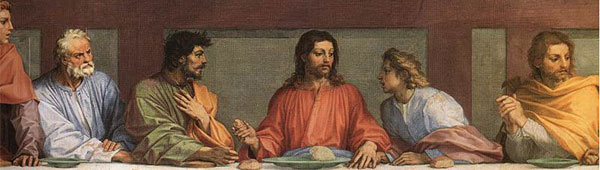
Art credits: (1) The Last Supper (detail) by Andrea del Sarto; 2) The Mass of Saint Gregory, by Adrian Isenbrant; (3) Madonna with the Host, Jean Auguste Dominique Ingres.
[Michael Davies was president of Una Voce International and the author of many books on Catholic history and liturgy. One of his last works was Lead kindly light: The life of John Henry Newman (Neumann Press). The present article, "True and False Liturgical Reform: The First of Two Parts," was originally published in Latin Mass: A Journal of Catholic Culture and Tradition (Summer 2002), pp. 26-30, and is reprinted here by permission of Latin Mass Magazine, 391 E. Virginia Terrace, Santa Paula, CA 93060.]

Thursday, April 13, 2006

THE CHURCH IN CRISIS -- And Scenarios for a Solution

Present at the Demolition: A Philosopher Remembers and Reminds: An interview with Dr. Alice von Hildebrand

The following conversation with Dr. Alice von Hildebrand opens our discussion of this issue's focus: The Crisis in the Church: Scenarios for a Solution. Dr. von Hildebrand, professor of philosophy emeritus of Hunter College (City University of New York) has just completed The Soul of a Lion, a biography of her husband, Dietrich.

TLM: Dr. von Hildebrand, at the time that Pope John XXIII summoned the Second Vatican Council, did you perceive a need for a reform within the Church?

AVH: Most of the insights about this come from my husband. He always said that the members of the Church, due to the effects of original sin and actual sin, are always in need of reform. The Church's teaching, however, is from God. Not one iota is to be changed or considered in need of reform.

TLM: In terms of the present crisis, when did you first perceive something was terribly wrong?

AVH: It was in February 1965. I was taking a sabbatical year in Florence. My husband was reading a theological journal, and suddenly I heard him burst into tears. I ran to him, fearful that his heart condition had suddenly caused him pain. I asked him if he was all right. He told me that the article that he had been reading had provided him with the certain insight that the devil had entered the Church. Remember, my husband was the first prominent German to speak out publicly against Hitler and the Nazis. His insights were always prescient.

TLM: Had your husband ever talked about his fear for the Church before this incident?

AVH: I relate in my biography of my husband, The Soul of a Lion, that a few years after his conversion to Catholicism in the 1920's, he began teaching at the University of Munich. Munich was a Catholic city. Most Catholics at the time went to mass, but he always said that it was there that he became aware of the loss of a sense of the supernatural among Catholics. One incident especially offered him sufficient proof, and it greatly saddened him.

When passing through a door, my husband would always give precedence to those of his students who were priests. One day, one of his colleagues (a Catholic) expressed his astonishment and disapproval: "Why do you let your students step ahead of you?" "Because they are priests," replied my husband. "But they do not have a Ph.D." my husband was grieved. To value a Ph.D. is a natural response; to feel awe for the sublimity of the priesthood is a supernatural response. The professor's attitude proved that his sense for the supernatural had been eroded. That was long before Vatican II. But until the Council, the beauty and the sacredness of the Tridentine liturgy masked this phenomenon.

TLM: Did your husband think that the decline in a sense of the supernatural began around that time, and if so, how did he explain it?

AVH: No, he believed that after Pius X's condemnation of the heresy of Modernism, its proponents merely went underground. He would say that they then took a much more subtle and practical approach. They spread doubt simply by raising questions about the great supernatural interventions throughout salvation history, such as the Virgin Birth and Our Lady's perpetual virginity, as well as the Resurrection, and the Holy Eucharist. They knew that once faith -- the foundation -- totters, the liturgy and the moral teachings of the Church would follow suit. My husband entitled one of his books The Devastated Vineyard. After Vatican II, a tornado seemed to have hit the Church.

Modernism itself was the fruit of the calamity of the Renaissance and the Protestant Revolt, and it took a long historical process to unfold. If you were to ask a typical Catholic in the Middle Ages to name a hero or heroine, he would answer with the name of a saint. The Renaissance began to chant that. Instead of a saint, people would think of geniuses as persons to emulate, and with the oncoming of the industrial age, they would answer with the name of a great scientist. Today, they would answer with a sports figure or cinema personality. In other words, the loss of the sense of the supernatural has brought an inversion of the hierarchy of values.

Even the pagan Plato was open to a sense of the supernatural. He spoke of the weakness, frailty and cowardice often evidenced in human nature. He was asked by a critic to explain why he had such a low opinion of humanity. He replied that he was not denigrating man, only comparing him to God.

With the loss of a sense of the supernatural, there is a loss of the sense of the need for sacrifice today. The closer one comes to God, the greater should be one's sense of sinfulness. The further one gets form God, as today, the more we hear the philosophy of the new age: "I'm OK, You're OK." This loss of the inclination to sacrifice has led to the obscuring of the Church's redemptive mission. Where the Cross is downplayed, our need for redemption is given hardly a thought.

The aversion to sacrifice and redemption has assisted the secularization of the Church from within. We have been hearing for many years form priests and bishops about the need for the Church to adapt herself to the world. Great popes like St. Pius X said just the opposite: the world must adapt itself to the Church.

TLM: From our conversation throughout this afternoon, I must conclude that you don't believe that the accelerating loss of the sense of the supernatural is an accident of history.

AVH: No I do not. There have been two books published in Italy in recent years that confirm what my husband had been suspecting for some time; namely, there has been a systematic infiltration of the Church by diabolical enemies for much of this century. My husband was a very sanguine man and optimistic by nature. During the last ten years of his life, however, I witnessed him many times in moments of great sorrow, and frequently repeating, "They have desecrated the Holy Bride of Christ." He was referring to the "abomination of desolation" of which the prophet Daniel speaks.

TLM: This is a critical admission, Dr. von Hildebrand. Your husband has been called a twentieth-century Doctor of the Church by Pope Pius XII. If he felt so strongly, didn't he have access to the Vatican to tell pope Paul VI of his fears?

AVH: But he did! I shall never forget the private audience we had with Paul VI just before the end of the Council. It was on June 21, 1965. As soon as my husband started pleading with him to condemn the heresies that were rampant, the Pope interrupted him with the words, "Lo scriva, lo scriva." ("Write it down.") A few moments later, for the second time, my husband drew the gravity of the situation to the Pope's attention. Same answer. His Holiness received us standing. It was clear that the Pope was feeling very uncomfortable. The audience lasted only a few minutes. Paul VI immediately gave a sign to his secretary, Fr. Capovilla, to bring us rosaries and medals. We then went back to Florence where my husband wrote a long document (unpublished today) that was delivered to Paul VI just the day before the last session of the Council. It was September 1965. After reading my husband's document, he said to my husband's nephew, Dieter Sattler, who had become the German ambassador to the Holy See, that he had read the document carefully, but that "it was a bit harsh." The reason was obvious: my husband had humbly requested a clear condemnation of heretical statements.

TLM: You realize, of course, Doctor, that as soon as you mention this idea of infiltration, there will be those who roll their eyes in exasperation and remark, "Not another conspiracy theory!"

AVH: I can only tell you what I know. It is a matter of public record, for instance, that Bella Dodd, the ex-Communist who reconverted to the Church, openly spoke of the Communist Party's deliberate infiltration of agents into the seminaries. She told my husband and me that when she was an active party member, she had dealt with no fewer than four cardinals within the Vatican "who were working for us."

Many a time I have heard Americans say that Europeans "smell conspiracy wherever they go." But from the beginning, the Evil One has "conspired" against the Church -- and has always aimed in particular at destroying the mass and sapping belief in the Real Presence of Christ in the Eucharist. That some people are empted to blow this undeniable fact out of proportion is no reason for denying its reality. On the other hand, I, European born, am tempted to say that many Americans are naive; living in a country that has been blessed by peace, and knowing little about history, they are more likely than Europeans (whose history is a tumultuous one) to fall prey to illusion. Rousseau has had an enormous influence in the United States. When Christ said to His apostles at the Last Supper that "one of you will betray me," the apostles were stunned. Judas had played his hand so artfully that no one suspected him, for a cunning conspirator knows how to cover his tracks with a show of orthodoxy.

TLM: Do the books by the Italian priest you mentioned before the interview contain documentation that would provide evidence of this infiltration?

AVH: The two books I mentioned were published in 1998 and 2000 by an Italian priest, Don Luigi Villa of the diocese of Brescia, who at the request of Padre Pio has devoted many years of his life to the investigation of the possible infiltration of both Freemasons and Communists into the Church. My husband and I met Don Villa in the sixties. He claims that he does not make any statement that he cannot substantiate. When Paulo Sesto Beato? (1998) was published the book was sent to every single Italian bishop. None of them acknowledged receipt; none challenged any of Don Villa's claims.

In this book, he relates something that no ecclesiastical authority has refuted or asked to be retracted -- even though he names particular personalities in regard to the incident. It pertains to the rift between Pope Pius XII and then Bishop Montini (the future Paul VI) who was his Undersecretary of State. Pius XII, conscious of the threat of Communism, which in the aftermath of World War II was dominating nearly half of Europe, had prohibited the Vatican staff from dealing with Moscow. To his dismay, he was informed one day through the Bishop of Upsala (Sweden) that his strict order had been contravened. The Pope resisted giving credence to this rumor until he was given incontrovertible evidence that Montini had been corresponding with various Soviet agencies. Meanwhile, Pope Pius XII (as had Pius XI) had been sending priests clandestinely into Russia to give comfort to Catholics behind the Iron Curtain. Every one of them had been systematically arrested, tortured, and either executed or sent to the gulag. Eventually a Vatican mole was discovered: Alighiero Tondi, S.J., who was a close advisor to Montini. Tondi was an agent working for Stalin whose mission was to keep Moscow informed about initiatives such as the sending of priests into the Soviet Union.

Add to this Pope Paul's treatment of Cardinal Mindszenty. Against his will, Mindszenty was ordered by the Vatican to leave Budapest. As most everyone knows, he had escaped the Communists and sought refuge in the American embassy compound. The Pope had given him his solemn promise that he would remain primate of Hungary as long as he lived. When the Cardinal (who had been tortured by the Communists) arrived in Rome, Paul VI embraced him warmly, but then sent him to exile in Vienna. Shortly afterwards, this holy prelate was informed that he had been demoted, and had been replaced by someone more acceptable to the Hungarian Communist government. More puzzling, and tragically sad, is the fact that when Mindszenty died, no Church representative was present at his burial.

Another of Don Villa's illustrations of infiltration is one related to him by Cardinal Gagnon. Paul VI had asked Gagnon to head an investigation concerning the infiltration of the Church by powerful enemies. Cardinal Gagnon (at that time Archbishop) accepted this unpleasant task, and compiled a long dossier, rich in worrisome facts. When the work was completed, he requested an audience with Pope Paul in order to deliver personally the manuscript to the Pontiff. This request for a meeting was denied. The Pope sent word that the document should be placed in the offices of the Congregation for the Clergy, specifically in a safe with a double lock. This was done, by the very next day the safe deposit box was broken and the manuscript mysteriously disappeared. The usual policy of the Vatican is to make sure the news of such incidents never sees the light of day. Nevertheless, this theft was reported even in L'Osservatore Romano (perhaps under pressure because it had been reported in the secular press). Cardinal Gagnon, of course, had a copy, and once again asked the Pope for a private audience. Once again his request was denied. He then decided to leave Rome and return to his homeland in Canada. Later, he was called back to Rome by Pope John Paul II and made a cardinal.

TLM: Why did Don Villa write these works singling out Paul VI for criticism?

AVH: Don Villa reluctantly decided to publish the books to which I have alluded. But when several bishops pushed for beatification of Paul VI, this priest perceived it as a clarion call to print the information he had gathered through the years. In so doing, he was following the guidelines of a Roman Congregation, informing the faithful that it was their duty as members of the Church to relay to the Congregation any information that might militate against the candidate's qualifications for beatification.

Considering the tumultuous pontificate of Paul VI, and the confusing signals he was giving, e.g.: speaking about the "smoke of Satan that had entered the Church," yet refusing to condemn heresies officially; his promulgation of Humanae Vitae (the glory of his pontificate), yet his careful avoidance of proclaiming it ex cathedra; delivering his Credo of the People of God in Piazza San Pietro in 1968, and once again failing to declare it binding on all Catholics; disobeying the strict orders of Pius XII to have no contact with Moscow, and appeasing the Hungarian Communist government by reneging on the solemn promise he had made to Cardinal Mindszenty; his treatment of holy Cardinal Slipyj, who had spent seventeen years in a Gulag, only to be made a virtual prisoner in the Vatican by Paul VI; and finally asking Archbishop Gagnon to investigate possible infiltration in the Vatican, only to refuse him and audience when his work was completed -- all these speak strongly against the beatification of Paolo VI, dubbed in Rome, "Paolo Sesto, Mesto" (Paul VI, the sad one).

That the duty to publish this depressing information was onerous and cost Don Villa great sorrow cannot be doubted. Any Catholic rejoices when he can look up to a Pope with boundless veneration. But Catholics also know that even though Christ never promised He would give us perfect leaders, He did promise that the gates of hell shall not prevail. Let us not forget that even thought the Church has had some very bad popes, and some mediocre ones, she ahs been blessed with many great popes. Eighty of them have been canonized and several have been beatified. This is a success story that does not bear parallel in the secular world.

God alone is the judge of Paul VI. But it cannot be denied that his pontificate was a very complex and tragic one. It was under him that, in the course of fifteen years, more changes were introduced in the Church than in all preceding centuries combined. What is worrisome is that we read the testimony of ex-Communists like Bella Dodd, and study Freemasonic documents (dating from the nineteenth century, and usually penned by fallen-away priests like Paul Roca), we can see that to a large extent, their agenda has been carried out: the exodus of priests and nuns after Vatican II, dissenting theologians not censured, feminism, the pressure put on Rome to abolish priestly celibacy, immorality in the clergy, blasphemous liturgies (see articles by David Hart in First Things, April 2001, "The Future of the Papacy"), the radical changes that have been introduced into the sacred liturgy (see Cardinal Ratzinger's book Milestones, pp. 126 and 148, Ignatius Press), and a misleading ecumenism. Only a blind person could deny that many of the Enemy's plan have been perfectly carried out.

One should not forget that the world was shocked at what Hitler did. People like my husband, however, actually read what he had said in Mein Kampf. The plan was there. The world simply chose not to believe it.

But grave as the situation is, no committed Catholic can forget that Christ has promised the He will remain with His Church to the very end of the world. We should meditate on the scene related in the Gospel when the apostles' boat was battered by a fierce storm. Christ was sleeping! His terrified followers woke Him up: He said one word, and there was a great calm. "O ye of little faith!"

TLM: I take it by your remarks about ecumenism that you don't agree with the current policy of "convergence" rather than "conversion"?

AVH: Let me relate an incident that caused my husband grief. It was 1946, just after the war. My husband was teaching at Fordham, and there appeared in one of his classes a Jewish student who had been a naval officer during the war. He would eventually tell my husband about a particularly stunning sunset in the Pacific and how it had led him to the quest for the truth about God. He first went to Columbia to study philosophy, and he knew that this was not what he was looking for. A friend suggested he try philosophy at Fordham and mentioned the name Dietrich von Hildebrand. After just one class with my husband, he knew he had found what he was looking for. One day after class my husband and this student went for a walk. He told my husband during this time that he was surprised at the fact that several professors, after discovering he was Jewish, assured him that they would not try to convert him to Catholicism. My husband, stunned, stopped, turned to him and said, "They said what?!" He repeated the story and my husband told him, "I would walk to the ends of the earth to make you a Catholic." To make a long story short, the young man became a Catholic, was ordained a Carthusian priest, and went on to enter the only Charter House in the United States ( in Vermont)!

TLM: You spent many years teaching at Hunter College.

AVH: Yes, and several of my students became Catholics. Oh, the beautiful conversion stories I could relate if I had time -- young people who were swept up by the truth!

I want to make one point very clear, however. I did not convert my students. The most we can do is pray to be God's instruments. To be an instrument we must strive to live the Gospel every day and in every circumstance. Only God's grace can give us the desire and ability to do that.

It is one of the fears I have about traditional Catholics. Some flirt with fanaticism. A fanatic is one who considers truth to be his personal possession instead of God's gift. We are the servants of the truth, and it is as servants that we seek to share it.

I am very concerned that there are "fanatical" Catholics who use the Faith and the truth it proclaims as an intellectual toy. An authentic appropriation of the truth always leads to a striving for holiness. The Faith, in this present crisis, is not an intellectual chess game. For anyone not striving for holiness, that's all it will ever be. Such people do more harm to the Faith, particularly if they are proponents of the traditional Mass.

TLM: So you see the only scenario for a solution to the present crisis as the renewal of a striving for sanctity?

AVH: We should not forget that we are fighting not only against flesh and blood, but against "powers and principalities." This should elicit sufficient dread in us to make us strive more than ever for holiness, and to pray fervently that the Holy Bride of Christ, who is right now at Calvary, comes out of this fearful crisis more radiant than ever.

The Catholic answer is always the same: absolute fidelity to the holy teaching of the Church, faithfulness to the Holy See, frequent reception of the sacraments, the Rosary, daily spiritual reading, and gratitude that we have been given the fullness of God's revelation: "Gaudete, iterum dico vobis, Gaudete."

TLM: I cannot end the interview without asking your reaction to a well-worn canard. There are those critics of the ancient Latin mass who point out that the crisis in the Church developed at a time when the Mass was offered throughout the world. Why should we then think a revival is intrinsic to the solution?

AVH: The devil hates the ancient Mass. He hates it because it is the most perfect reformulation of all the teachings of the Church. It was my husband who gave me this insight about the Mass. The problem that ushered in the present crisis was not the traditional mass. The problem was that the priests who offered it had already lost the sense of the supernatural and the transcendent. They rushed through the prayers, they mumbled and didn't enunciate them. That is a sign that they had brought to the Mass their growing secularism. The ancient Mass does not abide irreverence, and that was why so many priests were just as happy to see it go.

TLM: Thank you, Dr. von Hildebrand, for this time and opportunity to speak to you.

[Alice von Hildebrand, wife of famed philosopher Dietrich von Hildebrand, is an internationally known philosopher and author of numerous books, most recently The Soul of a Lion. The present article, "THE CHURCH IN CRISIS -- And Scenarios For a Solution," was originally published in Latin Mass: A Journal of Catholic Culture and Tradition (Summer 2001), pp. 6-11, and is reprinted here by permission of Latin Mass Magazine, 391 E. Virginia Terrace, Santa Paula, CA 93060.]

Wednesday, March 29, 2006

The War on Symbolism

by Alice von Hildebrand

According to Plato, "Any change except to eliminate an evil, is an evil." It is easy to caricature this assertion and label Plato a hopeless conservative opposed to any kind of progress, a man stubbornly attached to a past he irrationally idealized.

I propose instead that Plato's claim is to be interpreted in the light of his Philosophy as a whole. My reading is that Plato warns us of the danger of irreverently rejecting the wisdom and experiences of our predecessors on the grounds that they are merely old or allegedly obsolete. Lamenting the spiritual, intellectual and artistic decline that he witnessed in his old age, Plato remarked that in Athens's heyday "reverence was our queen and mistress."

Certainly, Plato does not reject any improvement, e.g., a response to a legitimate need that arises because of changing circumstances. Nor does he reject the normal growth of things from one stage to another. What he is trying to impress upon us is that we should have respect for the wisdom acquired by our ancestors and refrain from discarding our spiritual, intellectual and social heritage, assuming arrogantly, in an Hegelian spirit, that to move forward guarantees improvement. Plato's works were written some 24 centuries ago, and yet much of their contents has a freshness and vitality that explains why pride of place is still given him among the very great thinkers of the world.

Our society, inebriated by its mind-boggling technological accomplishments, is constantly threatened by the arrogance inherent in material success. Thus: "Our ancestors were children; we are mature. Man has finally come of age. There is nothing that sooner or later cannot come under his control." The last fifty years have witnessed changes that affect our lives so radically -- landing on the moon, the atomic bomb (man's revenge that he cannot create: he can now destroy, with his fiat), television, computers, supersonic planes, and the Internet, to mention some of the most prominent ones -- that we are al tempted to believe ourselves superior to our ancestors. Many scientists are in a state of hubris that usually antagonizes wisdom and can lead to disaster.

It is one thing to achieve an ever-greater control over the material world, but another to have wisdom to put these discoveries at the service of the good. One could raise the troublesome question of whether scientific conquests do not often militate against true wisdom. What the contemporary world, rich in technological feats, lacks is wisdom. Science aims at achieving through knowledge an ever-greater dominion over the material world; the love of wisdom (philosophia) is to shed light on the key questions of human existence, such as the existence of God or immortal souls, the meaning of human life, the meaning of moral good and evil, and the like. These are questions that science cannot answer because it cannot even raise them. Its perimeter is limited to the material universe. Our society offers a depressing discrepancy between our scientific conquests and -- to quote Gabriel Marcel -- our steady devaluation of human life, which is less and less appreciated as a gift. This state of moral disarray finds its expression in the demoralizing literature, which has flowered in the 20th century. Kafka, Camus, Hemingway and Fitzgerald come to mind here. We are suffering from a "sickness unto death" -- namely despair, to refer to Kierkegaard's great work.

The danger that characterizes our society is the tacit assumption that change b its very nature guarantees betterment. New means better. Lack of respect for old age, and adulation of youth -- so typical of our society -- are expressions of this same ethos. Traditionally white hair was respectable: today, people seem to be ashamed of their closeness to eternal youth. We try to hide it much as we try to hide physical defects and blemishes. After the age of 35, most women (and many men now follow suit) owe it to themselves to dye their hair. The "world" would brand them as "badly groomed" if they showed streaks of gray in their hair.

By contrast, in ancient Rome one had to be a senex to be member of the Senate. According to Indian customs, the chief was always a man whose age inspired respect: he was the one whose wisdom, based on experience, was respected and heeded. He was the one consulted in times of crisis. In Greek tragedies, white hair is treated with respect. The same sentiment is expressed in the Old Testament.

Our present philosophy of life, which glorifies youth and novelty, creates a state of instability that is one of the diseases afflicting our society; we have no roots. What Plato calls the golden cord of tradition has been ruptured.

This ethos assumes much weight when it affects a sacred tradition. It is here that the words of Plato reveal their wisdom. I am referring to changes that have been introduced in Catholic life since Vatican II. Those of us who are now elderly remember vividly that priests were identifiable not only because of their Roman collars and dark suits, but also because of their tonsure. The latter had a clear symbolic meaning: the fact that part of the priest's hair was shaved indicated his total donation to God. After Vatican II, this longstanding tradition was abolished. I do not recall that a convincing reason was given for this change, but somehow the special dignity of the priesthood was no longer honored by a visible sign.

Before ascending to the altar for the celebration of the Holy Sacrifice of the Mass, priests had to don 7 pieces of clothing, each one of which symbolized a step in a particular scene of Christ's ascent to Golgotha, where the ultimate sacrifice of the God-man for our redemption took place. These symbols have been powerfully highlighted in [Martin] von Cochem's book, The Amazing Catholic Mass [i.e., The Incredible Catholic Mass] (TAN). Today many of them have been eliminated. It is most unlikely that young priests know either their names or their symbolic meanings. What is particularly regrettable is that priests are likely to be much less conscious of the fact that Holy Mass is essentially a non bloody re-enactment of the sacrifice of Christ on Calvary, a fact of which the priestly vestments they were wearing physically and forcefully reminded them.

Whereas in the so-called Tridentine liturgy the priest stood first at the foot of the altar -- once again symbolizing the way of the Cross toward the hill of Calvary -- in the Novus Ordo he immediately faces the congregation. The steps have been eliminated. And yet, how deeply meaningful and symbolic were these "steps" -- powerful expressions of the virtue of discretio, which teaches us that before reaching a noble goal, we should beware of rushing to it without proper preparation.

Another significant change is the abolition of minor orders: up to Vatican II, there were seven steps leading to the priesthood: porter, lector, exorcist, and acolyte, and then subdeacon, deacon, and finally the holy sacrament of the priesthood, in which a human creature is granted the unfathomable privilege of representing Christ, and of changing bread and wind into the holy Body and Blood of the Savior of the world. These seven steps had a deep meaning: inspired by a sentiment of sacred discretio, the Church in her wisdom reminded the candidate to the priesthood of the awesomeness of the step he was about to take. Whether in universities or in the military, we note grades of dignity. It was thus highly appropriate that the ascension to the highest dignity ever given to man should be marked by several degrees, each one of them granting the seminarian a more intimate participation in the mystery of Holy Mass. Once again, this tradition rich in symbolic meaning has been eliminated.

It is also regrettable that the Holy Sacrifice of the Mass is now celebrated on a table, the piece of furniture used for meals. An altar, on the contrary, was exclusively used for sacrifices, as clearly stated in the Old Testament.

Another important change is that priests now face their congregations, whereas for centuries they were facing east, and Christ is called the sol justitiae. He is the light -- the lumen Christi. Once again, a profound symbol was discarded.

Still another break with tradition is the elimination of the altar rails in catholic churches. For centuries, people knelt while receiving Holy Communion, and kneeling in our culture is the most perfect expression of an adoring posture -- that is, a bodily duplication of the proper posture of the soul. Why this change was introduced (at great financial cost) is difficult to understand, by unfortunately it is not the only case in which symbolism has been eliminated.

Symbolism plays a central role in religious life. A symbol is a material object that represents, or stands for, a spiritual reality. The symbol partakes of the dignity of this invisible reality and makes it physically present. Its purpose is to establish a harmony between the soul and the body of the faithful, the spiritual, and the material. For the posture of the body is bound to have an influence on the soul, just as the inner attitude of the soul calls for an adequate bodily expression. All of us know that if we were privileged to have a supernatural vision, we would immediately kneel and even prostrate ourselves. We only need read the New Testament; when Christ performed a miracle, its beneficiary prostrated himself and adored Him.

The kneeling posture when the faithful recite the words et incarnates est in the Creed and the beating of one's breast in the Confiteor are powerful expressions of one's adoration or one's sinfulness. Today, the number of times that a priest bows or genuflects in front of the altar has been substantially reduced. And yet repetition is of great significance in religious life. The mea culpa used to be repeated three times. The Donminus vobiscum is like a sweet refrain that keeps reminding us of the living participation of the faithful in the holy sacrifice taking place on what should be an altar. The value of repetition becomes obvious when we compare a sentence communication information (today is Saturday), and one which conveys an affective content. In the first case, repetition is inane once the message has been perceived. In the second case, repetition is never "repetitious"; it is old and always new, to quote St. Augustine. What would we think of a husband who never told his wife that he loved her, on the ground that she had already received this "information" when he asked her to marry him? The sweet words "I love you" are never old: each one of them is a new blossom on the tree of love. The Bible and the liturgy illustrate this powerfully: holy, holy, holy, sanctus, sanctus, sanctus. In heaven, the whole choir of blessed ones will eternally sing God's praise, without ever exhausting its plentitude. How deeply meaningful it was that the celebrant first prayed the Confiteor, followed by the faithful acknowledging their guilt to him -- who, while performing the sacred mystery, is in persona Christi -- and not to their brothers and sisters as is the practice today.

Another change that has had an upsetting effect on many faithful is that Catholics are now permitted to eat meat on Fridays. Until Vatican II, Friday was a day of abstinence, reminding the faithful that Christ died for us on that fateful day. It was therefore deeply symbolic that Friday should be a day of penance, and that his should be expressed by our abstaining form meat. Paul VI, who introduced this change, did remind the faithful that they should make some sacrifice of their own choice, by alas, how many young people (victims of a deplorable education in so-called Catholic schools) even know the meaning of the word sacrifice? The awareness of one's sinfulness and joyful willingness to make sacrifices are so essential to Catholic life that its total elimination was bound to have negative consequences on the religious lives of the faithful. That is true of the clergy as well: penance, abstinence, fast, hair shirts and the discipline have been eliminated or reduced to a minimum in most seminaries.

The abolition of the index is also relevant in this regard. For centuries, the Church as a vigilant mother warned her children that certain books contained poisonous doctrine, either in faith or morals. When a bottle contains toxic material, the law orders that that fact be indicated on the label: do not drink, do not inhale, do not eat. The obvious reason is protection of the non-initiated. The same thing applies in the intellectual and religious sphere. Most men are likely to be misled by brilliance, novelty, dynamism, and by what Dietrich von Hildebrand called "false depth." Kant's works are not easy reading. Many are those who assume that the very obscurity of his formulations constitutes proof that he is communicating a message of great importance that we do not understand because of its "depth," Whereas in fact his abstruse formulations often hide confusions and ambiguities. How many of us, if not protected by special graces and having a legitimate reason for doing so, can read scandalous books without being affected by their contents? Priests -- because of their role as confessors -- must be acquainted with the ugly traps into which men fall; for this reason the Church, in her motherly concern, reminds us that our intellects have been weakened by original sin. Our intellects are not "perverted," as Calvin claimed, and can still distinguish between true and false, good and evil, but this clarity of vision presupposes a fundamental attitude of humility. Just as we should remember that we are sinners, we should also remember that our intellectual faculties are limited. An attitude of humility never hurts. This was one of the precious messages of the great sage Socrates: "I know that I know not." This, of course, should not be interpreted as skepticism or intellectual despair, but rather as a reminder that the safest way of avoiding errors is to remember that we are prone to fall into them if we are not humbly vigilant.

Why this safeguard was abolished by Paul VI is not very clear. The pope told us that he trusted the intellectual maturity of Catholics, but to assume that one is mature is one of the typical marks of immaturity. In his holy rule, St. Benedict writes that when a monastery is facing important or even secondary decisions the abbot should ask the advice of the whole community and make up his mind only after having listened carefully to the various opinions offered for his consideration.

One of the great temptations of modern man is that, inebriated by the technological achievements of the 20th century, he is constantly exposed to the danger of believing that, given time, he can become God. Once again, the Greeks proved their wisdom; they considered hubris as a classical temptation likely to bring man to a tragic downfall. This is a subtle repetition of the temptation that the Evil One presented to Eve: thou shalt be like God (without God's help). Eritis sicut Deus.

The New Testament is truly -- to quote Roy Schoeman -- post-Messianic Judaism, for the Incarnation not only fulfills Judaism, but also opens up new vistas that were either only in a seminal stage in the Old Testament, or could not be realized without the divine miracle of the Incarnation. That the Second Person of the Holy Trinity should become man is something -- to quote Kierkegaard -- that never entered man's head. It is and can only be a divine "invention." For man's craving is always to go higher, so to speak. God, on the contrary, chose to assume the form of a slave, teaching us thereby that the message of the Gospel is incomprehensible to him who refuses to acknowledge that it should be read on one's knees, in an attitude of total receptivity and humility. Intellectual arrogance inevitably makes one blind, for many "brilliant" intellectuals have eyes and do not see, ears and do not hear. A high I.Q. is not necessarily an advantage from a religious point of view, for the divine message is best understood by the little ones who become like children and acknowledge that without God's help, they can do nothing.

No doubt the numerous changes that have been introduced in the Church over the course of the past forty years have confused many of the faithful. One judges a tree by its fruits. Maybe we should rediscover the beauty and religious import of past customs that have been discarded in the turmoil that characterized the post-Vatican II years.

What attitude should a true son of the Church adopt? As St. Paul instructs us, "test all things, keep what is good." May contemporary man understand that message.

[Alice von Hildebrand, wife of famed philosopher Dietrich von Hildebrand, is an internationally known philosopher and author of numerous books, most recently The Privilege of Being a Woman. The present article, "The War on Symbolism," was originally published in Latin Mass: A Journal of Catholic Culture and Tradition (Winter 2006), and is reprinted here by permission of Latin Mass Magazine, 391 E. Virginia Terrace, Santa Paula, CA 93060.]

Thursday, March 16, 2006

Musings on the October Synod

by Peter A. Kwasniewski

There is no question that the 11th Ordinance Synod of Bishops that took place in Oct. 2005, dedicated to the theme of "The Eucharist: Source and Summit of the Life and Mission of the Church" -- a synod already announced by John Paul II but carried into effect by his successor, a theologian noted especially for his liturgical and Eucharistic focus -- was in many ways a fruitful ecclesial event, making allowances for the limitations of any such enormous gatherings of prelates.[1] Pope Benedict XVI was unusually present and accessible in the sense that he came to all the plenary sessions, listened with great care to the discussions, and participated from time to time spontaneously, as a brother bishop. He is clearly at home in discussions of this sort, the give-and-take of theological debate and pastoral deliberations. For their part, the bishops spoke freely, at times movingly, but without saying anything that could be described as a real surprise. The 700 or so media agents approved for the event had to leave somewhat disappointed that no items of a liberal agenda (such as married clergy in the Latin rite, or communion for divorced and remarried Catholics) were taken seriously, much less proclaimed to a world waiting for more validation of its habitual permissiveness.

What surprised me the most, however, was the astonishing lack of discussion or even the awareness of the most fundamental point of all in any attempt to come to grips with the Church of today and her Eucharistic life -- namely, the extent to which the so-called reform of the liturgy has been a disastrous failure. Here was a golden opportunity for some honest soul-searching, for the admission of collective guilt in allowing the riches of the Western liturgical heritage to be pitilessly scattered and buried, for the proposal of radical cures to confront a disease already far advanced. Here was a chance, dare we say it, for humble acknowledgement that what the majority of the Fathers of Vatican II had expected and desired in a liturgical reform was far, far different from what actually transpired at the hands of Bugnini's band, that the de facto abolition of the unbroken custom of ad orientem worship[2] and the associated destruction of sanctuaries and tabernacles across the world was a wretched mistake.[3] Indeed, though one cannot expect the pope of today to declare that the helmsman of the barque of Peter in the 1970s was asleep on the job and did not wake up until he sent Bugnini off to a foretaste of purgatory in Tehran, one could have expected the pope, or at any rate some of the bishops, to confront directly the key question: What has happened to the Roman liturgy of the Mass? Could it be that there was some connection between unprecedented liturgical experimentation and church redesign on the one hand, and the massive drop in devotional life on the other? In short, did something go drastically wrong, and can we take steps to undo the damage?

But my hopes that this would happen were repeatedly dashed. The first indication that the synod would be dealing with worthy but, in a way, second-level questions (as compared with the burning heart of the matter, the Mass) was when the ZENIT news service reported on some comments made by the prefect of the Congregation for Divine Worship, Cardinal Francis Arinze, at a press conference on October 13.[4] According to Cardinal Arinze, up until that point no bishop had mentioned the "Tridentine rite" at the synod -- which means no one had directly raised the painful question of the faulty reform and the inheritance it so grievously distorted, not only by wretched translations into the vernacular but also by the rationalist presuppositions and execution of the reform as such, which constitute nothing less than a break with Tradition, as Cardinal Ratzinger himself had observed in more than one publication.[5] Cardinal Arinze went on to say: "If there are groups that desire the Tridentine Mass, this is already provided for. Bishops may allow it for groups. It is not a priority for the synod, as no one has spoken about it." If you imagine a group of hundreds of bishops and even more assistants, and not one of them brings up a matter that is, for many reasons, at the heart of all that the synod is supposed to be about, does this not sound a bit like a conspiracy of silence?

As I contended above, the burning heart of the matter is the Mass in concreto, not he Eucharist in abstracto. One of the most common mistakes today is when people think that since the Eucharist is the greatest mystery of the faith, we should focus our attention only on it, and not bother so much about he liturgy, which is a secondary affair, (rather like the shell of a hard-boiled egg: when it comes time for eating, you break the shell and eat the egg). But it is not like that. The only way in which our Lord gives himself to us is through the liturgy that His Spirit has lovingly created inside the heart of His Bride, who is our Mother. The Eucharist is not a free-floating entity but a distinctively sacramental, liturgical reality. We cannot be transformed eucharistically apart from being habituated to a life of meditation and contemplation by the sacred rites of the Church. The attempt to cut off the sacraments and view them as independent wholes, almost like Platonic Ideas, forgets altogether the way in which sacramental life is always and essentially a liturgical life, inculturated in forms of a given age and place.

We have been through many phases in the history of Western liturgy, and there have been peaks and valleys. Yet never have we been through a collective desacralization and ideological rewriting of the rites such as the past forty years have witnessed. This is the true crisis that stands behind the more attention-getting crises in the Church; this is the deepest reason for the Church's amnesia of identity, her loss of political nerve, slackened missionary impulse, abandonment of pure contemplation, and whatever other evils we are suffering from (and there are truly very many evils, as Amerio, Ferrara, and Woods, among others have documented all too well).[6] When she -- when we -- knew that we had, at our heart, the ultimate and supreme mystery of the universe to which all glory, laud, and honor was to be given, from sunrise to sunset, the mystery in which man would find his strength and comfort, the healing of his wounds and the salvation of his entire being, in which the very meaning of life begins to be disclosed and the secrets of divine intimacy are make ours to taste, as we yearn in hope for eternal consummation -- when this was our daily bread we knew we had to celebrate it with all reverence and beauty, we had to preach it and teach it to the ends of the earth, we had to fight against every power that would dare to stand in the way of Christ the King of glory, Redeemer of the world. This summarizes the message of Leo XIII in one of his last encyclicals, Mirae Caritatis (1902), on the Eucharist as the life of the world and the only hope for modern civilization.

Far be it from me to suggest that the Fathers of the recent synod do not, in fact, believe that the Eucharist is mankind's only hope. The very title of their final document shows the contrary: "The Eucharist: Living Bread for the Peace of the World." Many things they say are perfect echoes of what Leo XIII said. Similarly the lineamenta prepared before the synod as well as the 50 Propositions that the Pope unexpectedly released afterwards contain much that is beautiful and valuable. But what is fundamentally lacking is an acknowledgement of the properly liturgical causes of the Church-wide post-conciliar crisis, and the corresponding acknowledgement of the liturgical remedy to the same. Until this is done, no matter how numerous or "pastoral" the documents, we will not be liberated from the prison of our own design. We will continue to be like captives who spend their time longing with sighs and groans for better days (or more terribly, who are hallucinating that better days are already her to enjoy), when all along the door of their cell remains unlocked if only they would try to get out. The one solution that is ours to begin implementing even now is the one thing that none of the bishops, according to Cardinal Arinze, ever mentioned. One wonders: are they afraid of mentioning it? Or are they really unaware that the Catholic investment house called Tradition is open seven days a week, especially on Sundays, ready to pay out massive dividends to its customers?

But the best is what Cardinal Arinze said last, surely unaware of the irony of his words: "The problem we have discussed [so far in our synod] is that many people don't go to Mass, and those that come don't understand -- they go to Communion but not to confession, as if they were immaculate." Could one hope for a better confirmation of the point we are making? "Many people don't go to Mass." Does the reformed liturgy not speak to them after all? Why did their parents go to a Mass they could not understand? And those who do go -- exquisite irony here, given that the main point of the reform was maximal intelligibility -- "don't understand" what it's really about or what's required of them in return for the Lord's precious gift of Himself. (The bishops in general worried about the loss of a sense of the sacred, the loss of knowledge that the Mass is a true sacrifice, the loss of belief in the Real Presence. A person who cannot see the connection between these problems and the botched reform -- which intentionally emphasized a common brotherly meal, downplayed the sacrificial and took away dozens of poignant ritual testimonies to the Real Presence -- has a lot of waking up to do.) Finally, "they go to Communion but not to confession, as if they were immaculate."[7] Is there a form of the Roman rite that duly accentuates man's unworthiness and sinfulness, his need of divine help and healing, pardon and peace? And is there a form that does not? Experientia locuta, causa finita may not be a catchy phrase, but it is the truth.

There was once a "liturgical culture" in which the sacrament of penance, the sacrament of the Eucharist, and the ritual of divine worship were all of a piece, proclaiming a consistent message, calling to conversion of heart and promising eternal life to the faithful -- a life that one could almost taste in the "tranquility of order," the sublime adoration, manifested in the very manner in which the mysteries were handled. No one here was tempted to think himself immaculate; the only immaculate one was the Virgin Mother of God, and it was precisely her omnipresent cultus that helped us to see how far we had fallen and yet how high we could rise again by imitating her faith and humility, taking hold of the Lord's strong right arm. There can be such a liturgical culture once more. But it takes time, patience, and prayer, and most of all it takes priests and bishops who are awake enough and courageous enough to size up the problem form its roots.

Alas, it seems the time for this sizing-up is still in the future. Among the bishops' own propositions, the second proposition, deliberately in a place of prominence, refers to the "beneficial influence that the liturgical reform implemented since the second Vatican Council has had for the life of the Church." As readers of these pages are aware, this is a stock phrase that is repeated in all official documents (e.g. John Paul II's commemorative documents on Sacrosanctum Concilium: Vicesimus Quintus Annus of 1988 and Spiritus et Sponsa of 2003), apparently without regard to mountains of evidence to the contrary; Michael Davies has often spoken of the "obligatory optimism" of the Vatican. There is, of course, no room for an obligatory pessimism. It would seem that realism ought to be the default position.

Cardinal Arinze was not the only one who bore witness to this profound lack of analysis, this baffling disconnect between cause and effect. Cardinal Marc Ouellet, archbishop of Quebec, admitted frankly in an interview with Inside the Vatican that testimony of the Greek Catholic bishops at the synod was immensely important because they had a much deeper sense of the sacred.[8] "Something very enriching was the experience of the Eastern Churches. They have different liturgies and they have a different sense of the liturgy and so to hear them speak about the holy Eucharist was very defining for us.... They have a deep sense of the sacredness, and so to hear them speak about the holy Eucharist was very edifying for me. In the West, we need to recover the sacredness of the liturgy." Again these true but vague wards point to the much more precise analysis that many traditional Catholics have already given, though it seems to fall on deaf ears: we in the West had that sense of the sacred, we had (and still have) the liturgy that preserves the original undivided sensus liturgicus of the whole of Christendom before the Great Schism. In terms of ethos, atmosphere, density of prayer and symbolism, High Mass in the ancient Roman rite has for more in common with the Byzantine rite than it has with the Novus Ordo.[9] The lesson Cardinal Ouellet and the other bishops should have taken away is that we in the West need to recover the birthright that Catholics in the East have never been foolish enough to sell away for the pottage of modernity. The Eastern churches give us a model, an inspiration, and a warning: the model of traditional worship in spirit and in truth; the inspiration to return to our glorious and much-maligned heritage; the warning that we shall never reform our church life until we make the worthy glorification of God our absolute priority.

Cardinal Ouellet rightly pointed out that "adoration of the Blessed Sacrament is awakening and developing all over the world and this will help to restore the sacredness of the liturgical celebration of the Mass." Nevertheless, as I said above, this is simply not enough. Even in a Western world where everyone venerated the Body and Blood of Jesus, as they ought to do -- a tall order for any century, not just for the present one -- such uniform behavior would not, in and of itself, automatically produce a liturgy worthy of the sacra mysteria. We would still be eating the divine banquet with plastic knives and forks. While in a state of emergency there is no reason to complain if the cutlery is substandard, in "ordinary time" the service, when God and His gifts are in question, should be extraordinarily good.

There is still a glimmer of hope, as always. The Fathers of the October Synod did not, as it were, carry off an October Liturgical Revolution. It may well be too soon, humanly speaking, for the radical response that is required. We may need a hierarchy of bishops impregnated with traditional liturgical piety who, at a Synod in (say) 2055, by an unforeseen and overwhelming inspiration of the Holy Spirit, arrive together at the realization that it is time to dig up that treasure buried in a field, the full liturgical treasure of the Roman Church, and to spread its riches far and wide. Perhaps someday the cry will go up and resound in the heavens: "Burn the polyester jazzubles![10] Re-consecrate the high alters! Bring back the tabernacle, the relics, the fiddlebacks, the schola contorum!"

Meanwhile, in these duller times of ours, we are only at the beginning of a long, long journey, and we cannot assume that things will get better and better; that is the obligatory optimism machine, not faith in a divine Providence that embraces both the bitter Passion and the glorious Resurrection. It is up to us to pray and to work -- ora et labora, as the pope's patron saint instructs his monks to do in the Rule -- so as to make ourselves the intelligent instruments of that same provident God, who with his Son is ever at work,[11] in open and hidden ways, for the authentic renewal of the one, holy, catholic and apostolic Church.

Te rogamus, audi nos!

Notes:
  1. The important documents surrounding this synod are available at the Vatican website (http:www.vatican.va/roman_curia/synod/index.htm); these include the instrumentum laboris of July 7, 2005 and the Message of the General Assembly at the Conclusion of the Synod, October 22, 2005. A number of Pope Benedict's homilies and messages in connection with the event are certainly worth reading.

  2. See the definitive study by U. M. Lang, Turning Towards the Lord: Orientation in Liturgical Prayer (San Francisco: Ignatius Press, 2004). It is no longer possible to call into question that the ad orientem stance goes back to the apostolic age and is, with great probability, fro the Apostles themselves, as St. Basil the Great (329-379 AD) placidly states in his treatise On the Holy Spirit, as if saying something obvious to all at that time.

  3. Michael Davies, no great friend of the Bugnini reform, nevertheless saw the need to demonstrate that there was nothing in the Council documents and even in the postconciliar legislation that mandated or even recommended reordering the sanctuaries and decentering the tabernacles (see his The Catholic Sanctuary and the Second Vatican Council [Rockford, Ill.: TAN Books and Publishers, 1997]). It is never required that the "president's" chair be in front and center stage; it is never required that Mass be celebrated "towards the people"; and, for a time at least, it was taken for granted that the ordinary of the Mass would remain in Latin, as it had always been. Yes the ambiguities and loopholes of Sacrosanctum Conciluim have been pointed out, but the fact remains that most of what is most distinctive in people's minds about the "reform" has nothing to do with the Council per se, and everything to do with the Consilium, Bugnini, Paul VI, slumbering and scheming bishops, parish councils, etc. In other words, let the blame be placed where the blame is due.

  4. See ZE05101305.

  5. A few good sources may be mentioned here. On translated texts, see Erasmo Leiva-Merikakis, "The Catechetical Role of the Liturgy and the Quality of Liturgical Texts: The Current ICEL Translation," Comminio 20.1 (1993): 63-83; Eamon Duffy, "Rewriting the Liturgy: The Theological Implications of Translation," in S. Caldecott, Beyond the Prosaic: Renewing the Liturgical Movement (Edinburgh: T&T Clark, 1998), pp. 97-126. For well-researched critiques of the reform by orthodox Catholic theologians, see Klaus Gamber, The Reform of the Roman Liturgy: Its Problems and Background, trans. Klaus D. Grimm (San Juan Capistrano, CA: Una Voce Press, 1993); Aiden Nichols, OP, Looking at the Liturgy: A Critical View of Its Contemporary Form (San Francisco: Ignatius Press, 1996); Alcuin Reid, OSB, The Organic Development Of The Liturgy (Farnborough: Saint Michael's Abbey Press, 2004). For Ratzinger's views, see, among other works, The Feast of Faith: Approaches to a Theology of the Liturgy, trans. Graham Harrison (San Francisco: Ignatius Press, 1986); The Spirit of the Liturgy, trans. John Saward (San Francisco: Ignatius Press, 2000); God is Near Us: The Eucharist, the Heart of Life, trans. Henry Taylor (San Francisco: Ignatius Press, 2003).

  6. See Romano Amerio, Iota Unum: A Study of Changes in the Catholic Church in the 20th Century, trans. Fr. John Parsons (Kansas City, MO: Sarto House); Christopher A Ferrara and Thomas E. Woods, Jr., The Great Facade: Vatican II and the Regime of Novelty in the Roman Catholic Church (Wyoming, Minn.: The Remnant Press, 2002).

  7. Why is it that people now do not think themselves sinners? Why does Communion seem such a simple, lighthearted affair, almost like taking a potato chip? Could ever-multiplying lay "ministers of communion" or the giggling girls at the altar have something to do with this?

  8. See ZE05102107.

  9. Except when the Oratorians in England do it, but then they are the exception that proves the rule: the Novus Ordo has never been implemented in a way that makes it continuous with what came before, and the Holy See has not really lifted a finger to ensure that this should happen. The repeated warnings or regulations are no more than the feeble protest of a weak-willed parent against the tantrums of an unruly child. True liturgical reform would require the realistic measures of a St. Pius X who, to stamp out modernism, sent Vatican representatives throughout the world to make sure the heretics were identified and snuffed out.

  10. [Note from the Editor of the forthcoming Archaeological Dictionary of Catholic Worship: " 'Jazzubles' is a late 20th-century corruption of the original term 'chasubles,' which were the dignified, ornately decorated sacred vestments that priests used to wear in order to offer the holy Sacrifice of the Mass. It is possible that the proper name Jezebel had some influence on the corruption into 'jazzuble,' but etymological specialists are divided in their opinion on this matter."]

  11. Gospel of St. John, 5:17.
[Dr. Peter A Kwasniewski teaches philosophy at the International Theological Institute for Studies on Marriage and Family, in Gaming, Austria. His article, "Musings on the October Synod," was first published in Latin Mass: A Journal of Catholic Culture and Tradition (Winter 2006), pp. 16-20, and is reprinted here by permission of Latin Mass Magazine, 391 E. Virginia Terrace, Santa Paula, CA 93060.]