

A challenging prospect
The momentous proportions of the question at issue are not lost, I'm sure, on most Episcopalians. Becoming a Catholic is hardly a similar sort of thing to moving to the Methodist or Presbyterian church down the street. There are deep historical and cultural differences that distinguish non-Catholic from Catholic Christians, not to mention theological differences. One does not typically speak of "converting" to Methodism or Presbyterianism. But one does "convert" to become a Catholic. And those who do so speak in decisive metaphors about "crossing the English Channel" or "swimming the Tiber." The act is freighted with consequence. Most Episcopalians, I believe, are instinctively aware of this. Within their own church they may be conflicted over the ordination of practicing homosexuals, the demythologizing of Scripture, attacks on traditional Christian beliefs, and all manner of heterodoxy; and this may occasion profound anxiety--especially where the raising of families is concerned. Many choose to stay and fight in hopes of salvaging a cherished heritage. Others who have grown weary of the battle may turn to thoughts of flight. But flight whither? One of the 300 odd other Protestant denominations? One of the Eastern, Greek, Russian, or Antiochian Orthodox churches? "Lord, to whom shall we go? You have the words of eternal life!" The Catholic Church? The thought of becoming a Catholic, if it occurs at all, almost always gives significant pause. Imagine yourself as a Catholic--a Catholic!!! One can almost hear those Anglicans across the Atlantic who faced this question, only to respond: "Catholic? But how could we become Catholics? We're English after all!"
If the prospect of offering counsel under these circumstances is presumptuous, it may be nonetheless in some sense unavoidable, if not imperative, where things like conversion and conviction are concerned. For beneath all considerations of relative circumstance, perception, dissatisfaction, and cultural differences lies the tiny but ineluctable question of whether or not these things are, after all, true. The only good reason for believing anything, ultimately, is the conviction that what one believes is true. Nothing short of this conviction is adequate to the daunting prospect of converting to the Catholic Faith.
I know only too well how alien Catholicism may seem when viewed from the outside--like a looming colossus of steel and bronze. But I must hasten to add that the experience among converts once inside the Church is often quite different, as in the particularly well-attested feeling of having "arrived home" and "become more fully who they already were." The apparent strangeness and uniqueness of Catholicism, from a cultural and historical point of view, may consist, in the final analysis, in little more than its more complete and universal embodiment of what is already present, if only partially and incompletely, in the experience of other Christian communions. When C.S. Lewis converted to the Christian Faith at Oxford in the middle of the last century, he said that he could not have done so, if it had meant denying the truth that existed in the other religions of the world. When the Second Vatican Council of the Catholic Church described non-Catholic Christians as already "truly but imperfectly in communion with the Catholic Church" by virtue of their common baptism and faith in Jesus Christ, it was expressing a similar idea.
 However incompletely it may be expressed, all truth is God's truth; and to that degree it must be cherished.
This fact has been repeatedly attested by converts from the Anglican tradition--from Cardinal Newman, Cardinal Manning, and Gerard Manley Hopkins (pictured right) in the nineteenth century, to Monsignor Ronald Knox, Malcolm Muggeridge, Mortimer J. Adler and Sheldon Vanauken in the twentieth, to Thomas Howard and Canon Edward Norman in our own day. These converts all express their profound gratitude for what they received that was true, good, and beautiful in the Anglican tradition. All found God's grace already outside the Catholic Church before becoming Catholics. Each became a Catholic only after years of wrestling with the claims of the Church and becoming convinced that the Church of Jesus Christ "subsists" in a unique way and in the fullest way in the Catholic Church.
 Fr. Richard J. Neuhaus (pictured left below), editor of First Things magazine, says something similar of those who, like himself, have become Catholics from the Lutheran tradition. Each of them, he says, "finally, and only after much painful hesitation, acted upon the true and irrepressible intuition that, because there is only one Christ there can be only one Church, which is the Body of Christ, and therefore their baptism into the Church of Jesus Christ was, in fact, a baptism into the Catholic Church, which is the Church of Jesus Christ most fully and rightly ordered through time." ("Becoming More Fully Who We Are," Foreword to There We Stood, Here We Stand: Eleven Lutherans Rediscover Their Catholic Roots, ed. by Timothy Drake [1st Books Library, 2001', p. v)
Even though we speak of "conversion," therefore, it may be more precise to speak, as Neuhaus says, of a "delayed fulfillment of the conversion that happened, by the grace of God, in baptism." Converts to the Catholic Faith such as those just mentioned were already as Anglicans and Episcopalians and Lutherans "truly but imperfectly in communion with the Catholic Church," and sought to remedy that imperfection by conversion. This is not to say that they thereby achieved perfection in understanding, obedience, or holiness; but that they arrived where they understood God had intended them to be when they were called in baptism. Countless converts attest to this experience. Neuhaus himself recalls waking up the morning after his reception into the Catholic Church and realizing that something was very different: "I tried to put my finger on it, and then it came to me: For the first time in many years, I was not beginning the day with the question weighing on my mind, Where do I belong in the Church of Jesus Christ? I knew where I belonged. I was there. I was home." (Ibid.)
Negative experiences
Before I turn to those positive features of Catholicism that may assist in moving one toward the conviction that its claims are indeed true, I must spend some time discussing the negative things that may deter some from converting. Truth in advertising is important. Truth may be the sine qua non of religious conviction, but it is not the sum of religious experience. In fact, it is precisely because Catholicism is more than its theological claims that it's truth claims are so important, for without the conviction of truth, there would be little to sustain one's conversion amidst the avalanches of unpleasantness that may well await the convert on the contemporary Catholic scene. I want to be brutally honest about the state of disarray within the Catholic Church these days, which may not seem too inviting to the Anglican looking for a safe haven. It is true, of course, that if the Catholic Church is what she claims to be, we may expect to find her at war: she is not called the Church Militant for nothing. Given our recent history of rapid western secularization, it is hardly surprising that Christian communities all face challenges. Yet the significant difference, where religious confusion, chaos, heterodoxy, and heresy are concerned, is that Rome offers an inviolable doctrinal constitution beneath the chaos one may find at the surface level. There are times when it may look as if the Church's official teaching may be overwhelmed by the forces of revisionism, dissent, and heresy--but the faithful can hardly bring ourselves to ultimately doubt divine providence in His Church. History shows this conviction vindicated repeatedly. During the early Arian controversy, for example, nearly all the bishops went over to the side of the Arius, who denied Christ's divinity--nearly all, that is, except for the pope and St. Athanasius, whose faithfulness to apostolic tradition was ultimately vindicated. Still, the threat is real.
The accelerated disintegration within the Catholic Church over the last four decades has so many potentially depressing aspects that I hesitate to mention them. But honesty compels me to admit that the Catholic Church in the West, since the 1960s, has passed through something that looks a bit like a delayed adolescence. If we remember what the late sixties and early seventies were like in the western world, I think we may get the picture: it was a time of anarchy, rebellion, and widespread unrest. The conclusion of the Second Vatican Council in the middle of all this period provoked a great deal of unintended silliness that left observers wondering whether Catholics--particularly in the United States--were going through some sort of delayed teenage rebellion. There were stories of priests elevating pizzas at the consecration during Mass. Nuns and monks fled their religious orders in droves, and seminaries looked like they would be emptied. Novelty was in; tradition was out. Some of the silliness of those years has subsided. Yet it does not take a prophet to see the way the wind is blowing even decades later. As I have written elsewhere:
With few exceptions, the results of Catholic catechesis over the past forty years have been dismal. We Catholics, both laity and clergy, are all too often abysmally ignorant of our own Tradition. For more than two generations now, we have been robbed of the fullness of Catholicism, which is our birthright. With a few thankful exceptions, our collective acquaintance with Scripture is piecemeal, our knowledge of Tradition is pathetic, our hymns are embarrassing, our religious art is ugly, our churches look like U.N. meditation chapels, our ethics are slipshod, and our aesthetic and spiritual sensibilities are so far from being sublime that they almost look ridiculous. (Philip Blosser, "The Kasper-Ratzinger Debate and the State of the Church," The New Oxford Review [April 2002], 18-25)Catholic tradition--the richest treasure trove of spiritual, devotional, moral, ecclesial, and liturgical resources imaginable--is virtually ignored today. The oldest liturgy in world history--older than the celebrated Divine Liturgy of the Orthodox tradition--is the traditional Latin Mass of the Roman rite, which can be traced back to the beginnings of Church history; and it's celebration is permitted today, since the institution of the new Mass of 1970, only in a few scattered dioceses throughout the world under an indult status (that is, as a privilege, not a right). English Catholics in the 16th century gave their lives in exchange for their refusal to accept Cranmer's "new mass." Yet compared to the post-Vatican II liturgy as it is celebrated in most suburban parishes today, even Cranmer's Anglican liturgy must be seen today as a marvel of tradition, dignity, reverence, aesthetic beauty and decorum. Anglicans leaving the Book of Common Prayer for a Roman Catholic parish today must be prepared for the utter banality they
 will surely find in many dioceses. They must be prepared to leave behind the rich Anglican tradition of hymnody and Renaissance polyphony for folksy, guitar-accompanied attempts at "singing" (I use the term loosely) which have little if any aesthetic merit or theological substance to justify them. It was not for nothing that Thomas Day's popular and edifying book was entitled Why Catholics Can't Sing: The Culture of Catholicism and the Triumph of Bad Taste (1992).
 Anglicans converts to Rome are legion and, from Cardinal Newman to Thomas Howard, they have offered compelling reasons for their conversions. But since the changes following the Second Vatican Council (in the mid-1960s), one would do well to heed their warnings as well as their compelling reasons. Evelyn Waugh (1903-1966) (pictured left), author of the widely acclaimed Brideshead Revisited, asked Archbishop Cardinal Heenan of Westminster on behalf of his fellow converts: "Why were we led out of the church of our childhood to find the Church of our own adoption assuming the very forms we disliked?" Robert Speaight (1904-1976), a convert, prolific author, and the biographer of Hilaire Belloc, wrote: "The vernacular liturgy, popular and pedestrian, intelligible and distressing, has robbed us of much that was numinous in public worship; there is less emphasis on prayer and penitence,
 and the personal relationship between God and man ... is neglected in favor of a diffused social concern." Malcolm Muggeridge (1903-1990) (pictured right) the popular British journalist and television host who introduced Mother Teresa to the world, could not at first bring himself to become a Roman Catholic because of his dislike for the changes introduced since Vatican II, which, in his view, sought to reproduce all the "follies and fatuities of Protestantism." The "spirit of Vatican II was destroying Christendom," he declared. Thankfully, he was received into the Church in 1982 at the age of 79, despite his dismay over the disarray he found in the Church.
Perhaps one of the most illuminating accounts is that of Muggeridge's Canadian-born daughter-in-law, Ann Roche Muggeridge in her book, The Desolate City: Revolution in the Catholic Church. She writes:
The more a religion demands in the way of commitment, the greater the response of faith. Yet even now there are converts, of exceptionally high quality, and my own perception is that their numbers is increasing with the tenure of the present Pope. They are refugees fleeing the increasingly moral laxity of the mainline Protestant bodies, their defection a tragic loss to their former churches, as they were usually the most committed and active members. Catholics watched with a mixture of pity and amusement as the whole staff of the excellent Anglo-Catholic New Oxford Review argued and agonized itself into the Catholic Church over the issues of the ordination of women and homosexuals. I now know a substantial number of recent converts like this (in counter-revolutionary groups they usually outnumber "cradle Catholics") and am much edified by their purity and ardour. Seven of them are my godchildren, and I must confess that some of us, to our shame, earnestly tried to delay them, on the grounds of the growing disorder in the Catholic Church. They forced their way past us anyway, thank God; though the priest I brought them to for instruction and I could not resist saying, when they had their first shocking confrontation with revolutionary priests and nuns over the children's education: "Well, you can't say we didn't warn you!" The point is, these converts remind one of what one asks of the Church of God, as the old baptism question went; the answer being, "Faith!" They come because at the highest level of Catholic teaching, the doctrine of the faith, though much embattled, remains uncompromised and is as fearlessly proclaimed by John Paul II as by Peter, Paul, Ignatius, or Augustine. (p. 183)There is also a historical parallel from the inter-testimental period of the Roman occupation of Palestine that bears mention. According to Dan O'Neill,
There are documented cases of Roman occupiers who, in the face of a shattered and beaten Jewish society, nevertheless recognized that, indeed, these were the people of God. Salvation was of the Jews. In spite of a history of wicked, faithless kings, temple harlots, arrogant and manipulative priests, and competing religious views--in spite of all these formidable stumbling blocks--they endured circumcision and humiliation among their peers to convert. They recognized in the Law and the Prophets that God was speaking through this people. (Dan O'Neill, "The Pearl of Great Price: My Search for the Church," in The New Catholics: Contemporary Converts Tell Their Stories, ed. Dan O'Neill [New York: Crossroad, 1989], p. 177)A record of compelling testimony
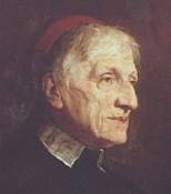
 I would encourage any Episcopalians contemplating conversion to read the accounts offered by converts who have gone before them--especially the Anglicans. Pre-eminently, I would encourage them to read John Henry Cardinal Newman (pictured right). Examine his An Essay on the Development of Christian Doctrine; his essay on Certain difficulties felt by Anglicans in Catholic teaching considered, his autobiographical Apologia Pro Vita Sua. Pertinent also are the instructions Newman gave in personal letters to prospective converts, which forms the subject of a study by Stanley L. Jaki, Newman to Converts: An Existential Ecclesiology
 (Real View Books, 4237 Kinfolk Court, Pinckney, Michigan 48169, realviewbooks@juno.com). Then there's also Ronald Knox and his books, The Belief of Catholics; A Spiritual Aeneid; and Difficulties: A Correspondence About the Catholic Religion. Read Evelyn Waugh's lives of Ronald Knox and Edmund Campion, conveniently combined in a single volume in Two Lives: Knox and Campion, and his magisterial novel, Brideshead Revisited (and view the spectacular made-for-TV series, starring Jeremy Irons, Laurence Olivier, and Claire Bloom, Brideshead Revisited, DVD 1981). Then, too, there are the compelling accounts by more recent converts, such as Sheldon Vanauken's essay "The English Channel: Between
 Canterbury and Rome" in his Under the Mercy (a sequel to his autobiographical bestseller, A Severe Mercy, reprinted in Dan O'Neill's anthology, The New Catholics (ch. 12, pp. 122-143; see my review of the book here); and especially
 Thomas Howard's writings, including his essay, "Lead, Kindly Light" (1981), named after Newman's well-known hymn and written four years before becoming a Catholic (in Communio [vol. 8, no. 4], reprinted in O'Neill's New Catholics, ch. 9, pp. 80-98), as well as his brief account of his conversion in a booklet by the same title, Lead, Kindly Light: My Journey To Rome (1994), and his more substantial meditation, On Being Catholic (1997).
In fact, permit me to distill from first two of Howard's works a number of observations that Episcopalians thinking about these matters may find most useful: first, from the essay, "Lead, Kindly Light," a summary of those points that Howard found most compelling prior to his conversion; and, second, from the booklet Lead, Kindly Light, a summary of his observations after his reception into the Catholic Church. Howard's observations may be particularly helpful for several reasons. He is a convert from Anglicanism. From his years in England, he is familiar with English Anglicanism. As a native Philadelphian and former Episcopalian, he is also well acquainted with the distinctive American experience on this side of the Atlantic. Furthermore, Howard is intimately familiar with American evangelical Protestantism, having been raised in that tradition before becoming an Episcopalian. He has never expressed anything but unqualified gratitude for this Protestant background, which means that he is gifted with exceptional sensitivity to subtle shades and nuances of religious experiences and concerns of various traditions. Finally, Howard was formerly an English professor. He loves the English language and literature and is a consummate stylist, gifted with the ability to express subtle nuances of religious experience with impressive agility.
[Note: In the following presentation of Howard's observations, I have injected my own commentary at various points where I felt it might be helpful to fill out the picture on various questions. I have also added the section headings as a help to the reader.]
A. "Lead, Kindly Light" (1981):
In his first essay, written before his conversion, Howard endeavors to offer a reply to those who expressed curiosity about what attracted him to Roman Catholicism. He replies as follows:
First, attracts is the wrong word. I am more attracted to Anglicanism, if we are thinking of things like music (imagine leaving King's College Chapel behind); and the way the liturgy is done (my parish in New York was Saint Mary the Virgin); and Cranmer's and Coverdale's matchlessly sublime prose; and architecture (fancy exchanging Norwich Cathedral, or even any tiny Norman or Perpendicular parish church among the hedgerows, for some ghastly shrine all done up in blonde wood, pastel plaster statues, and linoleum); and hymnody (must I leave forever J. M. Neale and John Bacchus Dukes, and "Christ is Made the Sure Foundation," and "See the Conqueror Mounts in Triumph"?I would want to qualify what Howard says here by recalling that there is no want of beauty in Catholic tradition. One need only call to mind the ethereal beauty of Gregorian chant, the polyphony of
 Palestrina, the sculptures of Bernini and Michelangelo, the flying buttresses of Notre Dame, the majesty of Chartres, the soaring spires and vaulted ceilings of Westminster Abbey and every English cathedral dating from before the Reformation. The lovely traditions of Evensong, the Nunc Dimittis, the Te Deum, and other ancient hymns of the Church, even many of the great hymns cherished and preserved within the Anglican and Lutheran traditions--all arose long ago and from deep within Catholic history. Further, one can readily find living expressions of such beauty and majesty in Catholicism today if one just knows where to look. Any High Mass sung in St. Peter's Basilica in Rome, the Brompton Oratory or Westminster Cathedral in London, the Basilica of the Shrine of the Immaculate Conception in Washington, D.C., will do.
The aesthetic squalor to which Howard is reacting is found chiefly in popular expressions of Catholic faith, the "folk art" of third world and low brow Catholicism, and in the philistine liturgical and aesthetic forms that have arisen since the Second Vatican Council. Given these facts, one must ask what it was that Howard found so compelling as to lead him to convert. His answer brings us to our first point:
1. The question of truth.
Howard writes: "The fundamental question, of course, is whether the Roman claim is true." There can be only two possible answers to that, he says. If one says no, then he has Augustine and Bede and Gregory and Aquinas and Erasmus and Thomas More and Ignatius and Bellarmine and Bossuet and Suarez and Newman and Chesterton and Knox against him for starters, "and that makes me nervous." But infinitely more serene than that, he has the colossal securus judicat orbis terrarum looking passionlessly at him: "The calm judgment of the whole world," he says, against him. "The Roman Church has, as it were, nothing to prove.
 Everyone else has to do the sleeve plucking and arm pawing to validate their cases."
Howard knows only too well the clamorous rejoinders to everything he says here. Whole libraries have been written on each side. He says only that he would interpose between his own remarks and any agitated "letters to the editor," the following books: J.H. Newman, An Essay on the Development of Christian Doctrine; Ronald Knox, A Spiritual Aeneid; Louis Bouyer, The Spirit and Forms of Protestantism; Henri de Lubac, Catholicism: Christ and the Common Destiny of Man; Dom Bede Griffiths, The Golden String; and The Baltimore Catechism. "Demolish them," he says, "before you demolish me."
I would personally want to add to Howard's observations at this point a word about the Catholic Church's courageous stance on issues of morality. If the Church has not budged a single inch from the apostolic Faith on points of orthodoxy, such as the divinity of Christ and the inviolable authority of Scripture, neither has she strayed one iota from such fidelity in her moral teaching on such issues as the sanctity of life, family, and marriage. In fact, the Church has stood against the prevailing tide of modern opinion by her consistent opposition to abortion, homosexuality, extra-marital cohabitation, divorce and remarriage, and a host of other ethical issues. In a Church whose membership constitutes roughly a fifth of the world's population, this fact speaks volumes. It says that Church teaching on matters of faith and morals is not dictated by prevailing opinion. It says that these matters fall within the category of what is true, and that their denial must therefore be opposed as false. It says that there must be on earth some authority by which these matters are decided, which brings us to the next point.
2. The question of authority.
Here again is an intractable question on which we are aware of the whole discussion before we start. The points that strike Howard as crucial on this point include Christ's words giving authority to His Apostles, and especially His words to Peter in Matt. 16:18-19. As Howard observes, "He did not say that the Church would be built on Peter's confession, and it takes jiggery-pokery to make the text say that." Christ even named Peter Cephas (a "rock" in Aramaic). Furthermore, he notes, Christ founded one Church: "He did not ascend leaving behind a book that anyone could take up and run off with (although as an evangelical, I will defend against all comers the authority of the Bible)." Christ built His one Church on the foundation of Peter and the Apostles, and in the apostolic Church it was the bishops in council who defined doctrine and condemned heresy. "All the heresiarchs believed in the inspiration of the Bible," writes Howard, "but it took the Church to say, 'This is orthodox' or 'That is heterodox.' The notion of Sola Scriptura is a new-fangled and disastrous one: we have only to look at the jumble of Protestant sects to see this and the stranglehold that the riddle of 'verbal inerrancy' has on every evangelical seminary and theologian. They never talk of anything else at all."
On this point of authority, Howard as an Anglican admits to being despondent over the "bleak fact that there is no magisterium [authoritive teaching office]" in his church. The bishops have thrown in the towel, he says, on the whole question of heresy:
Not that one relishes anathemas flying about, but what sort of a church is it where a bishop, from under his very miter and with his crozier in his hand, may wonder aloud to the faithful whether Jesus was a bastard, or whether God exists at all in any sense ever imagined by Jews or Christians for four thousand years; or where a vastly popular priest "comes out of the closet" with stunningly self-congratulatory panache, and shrilly plumps for homosexual promiscuity as a deeply Christian style of life, and the church refuses either to silence or to unpriest him? To be Anglican these days is to be massively urbane at the very least, apparently: we wink at all. But how do I defend this to my Brazilian pentecostal brethren, or my fundamentalist colleagues? They call it apostasy. How shall I correct them?At this point Howard touches on a difficulty he has with the Anglican position, which he says is not easy to classify.
It is this: most Anglican clergy and theologians will either chuckle in an avuncular way or argue quite earnestly that "the glory of Anglicanism" is its very lack of definition, or better, its comprehensiveness. It does not worry them at all that two neighboring parish churches, both claiming to be Anglican, will have irreconcilable views on such matters as the priesthood, the Eucharist, the Apostolic Succession, the nature of the sacrament itself, and let's face it, on the church itself. This nice old Anglican phenomenon is here, cranking along after 450 years, to silence any anxious protestings on the part of any fevered layman that this sort of thing is at the very least nonsense, and at the worst cynicism. If this is a quality that we must call "Anglican," then I am appalled at being an Anglo-Saxon. It makes it sound synonymous with "cretinous" or "wooly-minded."3. The question of antiquity and catholicity.
Here again, Howard seems all too well aware of the clamorous rejoinders that await any voicing of the Catholic claims. "I know the Anglican case is that we did not begin with Henry [VIII]," he writes. In fact, the extreme Anglican case would be that Canterbury and not Rome represents the true Church of the Fathers. So be it, says Howard:
But something started in the sixteenth century in the scuffle, and it wasn't Rome. I myself am not disposed to chase the argument into such narrow defiles as the Nag's Head business, but a certain amount of tinkering is necessary to get the Anglican phenomenon steady and on course. It begs the question to say insouciantly that Anglicanism is simply English Catholicism. (Even the Gallicans have never made quite that claim for France.)
 But then, asks Howard: "Are we prepared to write Basil Cardinal Hume [the late Catholic Archbishop of Westminster, pictured left] off as a primate of a nonentity?" If Anglicanism can claim catholicity in the sense of being widespread geographically, he says, that claim is snowed under by the sheer magnitude of Rome's presence throughout the world.
Howard demurs from pursuing the comparisons any further than this, wishing to avoid any sort of Anglican-Roman "tit-for-tat quarrel" that might ultimately prove futile and alienating. Yet I think more needs to be said here, particularly about the hard historical facts bearing on the origins of Anglicanism. As much as I share Howard's disdain for "tit-for-tat quarrels" and his love for England and for many Anglican writers, I wonder whether a commitment to truth does not demand a hard honesty about certain facts of history that the
 Protestant textbook traditions in much of the English speaking world have been all too willing to ignore or deny. In the first place, I would put Eamon Duffy's The Stripping of the Altars: Traditional Religion in England, C.1400-C.1580, which has gone a long way towards dispelling the fantasy that English Protestantism was a popular, grass-roots movement against the imperial and alien claims of Rome. The facts are quite the reverse: it was Anglicanism that was a new and alien state religion, imposed upon the English populace against its will by its government, with the help of the financially invested upper classes.
 A cumulative case begins to emerge with the addition of other books: Philip Caraman's The Western Rising, 1549: The Prayer Book Rebellion; Evelyn Waugh's biography of Edmund Campion: Scholar, Priest, Hero and Martyr; Hilaire Belloc's Characters of the Reformation: Historical Portraits of the 23 Men and Women and Their Place in the Great Religious Revolution of the 16th Century, and How the Reformation Happened are also worth examining.
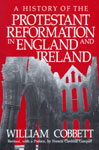 But many would do well to review even the most difficult details unearthed in History of the Protestant Reformation in England and Ireland, by William Cobbett (pictured below), the nineteenth-century English journalist and critic who was unpleasantly surprised and outraged to discover the actual details about the origins of his own Anglican tradition--a tradition, he said,
 "engendered in beastly lust, brought fourth in hypocrisy and perfidy, and cherished and fed by plunder, devastation, and by rivers of English and Irish blood." Under the Penal Laws, English Catholics were forbidden to attend Mass, prevented from inheriting property, excluded from attending universities like Oxford, even though they had been founded as Catholic universities. Penalties were severe. The civil rights of English Catholics were not restored until 1829. Even after the building of new Catholic churches was permitted, they were not allowed to mount identifying spires or bell towers for many years (witness the well-concealed facade and entrance to Cardinal Newman's University Church across from St. Stephen's Green in Dublin). Howard is too much of a gentleman to sully his discussion with such unpleasantries as these. Yet an accurate understanding of the historical continuities and discontinuities at issue between Anglicanism and Catholicism require, it seems to me, making a clean breast of such matters. We have heard plenty about "Bloody Mary" and "Good Queen Bess." Fair enough: when shall we hear the facts about "Bloody Queen Bess" and "Good Queen Mary"?
Howard insists that it would never be this sort of Anglican-Roman "tit-for-tat quarrel" that would budge him in either direction. He describes himself as too Saxon and too Anglican in his marrow, and too sentimental about all that Anglicanism means, not to bristle over that sort of thing. After all, does he really want to abandon Lancelot Andrewes and John Donne and George Herbert and (skipping a bit) T.S. Eliot and C.S. Lewis and Charles Williams? "They are my men. If it's good enough for them ... And all waggery aside, this rejoinder does, in fact, carry some weight with me." For better or worse, I am sure many Anglicans would agree.
4. The question of splendor.
Howard is not referring here to "ceremonial dazzle." He says the Anglicans are generally better than the Romans on this front anyway, with the exception of what goes on in the basilica in Rome itself. He means, rather, the sheer splendor of the Roman Catholic vision. "It is immense," he writes. "It is full of glory. It is unsupportably bright." Not only that: he finds it, he says, present in the Mass. Of course, any Protestant could offer a rejoinder at this point, and we may imagine the give-and-take proceeding as follows:
Evangelical Protestant: "Oh, but I believe in all that about the mysterium tremendum and the seraphim and the mystery of the cross and so forth."Howard offers, as one immediate example of what he means here, his own experience of trying to "salvage" brilliant and restless students over the last decade for the ancient faith. He says: "I despair of finding anything outside of Roman Catholic thought and spirituality that is big enough, with the possible exception of C.S. Lewis." He sends them, therefore, to Cardinal Newman and Ronald Knox and Romano Guardini and Gerard Vann, not to say Thomas Merton and Saint John of the Cross. Their vision seems to open onto vistas, he says, that dwarf Protestant horizons. But, he admits: the vision is Roman. "We Anglicans snatch at it here and there, with only intermittent felicity. We have it by derivation. We have generated very little that can match what was there before us." And he says this, he notes, as one who teaches, and who loves passionately, John Donne and George Herbert.
Howard: "But it is only in the liturgy that the whole drama is unfurled and the scrim of temporality is pierced and we begin to see both the abyss and the Sapphire Throne, and it is very hard to keep this vision alive in nonliturgical worship."
Anglican: "But what's the problem? We have the liturgy as well."
Howard: "Yes. But the thing I am speaking of seems, somehow, to show itself in that sense of the ineffable sublimity and sheer plentitude that animates not only such phenomena as liturgical music of Palestrina, Victoria, and Mozart, but also the serene sense in which Roman Catholic philosophy may claim that the Catholic faith, rightly understood, is absolutely satisfying to the human intellect."
5. The question of spiritual depth.
Romano Guardini, says Howard, would embody what he intends to say at this point. There is something about what one finds in Catholic spirituality that is, he says, fishing for the right word, "ripe." It embraces the Incarnation. It accepts the limitations of our mortal flesh. It is wise. It talks of mundane matters with an authority that is both high and charitable. It addresses us, he says, not in terms so much of "Jesus can help you" or "I'm just a poor wayfaring stranger" or "Are we weary and heavy laden, cumbered with a load of care"--even though these are all legitimate sentiments as far as they go--but rather in terms of transfiguration. Even transubstantiation: "the miracle whereby the ordinary stuff of our lives, including the ambiguities and conundrums and death, are changed into glory." The Eucharist, he notes, is the great paradigm of this. Yet he admits that it is very difficult to chase down just what this quality is, even for his own satisfaction. He simply says: "If one reads Guardini's The Lord, one will see what I mean." He proposes a sort of syllogistic inference:
Perhaps I ought to phrase this last point as a question, then: if the Roman Church has nourished that sort of thing (and the writings of Lady Julian and Richard Rolle and Bernard of Clairvaux and Saint John of the Cross and Saint Teresa of Avila and ten thousand others whose work towers above the terrible flea-marked junk filling religious bookstores these days), then I must ask myself whether that source is worth finding. Nearly all mere arguments--about Petrine claims, about Loreto, about indulgences and the Immaculate Conception and the Perpetual Virginity and infallibility and the Infant of Prague and bingo and the Mafia and horrible Mexican cults and Borgia popes and Torquemada and the Duke of Alba--die away in the light of this question of spirituality. Not that doctrinal questions do not matter. But one pauses before some such syllogism as this: "If the Church that makes those claims has nourished this spirituality, then what is one to make of it?" Of course there are riddles and horrors. Anything as old and enormous as the Roman Church is bound to be a horror show. But then one remembers how Christ insists on calling His poor Church, who paints herself up like the Whore of Babylon sometimes--One also recalls the experience of Peter Kreeft reading for the first time St. John of the Cross's Ascent of Mount Carmel, out of curiosity, not understanding him, but knowing that here was a mountain, something so massively realhow He insists on calling her his spotless Bride.
 it had to be true. Kreeft also mentions as one of the most influential books in his journey into Catholicism, Dietrich von Hildebrand's Transformation in Christ. Of course, one cannot begin to mention all the lives of the saints, whose impact on those who have read them is untold. But surely one must include Augustine, Benedict, Gregory, Patrick, Thomas Aquinas, Bonaventure, Francis of Assisi, Bernard of Clairvaux, Thomas More, John Fisher, Ignatius Loyola, Francis Xavier, Francis de Sales, Robert Bellarmine, Teresa of Avila, John of the Cross, Bernadette, Catherine Laboure, Louis de Montfort, Therese of Lisieux, and Josemaria Escriva, for starters.
* * *
Howard had not yet converted when he wrote his 1981 essay, "Lead, Kindly Light." He concluded his discussion then with these words:I am still Anglican. I may die an Anglican. And I will take arms in defense of the holy and faithful Christians I know of, by their tens of millions, for whom every word I have said would be either incomprehensible or reprehensible.B. "A Newcomer's Discoveries" (1994)
Meanwhile I can only pray, with one of my chief mentors, "Lead, Kindly Light."
Thomas Howard was received into the Catholic Church at the Easter Vigil in 1985. Nine years later, he published a brief account of his conversion in the booklet, Lead, Kindly Light: My Journey To Rome (1994), whose final chapter is entitled "A Newcomer's Discoveries" (ch. 9, pp. 79-88). The following discussion includes extensive quotations from and summaries of Howard's observations. What does Howard have to say after nine years of being a Catholic? What has he found? What has he learned?
He begins his chapter with some personal remarks that bear quoting in full:
For one thing, I have begun to learn about plentitude. That is, I have been the beneficiary of the Church's "fullness," expressed in multitudinous apostolates and charisms.What else has he learned? To answer that question, he says, would run to many pages; and since this would entail many things which he, as a newcomer, had scarcely begun to ascertain, there would be "something headlong" about rushing into such a commentary so early in the game on anything so ancient and vast as the Church and all it holds in its liturgy, teaching, disciplines, devotions, and spiritual writings. Nonetheless, he consents to offer some rudimentary impressions in the form of a numbered list, not to be mistaken for any sort of "systematic sequence," he cautions, but as an arbitrary arrangement of "ad hoc jottings." [Note: I have again added the section headings.]
For example, at the time of my being received one of the phone calls which came in was from one Sister Catherine D'Arcy, a Notre Dame sister. She herself was now retired from her school teaching and was confined to a wheelchair. But she flooded me and my family with largesse, both material and spiritual. We would drive over to the convent in Ipswich, Massachusetts, where she lived. There she would be, bustling with welcome, good cheer, solicitude, and generosity. Every time we went she would have gifts for all of us--on one occasion there were two shopping bags full of presents. She had no interest in her own numerous physical ailments, but only inquiries and prayers for every detail of our family life.
And again, a nearby convent of discalced Carmelite nuns virtually adopted us all. We would go and visit with them in the "speak room," with the grille between them and us. Joy, joy, joy radiated from them into our very marrow. They took us into their hearts, and have prayed for us from that day until now. None of us, I think, has ever encountered sheer Charity in any more dazzling manifestation than we have from these nuns.
1. "Everyone is here"
The "catholicity" or "universality" of the Church takes on a new significance in the newcomer's first-hand experience. Howard's observation is brief, humorous, and poignant:
The holy Catholic Church looks more like the five thousand whom the Lord fed on the hillside than it does the small group of insiders in the Upper Room. That is, everyone is here: the earnest and the preoccupied; the poor and the rich; the fashionable and the unfashionable (more of the latter than the former); the ignorant and the luminously wise; the proletariat and the bourgeoisie (to reach for anachronistic categories); the pathetic and the impressive. It is just "us" whom this very ancient Church comprises. None of us has any credentials at all other than the fact that we are baptized into this Church.2. Catholicism is both "higher and deeper"
What Howard means here is that Catholicism, when contrasted to other renderings of the Christian Faith of more recent lineage, is both "higher" and "deeper"--that is, more "heavenly" (intellectually refined and spiritually luminescent), and yet also more "worldly" (physically primal, earthy, ethnic and mysterious). It is both more conceptually transparent in its intellectual expression and yet more sacramentally opaque and mysterious in its material incarnations. It is simultaneously more spiritual and yet more physical; more otherworldly and yet more earthy; more culture-transcendingly universal and yet more particular, physically and culturally rooted, locally incarnated and expressed. Howard's illustrations are helpful:
That is, one finds the shimmering massif of Augustine, Anselm, Bonaventure, and Thomas (and, one might add, of Newman and von Balthasar and Dietrich von Hildebrand and Romano Guardini), but, at the other apparent extreme ("apparent" because the two extremes participate profoundly in the same mystery), the local and folk and ethnic piety which has clearly risen quite spontaneously from the genius of various peoples. I am thinking of tiny wayside shrines in Austria, and Mardi Gras, and the St. Anthony's gala festival which I used to see when I lived in New York City, and the strange, heart-piercing flamenco singing which one hears in Madrid as great floats carrying the Virgin struggle through the streets on the backs of scores of barefoot penitents. Much of this looks grotesque, even pagan, to non-Catholic, and no doubt superstition or mere festivity is not infrequently at work. But it would be perilous to dismiss these phenomena too summarily. The sense in which grace may, oddly, be truly at work in the midst of all the clutter should hinder the bystander from harsh judgments.Pietas and caritas, he says, often take strange and scandalous forms. But this is precisely what one ought to expect. Because, according to Catholic understanding, grace builds on nature, it is in fact inevitable that our experience of grace will display itself in multitudinous, extravagant, and perhaps even unexpected and bizarre ways. Howard asks: "Remember the uncouth woman who interrupted a dinner party and wept all over the Lord's feet and wasted all the nard?" This sort of thing, he says, eludes the categories of Christians who espouse a rigorously verbalist, propositionalist, non-sacramental rendering of the Faith.
3. Unrecognizable forms of faith
The forms of faith one encounters as a Catholic are not always readily recognizable. This would be true for a newcomer from a Protestant background in large swaths of Christendom. As Howard observes, "your muttering Balkan crone in a babushka kissing the icon of the Mother of God of Kazan is not going to be able to convince a young North American evangelical, accustomed as he is to energetic Bible studies and 'fellowship' and expertise in extempore prayer, that she is, in fact, a Christian." In fact, "Her mute and perplexed response to his catechizing ('Are you born again?' 'Do you know Jesus personally?') will convince him that his worst suspicions have been correct, and that all of these peasants who are so numerous in Orthodoxy and Catholicism must be numbered among the superstitious rather than among the faithful." Of course one needn't go as far as the Balkans: those who gather for Mass in any Catholic parish church on any day of the year will include anyone from wise and saintly souls to those whose conversation is laced with profanity and vulgarity, whose whole approach to life may seem to exclude even the smallest trace of anything that can be recognized as faith.
Where are these latter people--inside or outside of the pale of faith? Only God knows. The Church's task is to woo them, and to keep on in its pastoral efforts to fan any minuscule and lambent flicker of faith, and to keep offering them the gospel in word and sacrament. If they consciously and explicitly reject it all, then the Church can only pray for them: "Lord Jesus Christ, forgive us our sins, save us from the fires of hell, and lead all souls to heaven, especially those most in need of thy mercy." If judgment must fall on any of them (or on me), the Church must accompany them all the way to the block, as it were, with the appeals of grace.Some such attitude, says Howard, must surely explain why the Church has sometimes gone ahead and furnished Christian burial to, say, those Mafiosi who have been busy murdering their rivals on Saturday nights, as in the notorious Godfather films. Only God knows what seed of faith might still be alive in such brawny corruption. "The Church shares God's seeking of the lost," says Howard, "not his office as Judge."
4. Clear, authoritative teaching against heterodoxy and dissent
Doctrinal conflict over matters of faith and morals--particularly sexual morals--is experienced in the Catholic Church in a qualitatively different manner from the way it is experienced in denominations that have abandoned their link with the apostolic authority of the Petrine See in Rome. Howard's words on this point bear quoting at some length:
In church X, shall we say, we may find a bishop urging homosexuality as a profoundly Christian "style of life," or ostentatiously doubting the Lord's virgin birth, or busily eroding the confidence of his flock in the text of Scripture. Nothing can be done except ad hoc protest. Good men in the denomination may get up a White Paper, or write articles, or introduce a resolution in the next General Convention. But we all know what this sort of thing ends in. Alas. In the Catholic Church there occurs this same heresy and false teaching, often loudly taught in high theological quarters. But everyone--both in the world and the Church--knows that there is a desk on which the buck stops, so to speak, and that when Rome has spoken on the issue, it is concluded. Oh, to be sure, Father C. or Father F. over here can keep on burbling--Rome cannot stop that. But Rome can say and does say to the Church and the world, "This which you hear Fathers C. and F. teaching is not Catholic teaching. It is not in accord with the Faith once for all delivered to us by the apostles."5. Less individualistic, extemporaneous forms of spiritualityA pressure group organized by trendy nuns in favor of abortion exists explicitly in rebellion against what Rome teaches. No one needs be in the slightest doubt on the point; whereas another denomination, if it can ever get up the votes, can only pass a resolution. The Archbishop of Canterbury himself has not in our lifetime said, "No. That is heresy." Rome has. (See Veritatis Splendor, John Paul II's encyclical letter "To all the bishops of the Catholic Church regarding certain fundamental questions of the Church's moral teaching," August 6, 1993).
Catholics typically do not talk about their "relationship with the Lord," as do so many of their fellow-believers in evangelical Protestantism. Many may not even have a notion of such a relationship that exists independently of their attendance at Mass, their praying the rosary, going to confession, and so forth. These activities, for Catholics, constitute the daily shape that such a relationship takes. This is how they encounter the Lord--in the Eucharist; in hearing the Bible read at Mass--"great dollops of it"--in the liturgy ("which is where the early Church visualized the Bible's characteristic usage to lie"); in their prayers--private and extemporaneous, as well as communally; and by using the rosary.
On the subject of the rosary, Howard offers this caveat:
In this connection it would be an excellent thing for non-Catholics to refrain altogether from assessing whether the rosary is a legitimate, and even rich, mode of prayer. The rosary constitutes a discipline which is entirely unimaginable to one who is a stranger to it. The most common objection from outsiders is that the rosary is a matter of "vain repetition as the heathen do." The remark, biblical though it may be, is nothing to the purpose here. Where the rosary is sincerely and regularly prayed, you find ardent piety and pure devotion to the Lord. The rosary cannot coexist with cynicism, worldliness, unbelief, pride, and concupiscence. I have discovered this to be true, and the discovery has exposed any former strictures which I might ever have advanced against the rosary to be what they were--callow, ignorant, ill-conceived.6. Historical continuity
To be Catholic, says Howard, "is to be delivered, once for all, from the obligation to hoist any special banner, or to claim allegiance to any particular and recent renderings of the Faith." To be sure, one looks in a special way to Rome, an earthly, historical city. But Rome has been around considerably longer than the Geneva, Zurich, Amsterdam, Herrnhut (where the Moravians were founded), Canterbury, or Anderson, Indiana (birthplace of the American Church of God movement). As Howard says, there was no Peter, Paul, Linus, Cletus, or Clement in any of these latter cities. The Church universal has never said, "Geneva locuta est, causa finita est" ("Geneva has spoken, the case is closed") when it came to doctrinal definitions. But to pit one city against another in this way does little more than raise the hackles of partisanship and factionalism, which is hardly becoming among Christians. Howard's point is simply that the only history which we Christians do have in this world, very early on, settled upon the city of Rome as the locus and seat of pastoral authority for the universal Church. This can be seen throughout the writings of the early Church Fathers. Howard observes:
Like Augustine with the Donatists in his day, Catholics may have profound sympathy with any number of the "protests" that have been mounted against corruption, falsehood, worldliness, or sin in the Catholic Church. As Augustine would teach us to say, "Alas: your criticism is too true. There may be wounds and bruises and putrefying sores, from the crown of the head to the soles of the feet; but we cannot dismember and hack to pieces the Body of Christ." This has been done in the last five hundred years. We have no warrant to set ourselves over against this ancient Church. There may be among us wolves in sheep's clothing, even; yet the answer to that is not to leave the Fold, but to cleanse and protect and restore it. God bless the earnestness and fidelity and zeal with which many have striven for righteousness and truth and purity in the Church. But insofar as their striving has separated them from that old Church, then the measures have been too draconian. To pray with the Lord in his prayer recorded in John 17 may be to do more than voice a petition. It may, in this latter day, mean a difficult obedience.
* * *
Finally, therefore, why should Episcopalians become Roman Catholics? Not finally for any extraneous reason--whether for the Church's vastness, antiquity, aesthetic heritage, or the sense of security or personal identity it may furnish, even if all of these things may be true--but rather, and preeminently, for that one little reason that compels conviction, that one little sticking point: the conviction that her claims are true. Once a person understands and accepts that, there remains little question of choice. On the one hand, it will then be a duty binding in conscience to become a Catholic; on the other, it will then also be a privilege and a pleasure and a joy to do so. The duty is real, of course. Even the Second Vatican Council made this very clear, explicitly calling into question the spiritual state of any soul which, "knowing that the Catholic Church was made necessary by Christ, would refuse to enter or remain in it" (Lumen Gentium, 14). But the privilege and joy are real too. As Evelyn Waugh put the matter: "Conversion is like stepping across the chimney piece out of a Looking-Glass world, where everything is an absurd caricature, into the real world God made; and then begins the delicious process of exploring it limitlessly." Once that is clear, all I would add is that one must have no illusions, but come aboard Peter's Barque quickly and help bail. The philistines are ravaging the Ark of Salvation and we need all the help we can get from any who love God and His Church. "Lord, to whom shall we go? You have the words of eternal life." Veritas splendor! . . . Ora pro nobis, Sancta Dei Genetrix, ut digni efficiamur promissionibus Christi.

 One of the best examples of a powerful antedote to this kind of foolishness is a little essay by C.S. Lewis entitled "Modern Theology and Biblical Criticism," which is available in a collection of essays by Lewis entitled
 3. Thirdly, I find in these theologians a constant use of the principle that the miraculous does not occur... This is a purely philosophical question. Scholars, as scholars, speak on it with no more authority than anyone else. The canon 'if miraculous, unhistorical' is one they bring to their study of the texts, not one they have learned from it. If one is speaking of authority, the united authority of all the Biblical critics in the world counts here for nothing.
 The problem with Hans Kung is that, like the rest of that part of the post-Christian world that has been reluctant to let go of its sentimental attachment to Christianity, he wants to change the meaning of Christianity to conform to his post-Christian commitments rather than to admit that his beliefs are no longer, in any traditionally recognizable sense of the term, Christian. In short, Kung wants to belong to the historical Christian community without accepting key historical Christian beliefs. This is amply clear, once again, from his recently published autobiography,
 He was one of those Catholics who had already been drinking deeply at those contaminated Protestant fonts of biblical scholarship before the Second Vatican Council seemed to permissively fling open the doors of the Church to the world of non-Catholic scholarship. It is understandable, then, how he must have looked eagerly for Vatican II to sanction a revisioning of the Catholic Faith along lines that he saw as reasonable from his own studies of secular Protestant sources. His
 Barth is deceptive. He writes and talks as if he believes in the traditional Christian doctrines. But he doesn't. As University of Edinburgh Professor J.C. O'Neill writes in his chapter on Barth in
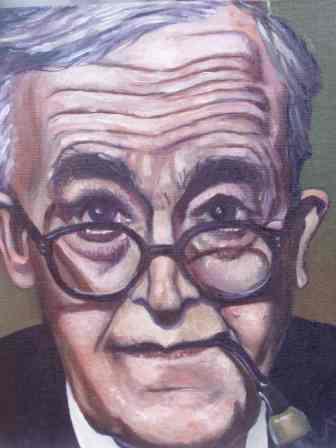
 While other Protestant theologians, like Paul Tillich (pictured left), clearly distinguish when they're writing "devotionally" (when they sound like evangelical Christians) and when they're writing "scholarly" (when they sound like atheists), Barth is more subtle and requires greater discernment. Many of these Protestants continued to employ a Christian vocabulary while investing their terms with demythologized post-Christian meanings. Hans Kung is one of the numerous fatalities resulting from this historical development.
 In the interview, Kung describes his personal acquaintance with the popes since Pius II, and calls John Paul II a man of "the mediaeval, anti-reformation, anti-modern paradigm of the church." Remarks such as these must be understood on some level as grandstanding, since otherwise they would be nearly unintelligible. No pope, after all, has done more to address contemporary concerns centering on the subjective experiential dimension of the lived experience of the believer than Karol Wojtyla, the student of phenomenology, author of
 Opus Dei, who are favourable for this secret organisation which is an authoritarian, Spanish organisation [... is he playing to the
 So the reason for the vocational crisis and plummeting Mass attendance in Ireland and Germany, according to Kung, is all because we do not want to have ordained married men or ordained women--when, in fact, it is the disbelief underlying such attitudes of revisionism and dissent that have rendered the Catholic populations of these countries indifferent to priestly vocations and Mass attendance!
 What is evident throughout the interview is Kung's unrelentingly secular--that is to say, immanent, naturalistic (anti-supernaturalistic) viewpoint. This is particularly evident in his discussion of the pope's charism of infallibility. But I have discussed enough of Kung. He has done his share of damage over the past two generations. I am only too pleased that I did not waste much of my time as a student reading his books. My prayer is that others would not waste their time on him either, and, still more, that they would not be taken in by his misleadingly sophistical, tired reformulations of the failed and secularized Protestant/Enlightenment project.
 which relates the first meeting of Paul with Peter, as well as his later meeting with him. Imagine Paul, the most educated Jew in all Palestine-- the protoge of Rabbi Gamaliel, a Roman citizen, speaker of Latin and Greek as well as Hebrew and Aramaic, a Pharisee by training-- just imagine this Paul, converted independently on the road to Damascus, after three years going up to Jerusalem to submit himself to this head-strong and probably arrogant-seeming Joe Sixpack of a fisherman, PETER, accepting his authority as head of the Church!! A truckload to think about there.
 One of the chief measures of being Catholic is one's willingness to submit himself to the Church as to Christ, believing those two things can't be separated in matters of faith and morals, doctrine and discipline. I can understand the subjective experience of emptiness in segments of one's spiritual pilgrimage. St. John of the Cross wrote about that in his
 That has to be excruciatingly painful in some respects. They say that Mother Teresa lacked, for the great majority of her career in Calcutta, any personal sense of reassurance about God's will in what she was doing. And yet nobody--least of all the famished and dying Indians she pulled out of the gutters of Calcutta--would have ever known this: she had to go from day-to-day on sheer faith. This, it seems to me, is what we're asked to do when the externals of our faith life don't seem to "deliver." This is certainly the case for me at the moment, at least when it comes to Sunday Masses. The music and such seem to detract, rather than assist, the ascent of the soul to God.
 Catholic in your family, and so forth. But if you could have a talk with your dear patron saint, St. Ambrose, do you not think he would say, "Dear friend, get to confession and get yourself back to church!"? Furthermore, as to your heretical opinions, do you not think he would tell you, "Dear daughter, do you imagine that Christ established the Church only to undermine it by having her teaching held hostage by the opinions of the masses? Of course everyone is entitled to his own opinion, but do you think that following your own opinions, any more than following one's conscience, can possibly guarantee that one will do the right thing? Have we not the obligation to submit our opinions to the governance of the Church, to let our consciences and opinions be informed by her teaching? What would happen to the Church if we let her path be determined by majority vote or by the public media? Perhaps that is preciesly what is wrong with your American Church these days ... "
 One can feel as if God is smiling upon him when he is embarked upon the silliest and most deluded ventures. Try re-reading C.S. Lewis's Screwtape Letters. Such fiction, unlike a lot of non-fiction these days, has the power to lead us closer to reality rather than further away from it. Lewis says that the notion of "humanity's search for the divine" strikes him a bit like talking about "the mouse's search for the cat"! I'm much more inclined to suspect Blaise Pascal is right when he says: "Men despise religion. They hate it and are afraid it may be true." The cure for this, of course, is a more careful and ongoing study of what true religion involves--how it is not contrary to reason, but worthy of reverence and respect. Worthy of reverence because it really understands human nature. Attractive because it promises true good.
 There is so much falsehood about Opus Dei floating around these days, particularly as a result of that marvellously engaging but satanically misleading book by Dan Brown,
 Third, we should meditate at least 15 minutes a day, by which I don't mean the mind-emptying form of meditation found in Zen Buddhism and other Eastern forms of mysticism, but rather a focusing of the mind upon Christ, an imaginative picturing of Him in some of the scenes the Gospels opens up for us, as well as upon aspects of our own relatedness to Him and to the saints. St. Josemaria Escriva, the founder of Opus Dei, used to hesitate briefly before passing through every door, because he would mentally allow his own guardian angel to pass through the door ahead of him-- not a bad excercise to remind us of the unseen reality all about us.
 or else a horror and a corruption such as you now meet, if at all, only in a nightmare. All day long we are, in some degree, helping each other to one or other of these destinations. It is in the light of these overwhelming possibilities, it is with the awe and the circumspection proper to them, that we should conduct all our dealings with one another, all friendships, all loves, all play, all politics. There are no ordinary people. You have never talked to a mere mortal.
 Nations, cultures, arts, civilizations--these are mortal,and their life is to ours as the life of a gnat. But it is immortals whom we joke with, work with, marry, snub, and exploit-- immortal horrors or everlasting splendors. (C.S. Lewis,
 I think that's important too. Often our hunches represent intuitions that come from engrained habits of virtue. That's what allows the G.I. to throw himself on a grenade in a foxhole and save his buddies' lives at the cost of his own. He doesn't even have to think about it. It's instinctual.
 I've just purchased
 He's one of those authors who is not only a tremendous comfort, but offers some profound conceptual insights to back it up. You've probably seen Anthony Hopkins and Debra Winger in the movie Shadowlands about his short-lived marriage to Joy Gresham, who already had cancer before they were married and died shortly afterwards. It's based on his posthumously published book, A Grief Observed.
 There is a lot of reading about the female's experience of Catholicism that I find highly edifying-- for example,
 St. Edith Stein's work,
 "A parasite sucking out the living strength of another organism...the [housewife's] labor does not even tend toward the creation of anything durable.... [W]oman's work within the home [is] not directly useful to society, produces nothing. [The housewife] is subordinate, secondary, parasitic. It is for their common welfare that the situation must be altered by prohibiting marriage as a 'career' for woman." ~ Simone de Beauvoir,
 not people. [Housework] is peculiarly suited to the capacities of feeble-minded girls. [It] arrests their development at an infantile level, short of personal identity with an inevitably weak core of self.... [Housewives] are in as much danger as the millions who walked to their own death in the concentration camps. [The] conditions which destroyed the human identity of so many prisoners were not the torture and brutality, but conditions similar to those which destroy the identity of the American housewife." ~ Betty Friedan,
 Edith Stein (who wrote a dissertation
 under Husserl, before being martyred at Auschwitz), and still living philosophers such as John Crosby (left), Josef Seifert (right), Kenneth Schmitz , and others. A popularizer of the Pope's theology of the body is Christopher West, who has out a number of very good books I've recommended to my kids. Excellent, really; even revolutionary, in terms of overcoming the pervasive cultural drift, which is anything but healthy. [For more on this, check this
 But two things hold some help here: (1) the fact that there are often good souls in the precincts of the local church who can become wonderful spiritual friends, and, even more: (2) the knowledge that Christ is Himself there in His physical Body
 First, as to whether Luther (pictured left) gets the credit he does on account of stumping for the Bible to be not only in the common language but also commonly available to those who were not priests and scholars. My guess is that Luther's translation was fairly shortly made available to all who could read and purchase ... perhaps the earlier editions had a more narrow circulation.
 Zwingli (pictured left) was not only a pugnacious opponent of Luther but a philanderer and adulterer, though I do not know whether it follows that on this account what he said about Luther here is false. My main point in this post was to offer a corrective to the wide-spread assumption that the Catholic Church tried to keep the laity biblically illiterate.
 Though it may not be quite "heresy," once can still see "de-Catholicizing" tendencies in many translations of Scripture today. To take just one example, there are thirteen instances of the term paradosis (usually in its plural form, paradoseis) in the NT, of which ten are critical of human traditions that have departed from God’s Word. In the other three cases, Paul commends traditions to the churches to whom he writes (1 Cor 11:2; 2 Thes 2:15; 3:6). Significantly all ten of the negative references are translated by the